
The Ricardian model of trade is the oldest formal theory in international economics and still the sharpest. Published by David Ricardo in 1817, it answered a question that confused his contemporaries: why would a country that produces everything more efficiently than its trading partner still gain from trade? Adam Smith had already explained absolute advantage, showing that countries should produce what they make most efficiently. Ricardo went further. He demonstrated that what matters for trade is not absolute productivity but relative productivity. Even a country that is worse at producing everything has a comparative advantage in something, and trade based on that advantage makes both nations better off.
The intuition rests on opportunity cost. A country should specialise in goods it produces at a lower opportunity cost, not necessarily lower labour cost. If Portugal gives up less wine to produce cloth than England does, Portugal has a comparative advantage in cloth, regardless of whether Portuguese workers are more or less productive than English workers in absolute terms. Trade then lets each country consume beyond its domestic production possibilities, with the gains measured by the expansion of the consumption frontier.
Two centuries later, the Ricardian model of trade remains the workhorse of trade economics. It underlies modern quantitative trade models used by the IMF, World Bank, and central banks. Its predictions about specialisation patterns, relative wages, and trade volumes have been tested empirically for decades, and the core mechanism, productivity differences drive trade, survives scrutiny remarkably well. Richer models like Heckscher-Ohlin and gravity models add layers of realism, but Ricardo’s insight remains the foundation.
Mathematical Formulation
Consider the simplest version: two countries (Home and Foreign), two goods (wine and cloth), and one factor of production (labour). Let \( a_{LW} \) denote the unit labour requirement for wine at Home (hours of labour needed to produce one unit of wine) and \( a_{LC} \) the unit labour requirement for cloth. Foreign values are denoted with an asterisk: \( a_{LW}^{*} \) and \( a_{LC}^{*} \). Labour is the only input, is perfectly mobile between sectors within a country, and is immobile across countries. Each country has a fixed labour endowment \( L \) (Home) and \( L^{*} \) (Foreign).
Home has a comparative advantage in cloth if its opportunity cost of cloth in terms of wine is lower than Foreign’s:
This condition says Home gives up less wine to produce an additional unit of cloth than Foreign does. Equivalently, Home is relatively more productive in cloth, even if Foreign is absolutely more productive in both goods.
Under autarky (no trade), the relative price of cloth in terms of wine equals the opportunity cost: \( P_C / P_W = a_{LC} / a_{LW} \) at Home, and similarly for Foreign. When trade opens, the world relative price \( (P_C / P_W)^{W} \) settles between the two autarky ratios:
Each country specialises completely in the goods where it holds a comparative advantage. Home produces only cloth, Foreign produces only wine, and they trade. The world relative price is determined by world relative demand and relative supply, as shown by Dornbusch, Fischer, and Samuelson in their continuum-of-goods extension published by the American Economic Review.
Wages in the Ricardian model are pinned down by productivity. The Home wage in terms of cloth is \( w = 1 / a_{LC} \), and the Foreign wage in terms of wine is \( w^{*} = 1 / a_{LW}^{*} \). The ratio of nominal wages \( w / w^{*} \) reflects relative productivity and the world price. Countries with higher absolute productivity pay higher wages, but trade patterns depend on the comparative, not absolute, productivity ranking.
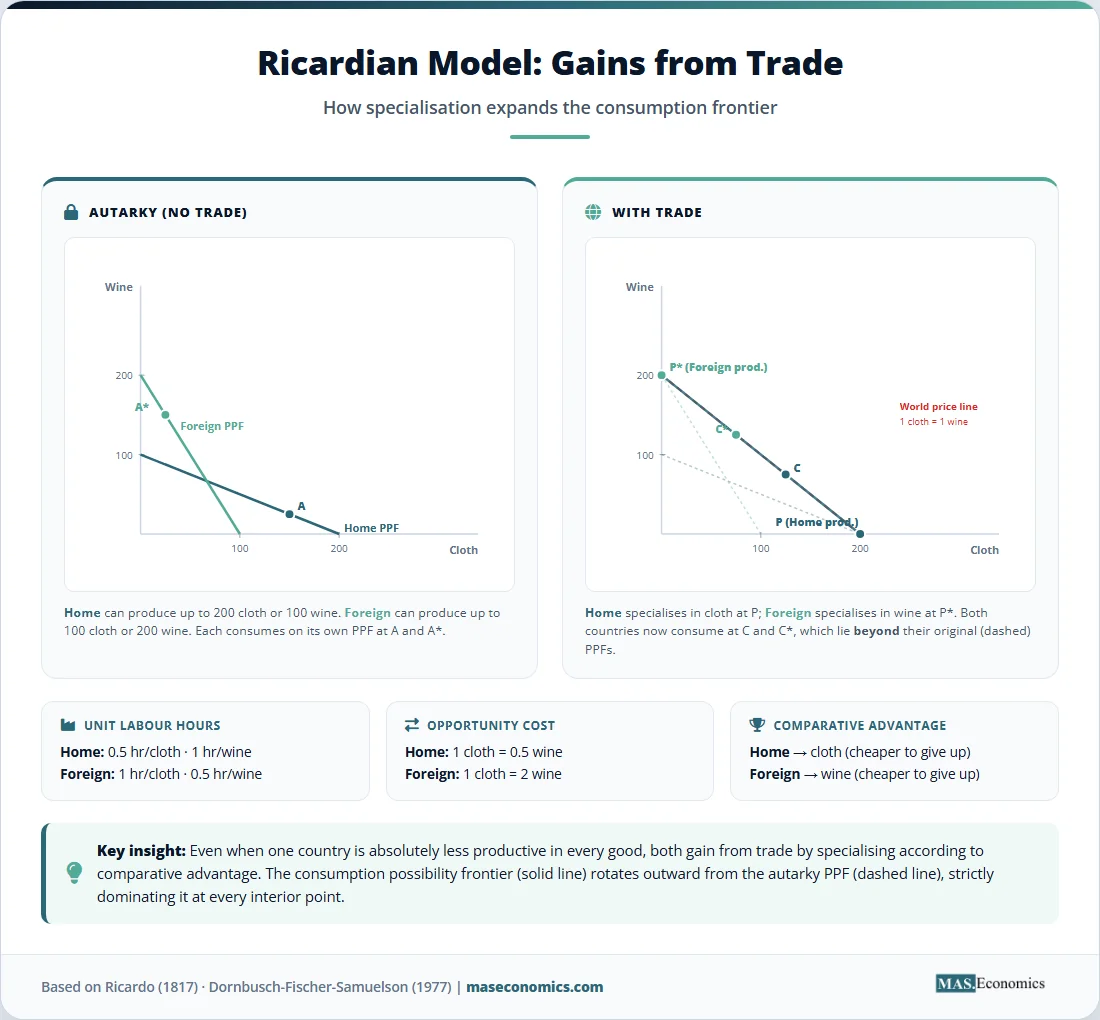
The gains from trade are measured by the expansion of the consumption possibility frontier. Under autarky, a country consumes along its production possibility frontier (PPF), which has slope \( -a_{LC} / a_{LW} \). With trade, the consumption frontier rotates outward to the world price line, strictly dominating the autarky frontier for all consumption bundles that include both goods.
Table 1. Model Variables: Notation for the Two-Country Ricardian Framework
| Symbol | Meaning | Interpretation |
|---|---|---|
| \( a_{LW} \) | Unit labour requirement for wine at Home | Hours of labour per unit of wine produced |
| \( a_{LC} \) | Unit labour requirement for cloth at Home | Hours of labour per unit of cloth produced |
| \( a_{LW}^{*}, a_{LC}^{*} \) | Foreign unit labour requirements | Same concept, Foreign country |
| \( L, L^{*} \) | Labour endowments | Total hours available in each country |
| \( P_C / P_W \) | Relative price of cloth in terms of wine | Units of wine exchanged per unit of cloth |
| \( w, w^{*} \) | Nominal wages | Determined by productivity and world prices |
| \( a_{LC} / a_{LW} \) | Opportunity cost of cloth at Home | Wine forgone per unit of cloth produced |

|
||
A concrete numerical example clarifies the mechanics. Suppose at Home, one hour of labour produces 2 units of cloth or 1 unit of wine, so \( a_{LC} = 0.5 \) and \( a_{LW} = 1 \). At Foreign, one hour produces 1 unit of cloth or 2 units of wine, giving \( a_{LC}^{*} = 1 \) and \( a_{LW}^{*} = 0.5 \). Home’s opportunity cost of cloth is 0.5 wine; Foreign’s is 2 wine. Home specialises in cloth, Foreign in wine, and any world relative price between 0.5 and 2 units of wine per cloth makes both countries better off.
Assumptions and Limitations
The classical Ricardian model rests on assumptions that are deliberately austere. Labour is the only factor of production, technology differences are exogenous, production functions exhibit constant returns to scale, markets are perfectly competitive, transport costs are zero, and preferences are identical and homothetic across countries. These assumptions make the model tractable but also generate predictions that the real world does not fully match.
The most prominent limitation is the prediction of complete specialisation. The basic model says each country produces only the good in which it has a comparative advantage. In reality, most countries produce most goods, a pattern driven by transport costs, imperfect competition, product differentiation, and non-tradable sectors. Extensions by Dornbusch, Fischer, and Samuelson (1977) generalised the model to a continuum of goods, resolving the complete-specialisation problem while preserving the comparative advantage mechanism.
A second limitation is the treatment of labour as the sole factor. Real economies use capital, land, and human capital, and trade patterns depend on the relative abundance of these factors. The Heckscher-Ohlin model and the Stolper-Samuelson theorem extend Ricardo’s logic to multi-factor settings, showing how trade affects factor prices and income distribution within countries.
A third limitation concerns the source of productivity differences. Ricardo treated them as given, but modern trade theorists have endogenised technology through innovation, knowledge diffusion, and firm heterogeneity. Eaton and Kortum (2002), published in Econometrica, developed a probabilistic Ricardian model in which each country draws productivity from a country-specific distribution, yielding quantitative predictions that match bilateral trade flows remarkably well. Melitz (2003) added firm-level heterogeneity, showing how trade reallocates resources from low- to high-productivity firms within industries.
Despite these limitations, the core Ricardian prediction, that comparative advantage drives trade patterns, is robust. Empirical studies consistently find that industries in which a country has relatively high productivity export more, exactly as Ricardo predicted two centuries ago.
Empirical Evidence
Empirical tests of the Ricardian model of trade began with MacDougall (1951), who examined US-UK trade in 25 industries after World War II. He found a strong positive relationship between relative labour productivity and relative exports: industries where US productivity exceeded UK productivity by a larger margin also had higher US-to-UK export ratios. Later work by Stern (1962) and Balassa (1963), published in the Journal of Political Economy, confirmed this pattern across different periods and country pairs.
The most influential modern test is Eaton and Kortum (2002). Their quantitative Ricardian framework uses bilateral trade data, productivity measures, and geographic barriers to estimate the parameters governing comparative advantage. They found that productivity differences explain a substantial share of observed trade patterns, and that their model’s predictions for welfare gains from trade align closely with computed general equilibrium simulations reported by the World Trade Organization.
Costinot, Donaldson, and Komunjer (2012) provided the cleanest empirical validation. Using agricultural data with direct productivity measures for specific crops across countries, they tested whether countries export more of the crops where their relative productivity is higher. The Ricardian prediction held: a ten percent increase in a country’s relative productivity in a given crop was associated with a statistically significant increase in export share. Their estimates, published in the Journal of Political Economy, suggest that eliminating Ricardian productivity differences would reduce world trade volume by roughly 5 to 15 percent.
The chart below shows the relationship between relative labour productivity and relative export performance across selected industries, based on empirical studies that replicate the MacDougall framework with modern data.
Sources: MacDougall (1951); Stern (1962); Costinot, Donaldson, and Komunjer (2012); OECD STAN productivity database. Values are illustrative, based on reported elasticities in the empirical literature.
The positive, convex relationship visible in the data is exactly what the Ricardian model of trade predicts: industries with a greater relative productivity advantage show disproportionately greater export dominance, reflecting both specialisation and the intensive margin of trade.
Why It Matters
The Ricardian model of trade shapes how economists, policymakers, and businesses think about globalisation, specialisation, and the welfare consequences of trade policy. Its influence extends far beyond textbooks into the quantitative models used to evaluate real trade agreements and the intuition that guides negotiations at the WTO, the OECD, and national trade ministries.
In the United States, the Ricardian framework underpins the Congressional Budget Office’s analysis of trade policy. When the CBO evaluates the economic effects of tariff changes or free trade agreements, its models assume that productivity differences drive specialisation patterns and that trade expansion raises aggregate welfare. The 2018-2019 tariff actions against Chinese imports, and the subsequent retaliation, were analysed by the Federal Reserve and the US International Trade Commission using frameworks descended directly from Ricardo. These studies found that tariffs reduced US welfare by forcing production away from sectors of comparative advantage and toward protected sectors with lower relative productivity.
The United Kingdom’s post-Brexit trade negotiations illustrate the model’s practical relevance. When the UK Trade Remedies Authority and HM Treasury evaluated bilateral deals with Australia, Japan, and the CPTPP bloc, they used quantitative Ricardian-style models to estimate sectoral gains and losses. The Office for National Statistics productivity data is fed directly into these calculations. Deals with countries whose relative productivity patterns complemented the UK’s, such as Australia in agriculture and the UK in financial services, were predicted to generate larger gains than deals with economies of similar productivity structure.
Canada’s trade strategy has long reflected Ricardian thinking. The Canada-United States-Mexico Agreement (CUSMA), successor to NAFTA, was evaluated by Global Affairs Canada using quantitative trade models built on Ricardian foundations. The agreement’s provisions for automotive rules of origin, dairy market access, and digital trade all reflect calculations about where each country’s comparative advantage lies. Canadian Bank research has shown that trade liberalisation under CUSMA concentrated Canadian production in sectors of comparative advantage, including energy, agriculture, and resource processing, raising average productivity but also requiring labour reallocation.
Australia provides perhaps the clearest real-world illustration of Ricardian specialisation at work. The Productivity Commission has repeatedly used Ricardian-style analyses to argue that Australia’s comparative advantage in mining, agriculture, and education services justifies its trade structure, even when manufacturing lobbies call for protection. The Reserve Bank of Australia has documented how shifts in relative productivity between Australia and its Asian trading partners have reshaped export composition over three decades, with iron ore, coal, and LNG rising in dominance as relative productivity in those sectors grew.
Beyond policy, the Ricardian model of trade guides corporate strategy. Multinational firms choosing where to locate production use relative productivity metrics, adjusted for wages, to identify sites of comparative advantage. The rise of global value chains, documented by the OECD, reflects firms slicing production across borders based on where each stage can be performed at the lowest relative opportunity cost, a direct application of Ricardian logic at the firm level. Multinational corporations have essentially operationalised comparative advantage within their internal networks.
The model also matters for understanding the limits of trade. Ricardian analysis shows that trade raises aggregate welfare but does not guarantee that every worker or region gains. The model’s assumption of perfect intersectoral labour mobility is an idealisation; in practice, displaced workers face retraining costs, geographic barriers, and wage losses. Recent research by Autor, Dorn, and Hanson on the “China shock” has shown that US regions heavily exposed to Chinese import competition experienced persistent declines in manufacturing employment and wages, lasting a decade or more. These findings do not refute the Ricardian model. They refine it, highlighting that the gains from trade predicted by Ricardo are aggregate and require policy complements, including trade adjustment assistance, to be broadly shared.
MASEconomics Explains
4 economic concepts behind the Ricardian model of trade
Conclusion
The Ricardian model of trade remains the most elegant demonstration in economics that differences, not similarities, create mutual benefit. Two centuries after its publication, the model’s central claim, that relative productivity determines trade patterns and that specialisation raises aggregate welfare, continues to hold up under empirical testing and to guide real trade policy. Its limitations, including complete specialisation and the single-factor assumption, have been addressed by richer successors, but the Ricardian logic remains intact within them.
Did you find this article helpful? Share it with someone who loves economics. And remember, at MASEconomics, we make complex ideas simple.