
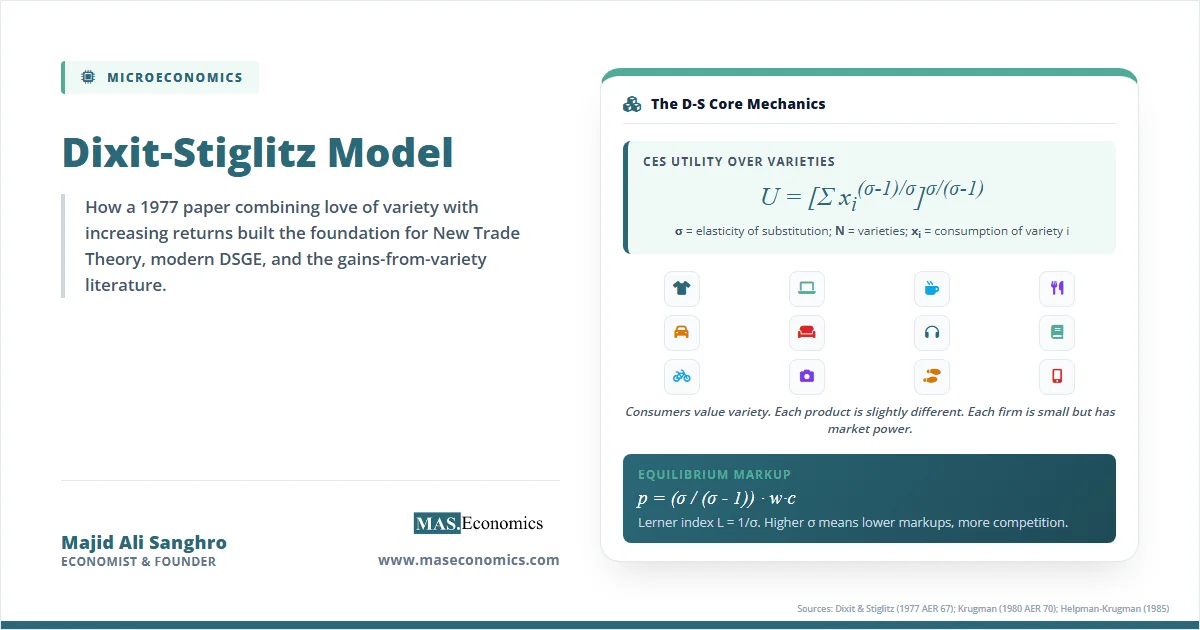
For decades, trade economists faced a stubborn puzzle: nearly half of world trade occurs between similar countries, such as the United States and Germany, in similar products, like Japanese cars versus German cars. Comparative advantage cannot explain this. The missing piece was a tractable model of differentiated products with increasing returns to scale. Avinash Dixit and Joseph Stiglitz provided exactly that in their 1977 American Economic Review paper. The Dixit-Stiglitz model introduced a framework of monopolistic competition with constant-elasticity-of-substitution preferences over differentiated goods, providing the foundation that allowed Paul Krugman to build New Trade Theory, Elhanan Helpman and Krugman to formalise gains from variety, and modern macroeconomic models to incorporate market power and product differentiation in a tractable form.
What the Dixit‑Stiglitz Model Shows
Before 1977, monopolistic competition existed as a concept, introduced by Edward Chamberlin in 1933, but it lacked a tractable general-equilibrium formulation. Economists could describe markets with many firms selling differentiated products, but they could not easily embed these markets into larger models of trade, growth, or macroeconomics. The math was too cumbersome.
Dixit and Stiglitz solved this with two key ingredients. First, they assumed consumers have a “love of variety,” meaning they strictly prefer consuming many slightly different products to consuming a single variety in larger quantities. They captured this using a constant elasticity of substitution (CES) utility function. Second, they assumed firms produce under increasing returns to scale, facing a fixed cost plus a constant marginal cost. Because of the fixed cost, average cost falls as output rises, giving each firm an incentive to specialise in a single variety.
In the resulting equilibrium, each firm produces a unique variety and charges a price above marginal cost, earning a positive markup. However, free entry drives economic profits to zero. The market settles at a determinate number of varieties, each produced at a finite scale by a different firm. This was a profound result: the market size directly determines the diversity of products available to consumers.
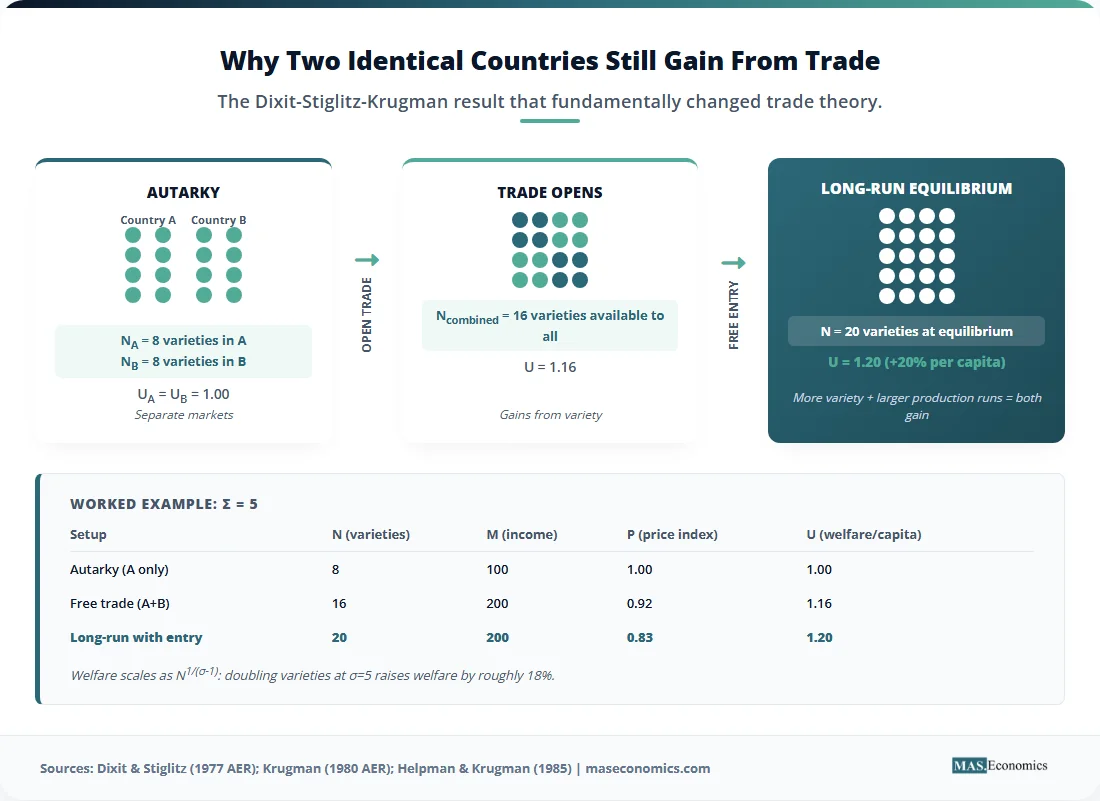
Paul Krugman seized on this framework in his 1979 and 1980 papers to build the New Trade Theory. He showed that two identical countries trading freely effectively pool their labour endowments, creating a larger market that sustains more varieties than either could alone. Both countries gain from trade, not because of comparative advantage, but because consumers have access to a wider array of products. Helpman and Krugman (1985) formalised these gains from variety further. The New Open Economy Macroeconomics, pioneered by Obstfeld and Rogoff (1995), embedded the Dixit-Stiglitz structure into international macro, and Melitz (2003) extended it to incorporate firm heterogeneity. Two Nobel Prizes, Krugman in 2008 and Stiglitz in 2001, trace their intellectual lineage directly to this model.
Dixit‑Stiglitz Model in Equations
The elegance of the Dixit-Stiglitz model lies in its mathematical tractability. By combining CES preferences with a simple production technology, the model yields closed-form solutions for prices, output, the number of varieties, and welfare.
Consumer Preferences: The CES Utility Aggregator
Consider a representative consumer with preferences over \( N \) differentiated varieties, represented by the CES utility function:
where \( x_i \) is consumption of variety \( i \), \( N \) is the number of available varieties, and \( \sigma > 1 \) is the elasticity of substitution between varieties. A higher \( \sigma \) implies varieties are closer substitutes; as \( \sigma \) approaches infinity, varieties become perfect substitutes, and the economy approaches perfect competition.
Demand for Variety i
Maximising utility subject to a budget constraint \( M \) yields demand for each variety:
where \( P \) is the CES price index. Each firm faces a downward-sloping demand curve with a constant elasticity of \( \sigma \).
Firm Production Technology
Firms produce using a single homogeneous input, labour, at a wage \( w \). The production technology features a fixed cost \( F \) and a constant marginal labour requirement \( c \):
The fixed cost \( F \) generates increasing returns to scale. Average cost falls as output increases, which incentivises each firm to produce a unique variety rather than duplicating another firm’s product.
Firm Profit Maximisation and Markups
Each firm is atomistic relative to the market and recognises that its pricing decision does not affect the aggregate price index \( P \). Profit maximisation implies setting marginal revenue equal to marginal cost. Given the constant demand elasticity \( \sigma \), the optimal price is a constant markup over marginal cost:
The price-cost margin, or Lerner index, equals \( 1/\sigma \). The markup factor is \( \sigma/(\sigma-1) \). Crucially, this markup is constant: it depends only on the elasticity of substitution and not on the number of competitors. This is a key limitation of the model, as real-world markups typically vary with market structure.
Free Entry and the Zero-Profit Condition
Free entry drives economic profits to zero:
Solving for output gives the equilibrium output per firm:
This result shows that equilibrium firm scale is determined entirely by the technology parameters \( F \) and \( c \), and the preference parameter \( \sigma \). It does not depend on market size.
Number of Varieties
Given a total labour endowment \( L \), the number of varieties \( N \) is determined by the labour market clearing condition:
The number of varieties scales linearly with market size. A larger economy does not just produce more of the same goods; it supports a wider diversity of products. This is the mechanism that drives the intra-industry trade results in Krugman’s work.
Welfare and Gains from Variety
Welfare in the Dixit-Stiglitz model depends on both income and the number of available varieties:
A doubling of market size raises the number of varieties proportionally and increases per-capita welfare. This is the gains-from-variety result: market integration improves consumer welfare by expanding the set of available products, even if technology and tastes are identical across countries. Unlike the Heckscher-Ohlin model or the Ricardian model, the gains arise from scale and diversity, not comparative advantage.
Sources: Dixit & Stiglitz (1977 AER); Krugman (1980 AER); calibration with σ = 5 (standard for differentiated goods).
| σ (Elasticity) | Markup Factor (μ = σ/(σ-1)) | Lerner Index L = 1/σ | Output per firm | Number of varieties (L=100, F=1) | Interpretation |
|---|---|---|---|---|---|
| 1.5 | 3.00 | 0.67 | 0.5 (small) | 67 | High differentiation, large markups |
| 2.0 | 2.00 | 0.50 | 1.0 | 50 | Moderate market power |
| 3.0 | 1.50 | 0.33 | 2.0 | 33 | Standard new-trade calibration |
| 5.0 | 1.25 | 0.20 | 4.0 | 20 | Typical empirical estimate |
| 10.0 | 1.11 | 0.10 | 9.0 | 10 | Near-perfect competition |
| ∞ | 1.00 | 0.00 | ∞ | 1 | Perfect competition limit |

|
|||||
Key Assumptions and Limitations
The Dixit-Stiglitz model relies on several restrictive assumptions. First, preferences are symmetric: all varieties enter the utility function identically. Consumers do not intrinsically prefer one variety over another before prices are considered. Second, the elasticity of substitution \( \sigma \) is constant, independent of consumption levels and the number of varieties. Third, firms are atomistic relative to the market, meaning there is no strategic interaction; they operate in a world of monopolistic competition rather than the oligopolistic rivalry found in Bertrand or Cournot models. Fourth, free entry drives profits to zero. Fifth, labour is the only homogeneous input.
These assumptions generate significant limitations. First, the model implies no pro-competitive effects. Markups are constant at \( \sigma/(\sigma-1) \), entirely independent of the number of competitors. In reality, empirical evidence shows that markups fall when more firms enter a market. Second, symmetric preferences are implausible. Consumers clearly value some varieties more than others. Third, the model assumes identical firms. Melitz (2003) addressed this by introducing firm heterogeneity, showing that trade liberalisation reallocates output toward more productive firms and forces less productive ones to exit, a result that the original Dixit-Stiglitz framework cannot capture. Fourth, non-CES preferences, such as translog or Kimball preferences, can deliver variable markups and pro-competitive effects, but at the cost of significant mathematical complexity, as demonstrated by Atkeson and Burstein (2008). Fifth, recent work by Bertoletti and Etro (2017) shows that Dixit-Stiglitz is just one specification among many plausible monopolistic competition models with “love of variety.” Finally, the model implies an infinite number of infinitesimally small firms. Reality features a finite number of large firms that interact strategically.
Empirical Evidence for the Dixit‑Stiglitz Model
The empirical literature built on the Dixit-Stiglitz foundation is vast. Dixit and Stiglitz (1977) were primarily a theoretical contribution, but their implications have been tested extensively through the trade and macro models it enabled.
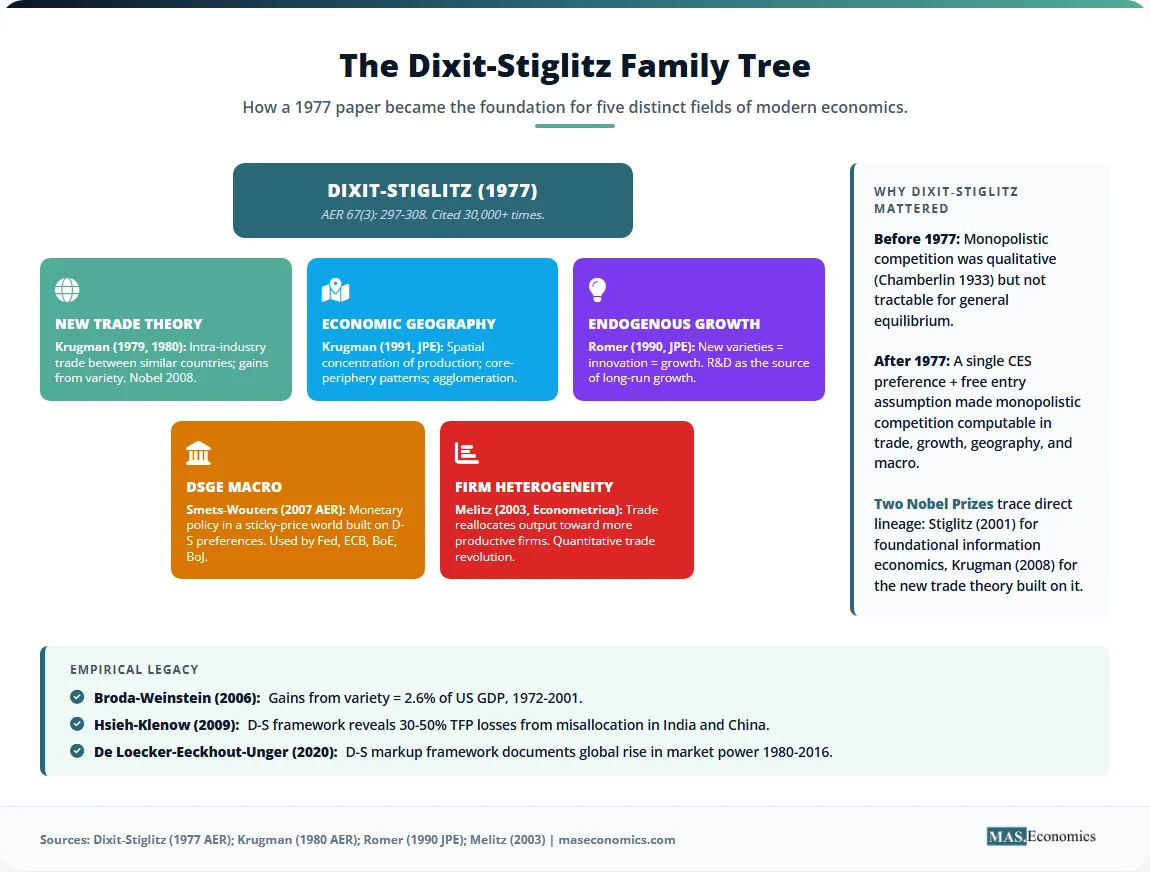
Krugman (1980) provided the seminal empirical application, showing that the Dixit-Stiglitz framework could explain the volume of intra-industry trade between similar countries. Helpman and Krugman (1985) synthesised this work into a comprehensive trade theory. The empirical validation of gains from variety came from Feenstra (1994), who developed a method for incorporating new product varieties into an exact import price index. Feenstra (1994) showed that conventional price indexes, which ignore changes in the set of imported varieties, can severely overstate import price inflation, implying unmeasured welfare gains from variety growth.
Broda and Weinstein (2006) extended this methodology significantly. In a landmark Quarterly Journal of Economics paper, Broda and Weinstein (2006) estimated that gains from variety in US imports were equivalent to 2.6 percent of GDP between 1972 and 2001. This is a substantial number, representing hundreds of billions of dollars in consumer welfare that would be invisible in standard trade models based solely on comparative advantage.
On the firm side, Melitz (2003) extended the Dixit-Stiglitz model to incorporate heterogeneous firms. His model predicted that trade liberalisation would cause the most productive firms to expand into export markets, less productive firms to serve only the domestic market, and the least productive firms to exit entirely. Bernard, Eaton, Jensen, and Kortum (2003) provided empirical implementation of these ideas using plant-level data, confirming that trade does indeed reallocate market share toward more productive firms.
In macroeconomics, Obstfeld and Rogoff (1995) embedded Dixit-Stiglitz preferences into their New Open Economy Macroeconomics framework. Smets and Wouters (2003) built them into the Eurozone DSGE model that became standard at the ECB; their subsequent 2007 AER paper extended a similar framework to US data. Hsieh and Klenow (2009) used the Dixit-Stiglitz markup structure to estimate that misallocation of resources across firms reduces total factor productivity by 30 to 50 percent in China and 40 to 60 percent in India compared to the United States. In his Nobel Lecture (2008), Krugman explicitly acknowledged the Dixit-Stiglitz model as the essential foundation for his work.
How the Dixit‑Stiglitz Model Matters
The Dixit-Stiglitz model is not merely an elegant theoretical exercise; it is the structural foundation for vast swaths of modern economics, from trade policy to central banking.
First, it enabled the New Trade Theory and earned Krugman the 2008 Nobel Prize. Krugman explicitly cites Dixit-Stiglitz as the model that allowed him to formalise modern theories of international trade. His 1980 paper, “Scale Economies, Product Differentiation, and the Pattern of Trade,” remains the seminal extension, showing why similar countries trade similar goods.
Second, modern DSGE macro models rely on it. The Smets-Wouters model used by the ECB, the Federal Reserve’s FRB/US, the Bank of Canada’s ToTEM, the Bank of England’s COMPASS, and the IMF’s GIMF all embed Dixit-Stiglitz preferences over differentiated goods. This structure generates price stickiness and market power, which are essential for modelling the real effects of monetary policy.
Third, trade policy assessment uses it directly. The EU’s trade-policy assessments, the US International Trade Commission, and WTO impact assessments all use Dixit-Stiglitz-Krugman models to compute the gains from trade agreements. Computable General Equilibrium models like the Global Trade Analysis Project embed the Dixit-Stiglitz structure as their core differentiated-goods module.
Fourth, the model underpins economic geography. Krugman’s 1991 Journal of Political Economy paper on increasing returns and economic geography extends Dixit-Stiglitz to spatial models, explaining why industries cluster in core regions while the periphery lags. This framework informs the Bank of England’s regional analyses and EU regional development policy.
Fifth, endogenous growth theory builds on it. Romer (1990) embedded Dixit-Stiglitz into growth models, treating new varieties as the result of innovation. In this framework, the number of new varieties is the engine of long-run growth, directly linking endogenous growth theory to the Dixit-Stiglitz market structure.
Sixth, it provides the framework for analysing productivity and misallocation. Hsieh and Klenow (2009) used Dixit-Stiglitz-based markups to estimate that India and China lose 30 to 50 percent of total factor productivity through misallocation across firms. This finding has reshaped development economics.
Seventh, quantitative trade models descended from it are now standard. The Eaton-Kortum and Melitz models are the workhorses of quantitative trade analysis at the IMF, World Bank, and central bank research departments. They are used to estimate the gains from recent trade agreements like the CPTPP, RCEP, and AfCFTA.
Eighth, the gains-from-variety result reshaped how we view globalisation. Broda and Weinstein’s estimate of a 2.6 percent GDP welfare gain from variety expansion between 1972 and 2001 demonstrated that the consumer benefits of globalisation extend far beyond lower prices.
Ninth, climate and structural transformation modelling use it. Dixit-Stiglitz is embedded in the IMF’s G-Cubed model and most multi-sector climate-economy frameworks, allowing modellers to capture how environmental policies interact with product differentiation and market power.
Tenth, the modern policy debate on competition and big firms references it. The markup-rise literature, notably De Loecker, Eeckhout, and Unger (2020), explicitly compares Dixit-Stiglitz benchmark predictions with observed cross-firm markup distributions. The empirical analysis of market power flows directly from the markup formula that Dixit and Stiglitz derived.
Eleventh, the framework is being repurposed for AI economics and platforms. Models of platform economies and digital differentiation, such as Etro (2021) on platform competition, increasingly rely on Dixit-Stiglitz structures to understand how digital marketplaces sustain vast arrays of niche products.
MASEconomics Explains
4 economic concepts behind the Dixit-Stiglitz model
Conclusion
The Dixit-Stiglitz model provided the workhorse framework for monopolistic competition by combining CES preferences with increasing-returns technology and free entry. It showed that market size determines product variety, that consumers gain from access to more varieties, and that trade between identical countries can be welfare-improving. The model is the analytical foundation for New Trade Theory, modern DSGE macroeconomics, economic geography, endogenous growth, and quantitative trade policy analysis. Despite known limitations, notably constant markups and symmetric varieties, it remains the standard tractable framework for analysing differentiated goods, market power, and the welfare gains from market integration. Nearly every major advance in trade and macroeconomics over the past four decades rests on the mathematical foundation Dixit and Stiglitz laid in 1977.
Did you find this article helpful? Share it with someone who loves economics. And remember, at MASEconomics, we make complex ideas simple.