
Between 1980 and 2000, the wages of college-educated American workers pulled steadily away from those of workers with only a high school education, even as the United States traded more heavily with low-wage developing countries. Standard trade theory had a clean prediction for what rising trade should do to wages, and at first the widening gap looked like confirmation. The relationship between trade and wages for skilled and unskilled workers became one of the most studied questions in economics, because the closer economists looked, the less the evidence matched the theory’s mechanism, even when it seemed to match the headline.
The puzzle is worth stating plainly. A clear theoretical model predicted that trade with labor-abundant economies would raise the wages of skilled workers in rich countries and depress the wages of unskilled workers. The skill premium did rise. Yet the specific fingerprints the theory required, the price movements and the patterns of skill use across industries, largely failed to appear. Understanding why forces a careful separation of what trade predicts, what the data showed, and what else was happening to labor markets at the same time.
Factor-Proportions Model Predictions
The starting point is the Heckscher-Ohlin framework, in which countries export goods that use their abundant factor intensively. A rich country abundant in skilled labor exports skill-intensive goods such as aircraft, pharmaceuticals, and software, and imports labor-intensive goods such as apparel and footwear. The mechanism that links this trade to wages runs through the Stolper-Samuelson theorem, which connects the prices of goods to the returns earned by the factors that produce them.
The logic is precise. When a country opens to trade, the price of its export good rises and the price of its import-competing good falls. The Stolper-Samuelson theorem says that a rise in the relative price of the skill-intensive good raises the real return to skilled labor by proportionally more, while reducing the real return to unskilled labor. For a skill-abundant rich country, trade should therefore raise the skill premium, the wage of skilled workers relative to unskilled workers. The same theorem run in reverse predicts that a labor-abundant developing country should see its unskilled wages rise and its skill premium fall.
This prediction sits inside the larger logic of comparative advantage and specialization. Trade is not a zero-sum transfer; it raises total income in both countries. But it redistributes that income across factors, and the factor-proportions model is explicit that the scarce factor in each country, unskilled labor in the rich country, loses in real terms. The wage gap is not an accident of the model; it is a direct consequence of the gains-from-trade mechanism itself.
Note. The skill premium is the ratio of the average skilled wage to the average unskilled wage, usually proxied by the college wage relative to the high-school wage. A rising premium means skilled pay is pulling ahead, whether because skilled wages rose, unskilled wages fell, or both.
Rising Skill Premium Without Textbook Mechanism
The college wage premium in the United States climbed sharply from the late 1970s through the 1990s, and similar widening appeared across several advanced economies. On the surface, this was exactly what the factor-proportions model predicted. The problem emerged when economists checked the channel through which trade was supposed to be operating.
The Stolper-Samuelson mechanism works entirely through goods prices. For trade to be raising the skill premium, the relative price of labor-intensive imported goods had to be falling. When researchers examined the price data for the 1980s, they found that the relative prices of unskilled-labor-intensive goods did not fall by nearly enough, and in several studies did not fall at all in the required direction. Without the price movement, the theorem’s engine was not turning, yet the premium was rising anyway. Something other than the trade channel had to be doing most of the work.
A second piece of evidence pointed the same way. The factor-proportions story predicts that as relative goods prices shift, industries should substitute toward the now-cheaper factor: unskilled-labor-intensive industries should expand and skill-intensive ones should contract within the rich country. Instead, the data showed that nearly every industry was using relatively more skilled labor at the same time, even as the skill premium and therefore the relative cost of skilled labor rose. Firms were paying more for skilled workers and hiring proportionally more of them across the board. That pattern is the signature of demand shifting toward skill within industries, not of trade reallocating production between industries.
| Feature | Trade (factor proportions) | Skill-biased technical change |
|---|---|---|
| Driving force | Falling relative price of labor-intensive imports | Technology that raises demand for skilled labor |
| Predicted price pattern | Unskilled-intensive goods get relatively cheaper | No particular trade-price requirement |
| Skill use within industries | Industries shift toward the cheaper factor | Skill use rises across nearly all industries |
| What the 1980s-90s data showed | Required price fall largely absent | Economy-wide rise in skill use, as predicted |
| Consensus weight | Modest contribution | Larger share of the rise |
|
Summary based on the trade-and-wages literature of the 1990s, including Lawrence and Slaughter and related studies.

|
||
Skill-Biased Technical Change as Rival
The leading alternative was skill-biased technical change. The spread of computers and information technology through the 1980s and 1990s raised the productivity of educated workers more than that of less-educated workers, shifting labor demand toward skill within essentially every sector. This explanation fits the two facts that trade could not: it requires no particular movement in import prices, and it predicts exactly the economy-wide rise in skill intensity that the data showed.
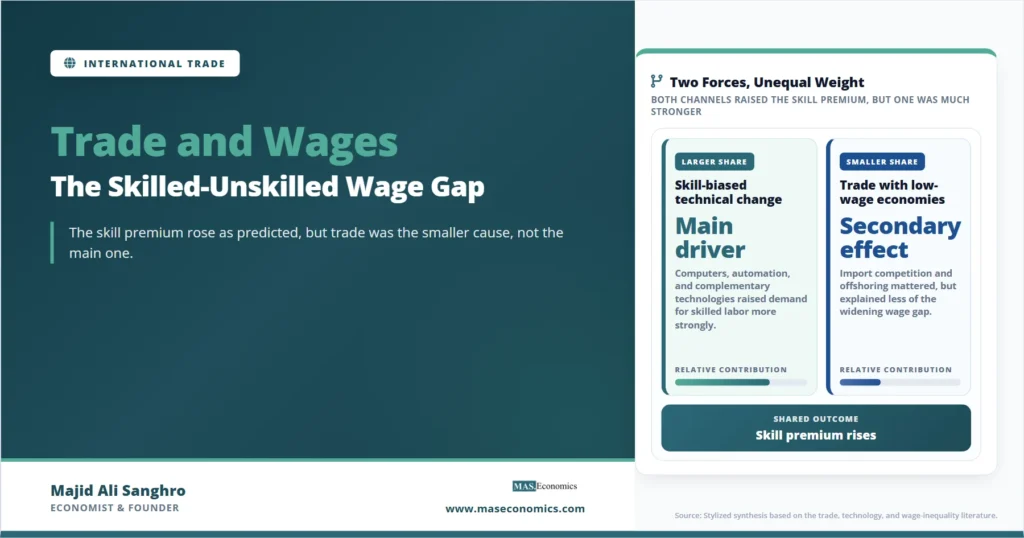
Through the 1990s, the consensus among trade economists settled on the view that skill-biased technical change accounted for the larger part of the rising premium, with trade playing a real but secondary role. This was not a dismissal of trade. The estimates that attributed perhaps 10 to 20 percent of the widening to trade still represented a meaningful effect on millions of workers. But it reframed the wage gap as primarily a technology story onto which trade added pressure, rather than a trade story confirmed by theory.
Caveat. Trade and technology are difficult to separate cleanly. Import competition can itself spur firms to adopt labor-saving technology, so part of what looks like skill-biased technical change may be an indirect response to trade. The two channels interact rather than competing as fully independent causes.
Broken Symmetry in Developing Countries
The factor-proportions model made an equally sharp prediction for the other side of the trade relationship, and that prediction failed even more visibly. If trade raises the skill premium in rich countries, it should lower the premium in labor-abundant developing countries, since their abundant factor, unskilled labor, is the one that gains. Yet when Mexico, and later other middle-income economies, liberalized trade in the 1980s and 1990s, their skill premiums often rose rather than fell.
Several mechanisms reconcile this with the broader theory without rescuing the simple version. Trade liberalization frequently arrived together with foreign direct investment and imported capital equipment that was complementary to skilled labor, raising skill demand in the developing country directly. Global production chains assigned developing countries the more skill-intensive tasks within what rich countries treated as unskilled-intensive industries, so the “unskilled” apparel sector abroad was skill-intensive relative to local norms. This task-level view of trade, developed in the trade in tasks model of offshoring, explains why both ends of a supply chain could see skill demand rise at once. The simple two-country, two-good symmetry of Heckscher-Ohlin did not survive contact with how production was actually fragmented across borders.
The deeper lesson echoes the history of the Heckscher-Ohlin model and its empirical troubles. The framework is logically sound and remains the right tool for thinking about how trade redistributes income across factors. But its specific quantitative predictions about wages rest on assumptions, identical technology across countries, trade in final goods rather than tasks, two factors and two goods, that the late-twentieth-century world did not satisfy.
Distribution Behind the Average
One reason the wage debate stayed politically charged is that the aggregate gains from trade are real while the losses are concentrated. Even when trade contributes only a modest share of the rising skill premium, the workers on the losing side are specific people in specific places, often older, less mobile, and tied to industries directly exposed to imports. The average worker can gain from cheaper goods while an identifiable minority loses both relative and absolute ground.
This distributional reality is the subject of the companion analysis of trade and inequality from Stolper-Samuelson to the China shock, which traces how later research on the surge of Chinese imports after 2000 revived the case that trade shocks can impose large, persistent local losses. That work did not overturn the technology consensus so much as sharpen it: trade’s effect on the national skill premium may be modest, but its effect on particular communities and labor markets can be severe. The two findings are consistent once the question shifts from “what moved the average wage gap” to “who bore the adjustment.”
Reading Trade-and-Wage Claims Today
The episode left a durable methodological lesson. A theory can predict the right direction of an outcome for the wrong reason, and only by testing the mechanism, the prices, the patterns of factor use, rather than the headline correlation, can the true cause be identified. When a politician attributes stagnant wages entirely to trade, or an economist attributes them entirely to technology, the historical record cautions against both. The skill premium rose because of several forces operating together, with technology the larger and trade the smaller but still a real contributor.
The same caution applies to modern claims. As trade increasingly takes the form of offshored tasks and digital services rather than shipped goods, the channels through which it touches wages keep shifting, a pattern visible in the growth of digital trade and cross-border data flows. The factor-proportions intuition, that trade redistributes income across factors even as it raises the total, remains the right organizing idea. The specific prediction about skilled and unskilled wages was the part that needed revising in light of evidence.
Explains
Three ideas that frame the trade-and-wages debate
Explore more on trade theory and its real-world tests.
Explore the MASEconomics BlogConclusion
The story of trade and wages for skilled and unskilled workers is a case where the data confirmed a theory’s headline and rejected its mechanism at the same time. The skill premium rose across advanced economies, exactly as the Stolper-Samuelson channel implied it should, but the price movements and industry-level patterns that channel requires were largely missing, while the economy-wide rise in skill use pointed clearly toward skill-biased technical change. The consensus that emerged gave technology the larger role and trade a smaller but genuine one.
The failure of the symmetric prediction, that developing countries should see their skill premiums fall, exposed how much the simple model left out: capital-skill complementarity, foreign investment, and the fragmentation of production into tasks rather than goods. None of this discredits the core insight that trade redistributes income across factors even while raising aggregate income. It shows instead that the precise wage predictions of a two-factor, two-good model cannot be read directly onto a world of global supply chains and rapid technological change. The right conclusion is neither that trade is blameless nor that it is the primary cause, but that wage inequality has several sources, and disentangling them requires testing mechanisms rather than trusting correlations.
Frequently Asked Questions
Does international trade increase the wage gap between skilled and unskilled workers?
Trade does push the skill premium upward in skill-abundant rich countries, but the evidence from the 1980s and 1990s suggests it was a secondary cause rather than the main one. The relative prices of labor-intensive imports did not fall by enough to drive the gap through the standard trade channel, and skill use rose across nearly all industries, which points to technology as the larger force. Most estimates attribute a meaningful but minority share of the widening to trade.
What does the Stolper-Samuelson theorem predict about wages?
It predicts that a rise in the relative price of a good raises the real return to the factor used intensively in producing it and lowers the real return to the other factor. Applied to trade, a skill-abundant country that exports skill-intensive goods should see skilled wages rise and unskilled wages fall in real terms, raising the skill premium. The prediction holds only if the underlying goods-price movements actually occur.
Why did skill premiums rise in developing countries too?
The simple model predicts the opposite, that labor-abundant countries should see their skill premiums fall. In practice, liberalization often arrived with foreign investment and imported equipment that complemented skilled labor, and global supply chains assigned developing countries the more skill-intensive tasks within industries. These forces raised skill demand directly, overriding the textbook prediction.
Is trade or technology more responsible for wage inequality?
The consensus from the trade-and-wages literature gives skill-biased technical change the larger role and trade a smaller but real one. The two are hard to separate fully, since import competition can itself prompt firms to adopt labor-saving technology. The practical takeaway is that wage inequality has multiple sources and cannot be attributed to any single cause.
Thanks for reading! If you found this helpful, share it with friends and spread the knowledge. Happy learning with MASEconomics