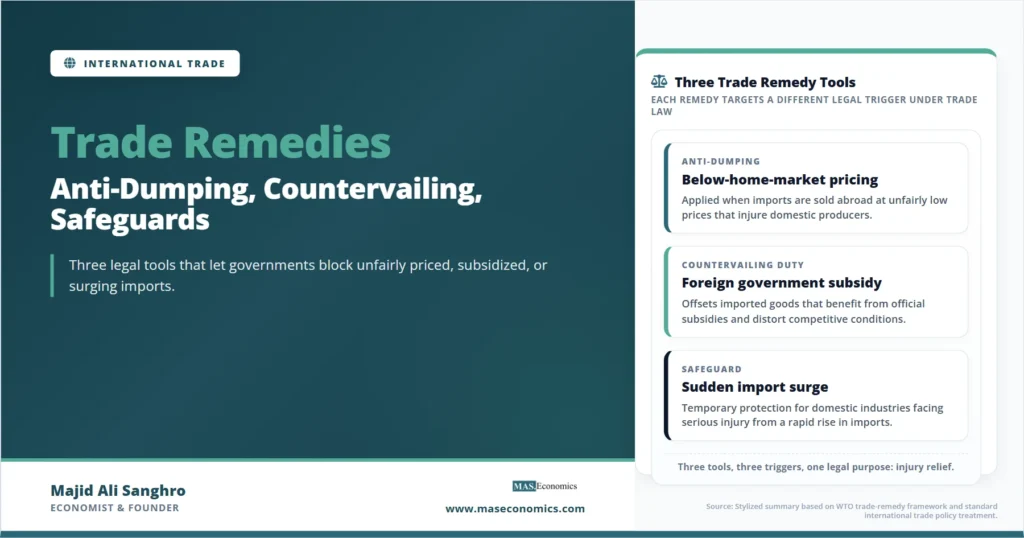
In 2024, the United States, the European Union, Canada, and several other economies opened or expanded investigations into electric vehicles, steel, solar components, and a long list of chemicals, almost all of them aimed at one exporter: China. None of these were ordinary tariffs set by legislation. They were trade remedies anti-dumping actions and their close relatives, countervailing duties and safeguards- applied case by case after a formal investigation found that imports were either unfairly priced, unfairly subsidized, or surging fast enough to threaten a domestic industry. These instruments sit inside a body of international law that lets a government raise barriers selectively without abandoning its commitment to open trade in general.
The distinction matters because the three remedies answer three different questions. Anti-dumping asks whether a foreign firm is selling abroad below the price it charges at home. Countervailing duties ask whether a foreign government is subsidizing its exporters. Safeguards ask whether imports, fairly traded or not, are rising so quickly that a domestic industry needs temporary breathing room. Each has its own legal test, its own evidence standard, and its own consequences for the exporter on the receiving end.
Definition of Dumping and Response
Dumping has a precise legal meaning that differs from the everyday sense of “selling cheap.” Under the World Trade Organization’s Anti-Dumping Agreement, a product is dumped when it is exported at a price below its “normal value,” which is usually the price the same product sells for in the exporter’s home market. The gap between that normal value and the export price is the dumping margin, and it is the basis for any duty that follows.
Consider a steel producer that sells a ton of rebar for $700 in its own country but exports the same rebar for $550. The export price undercuts the home price by $150, so the dumping margin is roughly 27 percent of the export price. If an importing country’s authorities confirm that margin and find that the low-priced imports are causing material injury to local producers, they can impose an anti-dumping duty to close the gap.
Dumping Margin
A duty is not automatic once dumping is shown. The legal architecture requires three findings together: that dumping is occurring, that the domestic industry producing the like product is suffering material injury, and that there is a causal link between the two. The importing authority can stop an investigation immediately if import volumes are negligible or if the margin falls below a small threshold, which keeps minor or commercially trivial cases out of the system. This three-part test is why anti-dumping sits apart from the broad tariffs covered in an overview of trade policy instruments: it targets a specific exporter for a specific pricing practice rather than taxing all imports of a good.
Economists have long noted a tension here. Selling below the home-market price is not, in itself, anti-competitive. Firms do it for ordinary reasons, including spreading fixed costs across a larger volume, clearing inventory, or pricing to enter a new market. The economic worry that justifies intervention is narrower: predatory dumping, where a firm prices low to drive rivals out and then raises prices once it controls the market. In practice, most anti-dumping cases do not involve a credible predatory threat. They protect domestic producers from price competition that happens to come from abroad, which is one reason the instrument attracts both heavy use and steady criticism.
Countervailing Duties: Offsetting Subsidies
Countervailing duties answer a different question. Instead of asking whether a foreign firm is pricing unfairly, they ask whether a foreign government is putting its thumb on the scale. When an exporting government provides a subsidy that lowers production costs, such as a cash grant, a tax break tied to exports, cheap state loans, or land below market value, the importing country can impose a countervailing duty equal to the size of that subsidy.
The logic is symmetry. If a subsidy of $80 per ton lets a foreign producer undercut domestic rivals, a countervailing duty of $80 per ton restores the price that would have prevailed without government support. The duty is meant to neutralize the distortion, not to punish the exporter. The governing rules sit in the WTO Agreement on Subsidies and Countervailing Measures, which defines which subsidies are actionable and requires the same injury and causation tests used in anti-dumping cases.
Two features distinguish countervailing cases in practice. First, the defendant is effectively a foreign government, which makes these cases diplomatically heavier than ordinary commercial disputes. Second, the same imports can attract both anti-dumping and countervailing duties at once when a producer is both subsidized and selling below normal value, though importing authorities are expected to avoid double-counting the part of the price advantage that the two remedies would otherwise correct twice.
Note. Anti-dumping targets a firm’s pricing behavior. Countervailing duties target a government’s subsidy. A single shipment can trigger both, because a producer can be subsidized and still price below its home-market value.
Safeguards: Temporary Relief Without an Accusation
Safeguards are the odd member of the family because they require no finding of unfair conduct at all. Under the WTO Agreement on Safeguards, a country can restrict imports of a product, fairly traded or not, when a sudden surge causes or threatens serious injury to domestic producers. The remedy is meant to give an industry temporary room to adjust, not to correct a wrong.
Because safeguards penalize trade that breaks no rule, the legal test is tougher, and the conditions are tighter. The injury standard is “serious injury,” which is higher than the “material injury” used in anti-dumping and countervailing cases. The measure must be temporary, must be progressively liberalized over its life, and generally applies to imports from all sources rather than singling out one exporter. A country that imposes a safeguard may also have to offer trading partners compensation, usually in the form of lower barriers elsewhere, or face authorized retaliation. These costs make safeguards the least-used of the three remedies, reserved for cases where an industry faces a genuine import shock rather than a specific unfair practice.
The 2018 United States safeguard on solar panels and washing machines is a familiar example. It applied broadly rather than to a single country, was scheduled to decline over four years, and was challenged at the WTO by affected exporters. The pattern is typical: safeguards are blunt, broad, and time-limited, which is exactly what the rules intend.
Comparison of the Three Remedies
The cleanest way to hold the three instruments apart is to line up the question each one asks, the legal test it must satisfy, and the scope of the duty it produces. The differences in injury standard and country coverage are not technicalities; they determine how often each remedy is used and how exporters respond.
| Feature | Anti-Dumping | Countervailing Duties | Safeguards |
|---|---|---|---|
| Target of the action | Foreign firm’s pricing | Foreign government’s subsidy | Import surge itself |
| Unfair conduct required | Yes, below-normal-value pricing | Yes, an actionable subsidy | No |
| Injury standard | Material injury | Material injury | Serious injury (higher bar) |
| Country coverage | Specific exporter(s) | Specific exporter(s) | All sources, generally |
| Size of the duty | Up to the dumping margin | Up to the subsidy amount | As needed to prevent injury |
| Duration | Usually five years, reviewable | Usually five years, reviewable | Temporary, must be phased out |
| Compensation to partners | Not required | Not required | May be required |
| Governing WTO agreement | Anti-Dumping Agreement | SCM Agreement | Agreement on Safeguards |
|
Source: WTO Anti-Dumping Agreement, SCM Agreement, and Agreement on Safeguards.

|
|||
Investigation Process Steps
All three remedies run through a formal investigation, and the sequence is broadly similar even though the legal tests differ. Understanding the steps explains why these cases take months, why provisional duties often arrive before final ones, and why the outcome turns as much on procedure as on economics.
An investigation usually begins with a petition from a domestic industry, which must show enough preliminary evidence of dumping or subsidization and injury to justify opening a case. The investigating authority then gathers data through questionnaires sent to foreign producers, domestic firms, and importers. A preliminary determination can trigger provisional duties, which protect the domestic industry while the inquiry continues but are refunded if the final finding goes the other way. A final determination follows, and if it confirms dumping or subsidization, injury, and a causal link, definitive duties are imposed. Most measures then run for around five years, subject to “sunset” reviews that decide whether the duty is still needed.
The procedural detail is where much of the controversy lives. The choice of which home-market price counts as normal value, whether to construct a value from costs when home sales are thin, and how to treat exporters from economies that the investigating authority does not regard as fully market-based can all swing the size of the duty dramatically. Two authorities looking at the same shipment can reach very different margins depending on these methodological choices, which is why exporters invest heavily in the questionnaire stage.
Frequency of Trade Remedy Use
Anti-dumping is by far the most common of the three remedies. Members of the WTO have notified thousands of anti-dumping initiations since the system began in 1995, with countervailing cases a distant second and safeguards rarer still. Use is not steady year to year. It rises when global overcapacity in industries such as steel, aluminum, and chemicals pushes exporters to sell abroad aggressively, and it spikes during periods of economic stress when domestic industries press hardest for protection.
The exporters most often named follow the same logic. China has been the single most frequent target of anti-dumping and countervailing actions for two decades, reflecting its scale in metals, chemicals, machinery, and increasingly clean-energy goods. The actual year-by-year and country-by-country counts are published in the WTO’s trade-remedies data portal, drawn from the semi-annual reports members file. Readers who want exact figures should consult that source directly, since the numbers are revised as members update their notifications.
Trade Remedies Among Other Barriers
Trade remedies are sometimes lumped together with ordinary protectionism, but they occupy a specific legal and economic niche. They are not tariffs in the legislative sense, and they are not the quotas and standards that make up the world of non-tariff barriers. They are exceptions, written into trade law, that let a member restrict imports of a specific product after a specific finding, while leaving its general tariff commitments intact.
That design has a clear economic cost. Like any import barrier, a trade-remedy duty raises the domestic price of the protected good, and the burden falls partly on domestic buyers, a dynamic explored in the microeconomics of who actually bears a tariff. Producers of the protected good gain, downstream users that buy it as an input lose, and consumers pay more. The case for the duty rests on correcting a distortion, an unfair price or a foreign subsidy, that the market would not otherwise correct. The case against rests on the frequency with which the instruments protect inefficient producers from ordinary competition under the cover of fairness language.
There is also a strategic dimension. A large country with market power can, in narrow circumstances, improve its own welfare by taxing imports, a result formalized in optimal tariff theory. Trade remedies are not designed as optimal tariffs, but the political economy that surrounds them, concentrated producer gains against dispersed consumer losses, helps explain why they remain popular even when the aggregate welfare case is weak. When disputes over their use cannot be resolved bilaterally, they move into the formal WTO dispute settlement process, where panels assess whether an investigating authority followed the rules.
Caveat. A finding of dumping does not establish that a foreign firm acted predatorily or that consumers are harmed. It establishes only that the export price fell below normal value and that domestic producers were injured. The economic case for intervention is narrower than the legal trigger.
Explains
Three concepts that make trade remedies clearer
Build a clearer picture of how trade policy actually works.
Explore the MASEconomics BlogConclusion
The system of trade remedies anti-dumping rules, countervailing duties, and safeguards gives governments a legal way to raise selective barriers without renouncing open trade in general. The three instruments are distinct in their logic: anti-dumping responds to a firm’s below-normal-value pricing, countervailing duties offset a foreign government’s subsidy, and safeguards provide temporary relief from an import surge regardless of fault. They share a procedural backbone, an investigation that must establish injury and causation. Still, they differ in their injury standards, their country coverage, and the obligations they impose on the importing country.
Anti-dumping dominates the caseload, countervailing duties run second, and safeguards remain rare because their higher injury bar and compensation requirements make them costly to use. China has been the most frequently named exporter for two decades, and the recent wave of investigations into electric vehicles, steel, and clean-energy goods continues that pattern. The instruments are exceptions carved into trade law, and their economic effect is the same as any import barrier: higher prices for the protected good, gains for its producers, and losses spread across downstream users and consumers.
The recurring debate is not about whether unfair pricing or subsidies can occur, but about how often these remedies actually correct a distortion rather than shelter producers from competition that the fairness language conveniently describes as unfair. The legal trigger is broader than the economic justification, which is why trade remedies will remain among the most used and most contested tools in international trade policy.
Frequently Asked Questions
What is the difference between anti-dumping duties and countervailing duties?
Anti-dumping duties respond to a foreign firm selling exports below the price it charges in its own home market. Countervailing duties respond to a foreign government subsidizing its exporters. One targets private pricing behavior; the other targets state support. The same imports can attract both when a producer is subsidized and also selling below normal value.
Is dumping illegal under WTO rules?
No. WTO rules do not prohibit firms from dumping. The Anti-Dumping Agreement disciplines how governments may respond to dumping, not the act itself. An importing country can impose duties only after an investigation establishes dumping, material injury to a domestic industry, and a causal link between the two.
Why are safeguards used less often than anti-dumping measures?
Safeguards penalize imports that break no rule, so the legal conditions are stricter. They require a higher “serious injury” standard, must be temporary and progressively liberalized, generally apply to all exporters rather than one, and may require compensation to trading partners. These costs make them the least-used of the three remedies.
How long do anti-dumping duties last?
Definitive anti-dumping and countervailing duties typically last about five years. Before they expire, authorities conduct a “sunset” review to decide whether removing the duty would likely lead to renewed dumping or subsidization and injury. If so, the measure can be extended for further periods.
Which country faces the most trade remedy actions?
China has been the single most frequently named exporter in anti-dumping and countervailing investigations for roughly two decades, reflecting its large share of global production in steel, aluminum, chemicals, machinery, and clean-energy goods. Current counts by exporter are published in the WTO trade-remedies data portal.
Thanks for reading! If you found this helpful, share it with friends and spread the knowledge. Happy learning with MASEconomics