The most quoted interest rate on earth governs a market most people have never heard of, for loans that last one night, between institutions that mostly no longer need them. The federal funds rate is the rate at which American banks lend their reserve balances, deposits held at the Federal Reserve, to one another overnight, unsecured. As of July 2026 it stands at 3.63 percent. On that obscure foundation rests an astonishing share of world finance: credit card rates, business loans, savings yields, currency values, and the borrowing costs of governments on every continent move when this rate moves, which is why eight times a year the world’s markets hold their breath for a committee announcement about it.
The gap between the rate’s tiny technical domain and its planetary reach is the thing to understand. It is not important because the overnight interbank market is important; that market has actually withered. It is important because the Federal Reserve chose it as the handle on the entire structure of dollar interest rates, and the dollar is the currency in which the world does its borrowing.
A Rate for One Night, Set for the World
The mechanics start with reserves. Banks hold balances at the Federal Reserve to settle payments among themselves, and a bank running short by evening can borrow another bank’s excess until morning. The interest on that unsecured overnight loan is a federal funds transaction, and the volume-weighted average across each day’s trades is the effective federal funds rate, the 3.63 percent above. In the era when reserves were scarce, this market was large and lively; in today’s system, where reserves are abundant and the Fed steers the rate by setting what it pays on them directly, actual interbank volume is modest and the rate sits obediently inside the announced band. The full story of that regime change, and of the money the rate is priced on, runs through our explainer on the money supply.
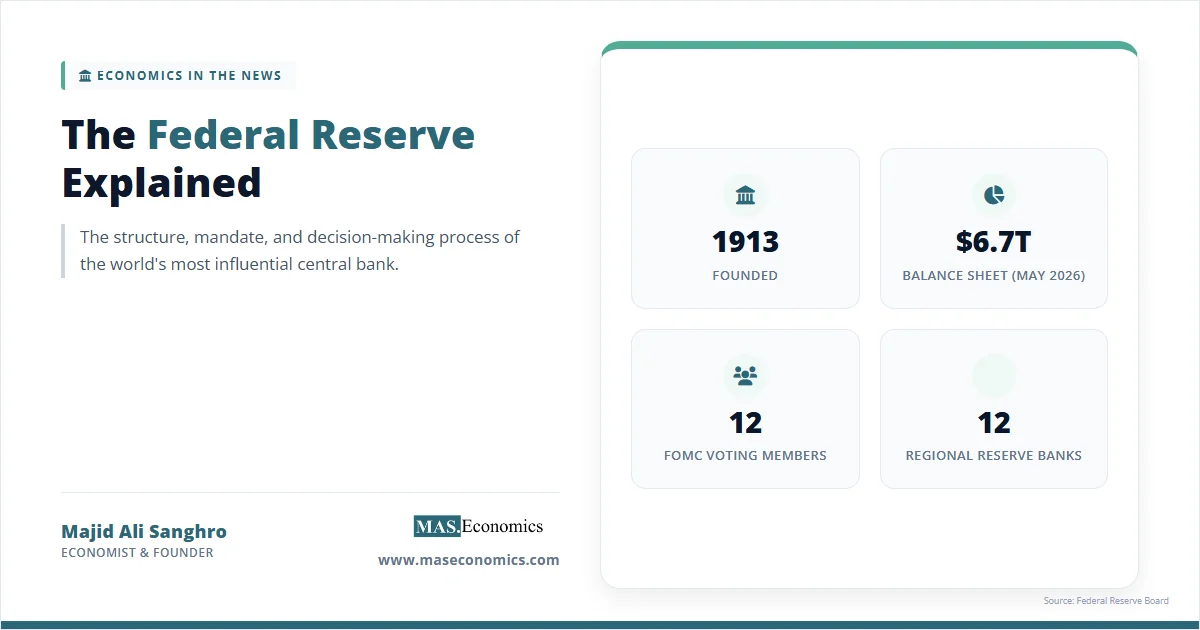
What the committee actually announces is a target range a quarter point wide, and the machinery holding the effective rate inside it belongs to the Federal Reserve’s structure: the Federal Open Market Committee votes the range at its scheduled meetings, and the administered rates the Fed pays banks and money funds pin the market to it. How the committee chooses the level is the trillion-dollar judgment, balancing inflation against employment; the classic description of that reaction, mapping inflation and slack into a recommended rate, is the subject of our article on the Taylor rule.
How One Night Reaches Thirty Years
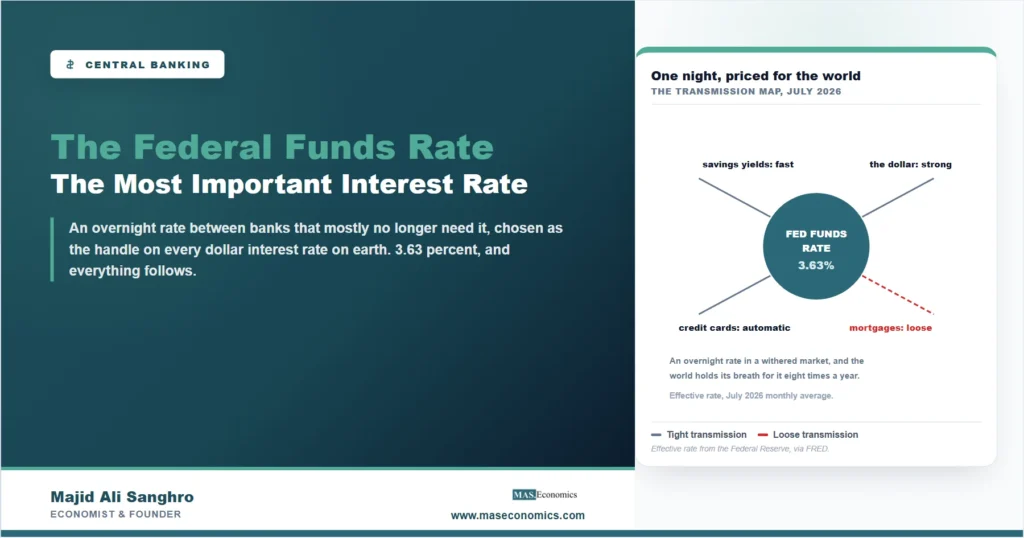
The transmission outward happens in rings of decreasing tightness. The inner ring is nearly mechanical: money market yields, bank funding costs, and the prime rate that prices credit cards and many business loans reset with the target almost immediately, which is why a hike shows up on card statements within a billing cycle or two while savers see deposit yields follow more grudgingly. The middle ring is the exchange rate: higher dollar rates pull capital toward dollar assets, strengthening the currency and tightening conditions for every government and firm abroad that borrowed in dollars, the channel that makes an American committee meeting a fiscal event in distant capitals, and the reason the dollar backstop system exists at all.
The outer ring is the loosest, and currently the most instructive. Long-term rates, the ten-year Treasury yield and the mortgage rates priced off it, embed expectations of where the funds rate will average over years, plus a premium for bearing duration, so the Fed steers them only indirectly. The distinction is not academic this year: the Fed has been cutting the funds rate while mortgage rates barely moved, because the long end has been repriced by term premium rather than policy expectations, the decomposition our analysis of why the cuts have not reached the mortgage market works through with the data. “The Fed sets interest rates” is true for the overnight rate, approximately true for the inner ring, and a simplification that currently fails for the rates most households actually meet.
One more boundary keeps the concept sharp. The funds rate is a target for a specific American overnight market; it is not the only reference rate even in dollars, and much of finance now prices off a secured overnight rate derived from repo transactions. But the policy target remains the handle: when the committee moves the range, every dollar reference rate moves with it, which is why the distinction matters to plumbing specialists and almost never to the direction of anyone’s borrowing costs.
Reading the Number Like It Matters
Three habits make the rate’s headlines legible. First, read levels against inflation: 3.63 percent means little alone, but against inflation of 3.46 it is a real rate near zero, historically easy rather than tight, which reframes every argument about whether policy is restrictive. Second, read direction against the dual mandate: cuts signal the committee weighs labor market risk more heavily, hikes signal inflation fear, and the statement’s language about which risk dominates is the actual news in most announcements. Third, watch the gap between the funds rate and the long rates that price real decisions; when they move together, policy is transmitting, and when they diverge, as now, something else, fiscal risk, term premium, global flows, has taken over the far end of the curve, and the world’s most important interest rate is discovering the limits of its importance.
MASEconomics Explains
3 economic concepts behind the federal funds rate
These concepts are explored in depth across our educational articles library.
Explore the MASEconomics BlogConclusion
The federal funds rate is a strange candidate for the world’s most important price: an overnight, unsecured, interbank rate, 3.63 percent as of July 2026, in a market the modern reserve system has mostly retired. Its power is entirely positional. The Federal Reserve chose it as the handle on dollar interest rates, holds it in an announced range through administered rates, and lets arbitrage carry every move outward, through card rates and deposit yields within weeks, through the dollar to the world’s borrowers, and, more loosely, out to the long rates that price houses and governments.
The loose outer ring is the honest caveat on the title. This year’s divergence between a cutting Fed and stubborn mortgage rates shows the handle turning while part of the machine declines to follow, a reminder that the rate commands expectations and premia only imperfectly. Read against inflation for stance, against the mandate for direction, and against the long end for traction, the eight-times-a-year announcement stops being a ritual and becomes what it actually is: the posted price of the world’s reserve currency, one night at a time.
Frequently Asked Questions
What is the federal funds rate in simple terms?
It is the interest rate at which American banks lend their reserve balances at the Federal Reserve to one another overnight, unsecured. The Fed announces a target range for it and holds the market inside that range, making it the reference point from which other dollar interest rates are priced.
Who sets the federal funds rate?
The Federal Open Market Committee, which meets on a published schedule eight times a year and votes a target range a quarter point wide. The Fed then maintains the range through the administered rates it pays on bank reserves and to money market funds, so the market rate follows the announcement without daily intervention.
How does the federal funds rate affect mortgages and credit cards?
Credit cards and floating-rate loans are priced off the prime rate, which moves with the funds rate almost automatically, so changes reach card statements within a cycle or two. Mortgages follow long-term Treasury yields, which embed expectations and term premium, so the link is loose; long rates can stay high even while the Fed cuts, as in 2025 and 2026.
What is the federal funds rate right now?
The effective federal funds rate averaged 3.63 percent in July 2026. Against consumer inflation of 3.46 percent, that puts the real policy rate near zero, which is historically accommodative rather than tight, a comparison worth making whenever the level is debated.
Why is the federal funds rate called the most important interest rate?
Because it anchors the price of the dollar, the currency in which the world borrows. Dollar deposit rates, loan rates, and reference rates all reprice from it, and through exchange rates and dollar debt it tightens or eases conditions far beyond the United States. Its importance comes from that position, not from the small overnight market it technically governs.
Thanks for reading! An overnight rate in a withered market, and the world holds its breath for it eight times a year: position is everything in finance. Happy learning with MASEconomics