On the morning of September 17, 2019, the federal funds rate broke through the top of the Federal Reserve’s target range, touching 5.25 per cent against a 2.00–2.25 per cent band. The ample reserves vs scarce reserves distinction lay behind the disruption. The episode looked like a plumbing failure; it was actually a regime question, one that determines how the Fed sets the policy rate, how transmission works through the banking system, and how vulnerable money markets are to shocks.
Before the 2008 financial crisis, the Fed operated in a scarce‑reserves regime. Reserve balances were kept tight, the supply was the active policy lever, and the federal funds rate moved through open‑market operations that adjusted the quantity of reserves day by day. After 2008, the balance sheet grew from less than $1 trillion to more than $4 trillion, and the supply of reserves became enormous relative to what banks needed for ordinary settlement. The operating framework changed accordingly, and the Fed now sets the policy rate by adjusting the interest it pays on reserves rather than by managing the quantity of reserves. The 2019 spike was the moment when the new framework hit a constraint that the old framework would not have generated, and the diagnosis required a clear understanding of which regime the Fed was actually operating in.
Bank Reserve Functions
Reserves are deposits that commercial banks hold at the central bank. They are the most liquid assets a bank can own, settling all interbank payments and meeting any regulatory or precautionary need for immediately available funds. Reserves do not earn the bank money in the same way that loans do, but they earn whatever rate the central bank pays on reserve balances, and they remove any settlement risk from the bank’s daily operations.
Banks need reserves for three reasons. The first is settlement: when a customer of Bank A transfers funds to a customer at Bank B, the underlying transaction clears across the central bank’s balance sheet, and Bank A’s reserve account is debited while Bank B’s is credited. The second is regulatory: most central banks require banks to hold reserves equal to some fraction of their deposit liabilities, although the size of this requirement has fallen sharply in many systems, and the Federal Reserve dropped it to zero in March 2020. The third is precautionary: banks hold reserves above the regulatory minimum to handle unexpected outflows, late-day payment surges, or temporary funding shortfalls.
The total quantity of reserves in the banking system is determined by the central bank’s balance sheet, not by the choices of individual banks. When the Fed buys a Treasury security from a primary dealer, it credits the dealer’s bank with new reserves and debits its own holdings of securities with the purchase. Reserves are created by the act of the central bank acquiring assets. The discussion of how this expansion works at a deeper level sits in the article on how central banks create money, and the role of the balance sheet in fiscal and monetary interactions is explored in the article on central bank balance sheets.
Scarce Reserves Pre‑2008
In the scarce-reserves regime that prevailed in the United States from the early 1980s through 2008, the supply of reserves was kept deliberately tight. Aggregate reserves typically ran around $10 to $20 billion, which is small relative to the daily payment flows of the banking system. Banks short on reserves at the end of the day borrowed from banks with surplus reserves in the federal funds market, and the rate that emerged from those transactions was the federal funds rate.
The Fed controlled the funds rate by adjusting the quantity of reserves. When it wanted the rate to fall, it bought securities through open-market operations, adding reserves to the system; the increased supply lowered the price at which banks willing to lend reserves would do so. When it wanted the rate to rise, it sold securities or let them mature without replacement, draining reserves and forcing banks to bid more aggressively for the smaller available stock. The mechanism was a textbook supply-demand intersection, and the demand curve for reserves was downward-sloping because banks needed reserves to clear payments, and the marginal value of holding additional reserves fell as the stock grew.
The scarce-reserves system had two practical features that mattered. First, the desk at the Federal Reserve Bank of New York had to estimate demand each day and conduct open-market operations to hit the target rate. The system required constant active management, and small forecasting errors could produce visible deviations in the funds rate. Second, the interest the Fed paid on reserve balances was effectively zero, because reserves were scarce and the marginal value of an additional reserve was set by the federal funds rate, not by the central bank’s administered rate. The connection between this operating framework and the broader set of monetary policy tools ran through the daily reserve-management routine more than through any administered rate.
Ample Reserves After 2008
The financial crisis of 2008 ended the scarce-reserves regime. The Fed’s response to the crisis required massive injections of liquidity into the banking system, and its subsequent program of quantitative easing expanded the balance sheet from under $1 trillion to over $2 trillion by 2010, then to $4.5 trillion by 2014, and to roughly $9 trillion at the peak of the 2020-2021 expansion. Reserves at commercial banks grew in lockstep with the balance sheet, from around $10 billion in early 2008 to over $4 trillion at the peak.
At those levels, reserves are not scarce by any reasonable definition. The aggregate quantity sits far above what banks need for settlement, regulatory compliance, and precaution combined. A scarce-reserves operating framework cannot function in this environment, because the federal funds market loses its price-discovery function when every bank already has more reserves than it needs. The marginal value of an additional reserve to most banks is whatever the Fed pays them on the reserves they already hold.
The Fed responded by switching to a floor system. Under this framework, the policy rate is set administratively rather than through quantity management. The Fed pays interest on reserve balances, currently labelled the interest on reserve balances rate, or IORB, and the federal funds rate trades just below this administered rate. Banks have no incentive to lend reserves below the IORB rate, because they can earn that rate by simply holding reserves at the Fed. A secondary floor, the overnight reverse repo facility rate (ON RRP), serves as a lower bound for money market funds and other non-bank participants who cannot earn IORB directly. The Fed sets these two administered rates, and the federal funds rate effectively follows.
The shift to ample reserves was not just a technical change. It transformed the relationship between the balance sheet and monetary policy. In the scarce regime, the quantity of reserves and the policy rate were jointly determined every day, and the Fed could only do one operation at a time. In the ample regime, the balance sheet size and the policy rate can be set independently. The Fed can run a large balance sheet and set the policy rate wherever it wants, because the rate is set by administered prices rather than by reserve scarcity.
Historical Reserve Balances
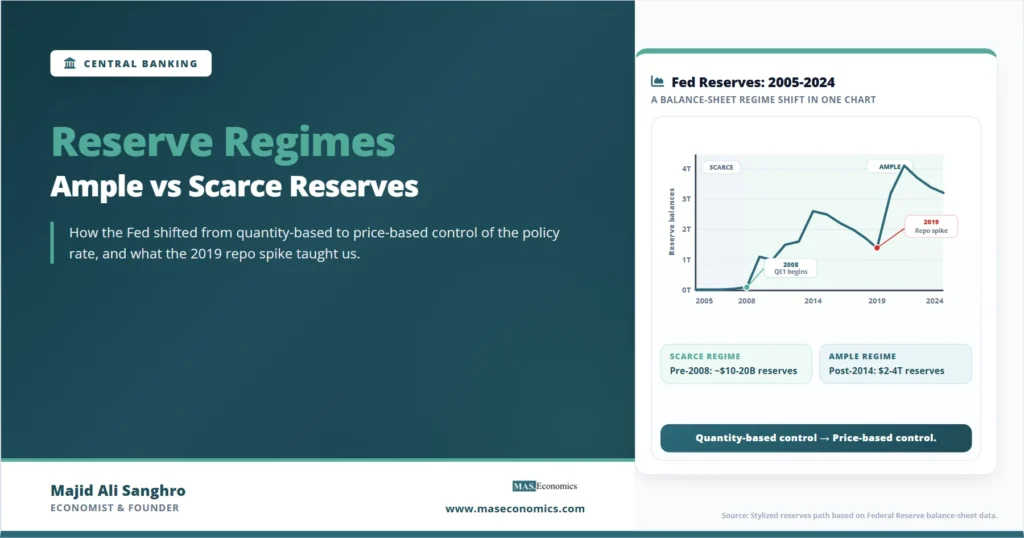
The visual history of reserves at the Federal Reserve over the past two decades makes the regime shift hard to miss. Before 2008, reserves ran in a narrow band near zero. After 2008, they grew through three distinct rounds of quantitative easing, fell modestly during the 2017-2019 balance-sheet normalization, surged again in 2020 during the pandemic response, and remained at unprecedented levels through the subsequent years.

The chart makes the regime change visible. From 2005 through mid-2008, reserves ran along the bottom of the plot, indistinguishable from zero on the scale needed to show the post-crisis levels. The crisis response in late 2008 lifted reserves to nearly $1 trillion within months. Each subsequent round of asset purchases extends the level upward until the 2021 pandemic peak puts reserves above $4 trillion. The orange dashed line marks the rough threshold above which the system operates as ample rather than scarce; the precise boundary depends on the structure of the banking system and the regulatory framework, but the order of magnitude is clear. The 2019 spike sits in the middle of the chart, at a moment when reserves had fallen to around $1.4 trillion through balance-sheet normalization, well above the pre-2008 levels but apparently low enough to cause stress in the repo market.
The Two Regimes Side by Side
The comparison between the two operating frameworks is more useful as a table than as continuous prose, because the differences run through five or six dimensions, and each pair of features illuminates the regime question from a different angle.
| Dimension | Scarce reserves regime | Ample reserves regime |
|---|---|---|
| Aggregate reserves | Small relative to settlement needs ($10–20 billion in the US before 2008) | Far above settlement and regulatory needs ($2–4 trillion in the US since 2014) |
| Demand curve for reserves | Downward-sloping in the operating range | Effectively flat at the administered floor rate |
| Primary policy lever | Open-market operations adjusting reserve quantity | Interest on reserve balances (IORB) plus ON RRP rate |
| Federal funds rate determination | Cleared by supply and demand for reserves | Anchored just below IORB by arbitrage |
| Balance sheet and policy rate | Jointly determined | Independently controllable |
| Daily desk activity | Active, forecasting demand and adjusting supply | Passive in normal conditions; intervenes only during stress |
| Risk of money-market disruption | Higher in normal periods; managed through frequent operations | Lower in normal periods; concentrated at the boundary between regimes |
| Operating principle | Quantity-based control of the policy rate | Price-based control through administered rates |
|
Source: MASEconomics editorial synthesis based on Federal Reserve operating framework documentation and academic literature on reserve regimes.
|
||
The most consequential row is the one about balance-sheet and policy-rate independence. In the scarce regime, a central bank that wants to do quantitative easing has to accept that the policy rate will fall to zero or near zero, because the act of buying assets at scale floods the system with reserves and pushes the funds rate to whatever level the demand curve crosses. In the ample regime, the central bank can buy trillions of dollars of assets and still set the policy rate at 5 percent, because the rate is set by what the Fed pays on reserves rather than by where supply meets demand. This separation is what allowed the Fed to run a large balance sheet through 2022-2024 while raising the federal funds rate from near zero to over 5 percent. The same mechanism is why quantitative easing and conventional rate policy became, in the ample regime, two separable tools rather than one combined instrument.
September 2019 Repo Spike
The 2019 repo spike was a test of where the boundary between ample and scarce really sits. Through 2018 and into 2019, the Fed had been letting its balance sheet shrink by allowing maturing Treasuries to roll off without replacement. Reserves had fallen from a peak of around $2.8 trillion in 2014 to roughly $1.4 trillion by September 2019. The Fed had assumed this level was still comfortably in the ample range. The funds rate was trading inside the target band, the IORB floor was holding, and there were no obvious signs of strain.
The strain appeared when two events coincided. Corporate tax payments drained reserves from banks to the Treasury General Account, and a large Treasury settlement absorbed dealer balance sheets simultaneously. The combined withdrawal exceeded the system’s spare capacity, and dealers who normally funded their Treasury positions through overnight repo could not find the cash to do so at usual rates. Repo rates jumped to 10 percent overnight, and the funds rate followed it up to 5.25 percent. The Fed had to step in with emergency repo operations and then, more permanently, with a standing repo facility.
The episode revealed that the ample-reserves regime is not infinitely robust. There is a minimum level of reserves below which money markets become vulnerable to stress events, even if the average level over the previous months looked comfortable. The exact location of this minimum is not directly observable; it depends on the distribution of reserves across banks, on the demand for intraday liquidity, on regulatory constraints that affect how willing banks are to lend reserves, and on the structure of the repo market. The 2019 spike taught the Fed that this minimum sits higher than it had assumed, and the operational lesson was codified in the standing repo facility that the Fed introduced in 2021 to provide a permanent backstop against similar episodes.
Policy Rate and Transmission Implications
The regime question matters for more than central-bank technicians. It shapes how the policy rate transmits to broader financial conditions and to the economy.
In a scarce-reserves regime, changes in the policy rate move through the banking system primarily through the quantity of reserves. When the Fed drains reserves, banks that need to borrow in the funds market face higher rates, and these higher rates pass through to the prime rate, to deposit rates, and to lending rates with relatively short lags. The transmission is tight because the same reserve-management routine that sets the policy rate also affects the marginal cost of bank funding directly.
In an ample-reserves regime, the transmission works differently. The IORB rate sets a floor for what banks can earn on liquid assets, and movements in IORB push the entire short-rate complex upward or downward through arbitrage. But the transmission to bank lending rates and to deposit rates is no longer tied to a binding reserve constraint, because banks are not facing a scarcity of reserves to fund their balance sheet. The pass-through to retail rates depends more on competitive conditions in the banking sector, on the spread between policy rates and what banks pay depositors, and on the responsiveness of loan demand. The transmission is still real, but it is less mechanical than under the scarce regime, and the lags between policy changes and observable effects can be different. The interaction between this transmission and the broader policy framework, including the Taylor rule tradition of feedback rules, is now a live area of central-bank research.
The shift to ample reserves also changes the relationship between the policy rate and the central bank’s broader communication strategy. With the funds rate anchored mechanically by IORB, the policy signal comes from the announced level of IORB and from communication about its future path. Tools like forward guidance become more central, because the rate path is what matters for asset prices and for credit conditions, and the mechanical link between today’s rate and the broader yield curve has weakened.
Other Central Bank Regimes
The Fed is not the only central bank that operates in an ample-reserves environment, and the comparison across major central banks is informative.
The Bank of England moved to a floor system in 2009 and has remained there. The European Central Bank operates a more nuanced framework with a corridor between its deposit facility rate at the floor and the marginal lending facility rate at the ceiling, and within that corridor, the level of reserves determines whether the policy rate trades closer to the floor or the ceiling. The ECB has operated near the floor since the post-2014 expansion of its balance sheet, but the corridor structure means it can move toward a corridor-based system as reserves are reduced through quantitative tightening.
The Bank of Japan has run a floor system since the early 2000s, with a brief return to quantity-based operations under the 2013 quantitative and qualitative easing framework. The Swiss National Bank, the Swedish Riksbank, and the Reserve Bank of Australia all operate floor or near-floor systems with various features adapted to their specific banking structures. The pattern across advanced economies is that the scarce-reserves regime has largely disappeared as a routine operating framework, although several central banks retain the technical infrastructure to return to it if reserves were reduced sufficiently.
Emerging market central banks present a more varied picture. Many still operate with reserve requirements at meaningful levels and with smaller balance sheets, and their operating frameworks sit closer to the scarce-reserves end of the spectrum. The choice of regime is shaped by the depth of the domestic money market, the role of reserve requirements as a regulatory tool, and the central bank’s exposure to external pressures on its balance sheet. The general principle is that the regime adapts to the size of the balance sheet rather than the other way around.
Current Debate on Reserve Regimes
Three questions about reserve regimes are open in current central-banking research and practice, and each one has implications for how the next decade of monetary policy unfolds.
The first is how low reserves can go without leaving the ample regime. The 2019 spike suggested the boundary is higher than the Fed had estimated, but the exact threshold remains uncertain and is sensitive to changes in regulation, in payment system architecture, and in the size of the non-bank financial sector. As the Fed has continued balance-sheet runoff since 2022, the question of where to stop has become increasingly important for operational planning.
The second is whether the ample-reserves framework is the right framework even in a steady state. Some economists argue that the operating simplicity of a floor system is worth the cost of a permanently large balance sheet, while others argue that a smaller balance sheet would be preferable on financial-stability grounds and that the central bank should aim to return to a leaner system over time. This debate has direct fiscal implications, because the spread between what the Fed pays on reserves and what its asset holdings earn determines its remittances to the Treasury.
The third is how the regime choice interacts with other policy tools and frameworks. The interaction between ample reserves and balance-sheet policy through QE and QT, the interaction with average inflation targeting as the strategic framework, and the interaction with macroprudential policy through bank capital and liquidity requirements all create cross-currents that the central bank has to manage simultaneously. Reserve regime is not a standalone choice; it is one decision in a system of decisions about how monetary policy operates.
Explains
Three concepts that anchor the reserve-regime distinction
Continue building your central banking toolkit.
Explore the MASEconomics BlogConclusion
The distinction between ample reserves vs scarce reserves is one of the most consequential operational choices a central bank makes, even though it is invisible to most readers of policy statements. In a scarce-reserves regime, the policy rate emerges from the daily clearing of supply and demand for reserve balances, the desk manages the quantity of reserves through open-market operations, and the balance sheet size and the policy rate are jointly determined. In an ample-reserves regime, the policy rate is set administratively through the rate paid on reserves, the desk is mostly passive in normal conditions, and the balance sheet and the policy rate can be set independently. The shift between these two operating frameworks is the most important change in Fed operations since the move to interest-rate targeting in the early 1980s.
The 2019 repo spike showed that the boundary between the two regimes is not fixed and not directly observable. Reserves can look comfortably ample on aggregate while leaving particular banks or particular market segments stressed, and an unanticipated drain can push the system across an invisible threshold into something resembling scarce conditions for a few hours or days. The standing repo facility, the level of the balance sheet, and the design of administered rates are all calibrated against the central bank’s best estimate of where this boundary sits, and the estimate gets updated whenever a stress episode reveals new information.
The choice of reserve regime is not just a technical preference. It shapes how monetary policy transmits to financial conditions, how vulnerable money markets are to shocks, how separable balance-sheet policy is from interest-rate policy, and how the central bank communicates with markets. Behind every published policy rate sits a set of decisions about what kind of operating framework that rate exists inside, and the answer to those decisions has shifted decisively toward ample reserves across most of the advanced-economy central-bank world over the past fifteen years.
Frequently Asked Questions
What is the difference between ample reserves and scarce reserves?
In a scarce-reserves regime, the central bank keeps the aggregate quantity of reserves tight, and the policy rate emerges from the supply and demand for reserves in the interbank market. In an ample-reserves regime, the central bank supplies far more reserves than banks need for settlement and regulatory purposes, and the policy rate is set administratively through the rate paid on reserve balances. The Fed operated in the scarce regime until 2008 and has operated in the ample regime since then.
Why did the Fed move to an ample-reserves system?
The 2008 financial crisis required massive liquidity injections that flooded the banking system with reserves, and subsequent quantitative easing programs expanded the balance sheet far beyond what a scarce-reserves framework could accommodate. With reserves above $4 trillion at the peak, the federal funds market could no longer perform price discovery in the traditional sense. The Fed shifted to a floor system in which the rate paid on reserves anchors the policy rate, allowing it to manage the balance sheet independently of the policy rate.
What is the interest on reserve balances rate?
The interest on reserve balances rate, or IORB, is the rate the Federal Reserve pays banks on the reserve balances they hold at the Fed. In the ample-reserves regime, this rate serves as the effective floor for the federal funds rate, because no bank has any incentive to lend reserves below the IORB rate when it can earn that rate by simply holding the reserves at the Fed. The Fed sets the IORB rate as its main policy lever.
What was the September 2019 repo spike?
In mid-September 2019, the overnight repo rate jumped to around 10 percent and the federal funds rate broke above the top of the Fed’s target range. The cause was a sudden drain of reserves through corporate tax payments and a large Treasury settlement, combined with regulatory constraints that limited banks’ willingness to lend reserves. The episode revealed that the ample-reserves system had been pushed closer to a threshold than the Fed had realized, and it led to the creation of the standing repo facility.
Can the Fed still do quantitative tightening under an ample-reserves system?
Yes, but with limits. The Fed has been reducing its balance sheet since 2022 by letting maturing assets roll off, which gradually drains reserves from the banking system. The constraint is that reserves cannot fall below the level at which the system stops behaving as ample without risking money-market disruption similar to the 2019 episode. The Fed monitors several indicators to identify this threshold and has adjusted the pace of runoff to keep reserves comfortably above it.
Do all major central banks use the same operating framework?
Most advanced-economy central banks now operate in some version of an ample-reserves or floor system, including the Bank of England, the Bank of Japan, and the European Central Bank. The exact design varies. The ECB uses a corridor with floor and ceiling rates, the Bank of England uses a pure floor system, and the Bank of Japan operates in a yield-curve-control framework that combines the floor with broader balance-sheet operations. Many emerging market central banks still operate closer to a scarce-reserves system with active use of reserve requirements as a policy tool.
Thanks for reading! If you found this helpful, share it with friends and spread the knowledge. Happy learning with MASEconomics