In 1791, before the United States had factories worth defending, Alexander Hamilton submitted his Report on Manufactures to Congress and made the case that it should acquire some by sheltering them until they could stand. The infant industry argument has been running ever since: new industries in late-starting countries face established foreign rivals whose costs have been driven down by decades of experience and scale, so a temporary wall of protection, the argument goes, buys the newcomer time to learn, grow, and eventually compete unaided. It is the oldest respectable case for tariffs, restated by Friedrich List for nineteenth-century Germany, installed as official doctrine across the developing world after 1945, largely discredited by the results, and now revived at enormous scale in the industrial strategies of the world’s richest economies. The argument’s logic is genuinely sound, which is precisely what makes its record so instructive: it fails not in the theory but in the exit.
The Oldest Case for Protection
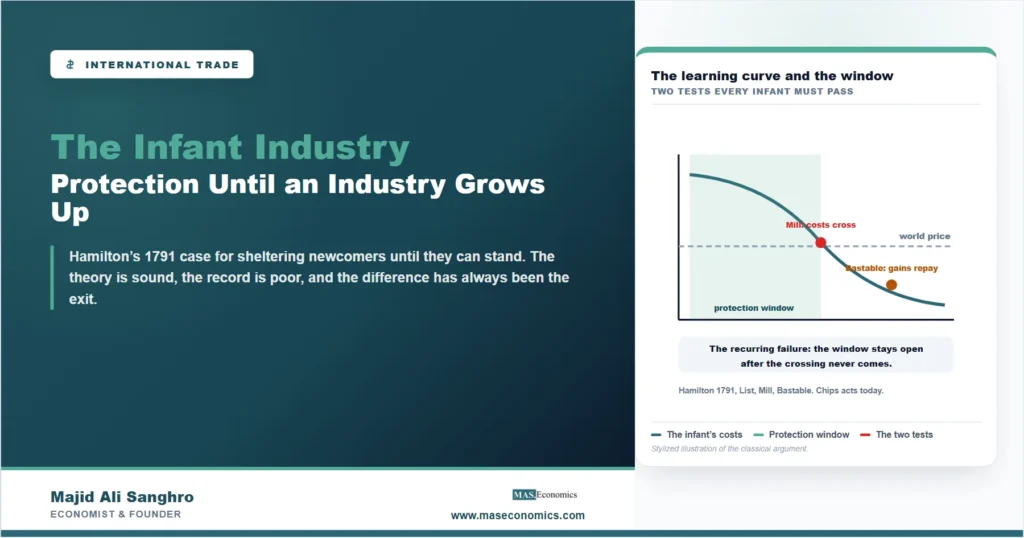
The argument begins from a real feature of industrial economics: costs fall with cumulative experience. A firm’s thousandth aircraft or millionth chip is cheaper than its first, because workers learn, processes are refined, and scale spreads fixed costs; the newcomer therefore starts at a cost disadvantage that has nothing to do with any permanent unsuitability, only with arriving late. Left to an open market, the argument runs, the infant is undersold and dies before the learning that would have justified its existence can occur; a temporary tariff or subsidy holds the foreign rival at bay while the infant descends its learning curve, after which the protection is removed and the country owns a competitive industry it otherwise never could have had. Framed this way, protection is not a rejection of comparative advantage but an investment in changing it.
Stated carefully, though, the argument needs more than falling costs. If the learning is profitable and the firm can capture it, a private investor should finance the loss-making childhood the way investors finance any startup, no government required. The honest case therefore requires a market failure: capital markets too shallow to fund a decade of losses, or learning that spills over to suppliers, workers, and rival firms so that no single company can capture enough of it to justify the investment. Where no such failure exists, the infant industry argument is just a request for other people’s money wearing a development theory.
The Two Tests an Infant Must Pass
Two nineteenth-century economists supplied the discipline the argument needs, and their names still label the tests. John Stuart Mill, who endorsed infant protection reluctantly, insisted the industry must eventually stand without it: if costs never fall below the world price, the country has simply bought a permanently expensive industry with its consumers’ money. Charles Bastable tightened the arithmetic: it is not enough for the industry to mature eventually, since the years of protection have costs, higher prices for every consumer and distorted investment, and the discounted value of the future gains must exceed them. Passing Mill’s test but failing Bastable’s is entirely possible: an industry that becomes competitive after forty sheltered years may never repay what its childhood cost. The modern literature adds the third test already implied above, that the learning must spill beyond the firm; together the three form a needle that genuinely deserving infants must thread, and the striking fact about the argument’s history is how rarely anyone measured any of them before building the wall.
A Nursery Full of Forty-Year-Olds
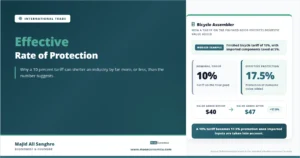
The argument’s dominant historical record is the import-substitution era, when much of Latin America and South Asia industrialized behind high walls from the 1950s onward. The strategy produced industries, but the infants did not grow up: shielded from competition, they had little reason to descend the learning curve at all, and the protection intended as scaffolding became the business model. The political economy did the rest. A tariff creates a constituency whose existence depends on its renewal, firms that lobby, unions that vote, and ministries that identify with their wards, so the temporary wall acquired permanent defenders while its costs stayed scattered across consumers who never saw the bill. Worse, the walls were higher than they looked: when inputs enter cheaply while outputs are protected, the effective shelter on the value a firm actually adds can be a multiple of the printed tariff, a trap dissected in our article on the effective rate of protection. Decades on, consumers in these economies were still paying multiples of world prices for cars and appliances made by industries as old as their grandparents and still officially infant, and by the 1980s the strategy’s exhaustion had discredited the argument almost entirely, alongside the broader toolkit surveyed in our overview of trade policies.
Almost, because the same decades produced the exception that keeps the argument alive. South Korea and Taiwan sheltered chosen industries as aggressively as anyone, yet their infants grew into world-class exporters. The difference was not the protection but the discipline attached to it: support was conditional on export performance, which forced the protected firms to face world-market competition on the selling side even while sheltered at home, and the state withdrew support from those that failed the test. Export discipline restored the feedback the tariff removes, letting governments distinguish learners from lobbyists, and it remains the sharpest single lesson the record offers: protection without an enforced performance test selects for political skill, not industrial learning.
The Argument’s Rich-Country Revival
The infant industry argument was born in developing-country economics, but its largest-ever application is happening now in the developed world. The semiconductor programs, electric vehicle supports, and green-technology packages of the 2020s are Hamilton’s logic at continental scale, justified in the same vocabulary of learning curves, strategic industries, and catching up, with security added as an accelerant; the sums involved dwarf anything the import-substitution era attempted, a turn examined in our article on the revival of industrial policy and, sector by sector, in the economics of the chip industry. The old tests apply with their old force, and the old failure modes are already visible: open-ended support, constituencies forming around it, and no stated conditions under which it ends. The narrower, more testable version of the idea also survives, in the bounded experiments of special economic zones, which shelter learning inside a fence the rest of the economy does not pay for. Whether the new nurseries produce Korean-style graduates or Latin American-style forty-year-olds will depend, as it always has, on whether anyone is willing to enforce the exit.
MASEconomics Explains
3 economic concepts behind the infant industry argument
These concepts are explored in depth across our educational articles library.
Explore the MASEconomics BlogConclusion
The infant industry argument is theoretically respectable, historically disappointing, and permanently popular, and all three properties flow from the same source: it defers the market test. The logic is real, since latecomers do face experience-based cost gaps that shelter can, in principle, bridge; the record is poor, since protection removes the very feedback that would reveal whether the bridge is being crossed, and the politics of a tariff guarantee defenders for it long after the crossing has failed. Mill’s test, Bastable’s arithmetic, and the spillover requirement were available from the beginning; the industries that never grew up are mostly industries nobody dared to measure.
The argument’s future is being written in the rich world’s industrial programs, on budgets the original infants never dreamed of. The one variable the record says will decide the outcome is the exit: East Asia’s graduates were produced by support that could be lost, and the world’s nurseries of forty-year-olds by support that could not. Protection until an industry grows up is a defensible policy exactly as long as someone in the government is willing to notice, and to act on, whether it is growing up at all.
Frequently Asked Questions
What is the infant industry argument in simple terms?
It is the claim that new industries in late-industrializing countries deserve temporary protection from imports while they learn and grow, because established foreign rivals enjoy cost advantages built on decades of experience. Once the sheltered industry matures and its costs fall, the protection is supposed to be removed.
Who invented the infant industry argument?
Alexander Hamilton made the first systematic case in his 1791 Report on Manufactures, and Friedrich List developed it for continental late-starters in the nineteenth century. John Stuart Mill gave it its most influential qualified endorsement, insisting protection be strictly temporary, and Charles Bastable added the requirement that eventual gains repay the cost.
Why does infant industry protection usually fail?
Because protection removes the competitive pressure that drives learning, and creates a political constituency for its own permanence. Sheltered firms profit without maturing, lobby to keep the wall, and consumers pay indefinitely. The import-substitution era produced many such industries, decades old and still uncompetitive at world prices.
Did the infant industry argument ever work?
The strongest cases are South Korea and Taiwan, which protected chosen industries but tied support to export performance, forcing sheltered firms to compete in world markets on the selling side and withdrawing help from failures. That export discipline preserved the feedback protection normally destroys, and several protected infants became world-class exporters.
Is modern industrial policy the same as the infant industry argument?
Largely yes, restated in the vocabulary of strategic sectors, learning curves, and supply-chain security, and applied at far larger scale by rich countries in chips, electric vehicles, and green technology. The classical tests still apply: whether the supported industries will ever stand unaided, whether the gains repay the cost, and whether anyone will enforce an exit.
Thanks for reading! The argument is sound, the record is poor, and the difference between them has always been the exit nobody enforces. Happy learning with MASEconomics