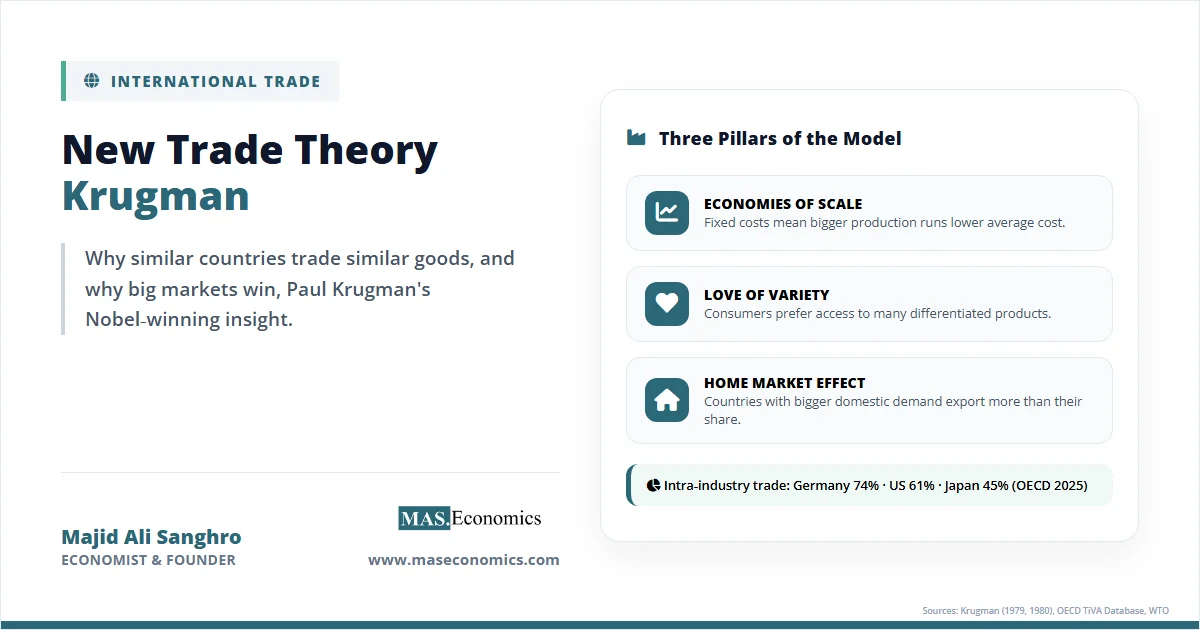
Germany exports BMWs and Mercedes to Japan. Japan exports Lexus and Infiniti to Germany. Neither country has a clear comparative advantage in automobiles; both are capital‑abundant, high‑wage economies with advanced manufacturing. Traditional trade theory predicts that countries with similar factor endowments should trade little. New Trade Theory Krugman resolves this apparent anomaly. Paul Krugman’s Nobel Prize‑winning work shows that when production exhibits increasing returns to scale, and consumers value variety, trade between similar countries becomes not only possible but inevitable, and large markets gain a built‑in advantage.
What New Trade Theory Krugman Explains
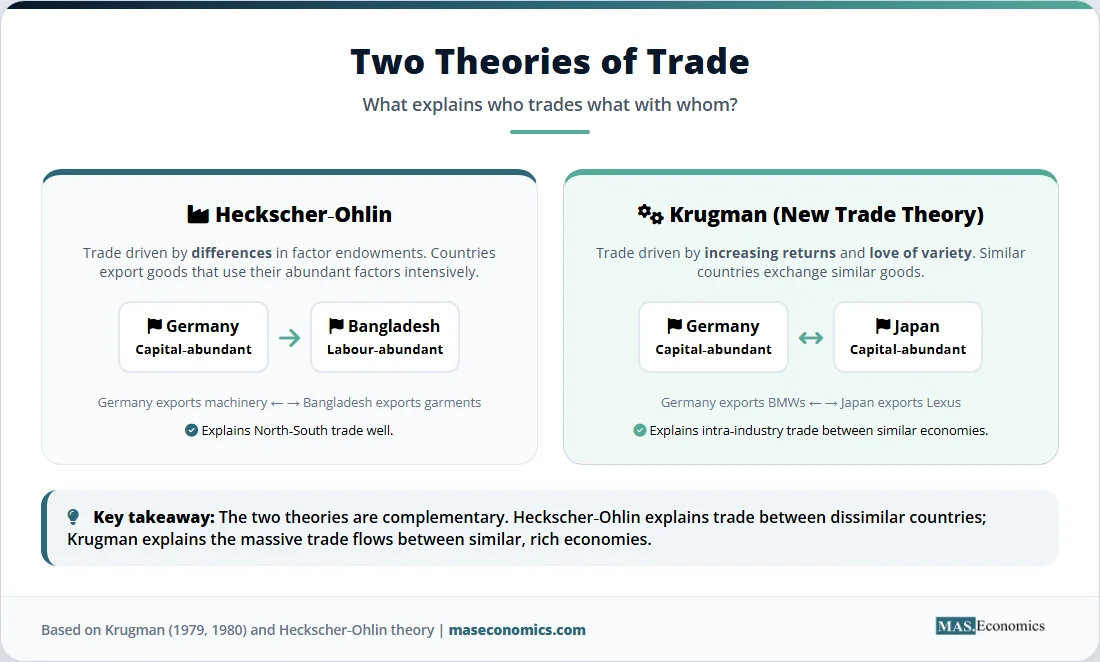
Before Krugman, the dominant explanations for international trade were comparative advantage (Ricardo) and factor proportions (Heckscher‑Ohlin). Both theories predict that trade flows should reflect differences: differences in technology or differences in resource endowments. A country with abundant capital exports capital‑intensive goods; a country with abundant labour exports labour‑intensive goods. The implication is that trade between dissimilar countries, say, Germany and Bangladesh, should dominate.
Reality refused to cooperate. After World War II, the fastest‑growing trade flows occurred between industrialised countries with similar factor endowments. The European Economic Community boomed on intra‑industry trade in manufactured goods. France and Germany, both skilled‑labour‑abundant, exchanged cars, chemicals, and machinery. The Grubel‑Lloyd index, a measure of intra‑industry trade, soared across advanced economies. Heckscher‑Ohlin could not account for this pattern. Some other force was at work.
Krugman identified that force in a pair of landmark papers published in 1979 and 1980. (Krugman, “Increasing Returns, Monopolistic Competition, and International Trade,” Journal of International Economics, 1979) If production is subject to economies of scale, unit costs fall as output rises, then countries cannot produce every variety of every good efficiently. Instead, they specialise in a limited range of varieties and trade to satisfy the demand for variety. Combined with consumers who like diversity, this gives rise to intra‑industry trade even between identical countries. A second insight, the home market effect, predicts that the country with the larger domestic market will export more than its share, turning size into a competitive advantage.
The Krugman Model in Equations
The Krugman model formalises these ideas using the Dixit‑Stiglitz framework of monopolistic competition. The economy contains a single industry with wide potential varieties. Consumers have a taste for variety, captured by a constant elasticity of substitution (CES) utility function.
Consumer side. A representative consumer derives utility from consuming quantities \( c_i \) of differentiated varieties \( i = 1,\dots,n \):
The parameter \( \theta \) governs the strength of the love of variety and is linked to the elasticity of substitution \( \sigma \) between any two varieties by \( \sigma = \frac{1}{1-\theta} > 1 \). Maximising utility subject to a budget constraint yields the demand for variety \( i \):
where \( p_i \) is the price of variety \( i \), \( I \) is total income, \( L \) is population, and \( P \equiv \left( \sum_{j=1}^{n} p_j^{1-\sigma} \right)^{1/(1-\sigma)} \) is the price index. Each firm faces a downward‑sloping demand curve with elasticity \( \sigma \).
Producer side. All firms share the same technology. Production of any variety requires a fixed cost \( F \) (in labour units) and a constant marginal cost \( c \) per unit. Labour is the only factor. The total labour required to produce \( q \) units of a variety is \( L = F + cq \). This cost structure embeds increasing returns to scale: average cost \( AC = \frac{F}{q} + c \) falls as output rises.
Profit maximisation under monopolistic competition sets marginal revenue equal to marginal cost, yielding the standard markup pricing rule:
where \( w \) is the wage rate. Free entry drives profits to zero, which determines the equilibrium output per firm:
The zero‑profit condition pins down the equilibrium number of varieties. With total labour supply \( L \), full employment requires \( n (F + c q^*) = L \). Substituting \( q^* \) and solving gives:
| Symbol | Definition |
|---|---|
| \( \theta \) | Taste‑for‑variety parameter (0 < θ < 1) |
| \( \sigma \) | Elasticity of substitution between varieties (\( \sigma > 1 \)) |
| \( c_i \) | Consumption of variety i |
| \( p_i \) | Price of variety i |
| \( P \) | Ideal price index |
| \( F \) | Fixed labour requirement |
| \( c \) | Marginal labour requirement |
| \( w \) | Wage rate |
| \( q^* \) | Zero‑profit output per firm |
| \( n \) | Equilibrium number of varieties |
| \( L \) | Total labour supply |

| |
The key result is that the number of varieties \( n \) rises with market size \( L \) and falls with the fixed cost \( F \) and the substitutability parameter \( \sigma \). Opening to trade acts like an expansion of \( L \), increasing the equilibrium number of varieties available to consumers in both countries. Gains from trade arise not from comparative advantage but from greater product variety and the realisation of economies of scale.
The home market effect emerges when trade costs are added. Firms locate production in the larger market because the larger market offers higher sales volumes that cover fixed costs. The large country runs a trade surplus in the increasing‑returns sector, exporting more than its pure share of world demand would suggest. (Krugman, “Scale Economies, Product Differentiation, and the Pattern of Trade,” American Economic Review, 1980)
Assumptions and Limits of the Model
The Krugman model rests on a set of simplifying assumptions that define its scope.
Single factor and industry. The basic model has one factor (labour) and one differentiated‑goods sector. This omits factor‑intensity differences that drive Heckscher‑Ohlin trade and general‑equilibrium interactions between sectors.
Symmetric firms. All firms have identical cost structures and produce a single variety. There is no firm heterogeneity, a limitation later addressed by Melitz (2003) in the firm‑heterogeneity model of trade.
CES preferences. The elasticity of substitution is constant across all varieties. This simplifies aggregation but rules out richer demand patterns, such as goods that are closer or farther substitutes depending on characteristics.
No trade costs in the simplest version. The pure variety‑gains model ignores transport costs, tariffs, and other barriers. Introducing trade costs reduces the number of exporting firms and can reverse the home market effect if costs are prohibitive.
Single sector only. Without a comparative‑advantage sector, the model cannot explain the large share of inter‑industry trade still observed between developed and developing countries. The full picture requires integrating Krugman‑type economies of scale with traditional factor‑proportions forces.
These limitations do not invalidate the theory. They define its domain. Where intra‑industry trade in manufactures dominates, New Trade Theory provides the superior lens. Where factor‑endowment differences are large, Heckscher‑Ohlin remains essential.
How Much Trade Is Intra‑Industry?
The Grubel‑Lloyd index measures intra‑industry trade for a given product category on a scale from 0 (purely inter‑industry) to 1 (purely intra‑industry). Across advanced economies, the index has trended upward for decades, particularly in manufactured goods.
Data from the OECD shows that intra‑industry trade accounts for a large share of total trade in major economies. Germany, with its deep specialisation in automotive and machinery production, records some of the highest intra‑industry trade shares. Japan, despite its manufacturing prowess, has a somewhat lower share because its trade pattern still includes a substantial inter‑industry component with Asian neighbours. The United States, the United Kingdom, and France cluster in the middle range, reflecting diversified trade structures. (OECD Intra‑Industry Trade Indicators, 2025)
Source: OECD TiVA Database, 2025; WTO World Trade Statistical Review 2024; author’s calculations. Intra-industry trade volumes estimated from total merchandise trade × intra-industry share. Shares may not sum to 100% due to rounding.
The pie chart shows the estimated share of intra‑industry trade in total manufactured goods trade for five large economies. Germany leads at 74 percent, followed by France and the United Kingdom. The United States sits at 61 percent, while Japan registers 45 percent. These figures align with the Krugman model’s prediction that industrialised, similarly endowed economies trade heavily within sectors. The variation across countries reflects differences in market structure, distance, and specialisation patterns.
Further evidence for the home market effect appears in industry‑level data. Countries with large domestic markets for a product tend to be net exporters of that product, even after controlling for factor endowments. (Davis and Weinstein, “Market Access, Economic Geography, and Comparative Advantage: An Empirical Test,” Journal of International Economics, 2003) The US exports in aircraft, pharmaceuticals, and the entertainment sectors, with high fixed costs and strong domestic demand. Germany’s trade surplus in luxury cars mirrors its enormous domestic and regional market.
Why the Krugman Model Shapes Policy
New Trade Theory reshaped how economists and policymakers think about trade liberalisation, industrial policy, and regional integration. Its implications extend far beyond the classroom.
European integration. The single market programme rested on the idea that removing barriers between similar, high‑income economies would generate large gains through increased scale and product variety. Krugman’s work provided the intellectual foundation. The explosion of intra‑EU trade in the 1990s and 2000s validated those predictions. French consumers gained access to German machinery varieties; German consumers gained access to Italian furniture varieties. The measured welfare gains from increased variety were substantial. (WTO World Trade Report, 2008)
North American trade. The US‑Canada Free Trade Agreement and NAFTA generated large increases in intra‑industry trade in automobiles, chemicals, and machinery. Canadian and American plants rationalised production across the border, achieving longer production runs and lower unit costs. The home market effect explained why more automotive investment flowed to the larger US market after trade barriers fell.
Industrial policy and strategic trade. Because scale economies can create first‑mover advantages and market concentration, the Krugman model opened the door to arguments for strategic trade policy. A government could, in principle, subsidise a domestic firm to capture a larger share of a global market with high fixed costs, raising national welfare at the expense of trading partners. Boeing versus Airbus is the classic case study. Krugman himself cautioned against overinterpreting this result, pointing out that the information requirements for successful intervention are forbidding and the risk of retaliation is high. Yet the theoretical possibility alone has informed decades of debate over industrial policy in advanced economies. (Krugman, “Is Free Trade Passé?” Journal of Economic Perspectives, 1987)
Regional clusters and agglomeration. The New Trade Theory led directly to the New Economic Geography. Krugman’s 1991 model showed how the interaction of increasing returns, transport costs, and labour mobility can produce a core‑periphery pattern: manufacturing concentrates in one region while the other de‑industrialises. This insight changed how economists think about urbanisation, regional inequality, and the spatial distribution of economic activity. Policy debates about place‑based investment, enterprise zones, and regional development draw heavily on these ideas.
Trade agreements and deep integration. If the gains from trade between similar countries come from variety and scale rather than comparative advantage, then trade agreements should focus on regulatory harmonisation, standards mutual recognition, and the removal of behind‑the‑border barriers that fragment markets. The shift from tariff reduction (GATT) to deep integration (WTO, EU, CPTPP) reflects this logic. Large markets gain disproportionate influence in setting standards, another manifestation of the home market effect. (World Bank, “World Development Report 2020: Trading for Development”)
The Krugman model also illuminates the distributional consequences of trade liberalisation between similar countries. Because all firms within an industry face the same factor intensities, the Stolper‑Samuelson mechanism does not operate. Instead, the gains from variety accrue broadly, while adjustment costs are concentrated among workers in the least productive firms that exit. This framework inspired an entire generation of trade researchers to incorporate firm heterogeneity.
For further reading on related trade theories, see the articles on the Heckscher‑Ohlin Model, the Ricardian Model of Trade, the Linder Hypothesis, and the measurement of intra‑industry trade. The related concept of the Stolper‑Samuelson theorem provides a contrasting lens on factor returns under free trade.
MASEconomics Explains
Four economic concepts behind New Trade Theory Krugman
Conclusion
New Trade Theory Krugman transformed the understanding of international trade by showing that increasing returns and product differentiation generate trade between similar countries, that consumers gain from access to a wider variety of goods, and that large markets attract disproportionate shares of mobile industries. It reconciled the post‑war surge in intra‑industry trade with rigorous microfoundations and spawned an entire family of models that now dominate trade research. While the theory does not replace comparative advantage, it adds an indispensable dimension: trade is not only about exploiting differences but also about harnessing scale and satisfying the human taste for variety. The policy debates over strategic trade, industrial clusters, and deep integration all trace their roots to Krugman’s elegant bridge between market structure and international exchange.
Did you find this article helpful? Share it with someone who loves economics. And remember, at MASEconomics, we make complex ideas simple.