A student finishes a degree and turns down a job offer paying 60,000 dollars a year to spend two years in a master’s program. The tuition is 40,000 dollars, and that figure is what most people would call the cost of the degree. But it is not the real cost. The two years of forgone salary, 120,000 dollars, never appear on any invoice, yet they are by far the larger sacrifice. The true price of the degree is the tuition plus the income given up to pursue it, and the second part is invisible precisely because no one writes a check for it. This gap between what something appears to cost and what it truly costs is the heart of opportunity cost, the value of the best alternative given up whenever a choice is made.
Opportunity cost is often called the most important idea in economics, and the claim is not an exaggeration. Almost every economic decision, by individuals, firms, and governments, comes down to a comparison between what is chosen and what is sacrificed to choose it. Because resources are scarce, choosing one use of them always means forgoing another. The concept reframes cost away from money actually spent and toward alternatives actually surrendered, and once that shift is made, a great deal of decision-making that looks irrational starts to make sense, while some that looks sensible turns out to ignore the costs that matter most.
Cost Is What You Give Up, Not What You Pay
The everyday meaning of cost is the money handed over for something. The economic meaning is broader and more demanding: the cost of any choice is the value of the most valuable alternative that the choice rules out. Money is often part of this, because money spent on one thing cannot be spent on another, but money is only a stand-in for the real sacrifice, which is the foregone alternative itself.
Consider an evening with three options: working an extra shift for 80 dollars, studying for an exam, or seeing friends. Whichever is chosen, the opportunity cost is the single best of the two options given up, not the sum of both. If the shift is chosen, the cost is the more valuable of studying or socializing, whichever that person would have preferred. Opportunity cost is always measured against the next-best alternative, the one that would have been chosen had the actual choice not been available. This is why it is sometimes phrased as the cost of the road not taken, with the emphasis on a single road rather than all of them at once.
This way of thinking is one of the foundations laid out in any introduction to economics, where scarcity is the starting premise. Because no one can have everything, every choice involves giving something up, and the discipline of economics is in large part the study of how people, firms, and societies make those trade-offs.
Explicit and Implicit Costs
Opportunity cost has two components, and missing the second is the most common error in everyday reasoning. Explicit costs are the direct money payments a choice requires, the tuition, the rent, the wages paid to employees. Implicit costs are the values of resources already owned that are used up by the choice, which carry no money payment but still represent something given up. The forgone salary of the returning student is an implicit cost. So is the rent a shop owner could have earned by leasing out a building they instead use for their own business.
| Item | Type of cost | Why it counts |
|---|---|---|
| Rent paid on a leased shop | Explicit | Direct money payment to a landlord |
| Wages paid to staff | Explicit | Direct money payment for labour |
| Salary the owner gave up to run the business | Implicit | Income forgone by not working elsewhere |
| Interest forgone on savings invested in the firm | Implicit | Return the money could have earned elsewhere |
| Total economic cost | Explicit + implicit | The full opportunity cost of the venture |
|
Source: MASEconomics editorial synthesis.

|
||
The distinction matters because it changes how profit is judged. An accountant measures profit as revenue minus explicit costs, which can show a healthy positive number. An economist measures profit as revenue minus both explicit and implicit costs, which is a harder test. A business that earns 50,000 dollars in accounting profit but required the owner to give up a 70,000-dollar salary is running at an economic loss of 20,000 dollars, because the owner would have been better off working elsewhere. Economic profit asks not merely whether a venture makes money, but whether it makes more than the best alternative use of the same resources. This is the question that opportunity cost forces into the open.
Note. Economic profit is almost always lower than accounting profit, because it subtracts implicit costs that accounting ignores. A positive accounting profit paired with a negative economic profit means the resources would earn more in their next-best use, even though the business is not losing money in the bookkeeping sense.
Sunk Costs Are Not Opportunity Costs
A crucial companion idea is that not every expense belongs in a decision. A sunk cost is money already spent that cannot be recovered, and because it cannot be changed by any future choice, it should not influence that choice. Opportunity cost looks forward to alternatives still available; sunk cost looks backward to money already gone. Confusing the two leads to the familiar trap of throwing good money after bad.
Suppose a firm has spent 1 million dollars developing a product and discovers it would cost another 500,000 dollars to finish, but the finished product would sell for only 400,000 dollars. The 1 million already spent is sunk and irrelevant to the decision now. The only relevant comparison is the 500,000 dollars still required against the 400,000 dollars the product would earn. On those terms, finishing the product destroys value, and the correct decision is to stop, however painful it feels to write off the original investment. The opportunity cost of spending the final 500,000 dollars is whatever else that money could do, and almost anything beats a guaranteed 100,000-dollar loss.
Caveat. The instinct to continue a project because of what has already been invested is the sunk cost fallacy. Past spending is not an opportunity cost, because it is the same whether the project continues or stops. Only costs and benefits that change with the decision should enter it.
The Production Possibilities Frontier
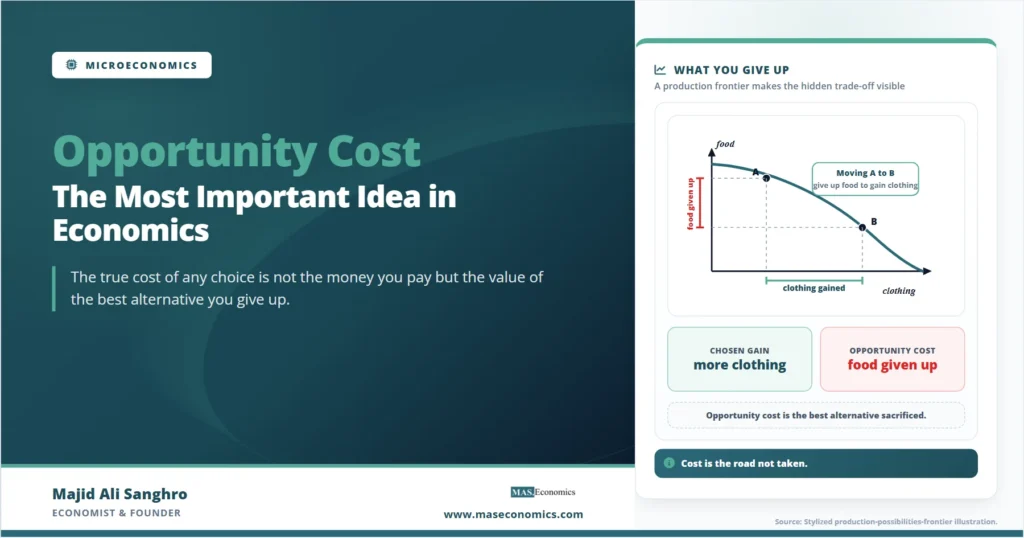
Opportunity cost becomes visible the moment a choice is drawn as a trade-off between two goods. The standard tool for this is the production possibilities frontier, a curve showing every combination of two goods an economy can produce when its resources are fully used. To produce more of one good, the economy must move along the frontier, and moving along it means producing less of the other. That reduction is the opportunity cost, read directly off the curve as the amount of one good sacrificed to gain more of the other.
The frontier bows outward rather than running as a straight line, and the shape carries economic meaning. A straight frontier would mean opportunity cost is constant, that each extra unit of clothing always costs the same amount of food. The outward bow reflects increasing opportunity cost: as an economy specializes more heavily in clothing, it must pull resources that were better suited to food, so each additional unit of clothing costs progressively more food than the last. Resources are not equally productive in every use, and the rising slope of the frontier is the visible trace of that fact.
Opportunity Cost and Comparative Advantage
The single most powerful application of opportunity cost is in explaining why trade and specialization make everyone better off. The principle of comparative advantage holds that a person or country should specialize in producing whatever it can make at the lowest opportunity cost, even if it is not the most efficient producer of anything in absolute terms. The logic runs entirely through opportunity cost: what matters is not who can produce more, but who gives up less of other things to produce a given good.
A classic illustration involves two people who can both produce two goods. Suppose one is faster at producing both, holding an absolute advantage in each. It might seem that this person should do everything, but that ignores opportunity cost. The time the faster producer spends on the good they are only slightly better at is time taken away from the good they are far better at. By specializing where their opportunity cost is lowest and trading for the rest, both people end up with more than they could produce alone. The distinction between being better in absolute terms and being better in opportunity-cost terms is exactly the line that separates absolute advantage from comparative advantage, and it is opportunity cost that does the work.
| Producer | Bread per hour | Cloth per hour | Opportunity cost of 1 bread |
|---|---|---|---|
| Anna | 6 | 3 | 0.5 cloth |
| Ben | 2 | 4 | 2.0 cloth |
| Lower opportunity cost in bread | Anna | — | Anna specializes in bread |
|
Source: Stylized example based on standard formulas. Numbers chosen for illustration.
|
|||
Anna produces more of both goods, so she holds an absolute advantage in each. But the opportunity cost tells a different story. For Anna, making one loaf of bread means giving up half a unit of cloth, since in the time it takes to make a loaf she could have made half a unit of cloth. For Ben, making one loaf costs two units of cloth. Anna’s opportunity cost of bread is far lower, so she should specialize in bread, while Ben, whose opportunity cost of cloth is comparatively lower, should specialize in cloth. Each does what they sacrifice least to do, and trade leaves both with more than self-sufficiency would. The remarkable conclusion is that even the less productive party has something worth specializing in, because comparative advantage is about relative sacrifice, not absolute skill.
Opportunity Cost in Everyday Decisions
The discipline of asking “what am I giving up” extends well beyond formal economics. Time is the clearest case, because it cannot be stored or recovered. An hour spent on one activity is an hour unavailable for every other, so the opportunity cost of any use of time is the most valuable thing that hour could otherwise have done. This is why a highly paid professional might rationally pay someone else to do household tasks they could easily do themselves: the opportunity cost of their own time is high enough that doing the task personally means giving up more valuable work.
Governments face the same logic at a larger scale. A budget spent on one program is unavailable for another, so the opportunity cost of public spending is the next-best use of those funds. A decision to build a highway is also a decision not to build the schools or hospitals the same money would have funded. Recognizing opportunity cost does not by itself say which choice is right, but it insists that the comparison be made honestly, against real alternatives rather than against doing nothing. The same forward-looking comparison underlies the broader study of how people weigh options under constraints, explored in the treatment of satisficing and optimizing, where the central question is always what is gained against what is given up.
Where Opportunity Cost Sits in Economics
Opportunity cost is foundational because it underlies almost every other idea in the subject. Production costs, properly measured, are opportunity costs, which is why the economist’s notion of cost in the analysis of costs of production includes the implicit return on resources a firm already owns. Efficiency, in the sense studied in welfare economics and Pareto efficiency, is fundamentally about whether resources are being used where their opportunity cost is justified by their value. Even the simplifications economists make, examined in the discussion of assumptions in economics, are chosen with an eye to the trade-off between realism and tractability, which is itself an opportunity cost.
Seen this way, opportunity cost is less a single topic than a lens that runs through the whole subject. It turns the question “what does this cost” into the more useful question “what must be given up for this,” and that reframing is what allows economics to compare options that have no common price tag. Wherever resources are scarce and choices must be made, opportunity cost is the quiet logic underneath the decision.
Explains
Three ideas that make opportunity cost click
Build your economics foundations one core idea at a time.
Explore the MASEconomics BlogConclusion
The idea of opportunity cost rests on a simple but transformative shift: the cost of any choice is not the money it requires but the value of the best alternative it forecloses. That single move turns invisible sacrifices into visible costs, the forgone salary of the returning student, the lost rent of the owner-occupied shop, the schools not built when a highway is. It separates the costs that should guide a decision, the forward-looking alternatives still available, from those that should not, the sunk costs already spent and beyond recovery.
Because resources are scarce, every choice is a trade-off, and opportunity cost is the measure of that trade-off. It is what the production possibilities frontier displays as the slope between two goods, what comparative advantage uses to show that even the less productive party has something worth specializing in, and what economic profit captures by subtracting the implicit costs that bookkeeping leaves out. The concept does not make decisions easy, but it makes them honest, by insisting that the real question is never simply what something costs, but what must be given up to have it.
Frequently Asked Questions
What is opportunity cost in simple terms?
Opportunity cost is the value of the best alternative you give up when you make a choice. Because resources like money, time, and effort are limited, using them for one thing means not using them for something else. The opportunity cost is whatever that next-best option was worth. If you spend an evening working instead of studying, the opportunity cost is the value of the study time you sacrificed.
What is the difference between explicit and implicit costs?
Explicit costs are direct money payments, such as rent, wages, or tuition. Implicit costs are the values of resources you already own that a choice uses up, such as the salary you give up to start a business or the interest you forgo by investing your savings in it. Opportunity cost includes both. Accounting profit subtracts only explicit costs, while economic profit subtracts explicit and implicit costs together.
Is a sunk cost an opportunity cost?
No. A sunk cost is money already spent that cannot be recovered, so it is the same whether you continue or stop, and it should not affect future decisions. Opportunity cost looks forward to alternatives still available. Treating sunk costs as if they mattered to a current choice is the sunk cost fallacy, the mistake of continuing a losing project just because money has already been poured into it.
How does opportunity cost relate to comparative advantage?
Comparative advantage means producing whatever you can make at the lowest opportunity cost, even if you are not the most efficient producer in absolute terms. The whole principle runs through opportunity cost: a person or country should specialize where they give up the least of other goods to produce a given good, then trade for the rest. This is why even a less productive party still has something worth specializing in.
Why is opportunity cost considered so important in economics?
Because nearly every economic decision is a trade-off, and opportunity cost is how that trade-off is measured. It underlies the economist’s definition of cost, the meaning of economic profit, the shape of the production possibilities frontier, the logic of comparative advantage, and the evaluation of public spending. By reframing cost as what must be given up rather than what is paid, it lets economics compare options that have no common price.
Thanks for reading! If you found this helpful, share it with friends and spread the knowledge. Happy learning with MASEconomics