The American Economic Association launched its RCT Registry in 2013 with a quiet expectation that economists would adopt it within a decade. By the end of 2024, the registry held more than 9,000 trials from 153 countries, and the top development economics journals had made pre-registration effectively mandatory for any paper based on a randomised intervention. Pre-registration economics has moved from a niche reform proposal into the default operating standard for credible empirical work, alongside replication packages and public code.
The shift is consequential. A 2020 audit by the Berkeley Initiative for Transparency in the Social Sciences found that effect sizes reported in pre-registered economics studies were on average 30 to 40 percent smaller than those in matched non-registered studies. The reduction is not because pre-registration makes interventions less effective. It is because pre-registration disciplines what counts as a finding, and that discipline closes off the silent flexibility researchers used to enjoy when deciding which result to report. The reform sits inside the broader transformation of the economic research process over the past decade.
Tying Your Hands Before You See the Data
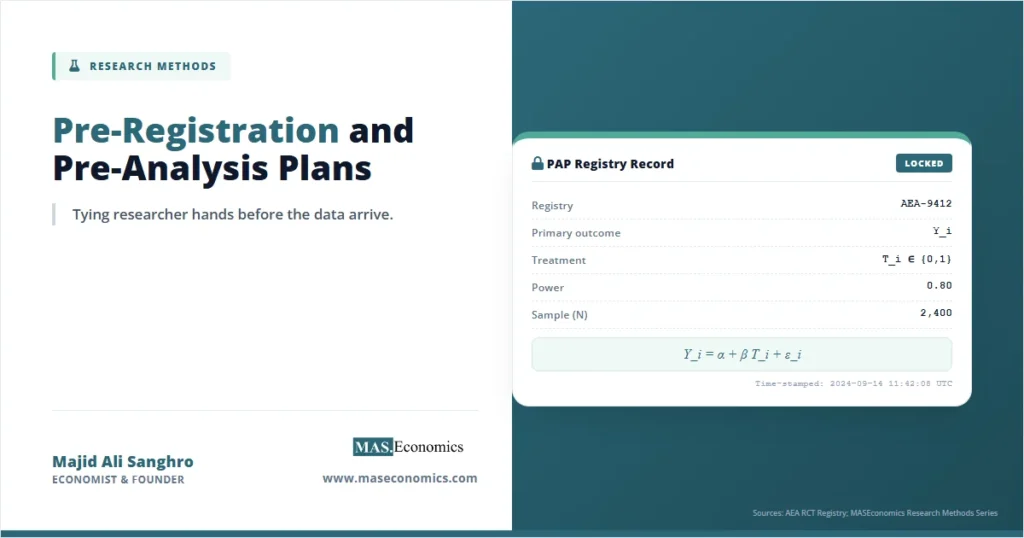
A pre-registration is a time-stamped, publicly accessible record of a research design, submitted to an independent registry before the researcher accesses the outcome data. A pre-analysis plan (PAP) is the longer companion document that specifies the exact hypotheses, sample, variable definitions, estimation equations, subgroup analyses, and robustness checks the researcher will run. The shortest pre-registrations cover a single primary hypothesis. The longest PAPs run to forty or fifty pages and read like an econometric appendix written before the data exist.
The economic logic is straightforward. Empirical research generates many decisions: which observations to drop, which control variables to include, how to define a treatment, how to specify the dependent and independent variables, which functional form to fit, and which subgroups to examine. Each decision is defensible in isolation. Taken together, they produce a researcher’s degrees-of-freedom problem documented by Simmons, Nelson, and Simonsohn (2011): even with no real effect, a researcher with five binary decisions to make can find a statistically significant result in over 60 percent of attempts simply by exploring the option space. Pre-registration removes that flexibility by fixing the decisions before the data arrives.
The terminology divides cleanly into three tiers. A standard pre-registration records the hypothesis, sample, and primary outcomes but allows discretion on the analysis. A pre-analysis plan specifies the full estimation strategy, including secondary outcomes and heterogeneity analyses. A registered report goes furthest: the journal accepts the study based on the protocol, before any data is collected, and commits to publishing the results regardless of whether they confirm the hypothesis. The three tiers solve progressively larger problems, and all three sit alongside the broader open-science agenda discussed in our piece on the replication crisis in economics.
From the AEA Registry to the OSF Workflow
The mechanics of pre-registration involve a sequence of steps that map closely to the structure of an empirical paper. Different platforms enforce different levels of strictness, but the workflow is broadly common across registries.
Step 1: Develop the hypothesis. The researcher writes the primary research question and the falsifiable hypothesis it implies. This stage benefits from the discipline described in our guide on formulating economic hypotheses: a hypothesis that cannot be rejected by any conceivable data is not testable and cannot be pre-registered. The pre-registration form will require the hypothesis in a single sentence and ask whether it is directional (a one-sided test) or non-directional (a two-sided test). The connection to classical hypothesis testing is direct: the pre-registration locks in the null, the alternative, and the rejection rule before any data is touched.
Step 2: Conduct the power analysis. Before submitting the registration, the researcher computes the minimum detectable effect size given the planned sample. Power analysis is non-optional in modern registries. The AEA RCT Registry asks for the assumed effect size, intra-cluster correlation, and target statistical power. A study designed with 50 percent power has a one-in-two chance of producing a non-significant result even if the hypothesised effect is real, which is why the discipline conventionally requires a power of 0.80 or higher.
Step 3: Draft the pre-analysis plan. The PAP specifies the regression equation, the primary outcome variable, the treatment definition, the comparison group, the standard error structure (cluster-robust, conventional, randomisation inference), and the rule for handling missing observations. The choice between cross-sectional, panel, and repeated cross-section designs has to be declared here, building on the framework laid out in our guide to cross-sectional versus longitudinal designs. Secondary outcomes and pre-specified subgroup analyses are listed separately. Anything not in the PAP is treated as exploratory in the final paper.
Step 4: Submit to the registry. The researcher uploads the PAP to one of the major registries. Submission is free. The registry generates a time-stamped record. On the AEA registry, the submission is reviewed for completeness within five business days and then assigned a permanent registry number that travels with the paper through publication.
Step 5: Freeze and embargo. Once accepted, the submission is locked. Many registries allow an embargo period during which the protocol is private; after that, it becomes publicly accessible. The OSF allows embargoes up to four years for studies that require commercial confidentiality, after which the plan becomes mandatory public.
Step 6: Collect data. Data collection proceeds against the locked protocol. The data-gathering stage itself follows the discipline of any rigorous empirical project, and the deeper guide on gathering reliable economic data applies in full. Any deviations (a smaller sample than planned, a survey question that had to be re-worded, a treatment arm that could not be implemented) are recorded in a deviations log that will accompany the final paper. The ethical questions surrounding informed consent, vulnerable populations, and data handling are discussed in our piece on common challenges and ethical issues in economic research.
Step 7: Run the analysis exactly as specified. The researcher executes the regressions in the PAP. The output of these regressions is the confirmatory analysis. Additional analyses are permitted but must be flagged as exploratory and reported separately, so that readers can distinguish a pre-specified test from a post-hoc one.
Step 8: Publish with the deviation log. The final paper cites the registry entry, reports the confirmatory results first, then exploratory analyses, then a deviations table that lists everything the researcher changed and why. Journals following the AEA Data and Code Availability Policy require both the registry citation and a public replication package before final acceptance.
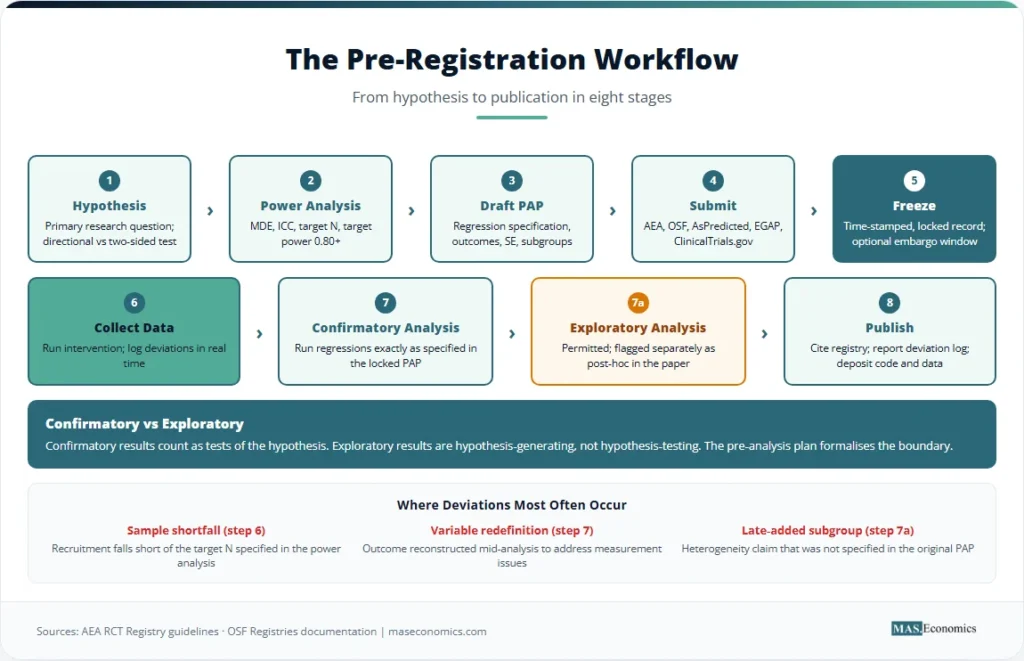
The colour coding inside the workflow matters. Steps that lock the protocol are non-negotiable at every registry. Steps after data collection are split into two parallel tracks, with confirmatory analysis on one side and exploratory analysis on the other. The most common failure point is the boundary between the two: researchers who run a pre-specified analysis, find a null result, and then quietly slide into exploratory subgroup work without flagging it. The deviations log is the audit trail that distinguishes legitimate exploration from undisclosed specification searching.
The AEA RCT Registry is not the only registry economists use. Lab and survey experiments often register on AsPredicted, observational designs on OSF, and political-science field experiments on EGAP. The choice of registry signals the type of study and the depth of the protocol, not the seriousness of the research.
Five Registries Economists Use
Economists do not pre-register on a single platform. The choice of registry signals the type of study and the strictness of the protocol. The table below catalogues the five registries that account for the overwhelming majority of pre-registered work in economics and adjacent disciplines, along with their founding date, scope, current coverage, and the practitioner communities that treat them as the standard.
| Platform | Founded | Scope | Coverage (2024) | Practitioner Adoption |
|---|---|---|---|---|
| AEA RCT Registry | 2013 | Randomised controlled trials in economics and adjacent social sciences | 9,000+ trials, 153 countries | Standard for J-PAL, IPA, and AEA journal submissions involving RCTs |
| OSF Registries | 2013 | All disciplines; observational and experimental designs; supports embargoes | 120,000+ registrations across fields | Most flexible; widely used in behavioural economics and political economy |
| AsPredicted | 2015 | Lightweight pre-registration for lab and survey experiments | 80,000+ registrations | Dominant in experimental psychology and behavioural economics |
| EGAP Registry | 2014 | Field experiments in political economy and governance | 2,100+ designs | Standard for development field experiments outside the AEA scope |
| ClinicalTrials.gov | 2000 | Clinical and health-economics interventions | 490,000+ studies | Mandatory for FDA-regulated work; used in health and welfare economics |
 | ||||
The five platforms are not interchangeable. The AEA registry imposes the strictest pre-collection requirements for randomised trials, including mandatory power analysis and IRB documentation. As predicted, by contrast, it is intentionally lightweight: nine short questions completed in under thirty minutes. OSF sits in the middle and accommodates the broadest range of designs, including observational studies that the AEA registry will not accept. The platform choice often follows from the type of research being conducted: experimental, quasi-experimental, observational, or mixed-method studies, each match different registry conventions. The growth rates also differ. ClinicalTrials.gov has grown faster than the others over the last decade because the FDA Amendments Act of 2007 made registration legally mandatory for most US-regulated drug and device trials. The AEA registry has grown through professional norm change rather than legal mandate, which is a slower but more durable path.
What the Adoption Curve Tells Us
The growth of pre-registration in economics is the clearest evidence that the discipline has internalised the lessons of the replication crisis. The number of new annual registrations at the AEA RCT Registry rose from 35 in its first full year (2014) to more than 1,400 in 2024, a forty-fold increase. The take-up curve is steepest among researchers affiliated with J-PAL, IPA, and the Center for Effective Global Action, all of whom now require registration as a condition of network membership. The pattern mirrors the broader shift toward credible empirical work captured in our piece on RCT, DiD, and synthetic control methods in policy evaluation.
Three real-world examples show how pre-registration changes what gets reported:
The Progresa-Oportunidades evaluation in Mexico was retroactively analysed by Parker and Vogl (2018) using a pre-specified analysis plan deposited at the AEA registry before the long-run outcome data were unblinded. The PAP listed primary outcomes (schooling, labour-market attainment) and secondary outcomes (migration, fertility). Of the six primary outcomes, four moved as predicted, two did not. The paper reported all six, with the two nulls flagged. Without the PAP, the conventional incentive would have been to lead with the four positive results and bury the nulls in an appendix.
The Microcredit Six-Country Replication coordinated by Banerjee, Karlan, and Zinman (2015) required all six teams to pre-register a common analysis plan. The pooled finding was that microcredit increased business creation modestly but had no measurable effect on average household income. Before pre-registration, the conventional pattern would have been six separate papers each highlighting whichever outcome happened to move in that particular country. The pre-registered common plan made the cross-country null robust and impossible to spin. The synthesis exercise is exactly the kind of project our guide on meta-analysis in economics treats in detail.
The Many Analysts, One Dataset exercise organised by Huntington-Klein et al. (2022) gave the same research question and the same dataset to over 70 independent research teams, with no pre-registration. The teams reported point estimates ranging from −0.05 to +0.27 on the same causal question, with confidence intervals that frequently failed to overlap. The exercise has become the standard demonstration of why analytical decisions matter and why pre-registering them in advance is the only way to bound the inferential range. The point reinforces the discipline’s broader commitment to credible causal inference, where identification strategy and analytical commitment are inseparable.
A fourth and increasingly common pattern is the registered report. The Quarterly Journal of Economics, the Journal of Development Economics, and the AEA: Insights now accept registered reports in which the journal commits to publication based on the protocol, before any data is collected. The acceptance decision is made in two stages: the design is reviewed and provisionally accepted, then the analysis is run, and the paper is published regardless of the result. This format eliminates publication bias by construction.
What Pre-Registration Cannot Solve
The empirical record on pre-registration is encouraging but bounded. The reform addresses one specific failure mode: undisclosed researcher flexibility in confirmatory analysis. It does not address several others.
It does not solve the file-drawer problem. A pre-registered null result that the researcher chooses not to write up disappears just as completely as a non-registered null. The registry record persists, but if no paper is submitted, the result remains effectively invisible to meta-analyses. The literature on publication bias in economics, building on DeLong and Lang (1992) and more recently Andrews and Kasy (2019), finds that the file-drawer effect remains large even in fields with high pre-registration uptake.
It does not eliminate p-hacking. Researchers can still pre-register for so many primary outcomes that one will reach conventional significance by chance alone (the multiple-comparisons problem). They can pre-register vague specifications that leave room for flexibility at the analysis stage. They can register late, after looking at preliminary data, and present the registration as if it had been pre-registered. The AEA registry now flags late registrations explicitly, but post-hoc registration is widely available on lighter-touch platforms.
It does not address external validity. A pre-registered RCT of a workfare programme in rural Bihar produces a credible estimate of the effect in that specific population at that specific time. The protocol does not, and cannot, register a hypothesis about whether the same effect would appear in São Paulo or Manila. Generalisation requires replication in new contexts, and quasi-experimental work using natural experiments often plays the complementary role of testing whether RCT findings travel.
It does not eliminate data fraud. A researcher who fabricates or selectively deletes observations can submit a pre-analysis plan and run the registered regression on doctored data. Pre-registration disciplines the analysis pipeline; it does not audit the data pipeline. The Data Colada investigations into high-profile fraud cases in behavioural economics in 2023 made this point in unusually public form.
The reform also imposes a cost. Drafting a thorough PAP for a complex RCT can take several weeks of researcher time. The opportunity cost falls disproportionately on early-career researchers and those without large grant-funded teams. Hardwicke and Wagenmakers (2023) argue that the fixed-cost burden of pre-registration creates a structural asymmetry: senior researchers with administrative support pre-register easily, while solo researchers and graduate students face a higher relative cost. The argument is not against pre-registration, but for institutional infrastructure that lowers the fixed cost.
A pre-registration is a commitment device, not a quality guarantee. A confirmatory analysis on a well-pre-registered study with a small sample and weak identification is still a small, weakly identified study. Pre-registration cannot rescue a flawed design; it can only make the flaws transparent.
MASEconomics Explains
Four economic concepts behind pre-registration in empirical research
These concepts are explored in depth across our educational articles library.
Explore the MASEconomics BlogConclusion
Pre-registration economics has reshaped how empirical findings in the discipline are produced, evaluated, and trusted. The AEA RCT Registry now holds more than 9,000 trials, registered reports are accepted at leading journals, and pre-analysis plans are a default requirement for development field experiments funded through J-PAL, IPA, and CEGA. The reform addresses a specific and well-documented failure mode of empirical research: the silent flexibility researchers exercise when deciding which result to report from a many-decision analysis pipeline. By fixing the decisions before the data arrive, pre-registration converts a discretionary process into a transparent one and produces effect-size estimates that are on average 30 to 40 percent smaller than their non-registered counterparts.
The reform is not a complete fix. It does not eliminate the file-drawer problem, does not stop sophisticated forms of specification search, does not improve external validity, and does not audit the underlying data. It imposes a real fixed cost that falls hardest on early-career and resource-constrained researchers. The natural complements are rigorous power analysis, public replication packages, registered reports, and the open-science workflow taking shape through the AEA Data Editor. Used together with the discipline of the scientific method in economics and the synthesis tradition documented in systematic literature reviews, these reforms move the credibility of economics research closer to the standards already enforced in clinical trials, where pre-registration has been mandatory for almost two decades.
Frequently Asked Questions
Is pre-registration mandatory for publishing in top economics journals?
Pre-registration is not formally mandatory at most general-interest journals, but it is effectively required for randomised controlled trials submitted to the American Economic Review, the Journal of Development Economics, AEJ: Applied Economics, and the Review of Economic Studies. Field-experiment papers without a registry citation are routinely desk-rejected at these journals. For observational and theoretical work, pre-registration remains optional but is increasingly used as a signal of credibility.
What is the difference between pre-registration and a pre-analysis plan?
Pre-registration is the broader term: it refers to any time-stamped record of a study design submitted before data collection. A pre-analysis plan is a specific, detailed document that fixes the regression equation, primary and secondary outcomes, variable definitions, and standard error structure. A pre-registration can be as short as a single page; a pre-analysis plan can run to dozens of pages. Top journals increasingly require the full pre-analysis plan rather than the short pre-registration.
Can you change a pre-registration after submitting it?
Once submitted to the AEA RCT Registry or OSF, the original protocol is permanently time-stamped and cannot be deleted or quietly edited. Researchers can submit amendments, but the original version remains visible alongside the amended version. Any deviation between the registered plan and the final paper must be reported in a deviations log accompanying the publication. The point of the registry is precisely that the locked record persists.
Does pre-registration prevent p-hacking?
Pre-registration reduces but does not eliminate p-hacking. A locked pre-analysis plan removes researcher flexibility in confirmatory analysis, which closes off the simplest forms of specification searching. However, researchers can still register vague specifications, register multiple outcomes that increase the chance one will reach significance, or run exploratory analyses post-data and present them as confirmatory. The reform reduces the easiest p-hacking; subtler forms persist and require additional checks such as multiple-testing corrections and replication.
Which registry should I use for an economics study?
The choice depends on the study type. Randomised controlled trials in economics typically use the AEA RCT Registry, which is the standard for J-PAL, IPA, and most development field experiments. Lab and survey experiments often use AsPredicted for its lightweight nine-question format. Observational designs and broader social science studies use OSF Registries. Political economy field experiments use the EGAP Registry. Health and welfare interventions that touch FDA-regulated outcomes use ClinicalTrials.gov.
Thanks for reading! If you found this helpful, share it with friends and spread the knowledge. Happy learning with MASEconomics