In 1965, Reinhard Selten published a paper in the Zeitschrift für die gesamte Staatswissenschaft introducing a refinement of Nash equilibrium for sequential games. The Nobel Committee cited that paper as a primary reason for awarding him the 1994 prize, jointly with Nash and Harsanyi. The refinement is called Subgame Perfect Equilibrium.
Subgame Perfect Equilibrium is the solution concept that requires Nash optimality not only along the equilibrium path but in every subgame, including those reached only off‑path. The refinement eliminates equilibria sustained by non‑credible threats, which are strategies optimal because they are never tested. The concept is defined formally using extensive‑form games, backward induction, and the Dixit entry‑deterrence example; tested in the laboratory via centipede and ultimatum games; and applied in competition policy, bargaining, and mechanism design.
What Subgame Perfect Equilibrium Means
John Nash defined his equilibrium in 1950 as a profile of strategies where no player has a unilateral incentive to deviate. For simultaneous-move games, this definition is sufficient. For sequential games, where players move in a specified order and observe previous actions, the Nash concept permits irrational behaviour off the equilibrium path. A player can threaten an action that would harm themselves, and if the threat deters the opponent, the threat is never carried out. The outcome is a Nash equilibrium because no one deviates given the other’s strategy, but the threat is hollow.
Selten’s 1965 insight was that a satisfactory solution concept for sequential games must pass a credibility test. Every contingency must be optimal, not just the one that occurs. If a player claims they will fight an entrant, that claim must be rational to execute once the entry has occurred. If fighting yields a loss while accommodating yields a profit, the threat to fight is not credible. A rational opponent will see through it and enter.
The requirement that strategies form a Nash equilibrium in every subgame is the formal expression of this credibility condition. A subgame is a portion of the original game that can be treated as a standalone game, starting from a single decision node and including all its successors. Subgame Perfect Equilibrium rules out any strategy profile where a player’s strategy prescribes a non-credible action in some subgame. This refinement transformed industrial organisation, where firms make sequential decisions about entry, capacity, and pricing. It also rebuilt bargaining theory, where parties exchange offers over time, and contract theory, where principals and agents move in sequence. In every case, the analyst must verify that future actions are optimal given future circumstances, a verification that the Nash equilibrium concept alone does not require.
Subgame Perfect Equilibrium in Equations
The formal apparatus begins with the extensive-form representation of a game. A finite extensive-form game is a tuple \( \Gamma = (N, T, P, U, A, \mathcal{H}, u) \). Here, \( N \) is the finite set of players. \( T \) is a game tree of decision nodes. \( P \) is the player function, specifying which player moves at each non-terminal node. \( A \) is the set of actions available at each node. \( \mathcal{H} \) is the partition of decision nodes into information sets, representing what the player knows when moving. \( u: Z \to \mathbb{R}^N \) maps terminal nodes \( Z \) to payoff vectors.
A subgame of \( \Gamma \) starting at node \( x \) is the restriction of \( \Gamma \) to the descendants of \( x \), provided \( x \) and all its descendants form a singleton information set or are entirely contained within information sets of \( x \)’s successor tree. A subgame is a self-contained game within the larger game.
A strategy \( s_i \) for player \( i \) is a complete plan of action. It specifies a move at every information set where \( i \) might be called to play, even those that previous moves by \( i \) would rule out reaching. A strategy profile \( s = (s_1, \dots, s_n) \) induces a unique path of play from the root to a terminal node.
A Nash equilibrium is a strategy profile \( s^* \) where no player gains from unilateral deviation.
A Subgame Perfect Equilibrium is a strategy profile \( s^* \) whose restriction to every subgame of \( \Gamma \) constitutes a Nash equilibrium of that subgame. Formally, for every subgame \( \Gamma’ \) and every player \( i \):
This condition ensures sequential rationality. At every point in the game, the remaining strategies form an equilibrium of the continuation game.
Backward Induction
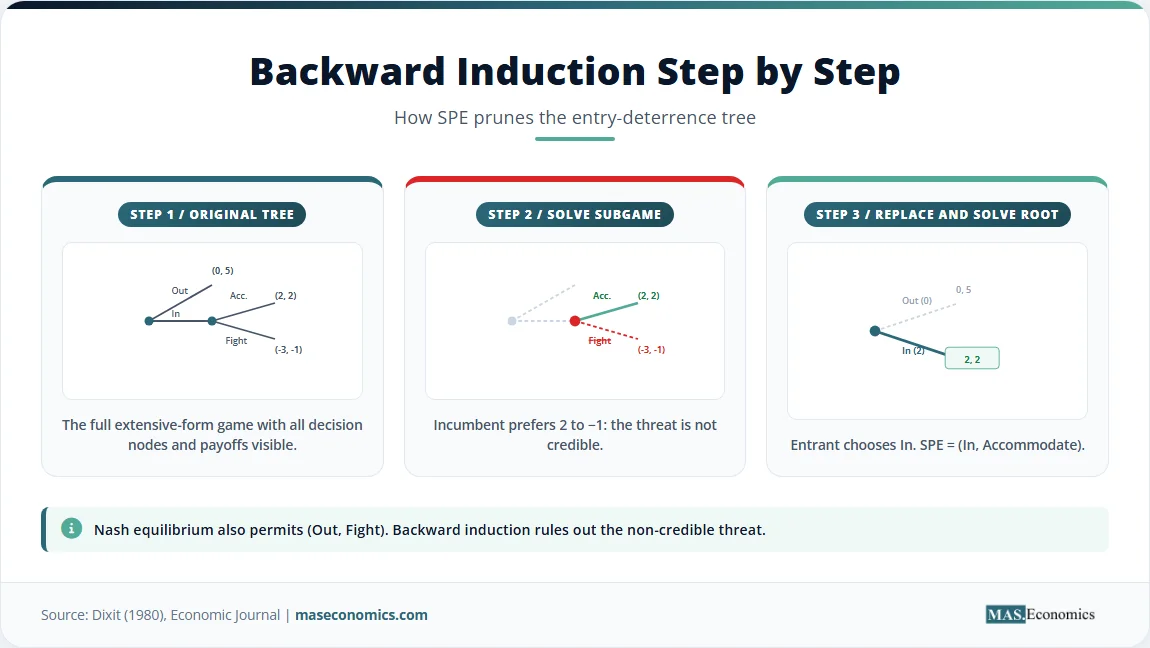
For finite games of perfect information, where every information set is a singleton, SPE is computed by backward induction. The algorithm, proven by Kuhn (1953), building on Zermelo (1913), works as follows. At every penultimate decision node, the deciding player selects the action that maximises her payoff among terminal-node continuations. Replace that node with the resulting payoff vector. Iterate up the tree until the root node is reached. The resulting strategy profile is an SPE.
The Entry-Deterrence Worked Example
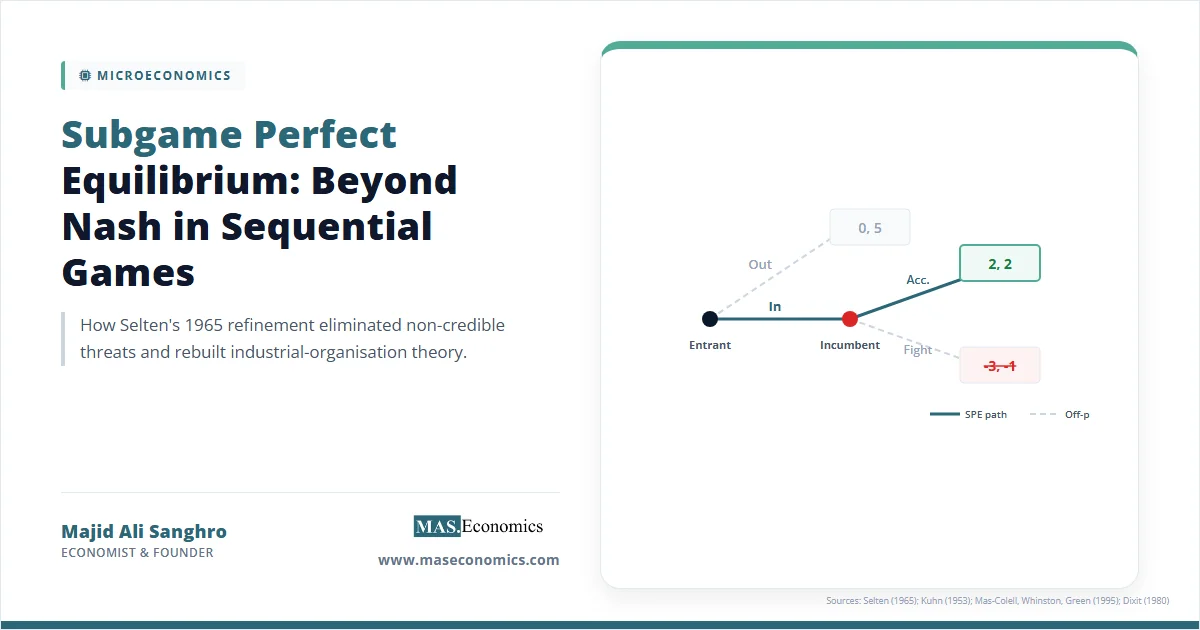
The canonical application is the entry-deterrence game, often taught alongside Dixit (1980). Two players move sequentially. The Entrant chooses In or Out. If the Entrant chooses In, the Incumbent chooses Fight or Accommodate. The payoffs are: Out yields the Entrant 0 and the Incumbent 5. Followed by Accommodate yields the Entrant 2 and the Incumbent 2. Followed by Fight yields the Entrant -3 and the Incumbent -1.
Backward induction solves this from the bottom up. At the Incumbent’s decision node following In, the Incumbent compares 2 from Accommodate against -1 from Fight. The rational choice is Accommodate. The Entrant, anticipating this response, compares 2 from In against 0 from Out. The Entrant chooses In. The SPE is the strategy profile (In, Accommodate), yielding payoffs (2, 2).
This game also has a second Nash equilibrium. Consider the profile (Out, Fight if In). Given the Incumbent’s threat to Fight, the Entrant’s best response is Out, yielding 0 rather than -3. Given the Entrant plays Out, the Incumbent’s threat is never tested, so the Incumbent has no incentive to deviate. The profile satisfies the Nash condition. However, the threat to Fight is not credible. Conditional on entry occurring, fighting yields -1 rather than 2. The Incumbent would not carry out the threat. SPE eliminates this equilibrium because the restriction of the profile to the In subgame is not a Nash equilibrium of that subgame.
| Symbol | Name | Definition |
|---|---|---|
| \( \Gamma \) | Game | Tuple (N, T, P, U, A, H, u) |
| \( N \) | Players | Finite set of decision-makers |
| \( T \) | Tree | Set of decision nodes |
| \( Z \) | Terminal nodes | Outcomes with payoff vectors |
| \( \mathcal{H}_i \) | Information sets | Partition of i’s decision nodes |
| \( s_i \) | Strategy | Function from \( \mathcal{H}_i \) to actions |
| \( s^* \) | SPE profile | Nash in every subgame |
| \( BR_i \) | Best response | Argmax over \( s_i \) given \( s_{-i} \) |
 |
||
When Backward Induction Breaks Down
The SPE concept rests on specific mathematical and epistemic assumptions. When these fail, the predictions of backward induction become unreliable.
The first assumption is that the game tree is finite. Infinite-horizon games require different techniques, often relying on fixed-point theorems rather than iterative pruning. The second assumption is common knowledge of rationality. Every player must be rational, know that others are rational, know that others know they are rational, and so on ad infinitum. The third assumption is common knowledge of the game structure, meaning payoffs and move sequences are mutually understood. The fourth requirement, specific to backward induction, is perfect information. Every decision node must be observable. The fifth condition requires that any subgame defined must respect the information-set boundaries of the larger game.
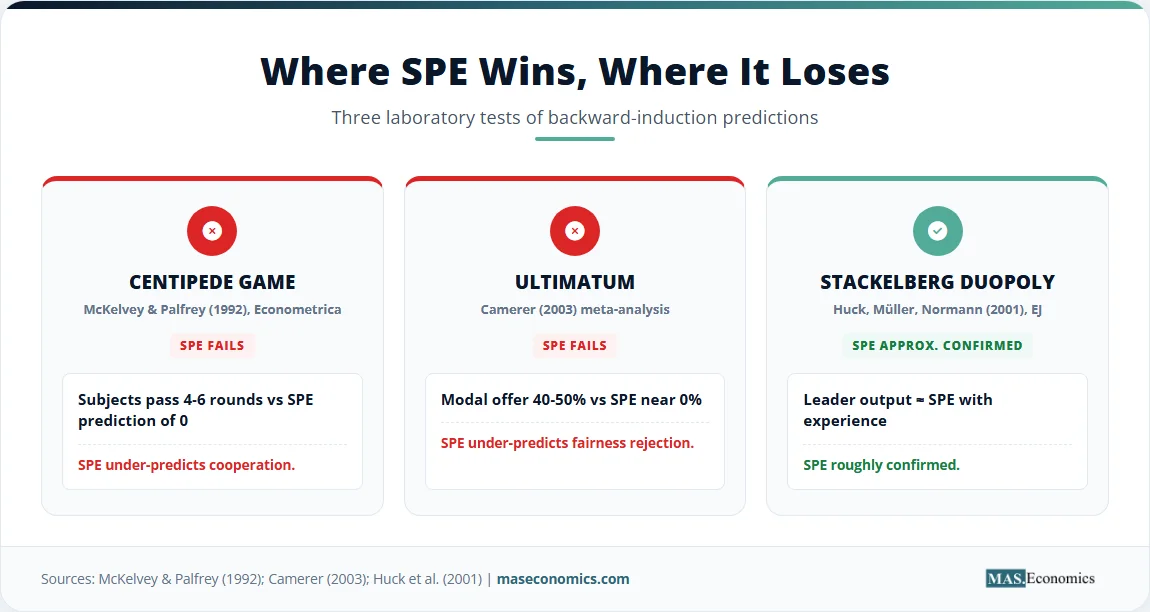
The most significant limitation is the empirical failure of common knowledge of rationality. The Centipede Game, introduced by Robert Rosenthal in 1981, illustrates the problem. Two players alternate taking a growing pot of money. Taking ends the game. Passing grows the pot but risks the opponent taking it. Backward induction predicts that the first player takes immediately. If the first player passes, they reveal they are not rational in the way the model assumes, collapsing the inference chain. McKelvey and Palfrey (1992, Econometrica) found that experimental subjects pass for several rounds, with cooperation declining but never reaching the zero-cooperation SPE prediction.
The chain-store paradox, identified by Selten himself in 1978, presents a related problem. A monopolist faces sequential potential entrants in multiple markets. Backward induction predicts the monopolist accommodates in the last market, which unravels to accommodation in all markets. In practice, monopolists often fight early entrants to establish a reputation for toughness, a behaviour explained only by introducing incomplete information, as formalised by Kreps and Wilson (1982, Econometrica) in their sequential equilibrium concept. SPE also does not refine games where every move occurs at a non-singleton information set, such as simultaneous-move subgames. For these, sequential equilibrium or trembling-hand perfection provides the necessary refinement.
Evidence for Subgame Perfect Equilibrium
Empirical tests of SPE fall into two categories: controlled laboratory experiments that isolate the sequential-logic mechanism, and field evidence from markets where the strategic behaviour is theoretically governed by backward induction.
The Centipede Game experiments by McKelvey and Palfrey (1992) provide the starkest rejection of the SPE prediction. In their design, two players could either take a larger share of an increasing pot or pass to the other player. Backward induction dictates that the first player takes on the opening move. Across multiple sessions, fewer than 10% of first-round players took immediately. Subjects passed for four to six rounds on average. The data show that players do not fully trust the rationality of their opponents, or they derive utility from the cooperative act of passing, a possibility the standard payoff matrix ignores.
Ultimatum bargaining provides a second, massive body of evidence against the SPE prediction. In the ultimatum game, a Proposer offers a split of a known sum to a Responder. The Responder accepts or rejects. Rejection means both players get zero. SPE predicts the Proposer offers the smallest positive amount, say one cent out of ten dollars, and the Responder accepts. Werner Güth, Rolf Schmittberger, and Bernd Schwarze first tested this in 1982. Colin Camerer’s 2003 meta-analysis in Behavioral Game Theory, published by Princeton University Press, aggregates hundreds of replications across dozens of countries. The modal offer is 40% to 50% of the pie. Offers below 20% are rejected approximately half the time. Responders punish unfair offers, violating the sequential-rationality assumption that any positive payoff is preferred to zero. The Proposers, anticipating this rejection, make fair offers.
Stackelberg duopoly experiments offer a partial confirmation of SPE. In a Stackelberg market, one firm chooses quantity first, and the second firm observes that quantity before choosing its own. SPE predicts the leader produces a large quantity, and the follower produces a smaller quantity, distinct from the simultaneous-move Cournot oligopoly equilibrium. Huck, Müller, and Normann (2001, Economic Journal) tested this. The SPE-predicted leader output is approximately confirmed in laboratory markets with experienced subjects. However, leaders often produce slightly less than the SPE quantity, converging toward Cournot output when commitment is weak or when subjects lack experience. The Stackelberg result confirms SPE as a first approximation, but highlights the sensitivity of the prediction to the credibility of the leader’s commitment.
How Subgame Perfect Equilibrium Matters
The theoretical and empirical limitations of SPE do not diminish its centrality in policy analysis. Government agencies and regulators rely on the SPE framework to evaluate oligopoly collusion, predatory pricing, and strategic commitment. The logic of sequential rationality provides the baseline against which real-world deviations are measured.
In industrial organisation, entry-deterrence games framed as SPE are the foundation of modern competition policy. The Federal Trade Commission in the United States and the European Commission’s Directorate-General for Competition evaluate predatory-pricing claims using SPE-style logic. A firm that prices below cost to drive out a rival is making a non-credible threat if the firm cannot recoup its losses after the rival exits. The SPE framework asks: Would the incumbent choose to fight once entry has occurred? If accommodation is more profitable ex post, the threat to fight is not credible, and predation claims fail. This analysis was central to the Brooke Group v. Brown & Williamson Supreme Court decision in 1993, which required evidence of recoupment, an inherently forward-looking, sequential-rationality test. Limit pricing, the practice of setting low prices to deter entry, is rationalised as SPE only when asymmetric information is introduced, as shown by Milgrom and Roberts (1982). Without incomplete information, the incumbent’s low price is not a credible commitment because it would raise prices once entry is deterred.
In bargaining theory, Rubinstein’s 1982 alternating-offers model uses SPE to characterise the unique division of surplus as a function of the players’ discount factors. Two players alternate, making offers about how to split a pie. If an offer is rejected, the pie shrinks by the discount factor. Backward induction yields a unique SPE where the first proposer offers a share that makes the responder indifferent between accepting and rejecting, and the responder accepts. This result is the workhorse of wage-bargaining models in OECD labour-market analyses. It structures predictions about mergers-and-acquisitions premium distributions and litigation-settlement theory. The model shows that patience is bargaining power: the more patient player receives a larger share. Every applied bargaining model that accounts for the sequential nature of negotiation traces its solution logic to Rubinstein’s SPE.
In contract design and mechanism design, optimal-contract problems in agency theory compute equilibria of sequential principal-agent games via backward induction. The principal offers a contract; the agent decides whether to accept; the agent then chooses an effort level. The principal designs the contract anticipating the agent’s optimal effort response, a direct application of sequential rationality. Holmström (1979) and Holmström and Tirole (1997) built the principal-agent problem framework on this logic. Auction theory uses SPE to characterise bidding in sequential and dynamic auctions. Krishna (2010) demonstrates that the dominant-strategy truth-telling in second-price sealed-bid auctions is a special case of a broader class of SPE in Vickrey-Clarke-Groves mechanisms. Modern algorithmic contract theory in tech-platform regulation extends the SPE framework to multi-agent settings where algorithms act as principals, continuously adjusting terms based on the sequential actions of users.
MASEconomics Explains
4 economic concepts behind sequential rationality
These concepts are explored in depth across our educational articles library.
Explore the MASEconomics BlogConclusion
Subgame Perfect Equilibrium is the solution concept that enforces sequential rationality by requiring Nash optimality at every subgame, eliminating non-credible threats. The Dixit entry-deterrence model demonstrates the canonical case: the incumbent’s threat to fight is a Nash equilibrium strategy but not sequentially rational, so SPE selects the unique outcome of entry and accommodation. Laboratory evidence from centipede and ultimatum games shows systematic deviations from the SPE baseline, driven by fairness norms and bounded rationality, while Stackelberg experiments confirm the SPE prediction approximately under experienced play. The framework underpins modern competition-policy analysis of predatory pricing, the Rubinstein bargaining model used in labour and merger analysis, and the game theory mathematics of principal-agent contract design.
Frequently Asked Questions
What is the difference between Nash Equilibrium and Subgame Perfect Equilibrium?
Nash Equilibrium requires that no player benefits from unilateral deviation given the other players’ strategies. Subgame Perfect Equilibrium refines this by requiring the Nash condition to hold in every subgame, eliminating strategies that rely on non-credible threats off the equilibrium path.
What is a non-credible threat?
A non-credible threat is a strategy that prescribes an action the player would not rationally choose if the decision node were actually reached. It sustains a Nash equilibrium by deterring opponents, but it fails the subgame perfection test because the threatener would deviate if called upon to execute the threat.
How does backward induction work?
Backward induction solves a finite game of perfect information by starting at the terminal decision nodes, determining the optimal action at each, replacing those nodes with the resulting payoffs, and moving backwards up the tree until the initial node is reached.
Does Subgame Perfect Equilibrium always exist?
Every finite extensive-form game of perfect information has at least one SPE in pure strategies, proven by Kuhn’s theorem. For games of imperfect information, mixed-strategy SPE existence follows from Selten’s trembling-hand perfection and related fixed-point arguments.
Thanks for reading! If you found this helpful, share it with friends and spread the knowledge. Happy learning with MASEconomics