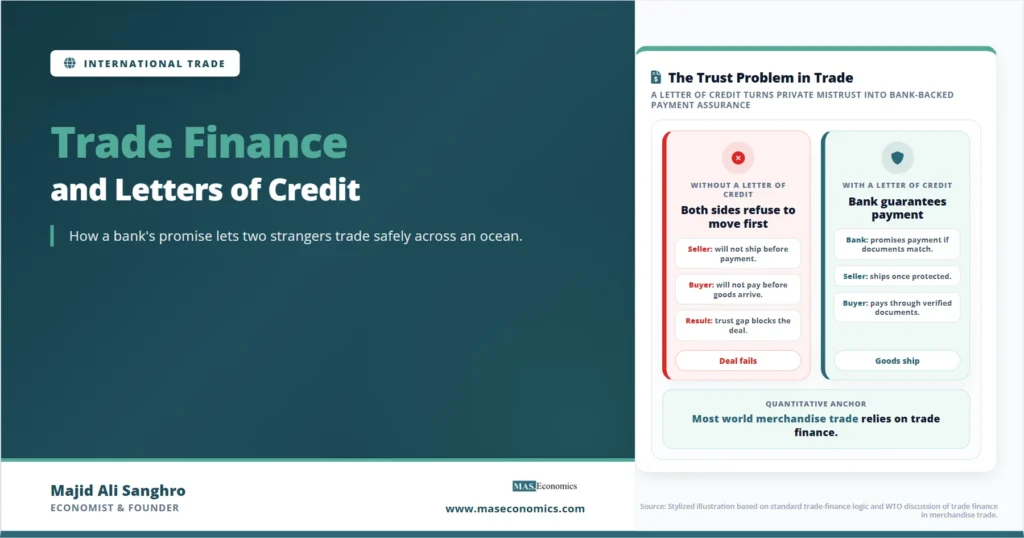
An exporter in Vietnam packs a container of furniture worth $200,000 and prepares to ship it to a buyer in Germany it has never met. The exporter wants to be paid before the goods leave the port. The buyer wants to inspect the furniture before sending a cent. Neither will move first, and the ocean between them takes six weeks to cross. This standoff, repeated millions of times a year across every border, is the problem that trade finance letters of credit and the wider machinery of cross-border payment exist to solve. The instrument that most often breaks the deadlock is the documentary letter of credit, a bank’s written promise that turns two strangers’ mutual distrust into a workable transaction.
The stakes are larger than any single shipment. The World Trade Organization estimates that the majority of world merchandise trade depends on some form of trade finance, and that gaps in its availability fall hardest on small firms and developing economies. When the plumbing of cross-border payment seizes up, as it did during the 2008 financial crisis, trade volumes collapse faster than the underlying demand for goods. Understanding how that plumbing works is part of understanding how global commerce actually moves.
Trust Gap in Cross‑Border Trade
Domestic trade rests on a web of trust that international trade cannot assume. A seller in one city can sue a buyer in the next under a shared legal system, check the buyer’s credit through familiar agencies, and expect payment in a known currency on familiar terms. Cross a border, and each of those supports weakens at once. Legal recourse spans two jurisdictions, credit information is patchy, the currency may differ, and the goods spend weeks in transit where ownership and condition are hard to verify.
This is, at root, a problem of information asymmetry, the same force that George Akerlof showed could break a market entirely in the market for lemons. The exporter cannot easily verify that the buyer will pay; the importer cannot easily verify that the goods will arrive as described. Each fears being the one who performs first and is left exposed. If nothing bridges the gap, the safest move for both is to not trade at all, and a profitable exchange simply fails to happen.
The payment methods available to a cross-border seller form a spectrum from full seller risk to full buyer risk. Where a transaction lands on that spectrum depends on how much the two parties trust each other and how much bargaining power each holds.
| Method | Who bears the main risk | How it works | When it is used |
|---|---|---|---|
| Open account | Exporter | Goods shipped first, payment due later on trust | Established relationships, strong buyers |
| Documentary collection | Shared, leaning exporter | Banks exchange shipping documents for payment, without guaranteeing it | Moderate trust, lower-value trade |
| Letter of credit | Shared, balanced by a bank | A bank guarantees payment against compliant documents | New relationships, high value, risky markets |
| Cash in advance | Importer | Buyer pays before goods are shipped | Untrusted buyers, custom goods |
|
Source: MASEconomics editorial synthesis of standard trade finance practice.

|
|||
Open account terms favor the buyer, who receives goods before paying and may simply default. Cash in advance favors the seller, who is paid before shipping and may fail to deliver. The two middle options exist precisely because most international deals sit between strangers who will accept neither extreme. The letter of credit is the most powerful of these, because it substitutes a bank’s creditworthiness for the buyer’s.
Letter of Credit Payment Cycle
A documentary letter of credit is a written undertaking issued by a bank, at the buyer’s request, to pay the seller a stated sum provided the seller presents documents that comply exactly with the terms set out in the credit. The crucial move is the substitution of parties. The exporter no longer relies on the importer’s promise to pay. It relies on the issuing bank’s promise, and banks are repeat players whose reputation and regulation make them far more reliable counterparties than an unknown firm abroad.
Equally important is what the letter of credit makes payment depend on. The bank does not pay against the goods themselves, which it never sees. It pays against documents: the bill of lading proving the goods were shipped, the commercial invoice, insurance certificates, inspection certificates, and whatever else the credit specifies. This is the principle of documentary compliance, and it has a strict consequence. If the documents conform to the credit’s terms, the bank must pay even if the goods turn out to be defective. If the documents contain discrepancies, even small ones, the bank may refuse to pay even if the goods are perfect.
Note. A letter of credit deals in documents, not goods. Banks examine paper, not cargo. This is what lets a bank in one country guarantee a transaction involving goods it will never inspect, sitting in a container halfway across an ocean.
The transaction unfolds in a defined sequence involving four main parties: the importer (applicant), the exporter (beneficiary), the importer’s bank (issuing bank), and the exporter’s bank (the advising or confirming bank). The steps trace a loop in which goods move one way and documents and money move the other.
The importer applies to its bank for a credit in favor of the exporter. The issuing bank sends the credit to the advising bank in the exporter’s country, which confirms its authenticity to the exporter. Reassured that payment is now backed by a bank, the exporter ships the goods and assembles the required documents. Those documents flow back through the banks, are examined for compliance, and on a clean presentation the exporter is paid. The importer reimburses its issuing bank and receives the documents needed to claim the goods. Each leg of the loop reduces someone’s exposure to a counterparty they could not otherwise trust.
Confirmed Credits and Trust Layers
A letter of credit shifts risk from the buyer to the issuing bank, but it does not erase risk entirely. The exporter now depends on the issuing bank’s ability to pay, and that bank sits in the importer’s country, subject to its political and economic conditions. If the importer’s country imposes currency controls, suffers a banking crisis, or descends into conflict, even a sound issuing bank may be unable to transfer funds. The exporter has traded commercial risk for country risk.
The confirmed letter of credit answers this. When the exporter’s own bank adds its confirmation, it takes on an independent obligation to pay the exporter against compliant documents, regardless of what happens to the issuing bank or its country. Trust is now layered: the exporter relies on a bank in its own jurisdiction, which relies on the issuing bank, which relies on the importer. Confirmation costs more, since the confirming bank charges for absorbing country risk, and exporters use it selectively when selling into markets they regard as unstable. The same political and currency exposures that make confirmation worthwhile are the exposures examined in the analysis of how exchange rates shape global trade.
Caveat. Documentary compliance is unforgiving. A misspelled name, a date outside the shipping window, or a missing signature can make documents discrepant, and a discrepant presentation gives the bank the right to refuse payment. Many disputes in trade finance turn on paperwork, not on the goods.
Other Trade Finance Instruments
The letter of credit is the centerpiece of trade finance, but it sits within a larger set of instruments that handle financing and risk in different ways. Some provide the working capital an exporter needs while waiting to be paid; others insure against the buyer defaulting; others guarantee a contractor’s performance rather than a payment.
Bank guarantees and standby letters of credit function as backstops, paid only if one party fails to perform, which makes them common in construction and large project contracts. Factoring and forfaiting let an exporter sell its receivables to a financial institution at a discount, converting a future payment into immediate cash and offloading the collection risk. Supply chain finance arrangements let a buyer’s strong credit rating lower the financing cost for its smaller suppliers. And export credit agencies, public bodies that insure and finance exports their governments wish to promote, support transactions that private lenders find too risky, a role that connects trade finance to the strategies multinational firms use, discussed in the article on the role of multinational corporations in the global economy.
Each instrument addresses a particular friction. Where the letter of credit solves the trust problem between strangers, factoring solves the cash-flow problem of waiting months to be paid, and guarantees solve the performance problem in long-running contracts. Together they form the financial counterpart to the physical logistics that move goods across borders, and they explain why a firm can sell confidently into a market it has never visited.
Trade Finance Disruption and Trade
The importance of this machinery becomes clearest when it breaks. During the 2008 global financial crisis, banks short of capital and wary of counterparties pulled back from issuing and confirming letters of credit. The cost of trade finance spiked, and exporters who could not secure payment guarantees simply could not ship. World trade fell far more sharply than world output, and a meaningful part of that collapse traced not to a drop in demand for goods but to a freeze in the credit that lets goods move. The episode is part of why the contraction spread so widely through the channels described in the account of how globalization links national economies.
The lesson reshaped policy. International bodies now monitor trade finance availability as a distinct indicator, separate from general lending, because a healthy appetite to buy goods means nothing if the payment mechanism is unavailable. The WTO and regional development banks run programs to fill trade finance gaps, particularly for small firms and lower-income countries where the gap is widest. Trade finance, once treated as back-office plumbing, is now understood as a structural condition for trade to occur at all, on the same footing as the tariffs and trade policies that usually dominate the conversation.
Explains
Three ideas behind trade finance
Connect the financial plumbing of trade to the bigger picture.
Explore the MASEconomics BlogConclusion
The system of trade finance letters of credit and its related instruments exists to solve a problem that distance and distrust create in every cross-border transaction. A seller wants payment before parting with goods; a buyer wants the goods before parting with money; and the weeks of transit between them strip away the legal recourse and credit information that make domestic trade routine. The documentary letter of credit resolves the standoff by substituting a bank’s reliable promise for an unknown buyer’s, and by making that promise depend on compliant documents rather than on goods the bank will never see.
The instrument layers further protections where they are needed. Confirmation shifts country risk onto a bank in the exporter’s own jurisdiction, while guarantees, factoring, supply chain finance, and export credit agencies handle the separate problems of performance, cash flow, and uninsurable risk. Each addresses a specific friction, and together they let firms trade with counterparties and into markets they could never assess on their own.
The clearest evidence of how much this machinery matters comes from its failures. When trade finance froze in 2008, trade volumes fell faster than demand, because goods cannot move without a way to pay for them safely. That experience reframed trade finance from invisible plumbing into a recognized condition for trade to happen, monitored and supported alongside the tariff and policy questions that more often hold the spotlight.
Frequently Asked Questions
What is a letter of credit in simple terms?
A letter of credit is a bank’s written promise to pay a seller on a buyer’s behalf, provided the seller presents documents that match the credit’s terms exactly. It lets two parties who do not know each other trade safely, because the seller relies on the bank’s reliability rather than the buyer’s.
Why do exporters use letters of credit instead of just being paid in advance?
Demanding cash in advance shifts all the risk to the buyer, who may refuse such terms or take their business elsewhere. A letter of credit balances the risk: the seller is assured of payment against compliant documents, while the buyer does not pay until the goods have been shipped and the documents prove it.
What is the difference between a confirmed and an unconfirmed letter of credit?
An unconfirmed credit carries only the issuing bank’s promise to pay, leaving the exporter exposed to risk in the importer’s country. A confirmed credit adds the exporter’s own bank as a second guarantor, which pays regardless of what happens to the issuing bank or its country. Confirmation costs more and is used for riskier markets.
Does a bank check the goods before paying under a letter of credit?
No. Banks examine documents, not goods. If the presented documents comply with the credit’s terms, the bank must pay even if the goods are defective. If the documents are discrepant, the bank may refuse to pay even if the goods are perfect. This documentary principle is central to how the instrument works.
How did the 2008 crisis affect trade finance?
Banks short of capital pulled back from issuing and confirming letters of credit, and the cost of trade finance rose sharply. Exporters who could not secure payment guarantees were unable to ship, and world trade fell faster than world output. The episode showed that a freeze in trade finance can stall trade even when demand for goods remains.
Thanks for reading! If you found this helpful, share it with friends and spread the knowledge. Happy learning with MASEconomics