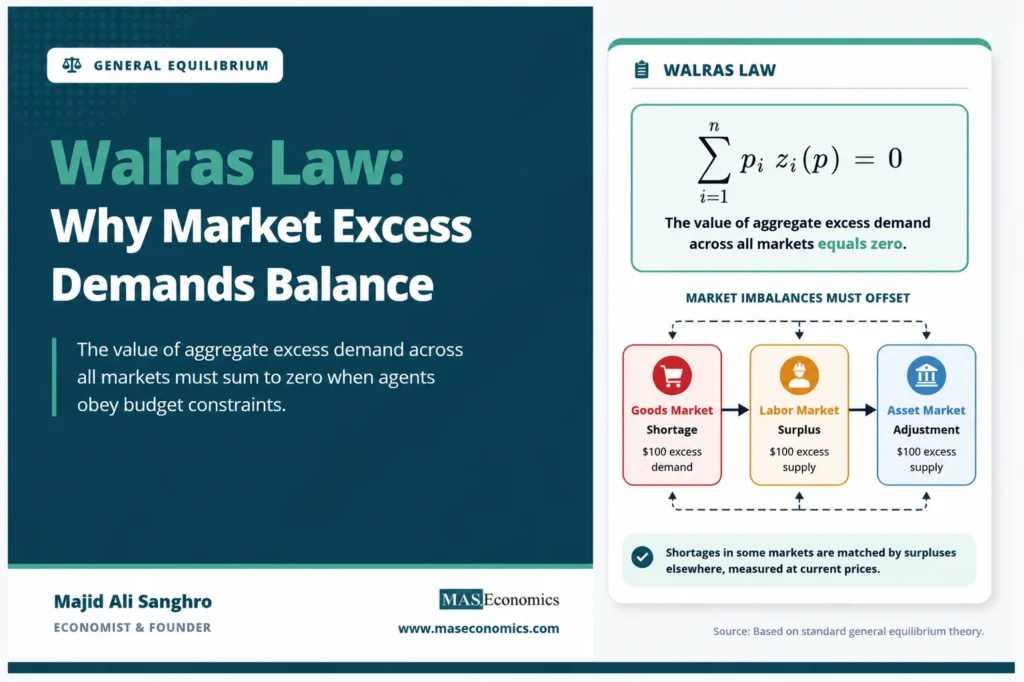
A market economy can have shortages in some markets and surpluses in others at the same time, but those imbalances cannot be independent of each other. Walras law states that the total value of excess demand across all markets must sum to zero when every buyer and seller respects a budget constraint.
The result is not a claim that markets always clear. It is an accounting restriction on disequilibrium. If households, firms, and other agents can spend only what their income and endowments allow, then excess purchasing power in one market must be matched by excess supply somewhere else.
This makes Walras law one of the simplest but most important ideas in general equilibrium. It shows why markets must be studied as a connected system rather than as isolated demand and supply curves.
Budgets create market balance
Walras law begins with a basic constraint. Each economic agent chooses a bundle of goods subject to the value of income, wealth, or initial endowments. Across the whole economy, one person’s planned purchase is another person’s planned sale. The economy cannot collectively demand more value than it can pay for.
Suppose there are \(n\) goods, with price vector \(p = (p_1, p_2, …, p_n)\). Let \(z_i(p)\) represent excess demand for good \(i\), meaning planned demand minus planned supply at the prevailing price vector. Walras law can be written as:
WALRAS LAW
This expression says that excess demands may exist in physical units, but their total value must balance. If one market has positive excess demand, at least one other market must have negative excess demand of equal value, measured at current prices.
The law follows from adding up individual budget constraints. If every agent’s planned expenditure equals the value of that agent’s resources, then the economy-wide sum of planned expenditures equals the economy-wide sum of available resources. Market imbalance can change where excess demand appears, but it cannot create net purchasing power from nothing.
Excess demand sums to zero
Excess demand is the gap between what people want to buy and what others want to sell at a given price. A positive excess demand means buyers want more of a good than sellers offer. A negative excess demand means planned supply exceeds planned demand.
Walras law does not require each \(z_i(p)\) to equal zero. It requires the price-weighted sum of all \(z_i(p)\) terms to equal zero. This distinction is central. A market economy can be out of equilibrium in many places, but the imbalances remain tied together through budget constraints.
Consider a two-good economy with food and cloth. If households want to buy $100 more food than producers offer at current prices, they must be planning to sell or spend $100 less somewhere else. If cloth is the only other good, the cloth market must show an excess supply worth $100. The shortage of food and the surplus of cloth are two sides of the same accounting relation.
This does not mean that prices are correct. It means that the disequilibrium has structure. Prices may still need to adjust. Quantities may still be rationed. Some agents may be frustrated in their plans. Walras law simply says that the total value of those frustrated plans cannot be positive or negative for the economy as a whole.
One market balance follows
Walras law has a powerful implication for equilibrium analysis. If there are \(n\) markets and \(n-1\) of them clear, then the remaining market must also clear, provided its price is positive.
The logic follows directly from the equation. Suppose markets 1 through \(n-1\) have no excess demand:
Walras law then becomes:
If \(p_n > 0\), then \(z_n(p)\) must equal zero. The last market clears automatically because the value of total excess demand cannot deviate from zero once every other market has already balanced.
This result explains why general equilibrium models often normalize one price or omit one market-clearing equation. The omitted equation is not ignored. It is implied by the others. In a system of connected markets, only \(n-1\) independent market-clearing conditions are needed when Walras law holds.
The result also prevents double counting. If goods markets, labor markets, and asset markets are all connected through budgets, solving every market-clearing equation as if it were independent can make the model look more complicated than it is. Walras law identifies the hidden accounting link among those equations.
Relative prices carry the signal
Walras law also helps explain why general equilibrium theory focuses on relative prices. If all prices double, the real trade-offs in the economy do not change. A price vector \(p\) and a scaled price vector \(\lambda p\), where \(\lambda > 0\), describe the same set of relative prices.
The market-clearing problem is therefore not about finding an absolute money number for every good. It is about finding a set of relative prices that makes all planned trades mutually consistent. This is why one price can be used as a numeraire. Other prices are then measured relative to that chosen benchmark.
For example, in a two-good model, the price of food can be set to 1, and the price of cloth can be expressed in units of food. Nothing economic is lost because only the ratio matters for substitution, budget allocation, and market clearing.
This price-normalization logic matters in Edgeworth Box analysis. A competitive equilibrium allocation depends on a price line passing through an endowment point. The slope of that line reflects a relative price, not an absolute money scale. Walras law sits behind that logic because each trader’s budget must balance at the same price vector.
Disequilibrium still respects budgets
A common misunderstanding treats Walras law as a theory of automatic market clearing. That is too strong. Walras law does not say prices adjust quickly, wages are perfectly flexible, information is complete, or institutions are frictionless. It says something narrower and more durable: planned excess demands must balance in value if budget constraints hold.
Markets can remain out of equilibrium because prices are sticky, contracts are fixed, search is costly, or expectations are wrong. In those cases, positive excess demand can persist in some markets while excess supply persists elsewhere. Walras law still requires the value of those imbalances to offset.
Labor-market unemployment is a useful example. If households cannot sell as much labor as they planned, their income falls. Lower income then reduces planned demand for goods or assets. The labor market imbalance and the goods-market imbalance are linked through the household budget constraint.
This is why Walras law is compatible with disequilibrium analysis. It does not remove the possibility of recessions, rationing, unemployment, or unsold inventories. It restricts how those imbalances can fit together across markets.
Core idea. Walras law is an accounting identity, not a behavioral claim that markets automatically clear. It follows from budget constraints and applies even when some markets are out of equilibrium.
Exchange economies show the logic
The cleanest version of Walras law appears in a pure exchange economy. Agents begin with endowments of goods and trade at given prices. Each agent chooses a preferred bundle that costs no more than the value of that agent’s initial endowment.
For agent \(h\), the budget condition can be written as:
Here, \(x^h\) is the chosen bundle and \(\omega^h\) is the initial endowment. The dot product measures the value of a bundle at prices \(p\). If every agent spends exactly the value of the endowment, summing across all agents gives:
The term inside the parentheses is aggregate excess demand. This gives the compact form of Walras law:
The equation is simple because the underlying accounting is simple. Aggregate planned purchases minus aggregate initial resources must have zero value. Individual agents may want to trade, and markets may not clear at the current price vector, but the value of total desired net trades must balance.
This exchange logic also explains why Walras law is central to competitive equilibrium. A competitive equilibrium is not only a set of prices. It is a price-allocation pair in which individual choices are budget-feasible and markets clear. Walras law shows that budget feasibility and market clearing are mathematically linked.
Money changes the interpretation
Walras law is easiest to see in a barter-style exchange model, but money does not remove the logic. It changes how the accounting is represented. If money is treated as one of the goods, then excess demand for goods must be matched by excess supply of money, or the reverse.
For example, if households want to buy more goods than firms currently supply, they must be trying to reduce money balances, borrow, or sell other assets. If those financial plans are included as markets, the total value of excess demand across goods, money, and assets still sums to zero.
Problems arise when a model includes some markets but leaves out the corresponding financial or budget channel. A goods-market shortage without any offsetting money, bond, labor, or asset-market surplus violates the accounting structure that Walras law requires.
This does not mean every real-world transaction clears smoothly through money markets. Credit constraints, defaults, payment delays, and institutional frictions can complicate the adjustment. Walras law remains a benchmark for checking whether the model’s markets and budget constraints are internally consistent.
Walras law has clear limits
Walras law is powerful because it is an identity, but that strength is also its limit. It does not explain how prices move. It does not prove that equilibrium exists. It does not guarantee that equilibrium is unique or stable. Those questions require additional assumptions about preferences, endowments, technologies, and price adjustment.
The law also depends on the model’s budget constraints being properly specified. If agents can default, receive transfers not included in the accounting, create credit inside the model, or face rationing constraints that prevent planned trades, then the relevant budget equations must be written carefully. Walras law applies to the complete system, not to a partial list of markets with missing channels.
A second limitation concerns zero-price goods. The statement that one remaining market must clear when all others clear requires the remaining good to have a positive price. If \(p_n = 0\), then \(p_n z_n(p)=0\) does not imply \(z_n(p)=0\). Free goods and nonpriced external effects require separate treatment.
These limits do not weaken Walras law. They clarify its role. It is not a full theory of equilibrium, price adjustment, or welfare. It is the accounting backbone that any complete general equilibrium model must respect.
Explains
Three concepts behind Walras law
Related equilibrium concepts are developed across the MASEconomics microeconomics library.
Explore the MASEconomics BlogConclusion
Walras law states that the total value of excess demand across all markets equals zero when agents obey their budget constraints. A shortage in one market must be matched by a surplus somewhere else, measured at the same price vector.
The law matters because it shows that market imbalances are connected. It explains why only \(n-1\) independent market-clearing equations are needed in an \(n\)-market economy, why relative prices are central, and why disequilibrium in one market cannot be analyzed without its budget-linked counterpart elsewhere.
Walras’ law does not prove that markets clear or that prices adjust well. It sets the accounting condition that any coherent general equilibrium system must satisfy. The theory of equilibrium begins from that restriction, then adds assumptions about behavior, prices, and market adjustment.
Frequently Asked Questions
What does Walras law mean?
Walras law means that the value of aggregate excess demand across all markets equals zero. If one market has excess demand, another market must have excess supply of equal value.
Does Walras law mean all markets clear?
No. Walras law does not say every market clears. It says that the value of all market imbalances must sum to zero when agents respect budget constraints.
Why does one market clear automatically in Walras law?
If all but one market clear, the total value of excess demand is already zero except for the remaining market. If the remaining market has a positive price, its excess demand must also be zero.
Why is Walras law important in general equilibrium?
Walras law links all markets through budget constraints. It shows that goods, labor, money, and asset markets cannot be analyzed as completely independent systems.
Is Walras law an assumption or an identity?
Walras law is an identity derived from budget constraints. It becomes valid in a model when all relevant markets and budget flows are included consistently.
Thanks for reading! If you found this helpful, share it with friends and spread the knowledge. Happy learning with MASEconomics