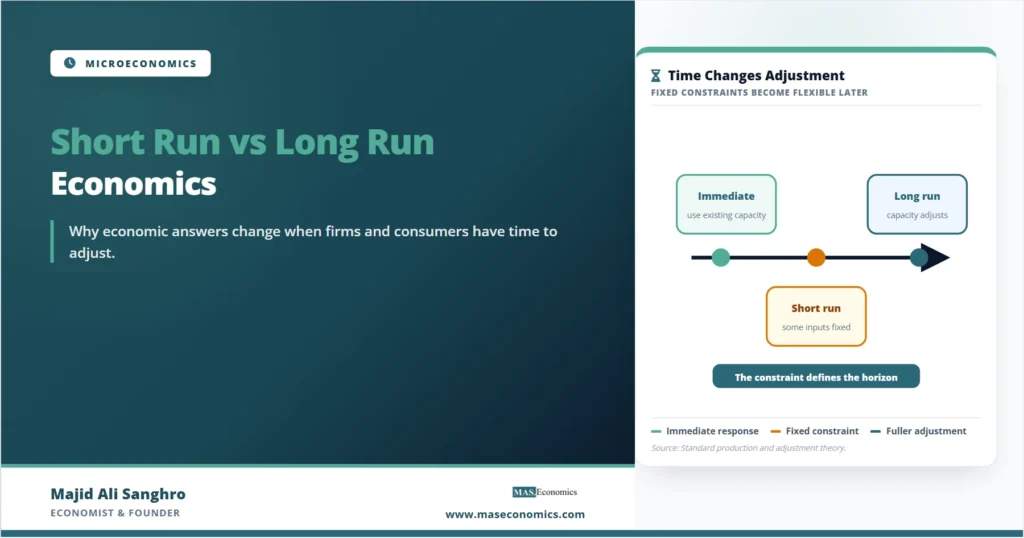
A factory can ask workers to work overtime this month, but it cannot build a new plant by Friday. A household can cut restaurant spending immediately, but it may need years to change housing, commuting, or career plans. That difference is the starting point for short run vs long run in economics.
The short run is a period in which at least one important constraint is fixed. The long run is a period in which the relevant constraints can adjust. The calendar length is not the same in every market. For a restaurant, the short run may be weeks. For electric power, housing, ports, education, or factories, the short run may last years because capacity changes slowly.
This distinction matters because the same shock can have different effects over different horizons. A price increase may raise profit quickly if firms cannot expand output. Over time, new firms may enter, old firms may invest, consumers may switch products, and workers may move. The economic answer changes because the adjustment options change.
The Time Horizon Is About Adjustment, Not the Calendar
In economics, the short run and long run are not defined by one universal number of days, months, or years. They are defined by what can adjust. The short run is the period in which some important input, contract, capacity, technology, habit, or institution is fixed. The long run is the period in which those constraints can change enough to alter behavior.
This is why a “short run” can be long in ordinary language. A city cannot add enough housing supply in a few months if zoning, permits, land assembly, construction labor, financing, and infrastructure all take time. A farm cannot instantly change soil quality or irrigation capacity. A university cannot immediately produce more trained engineers. The economic short run lasts until the relevant adjustment becomes possible.
The same logic works in reverse. Some long-run adjustments can happen quickly in digital markets where production capacity scales faster. A software firm may add users without building a new factory. A streaming platform may expand output differently from an airline, a steel mill, or a hospital. The time horizon depends on the technology and constraint being studied.
The MASEconomics article on costs of production is a useful starting point. Fixed costs and variable costs make sense only after identifying the time horizon. A cost that is fixed today may become variable later when contracts expire, capital is replaced, or production facilities can be changed.

Production Looks Different When Capacity Is Fixed
The short-run production problem begins with fixed capacity. A firm may have a factory, machines, leases, managers, and specialized equipment already in place. It can hire more labor, buy more materials, or run extra shifts, but it cannot immediately redesign the entire production system. Output can rise, but only within the limits of existing capacity.
This is why marginal cost often rises in the short run. When a firm pushes existing capacity harder, workers may become crowded, machines may need more maintenance, overtime may become expensive, and bottlenecks may appear. The firm can produce more, but each extra unit may cost more than the previous one.
In the long run, the firm can change more inputs. It can build a larger plant, adopt new technology, redesign the production process, move location, train workers, or enter a new market. Long-run cost curves therefore ask a different question: what is the lowest cost of producing each output level when the firm can choose its scale?
The distinction also explains why firms do not all respond to price changes in the same way. A small bakery, a semiconductor plant, a hospital, and a ride-share platform face different fixed constraints. Their short runs and long runs are different because their technologies and capital commitments are different.
Consumers Adjust Slowly Too
The short-run and long-run distinction is not only about firms. Consumers also face adjustment limits. If gasoline prices rise this week, many households still need to drive to work. They may combine trips, reduce leisure driving, or search for cheaper stations, but they usually cannot instantly move closer to work, buy an electric vehicle, or change jobs.
Over time, the response can become larger. Households may choose more fuel-efficient cars, move closer to transit, work remotely, change commuting patterns, or adjust where they shop. This is why demand is often more elastic in the long run than in the short run. The longer the horizon, the more substitutes and behavioral changes become available.
The same logic applies to food, housing, energy, education, and health care. Some choices are easy to adjust quickly. Others are tied to contracts, habits, income, location, family needs, or available alternatives. Economists ask about the time horizon because it tells them how much adjustment is realistic.
The MASEconomics article on supply and demand shows the basic price-quantity relationship. The short-run versus long-run distinction adds another layer: the slope and shift of curves can look different when buyers and sellers have more time to respond.
Macroeconomics Uses the Same Distinction
Macroeconomics uses short run and long run to separate immediate fluctuations from deeper capacity and growth. In the short run, spending, confidence, credit, inventories, interest rates, and sticky prices can affect output and employment. In the long run, the economy’s productive capacity depends more on labor force growth, capital accumulation, productivity, institutions, and technology.
The US Bureau of Economic Analysis GDP explainer distinguishes current-dollar GDP from real GDP, with real GDP adjusted to remove inflation over time. That distinction helps analysts compare output across periods. Short-run GDP movements may reflect demand shocks, inventories, or temporary disruptions. Long-run GDP growth depends more on productive capacity.
The NBER Business Cycle Dating Committee identifies business-cycle peaks and troughs using broad indicators such as income, employment, consumption, sales, industrial production, GDP, and GDI. That is a short-run cyclical task. It asks when economic activity turned down or recovered, not why living standards rise over many decades.
Long-run growth is a different question. The MASEconomics article on Romer’s endogenous growth theory explains why ideas, innovation, and knowledge accumulation matter for prosperity. A recession changes the path of activity in the short run; sustained productivity growth changes the economy’s capacity over the long run.
| Topic | Short-run focus | Long-run focus |
|---|---|---|
| Firm production | Existing plant, labor hours, inventories, overtime, bottlenecks. | Plant size, technology, entry, exit, scale, process design. |
| Consumer demand | Immediate budget response and limited substitutes. | Habits, location, durable goods, career choices, broader substitution. |
| Inflation | Price shocks, demand pressure, wages, expectations, policy lags. | Monetary credibility, productivity, institutions, anchored expectations. |
| Unemployment | Cyclical layoffs, hiring freezes, weak demand, temporary mismatch. | Skills, demographics, institutions, natural rate, productivity structure. |
| Economic growth | Business-cycle movement around capacity. | Capital, labor force, technology, ideas, institutions. |
|
|
||
Prices, Wages, and Expectations Take Time to Adjust
Many short-run macroeconomic models rely on slow adjustment. Prices may not change instantly because firms use contracts, menus, posted prices, customer relationships, and cost-review schedules. Wages may adjust slowly because labor contracts, morale, bargaining, and search frictions matter. Expectations may also change gradually when people are unsure whether a shock is temporary or persistent.
The US Bureau of Labor Statistics Consumer Price Index overview describes CPI as measuring changes in prices paid by urban consumers for goods and services. In actual inflation data, some prices adjust quickly while others move slowly. Energy prices may move sharply; rents, services, and wages may adjust through slower channels.
This is why the short run is central to inflation analysis. If demand rises suddenly and prices are sticky, output and employment may respond before the full price adjustment occurs. If supply is disrupted, prices may rise before firms and consumers can find substitutes. The MASEconomics article Inflation Simply Explained shows why price-level changes depend on several mechanisms, not one clock.
In the long run, economists often expect more adjustment. Firms can reprice, workers can renegotiate, consumers can change behavior, and producers can expand or exit. The long-run question is therefore less about the immediate shock and more about whether the economy’s underlying capacity, expectations, and institutions have changed.
Policy Effects Depend on the Horizon
Policy debates often become confused because people discuss different time horizons. A central bank rate increase may affect financial markets quickly, but its influence on borrowing, spending, hiring, inflation, and output can take longer. A government infrastructure project may raise spending in the short run, but its long-run effect depends on whether it raises productivity, lowers transport costs, or improves capacity.
The Federal Reserve’s longer-run goals statement refers to maximum employment, stable prices, and moderate long-term interest rates. Those goals already show why time matters. Monetary policy may respond to short-run inflation and employment conditions, but credibility and expectations are long-run concerns.
The MASEconomics article on central banking and monetary policy explains that policy works through transmission channels. Interest rates affect borrowing, asset prices, exchange rates, spending, and expectations. Those channels do not all move at the same speed.
Fiscal policy also differs by horizon. A tax rebate may support demand quickly if households spend it. A tax reform may change saving, investment, labor supply, and business location over time. The MASEconomics article on fiscal policy shows why short-run stabilization and long-run sustainability are not the same policy question.
Labor Markets Show the Difference Clearly
Labor markets are a useful example because employment adjusts at several speeds. A firm may reduce overtime quickly when demand weakens. It may delay layoffs because firing and rehiring are costly. It may pause hiring before cutting current workers. Workers may accept temporary jobs in the short run while searching for better matches over time.
In the long run, the labor market changes through education, training, migration, demographics, technology, and institutions. A worker cannot instantly acquire a new professional skill, but skill formation matters greatly over longer horizons. A region cannot instantly rebuild its industrial structure, but investment and migration can change employment opportunities over time.
This is why the MASEconomics article on unemployment types separates cyclical, frictional, and structural unemployment. Cyclical unemployment is closely tied to short-run demand conditions. Structural unemployment is more about long-run mismatch between skills, locations, industries, and technology.
The published article on the Friedman-Phelps natural rate hypothesis shows a related macroeconomic point: a short-run trade-off can disappear or change in the long run once expectations and wage-setting adjust. The same policy can therefore look different depending on whether the analysis is short-run or long-run.
Trade and Capital Mobility Add Another Layer
International economics also depends on the time horizon. In the short run, some factors of production may be stuck in particular industries. Workers, machines, land, and local suppliers cannot instantly move from one sector to another. A trade shock can therefore create winners and losers while adjustment is incomplete.
Over the long run, more adjustment becomes possible. Workers may retrain or relocate. Capital may shift toward expanding sectors. Firms may enter export markets or leave shrinking industries. Governments may invest in infrastructure, education, or adjustment support. These changes do not erase all distributional costs, but they change the analysis.
The MASEconomics article on the specific factors model focuses exactly on short-run trade winners and losers. It is a good example of why economists do not use one time horizon for every question. The short run asks who is stuck with which factor. The long run asks what can move.
This also explains why policy recommendations differ across horizons. Short-run assistance may be aimed at displaced workers or regions. Long-run policy may focus on education, mobility, competition, innovation, and productivity. Treating both as the same problem leads to weak analysis.
How to Read Economic Claims About Time
A careful reader should ask three questions whenever an economic claim mentions the short run or long run. First, what is fixed? Second, what can adjust? Third, how does the adjustment change the conclusion?
Consider the statement, “Higher prices reduce demand.” In the very short run, consumers may have few alternatives. Over time, they may switch brands, change habits, buy substitutes, or reduce dependence on the good. The basic direction may remain, but the size of the response can change.
Now consider the statement, “Higher interest rates reduce inflation.” In the short run, the effect depends on financial conditions, credit sensitivity, expectations, and the source of inflation. In the long run, credibility, policy regime, and expectations matter more. A time horizon is not a detail added at the end. It changes the structure of the answer.
Short-run analysis is useful because real people and firms live inside constraints. Long-run analysis is useful because constraints can change. Economics needs both because decisions have immediate effects and delayed consequences.
MASEconomics Explains
3 economic concepts behind short-run and long-run analysis
These concepts are explored in depth across our educational articles library.
Explore the MASEconomics BlogConclusion
Short run vs long run is a distinction about adjustment. In the short run, some important constraint is fixed. In the long run, the relevant constraints can change, so firms, consumers, workers, and policymakers have more options.
The distinction matters because economic effects unfold over time. Production costs, consumer demand, inflation, unemployment, policy transmission, and trade adjustment can all look different when capacity, contracts, expectations, technology, and behavior have time to respond. Good economic analysis names the horizon before drawing the conclusion.
Frequently Asked Questions
What is the short run in economics?
The short run is a period in which at least one important input, constraint, contract, or capacity limit is fixed. Some choices can adjust, but the full economic system cannot yet change.
What is the long run in economics?
The long run is a period in which the relevant constraints can adjust. Firms can change scale, consumers can change habits, workers can retrain, and policies can affect capacity, expectations, or institutions.
Is the short run always one year?
No. The short run is not a fixed calendar period. It depends on the market and the constraint being studied. Some industries adjust quickly, while others require years to change capacity.
Why does elasticity change between the short run and long run?
Elasticity often increases over longer horizons because buyers and sellers have more time to find substitutes, change habits, invest, enter markets, or leave markets. More adjustment options usually mean larger responses.
Why do economists separate short-run and long-run effects?
They separate them because immediate effects and later effects can differ. A policy, price change, or shock may affect spending, output, and employment quickly while changing capacity, productivity, and expectations more slowly.
Thanks for reading! If you found this helpful, share it with friends and spread the knowledge. Happy learning with MASEconomics