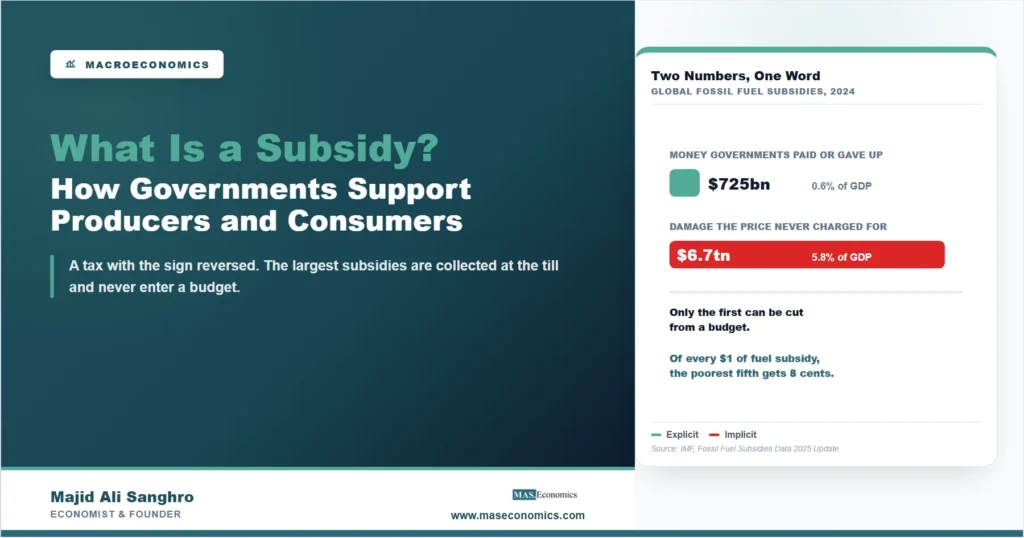
The International Monetary Fund’s latest count of global fossil fuel subsidies reports two figures rather than one. Governments paid out or gave up 725 billion dollars in 2024 by selling fuel below its supply cost. A further 6.7 trillion was the value of environmental and health damage that fuel prices never charged for. Both are called subsidies and they measure different things, and answering what is a subsidy begins with the distinction between them.
A subsidy is a government transfer that lowers the price a buyer pays or raises the price a seller receives, without the market having produced that price on its own. That definition makes it the mirror image of a tax, which raises the price a buyer pays and lowers what a seller keeps. Everything that is true about who really bears a tax turns out to be true, with the sign reversed, about who really receives a subsidy.
A Wedge Driven the Other Way
A tax puts a gap between what the buyer pays and what the seller receives, with the government taking the difference. A subsidy opens the same gap in the opposite direction: the seller receives more than the buyer pays, and the government covers the shortfall.
The consequence is that both sides of the market gain something and neither gains the whole amount. A subsidy of a fixed amount per unit does not reduce the consumer price by that full amount, because part of it is absorbed as a higher price to the producer. The split between the two is not chosen by the legislation. It is set by how responsive each side is to price, which is the same elasticity mechanism described in the article on price elasticity of demand and supply.

The figure also shows the part that is easy to miss. Trade expands past the point where the value buyers place on the last unit equals what it costs to produce, so the extra units are worth less than the resources used to make them. That shaded triangle is a real loss and it belongs to the same family as the loss produced by a tax, described in the article on the welfare cost of market distortions. A subsidy and a tax both distort. They simply distort in opposite directions.
Four Ways the Support Is Delivered
Almost no subsidy arrives as a cheque marked subsidy, which is one reason the total is so hard to see.
The most visible form is a direct budgetary payment: a grant to a producer, a cash transfer to a household, a payment per acre planted or per unit of output. It appears in a spending line and can be counted.
The second form is a tax expenditure, where the government collects less rather than pays more. An exemption, a credit, an accelerated depreciation allowance, or a reduced rate on one product all transfer money in the same direction as a grant. The fiscal effect is identical and the accounting is different, which is exactly why tax expenditures are politically easier to enact and harder to review.
The third form is credit. A loan at below-market interest, a repayment guarantee, or state-backed insurance transfers value without appearing as spending until something goes wrong. The transfer is the difference between the terms offered and the terms the borrower would have faced, and that difference rarely gets measured.
The fourth form is price regulation, and it is the largest of the four in agriculture. A government that keeps the domestic price of a product above the world price by restricting imports transfers money to producers without spending anything at all. Trade instruments are the usual mechanism, and the ones available are catalogued in the overview of tariffs, quotas, and other barriers.
The Support That Never Enters a Budget
The fourth form deserves separate treatment, because it makes the usual question about subsidies, how much do they cost the taxpayer, the wrong question.
The OECD has measured support to agriculture across 54 countries for decades, and its 2025 monitoring report puts total transfers at 842 billion dollars a year over 2022 to 2024. Market price support, which works by holding domestic prices above world prices rather than by paying anyone, generated 334 billion of that. The counterpart is on the household side: the same policies transferred 249 billion dollars a year away from consumers.
A quarter of a trillion dollars a year moves from shoppers to farmers through prices, and none of it passes through a parliament’s spending vote. It is a subsidy in every economic sense and invisible in every fiscal one. This matters for how the policy is judged, because a transfer collected at the till falls hardest on households that spend the largest share of their income on food, which are the poorest.
Support That Runs in Reverse
The same OECD figures contain a result that is rarely reported. Several countries hold domestic prices below world prices, usually to keep food affordable in cities, and the effect on producers is the opposite of support. Across the period, those policies cost producers 179 billion dollars a year.
This is a subsidy to consumers financed by farmers rather than by the state, and it is common in economies where a large share of the population is both poor and urban. The instrument looks like price control and works like a tax on agriculture, which over time reduces the incentive to plant, to invest, and to sell through formal channels. Farmers in those systems are told they are being protected while the price mechanism moves money out of the sector.
The Trillion-Dollar Confusion Over Fuel
Energy subsidies produce the most quoted and most misread number in the field. The distinction that resolves it is between explicit and implicit support.
| Measure | What it counts | Amount | Share of world GDP |
|---|---|---|---|
| Explicit subsidy | Fuel sold below its supply cost, through payments or controlled prices | $725 billion | 0.6% |
| Implicit subsidy | Environmental and health damage left out of the price, mostly air pollution and climate | $6.7 trillion | 5.8% |
|
|
|||
The IMF’s 2025 assessment, covering 170 countries, separates the two deliberately. Only the first is a subsidy in the sense most readers assume, meaning money a government hands over or declines to collect. The second is the value of a cost imposed on other people and never charged to anyone, which is a real economic problem and a different one. Treating an unpriced externality as government spending produces headlines that no finance ministry can act on, because there is no line item to cut. The International Energy Agency’s own subsidy estimates track the narrower consumption measure for the same reason.
The IMF paper also settles an argument about who fuel subsidies reach. For every dollar spent on explicit fuel subsidies, the poorest fifth of households receives about 8 cents. The instrument is defended as protection for the poor and delivers roughly a twelfth of its value to them, because subsidised fuel is allocated by consumption and richer households consume far more of it. A transfer aimed at the same households through cash would cost a fraction as much, which is the standard finding and the standard political obstacle.
When the Support Improves on the Market
None of this makes subsidies inefficient by definition. There is a specific case where a subsidy raises total welfare instead of lowering it, and it is worth stating precisely because it is invoked far more often than it applies.
When an activity produces benefits that the person doing it cannot capture, the market delivers too little of it. A vaccination protects the person vaccinated and everybody they would have infected. Research produces knowledge that competitors eventually use. In those cases the private return is below the social return, output settles below the efficient level, and a subsidy equal to the external benefit moves production toward the right quantity rather than away from it. The geometry of that argument is set out in the article on the positive externality diagram, and the wider category of problems it belongs to in the treatment of market failure and externalities.
Two conditions have to hold for that defence to work. The external benefit has to be real and large enough to justify the transfer, and the subsidy has to be sized to it rather than to the political weight of the recipient. Industrial policy arguments usually claim the first and rarely deliver the second, which is the tension running through the analysis of the semiconductor industry and the account of subsidies in the electric vehicle transition.
Why Subsidies Outlive Their Reasons
A subsidy creates a group of people whose income depends on it, and that group is smaller, better organised, and more certain of what it stands to lose than the taxpayers or consumers who fund it. The cost per funder is small and spread thin. The benefit per recipient is large and concentrated. That asymmetry is enough to explain why removal is so much harder than introduction.
Support also becomes capitalised into the value of whatever is fixed in supply. Where farm payments are tied to land, the expected stream of payments raises the price of land, so the benefit accrues to whoever owned it when the policy began. A farmer who buys land afterwards pays for the subsidy in the purchase price and gains nothing net from it, while still facing ruin if it is withdrawn. Both the defence of the policy and the case against it become true at once.
The OECD’s evaluation of agricultural policy shows how slowly this moves. The share of producer support delivered through the most distorting instruments has fallen by only five percentage points in twenty years, to 66 percent, despite repeated international commitments to reform. What has changed more is the denominator: support as a share of farm receipts fell from 20 percent in 2000 to 2002 to 12.6 percent in 2022 to 2024, largely because the value of output grew rather than because the policies were dismantled.
Every subsidy also has an opportunity cost that never appears in the debate about it. Money committed to holding one price down is money unavailable for anything else, a constraint set out in the article on fiscal space, and where the support is financed by borrowing it becomes part of the deficit discussed in the piece on government budget balances.
MASEconomics Explains
4 economic concepts behind subsidies
These concepts are explored in depth across our educational articles library.
Conclusion
The answer to what is a subsidy is a government transfer that lowers the price a buyer pays or raises the price a seller receives. It is a tax with the sign reversed, and it inherits every property of one: the benefit is split between the two sides of the market by elasticity rather than by legislation, and it distorts quantity in a way that destroys some value unless it is correcting an external benefit that the market has failed to price.
Two measurement problems follow from the definition and explain most of the confusion in public argument. Support delivered through prices rather than payments does not appear in any budget, and the OECD finds 249 billion dollars a year moving from consumers to farmers by that route. And the widely quoted figure of roughly 7 trillion dollars in fossil fuel subsidies mostly measures unpriced environmental damage, not government money; the money itself was 725 billion in 2024. The instrument is easy to define, and the arithmetic of who pays for it and who receives it is where the substance lies.
Frequently Asked Questions
What is a subsidy in simple terms?
A subsidy is government support that lowers the price a buyer pays or raises the price a seller receives. It can arrive as a direct payment, as a tax break, as cheap credit, or as a rule that holds a price above or below what the market would set.
What are the main types of subsidy?
Direct budgetary payments, tax expenditures such as exemptions and credits, concessional credit and state guarantees, and price support delivered through trade restrictions or controlled prices. Only the first appears clearly as spending, which is why totals differ so widely between sources.
Are subsidies good or bad for the economy?
A subsidy raises output above the level the market would reach, which destroys value unless the activity produces benefits the producer cannot capture. Vaccination and research are the standard cases where the transfer improves on the market outcome, and both require the subsidy to be sized to the external benefit.
Who really benefits from a subsidy?
The side of the market that is less responsive to price captures more of it, regardless of who receives the payment. Where support is tied to land or another fixed asset, the benefit is absorbed into the asset’s price, so it accrues to whoever owned it when the policy began.
Why are fuel subsidies criticised if they help the poor?
Because they are allocated by consumption, and richer households consume far more fuel. The IMF finds that for every dollar spent on explicit fuel subsidies, the poorest fifth of households receives about 8 cents, so the same protection could be delivered by cash transfers at a fraction of the cost.
Thanks for reading! The subsidies worth arguing about are usually the ones that never appear in a budget, because nobody has to vote to renew them. Happy learning with MASEconomics