In 2024 the average OECD country collected 34.1 percent of its national output in tax. The United States collected 25.6 percent, which placed it 31st of the 38 members, while Denmark collected 45.2 percent and Mexico 18.3 percent. Those gaps are usually read as a disagreement about how large government should be. Answering what is a tax properly shows that a large part of the gap is about something else: which activities a country has decided to tax at all.
The instrument itself is simple to define and unusually easy to misread. Almost every tax is written into law as a charge on one party and ends up being paid, in economic terms, by another. The distance between those two answers is where most of the interesting economics sits.
A Payment With No Direct Return
The OECD’s revenue statistics define taxes as compulsory, “unrequited payments to the general government”, meaning that what a taxpayer receives back is not proportional to what they hand over. That word does the defining work. A bus fare is compulsory in the sense that the bus will not move without it, but it buys a specific journey. A tax buys nothing specific. It buys a share in whatever the government does, whether or not the payer uses any of it.
This is not an accounting quirk. It is the reason taxation exists at all. Some things cannot be sold to individual users because nobody can be excluded from the benefit and one person’s use does not reduce another’s, a category examined in the article on public goods and private goods. Nobody would voluntarily pay their share of a legal system or a coastal defence, since the benefit arrives whether they pay or not. Compulsion is the mechanism that solves that problem, and unrequitedness is what compulsion produces.
Once a government can compel payment, it acquires three further uses for the power beyond raising money. It can shift resources between households, which is the redistributive function. It can change relative prices to discourage activity that imposes costs on others, which is why a charge on pollution behaves differently from a charge on wages, as set out in the treatment of taxes and welfare loss under a negative externality. And it can dampen or stimulate total spending across a cycle, the role described in the overview of fiscal policy objectives. Revenue is the primary purpose, and it is not the only one.

The Bases a Tax Sits On
Every tax has to attach to something measurable. The OECD classification sorts them by that base rather than by name, which is the only way to compare countries whose taxes are called different things.
Income taxes attach to what a person or company earns. Social security contributions attach to wages specifically and are usually tied, at least nominally, to a benefit entitlement. Taxes on goods and services attach to transactions, either broadly through a value added tax or narrowly through excise duties on fuel, alcohol, and tobacco. Property taxes attach to assets held rather than income earned or money spent. Payroll taxes on the employer, and a residual category of everything else, make up the remainder.
The same revenue can be raised from any of these bases, and the choice is not neutral. A base that is easy to observe is easy to tax, which is why wages paid by registered employers are taxed heavily almost everywhere while income earned in cash is not. The United States Treasury’s own revenue accounts show the same pattern in the composition of federal collections. A base that can move is hard to tax, which is why corporate profit is the most contested of the five. The OECD’s annual revenue statistics exist precisely because these classifications differ enough between countries that raw national figures cannot be compared.
Who Pays Is Not Who Is Named
A tax law names a payer. Economics asks a different question: whose real income falls when the tax is introduced. The first answer is the statutory incidence, the second is the economic incidence, and they routinely differ.
The clearest case in any national system is the American payroll tax. The law assesses it half on the employee and half on the employer, at the same rate on each side. The Social Security Administration’s published rate schedule shows 6.2 percent for old-age and survivors insurance plus 1.45 percent for hospital insurance on each of the two parties since 1990, a combined 7.65 percent each. The same schedule shows the self-employed paying 15.3 percent, which is exactly the two halves added together.
That last figure gives the game away. A self-employed worker is one person, and the law charges them both halves because there is nobody else to charge. The split into employer and employee shares is a collection convenience, not an economic division. What actually determines who bears a payroll tax is how wages respond, and since labour supply is relatively unresponsive to small wage changes while employers can adjust hiring and pay, the weight of the evidence puts most of the burden on the worker regardless of which half the law names.
Elasticity Decides Where the Burden Lands
The general rule behind that example is short. A tax is borne by whichever side of the market has fewer alternatives. Responsiveness to price is measured by elasticity, and the relationship between the two measures is developed in the article on price elasticity of demand and supply.
Consider a fixed charge on each unit sold. If buyers have few substitutes, as with fuel for a commuter with no alternative route, they keep buying when the price rises and the seller can pass nearly the whole charge forward. If buyers switch easily, as with one brand among many on the same shelf, the seller who raises the price loses the sale, so the charge comes out of the margin instead. The statute is identical in both cases. The outcome is not.
The same logic explains a result that surprises people about trade policy. An import duty is collected from the importing firm, and the question of how much of it reaches the shelf price is settled by elasticity in exactly the same way, which is the argument traced in the piece on who actually pays a tariff. Naming the payer in the legislation settles the paperwork and nothing else.
The Cost That Raises No Revenue
A tax moves money from private hands to public ones, and that transfer is not itself a loss to the economy. The loss comes from the transactions that stop happening.
When a charge drives a wedge between what a buyer pays and what a seller receives, some exchanges that both parties would have wanted no longer clear. Nobody gets that value. The buyer does not enjoy the good, the seller does not earn the margin, and the government collects nothing on a sale that never occurred. Economists call the missing value deadweight loss, and it is developed further in the article on the welfare cost of market distortions.
Two properties of that loss shape almost all practical tax design. It grows roughly with the square of the rate, so doubling a tax rate quadruples the waste, which argues for broad bases at low rates rather than narrow bases at high ones. And it is larger where behaviour responds more, so the same rate wastes more when applied to something people can easily stop doing. Taken far enough, the second property means a higher rate can eventually collect less money, the possibility set out in the discussion of the Laffer curve, though where any real economy sits on that curve is an empirical question rather than a slogan.
Marginal Rates and Average Rates
Rate structures are described by what happens to the share of income taken as income rises. A progressive tax takes a larger share from higher incomes, a proportional tax takes the same share throughout, and a regressive tax takes a smaller share as income rises. Most consumption taxes are regressive against annual income, because lower-income households spend a larger fraction of what they earn.
The confusion that recurs most often in public argument concerns two different rates. The marginal rate applies only to the next unit of income earned. The average rate is total tax divided by total income. In a bracketed system, moving into a higher bracket applies the higher rate only to the income above the threshold, so a raise never leaves a worker with less take-home pay through the rate schedule alone. The average rate always sits below the top marginal rate faced.
Where a tax system lands overall depends on the whole package rather than any single rate, since a country can combine a regressive consumption tax with transfers that more than offset it. That combined effect is what measures of distribution actually capture, as discussed in the article on the economics of inequality, and it is the reason the Nordic model can pair heavy consumption taxation with low measured inequality.
America Taxes Consumption Least
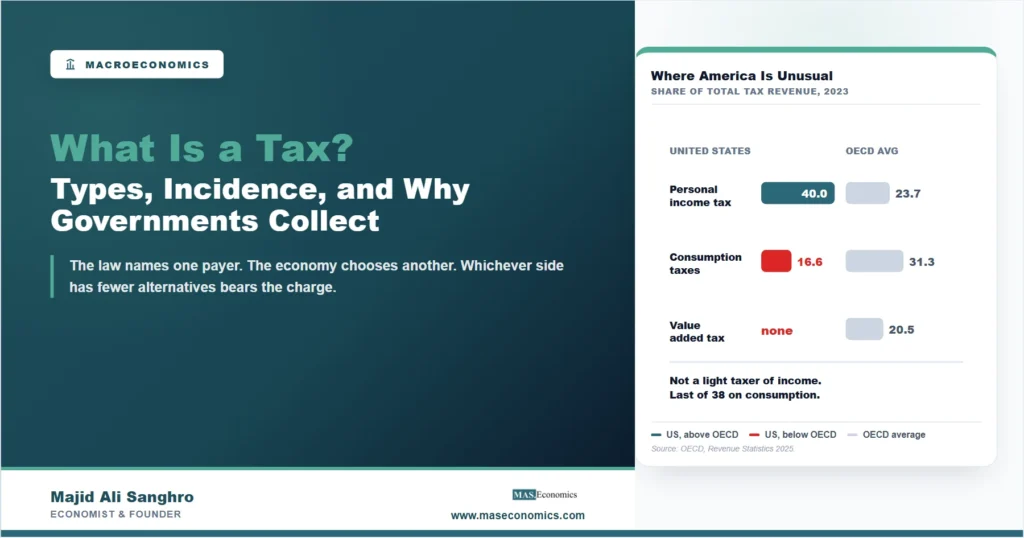
The United States collects 8.5 percentage points of GDP less than the OECD average. The usual explanation is that Americans have chosen smaller government. The composition of the revenue tells a more specific story.
| Share of total tax revenue | United States | OECD average |
|---|---|---|
| Personal income tax | 40.0% | 23.7% |
| Corporate income tax | 8.6% | 11.9% |
| Social security contributions | 23.5% | 25.5% |
| Taxes on property | 11.3% | 5.1% |
| Value added tax | 0.0% | 20.5% |
| Other consumption taxes | 16.6% | 10.8% |
| All other taxes | 0.1% | 2.6% |
|
|
||
The United States is not a light taxer of income. It draws 40 percent of all its revenue from personal income tax against an OECD average of 23.7 percent, and it leans on property taxes at more than twice the OECD rate. Where it is unusual is consumption. It has no value added tax at all, and its state sales taxes and excises bring total consumption taxation to 16.6 percent of revenue against 31.3 percent across the OECD. On taxes on goods and services the country ranks last of the 38 members.
That single structural choice accounts for a large share of the transatlantic gap in tax levels, because the value added tax is the workhorse that lets European states collect a third of national output without pushing income tax rates to politically impossible levels. It also explains why American tax debates concentrate so heavily on income and so little on consumption: the base that carries most of the revenue elsewhere barely exists there.
The consequence reaches beyond the United States. A country that taxes 8.5 points of GDP below the OECD average without spending correspondingly less has to borrow the difference, and the article on budget deficits and surpluses sets out how that gap becomes debt issuance. Because that borrowing is absorbed in a global capital market, an American decision about which base to tax shows up in the interest rate that governments and firms in other countries pay. Households in Karachi and Nairobi never vote on the American tax mix and are affected by its financing all the same.
Where Tax Systems Run Out of Reach
Every tax system is limited by what its administration can see. A charge on a base that cannot be observed is a charge on honesty, and it collects accordingly.
This is why the composition of tax revenue in lower-income economies looks so different. Where a large share of activity is unregistered, cash-based, or agricultural, income tax reaches only the formal workforce, and governments lean instead on trade taxes and consumption taxes collected at a small number of chokepoints. The result is a system that raises less money and distributes the burden less evenly than the statute books suggest.
Mobility of the base is the second limit, and it bites hardest at the top. Wages are earned where a person lives, but corporate profit can be booked where the tax rate is lowest, and financial income can be held through vehicles in other jurisdictions. Tax competition between countries is a direct consequence, and it is the reason corporate tax rates have converged downward across four decades while personal income taxes on wages have not.
The third limit is political rather than technical. Taxes that are efficient are often unpopular, and taxes that are popular are often narrow. A broad consumption tax is administratively strong and visibly regressive, which is exactly the combination that makes it difficult to legislate and durable once enacted.
MASEconomics Explains
4 economic concepts behind taxation
These concepts are explored in depth across our educational articles library.
Conclusion
The answer to what is a tax is a compulsory payment to government that buys the payer nothing in particular. That definition explains why taxation is the only workable way to finance goods nobody can be excluded from, and why the power to compel gets used for redistribution and for changing prices as well as for raising money.
Two facts do most of the analytical work afterwards. The party named in the law is not reliably the party whose income falls, because the burden settles on whichever side of the market has fewer alternatives, and the American payroll tax shows the legal split to be a collection convenience. And the level of taxation in a country is not a single decision but the sum of decisions about bases, which is why the United States can be a heavier taxer of personal income than the OECD average and a much lighter taxer overall, having declined to tax consumption at all through a value added tax. National tax figures describe systems that were built one base at a time. Reading them as a single verdict on the size of government loses most of the information.
Frequently Asked Questions
What is a tax in simple terms?
A tax is a compulsory payment to government that does not buy any specific service in return. What a taxpayer receives back is not proportional to what they pay, which is what separates a tax from a fee, a fine, or a price.
What are the main types of tax?
Taxes are classified by the base they attach to: income and profits, wages through social security contributions, goods and services through value added tax and excise duties, property, and payroll. The same amount of revenue can be raised from any of them, with different effects.
What is tax incidence?
Tax incidence is the question of whose real income falls because of a tax, as distinct from who the law requires to pay it. The burden settles on whichever side of the market is less able to change its behaviour, so a tax collected from sellers can be borne almost entirely by buyers.
Does moving into a higher tax bracket reduce take-home pay?
No. In a bracketed system the higher rate applies only to income above the threshold, not to the whole amount. The average rate paid always stays below the top marginal rate, so a pay rise never reduces net income through the rate schedule alone.
Why does the United States have no VAT?
Consumption taxation in the United States is levied by states as sales taxes and by the federal government as narrow excise duties, and no federal value added tax has ever been enacted. As a result the country raises 16.6 percent of its revenue from taxes on goods and services against an OECD average of 31.3 percent, the lowest share among the 38 members.
Thanks for reading! The most useful question to ask about any tax is not what it is called but what it attaches to, because the base decides almost everything that follows. Happy learning with MASEconomics