In the spring of a recession, before any legislature has met, before any minister has announced a package, and before a single economist has agreed on how bad it is, the government’s deficit has already started to grow. Income tax receipts fall as overtime disappears and bonuses are cut, and they fall faster than incomes do, because the last dollar earned was taxed at the highest rate. Unemployment benefit claims rise as jobs are lost. Sales tax receipts drop with spending, and corporate tax receipts, the most sensitive of all, collapse with profits. None of this required a decision. Automatic stabilizers are the parts of a tax and benefit system that move against the cycle on their own, cushioning household income when the economy weakens and withdrawing support when it recovers, and in most rich economies they do more of the work of fiscal stabilization than the packages that make the news. They are also the reason a recession is always accompanied by an alarming deficit that is, in large part, the system working as designed.
What Moves on Its Own, and Why It Moves the Right Way
A stabilizer is any feature of the budget whose revenue or spending responds to the state of the economy without a new decision. On the revenue side the principal one is the income tax, and its stabilizing power comes from two properties. It is levied on income, so receipts fall when income falls; and it is progressive, so that the income lost in a downturn, which is disproportionately the overtime, the bonuses and the top slice of earnings, was being taxed at above-average rates. A household that loses a fifth of its income may lose a third of its tax bill, and the difference cushions its spending. Corporate income tax behaves the same way with more violence, since profits are the residual after costs and swing far more than revenue. Consumption taxes stabilize less, because spending falls less than income, but they still fall.
On the spending side the principal stabilizer is unemployment insurance, which pays out precisely to the people who have just lost their earnings and have the highest propensity to spend whatever replaces them. Means-tested transfers, food assistance, housing support, income supplements for the low paid, expand as more households qualify. Pensions and health spending do not respond to the cycle and are not stabilizers, however large they are. The distinction is not the size of the program but whether its flows track the economy. The pieces our article on fiscal policy lays out are all present here; what stabilizers add is that these particular pieces act without anyone acting.

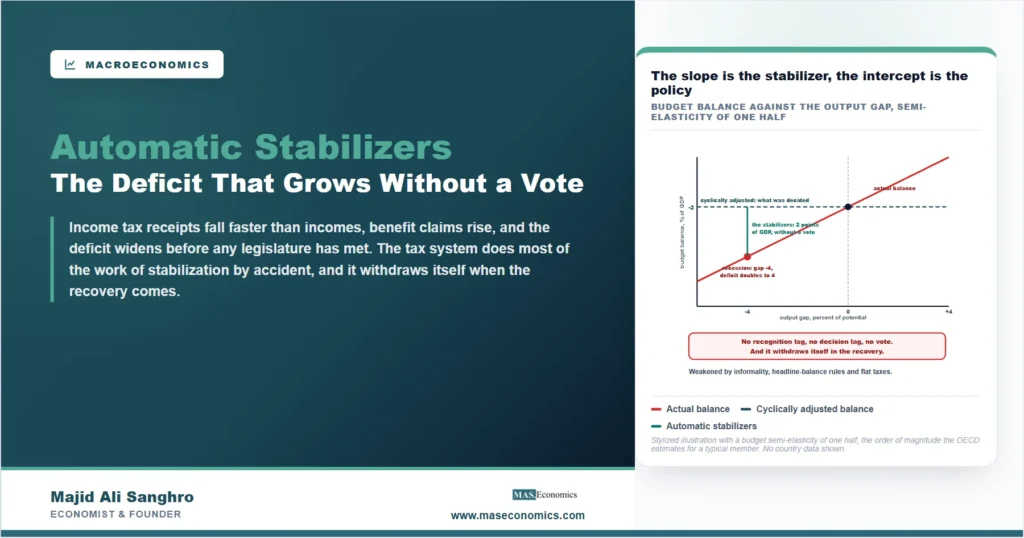
Stylized illustration with a budget semi-elasticity of one half, the order of magnitude the OECD estimates for a typical member economy. No country’s data is shown.
Measuring the Stabilizer: The Slope of the Budget Against the Cycle
The standard measure is the semi-elasticity of the budget balance with respect to the output gap: by how many percentage points of GDP the balance moves when output moves one percent away from potential. It is the slope of the red line in the figure, and it is built up from the parts: how much each tax base moves with output, how progressive each tax is, and how much unemployment spending rises per point of lost output. The OECD, which publishes these estimates for its members, finds values around one half for the typical economy, higher in the large European welfare states and lower in the United States, Japan and the economies with smaller governments and flatter taxes. A semi-elasticity of one half means a recession that takes output four percent below potential widens the deficit by two percent of GDP with no change in policy at all.
The same identity gives the concept that fiscal analysts actually watch: the cyclically adjusted, or structural, balance, which is the actual balance with the stabilizers stripped out. It is the intercept of the line, the deficit the government would run if output were at potential, and it is the measure of what has been decided rather than what has happened. The distinction matters in both directions. A deficit that widens in a recession is not evidence of loosening if the structural balance is unchanged; a deficit that narrows in a boom is not evidence of discipline if the structural balance has not moved. The European fiscal rules are written in structural terms for exactly this reason, and the arguments over them are largely arguments over the output gap, which is unobservable and is revised for years after the fact. Our article on fiscal space covers how much room the structural position leaves, and our article on budget deficits and surpluses covers the headline number that the stabilizers move.
| Instrument | Direction in a downturn | Strength | Where the strength comes from |
|---|---|---|---|
| Personal income tax | Receipts fall faster than income | Large | Progressive rates; the income lost first was taxed at the highest marginal rate |
| Corporate income tax | Receipts collapse with profits | Large per unit, volatile | Profits are a residual and swing far more than output |
| Social contributions and payroll taxes | Receipts fall with employment | Moderate | Proportional to wages; capped in some systems, which weakens the effect |
| Consumption taxes | Receipts fall with spending | Small | Spending falls less than income; flat rates add no progressivity |
| Unemployment insurance | Spending rises with job loss | Large per recipient | Pays exactly the households whose earnings have stopped; high propensity to spend |
| Means-tested transfers | Spending rises as more households qualify | Moderate | Eligibility tracks income; take-up and administrative lags reduce it |
| Pensions, health, defense, debt interest | Do not respond to the cycle | None | Large but acyclical; size is not the same as stabilizing power |
|
|
|||
Why They Work Better Than the Packages
Discretionary fiscal policy, the stimulus package voted through in a crisis, suffers from three lags that the economics textbooks have named since the 1960s. There is a recognition lag, the months before the data confirm that a recession has begun; a decision lag, the time a legislature takes to agree what to do; and an implementation lag, the time between the vote and the money reaching anyone. Added together they have often exceeded the length of the recession they were meant to fight, so that the stimulus arrived as the recovery was already under way and added to the boom instead of cushioning the slump. Stabilizers have none of these lags. They respond in the same pay period in which income falls, they need no agreement, and they reach exactly the households and firms whose income has dropped, which is also where the propensity to spend the support is highest. Our article on countercyclical fiscal policy sets out the case for leaning against the cycle; the stabilizers are the part of that case that does not depend on anyone getting the timing right.
They also do something discretionary policy cannot: they withdraw themselves. A stimulus package, once passed, is spent whether or not the economy still needs it, and the political difficulty of ending support that has become expected is one reason deficits ratchet upward across cycles. Stabilizers reverse on their own as incomes recover, tax receipts climb faster than output and benefit claims fall, so that the same features that widened the deficit in the slump narrow it in the recovery without a decision to tighten. The symmetric part is the least appreciated: in a boom, the stabilizers are a drag that keeps the economy from overheating, and a government that spends the boom-time revenue windfall as if it were permanent has quietly disabled half the mechanism.
The multiplier arithmetic shows the same thing from the demand side. In the simplest model of spending and income, which our article on the Keynesian cross sets out, the multiplier on any shock is one over one minus the fraction of each extra dollar of income that is spent. A proportional income tax at rate \(t\) cuts the fraction that reaches households to \(1 – t\), so the multiplier falls from \(1/(1 – c)\) to \(1/(1 – c(1 – t))\); with a propensity to consume of 0.8 and a tax rate of 0.3, the multiplier drops from 5 to about 2.3. A shock that would have halved output in a world without taxes is more than halved in its effect by the tax system alone, before any benefit is paid. The estimates of that damping in modern models, which our article on the fiscal multiplier discusses, are smaller than the textbook numbers but the mechanism is identical.
Where They Are Weak, and Who Weakens Them
Stabilizers can only cushion income that runs through the tax and benefit system. Workers in informal employment, the self-employed with irregular earnings, and those who have exhausted their benefit entitlement receive little, and in economies where much of the workforce is informal the stabilizers are correspondingly small, which is one reason downturns in such economies fall so heavily on households. Stabilizers also only smooth; they do not offset. A semi-elasticity of one half means the government absorbs about half of each point of lost output in its own balance, but the other half still lands on households and firms, and a deep enough shock overwhelms the mechanism, which is what the discretionary packages of 2008 and 2020 were for. The two are complements, and the debate over which matters more is usually a debate about the size of the shock.
The stabilizers can also be undone by other parts of the same government. Sub-national governments that are required to balance their budgets each year cut spending and raise taxes in a recession, exactly when their revenue falls, and their procyclical response offsets part of the central stabilizer. The United States is the clearest case: state balanced-budget rules turn the states into destabilizers in every downturn, and a large part of federal emergency legislation has historically consisted of transfers to the states to stop them cutting. A fiscal rule at the national level that targets the headline balance rather than the structural balance does the same damage, by forcing a tightening in the slump to offset the stabilizers’ own effect, which is why the rules economists defend are written in structural terms and the rules they criticize are not. Whether a government has the room to let its stabilizers run is a question about its debt position, which our article on sovereign debt sustainability takes up: a government that markets will not lend to in a recession loses the automatic response along with the discretionary one.
The final weakness is that stabilizers are the accidental product of decisions made for other reasons. Nobody designed the income tax to smooth the cycle; it is progressive for reasons of fairness and revenue, and the stabilizing property is a by-product. That means their strength drifts with tax reform. Flattening the income tax, capping payroll contributions, tightening benefit eligibility or shortening benefit duration all weaken the stabilizers, usually without anyone noting it, and several decades of such reforms have left the stabilizers in some economies weaker than they were. Proposals to build stabilizers deliberately, unemployment benefits that extend automatically when the unemployment rate crosses a threshold, transfers that trigger on a state’s employment data, tax rebates that pay out on a published rule, are attempts to make on purpose what the tax system once did by accident, and to take the recognition and decision lags out of the part of policy that has always suffered most from them.
MASEconomics Explains
3 concepts behind the deficit that grows without a vote
These concepts are explored in depth across our educational articles library.
Conclusion
Automatic stabilizers are the features of a tax and benefit system that move against the cycle on their own: a progressive income tax whose receipts fall faster than incomes, a corporate tax that collapses with profits, and unemployment and means-tested benefits that expand as earnings stop. Their strength is measured by the slope of the budget balance against the output gap, around half a point of GDP per point of gap in a typical rich economy, and the intercept of that line, the cyclically adjusted balance, is the measure of what was actually decided. A deficit that widens in a recession is, to that extent, the system working.
They do what discretionary packages struggle to do, because they have no recognition, decision or implementation lag, they reach exactly the households whose income fell, and they withdraw themselves in the recovery. They are weak where income does not run through the system, they smooth rather than offset, and they can be undone by sub-national balanced-budget rules, by headline-balance fiscal rules and by tax reforms that flatten rates or tighten benefits without noticing what else those reforms do. The proposals to build stabilizers deliberately, with benefits and transfers that trigger on published data, are attempts to keep on purpose a mechanism that the tax system produced by accident, and that has done more of the work of stabilization than the policies that were designed for it.
Frequently Asked Questions
What are automatic stabilizers?
Features of the tax and benefit system that respond to the state of the economy without any new decision: income and corporate taxes whose receipts fall in a downturn, and unemployment insurance and means-tested transfers whose payments rise. They cushion household income when output falls and withdraw support when it recovers, and they act in the same pay period in which incomes change.
How are automatic stabilizers different from discretionary fiscal policy?
Discretionary policy is a new decision, such as a stimulus package, and it suffers from recognition, decision and implementation lags that have often exceeded the recession it was meant to fight. Stabilizers need no decision, have no lags, reach exactly the households whose income has fallen, and reverse on their own as the economy recovers. The two are complements; a large enough shock needs both.
How large are automatic stabilizers?
They are measured by the semi-elasticity of the budget balance to the output gap: the change in the balance, in points of GDP, per percent of output gap. The OECD estimates it at around one half for a typical member economy, higher in the large European welfare states with progressive taxes and generous benefits, lower in economies with flatter taxes and smaller governments. A four-percent shortfall in output then widens the deficit by about two percent of GDP.
What is the cyclically adjusted budget balance?
The budget balance with the effect of the cycle removed: the deficit the government would run if output were at potential. It isolates policy decisions from the automatic movement of taxes and benefits, so that a deficit widening in a recession is not mistaken for a loosening. Fiscal rules that target the structural balance rather than the headline balance do so to let the stabilizers work.
Why is the progressive income tax the main stabilizer?
Because the income lost first in a downturn, overtime, bonuses and the top slice of earnings, was taxed at the highest marginal rates, so tax receipts fall by a larger proportion than income does and the household keeps a larger share of what remains. In the simple multiplier model a proportional tax at rate t reduces the multiplier from one over one minus c to one over one minus c times one minus t; progressivity strengthens the effect further.
What weakens automatic stabilizers?
Informal employment and exhausted benefit entitlements, which put income outside the system; sub-national balanced-budget rules that force spending cuts in a recession; national fiscal rules written in headline rather than structural terms; and tax and benefit reforms that flatten rates, cap contributions or shorten benefit duration. Because stabilizers are a by-product of decisions made for other reasons, their strength drifts unless it is protected deliberately.
Thanks for reading! The deficit that appears in a recession is, in large part, the tax system doing its job before anyone asked it to. Happy learning with MASEconomics