A manufacturer asks its bank to price a loan for a second production line and the quote comes back higher than the one it was given eight months earlier, high enough that the project no longer clears the board’s hurdle rate, so the line is postponed and the forty jobs it would have carried are postponed with it. Nothing about the firm has changed. What changed is the price of borrowed money, and part of the reason it changed is that the government has been issuing bonds to fund a road program. That sequence is the whole of crowding out: public borrowing bids for the same finance and the same real resources that private investment wants, and some private investment loses the auction. The idea is old, straightforward, and almost always argued badly, because it is usually deployed as a constant, government borrowing destroys private investment, when it is in fact a variable whose size depends on conditions that can be stated precisely. Getting from the slogan to the mechanism means separating three things the argument usually blends: how the squeeze works, what decides its size, and where it lands in an economy open to the rest of the world, which is not where most readers expect.
Two Ways the Same Resources Get Taken
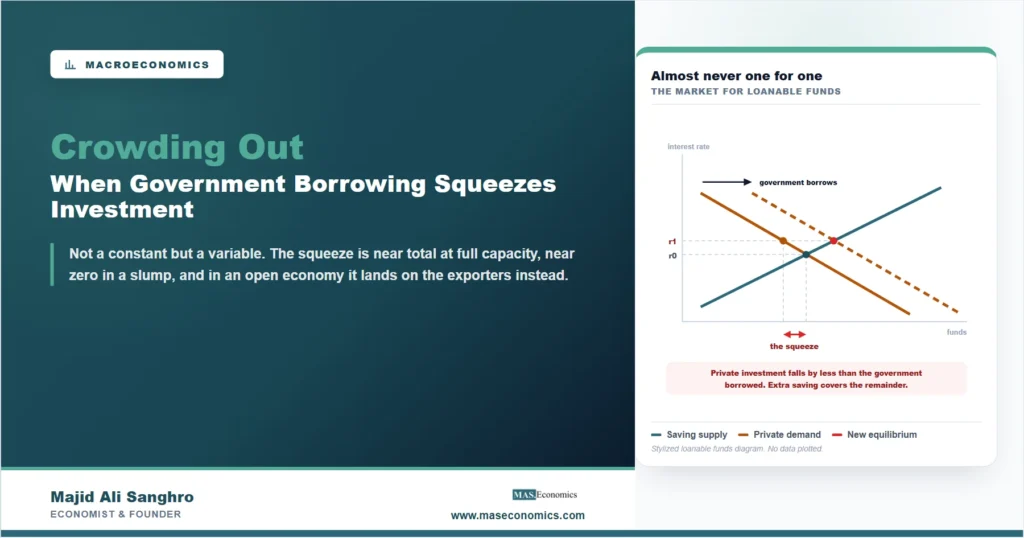
The familiar channel is financial. A government running a deficit covers it by selling bonds, which places it in the same market as every firm looking for finance, and our beginner’s guide to how governments and firms borrow covers the instrument itself. The pool of funds available at any moment comes from saving, and adding a large, price-insensitive borrower to the demand side raises the price of funds, the interest rate. At the higher rate, the projects that were only marginally worth doing stop being worth doing: the warehouse extension with a nine percent expected return survives a seven percent cost of finance and does not survive ten, so it disappears from the economy’s investment total without anyone announcing it. The reader who has watched a mortgage quote move has already met this mechanism from the household side. What matters, and what the slogan gets wrong, is the arithmetic of the squeeze. The government does not remove one rupee of private investment for every rupee it borrows, because the higher rate does two other things at once: it draws out additional saving from people who would otherwise have spent, and, in an open economy, it attracts funds from abroad. Both of those meet part of the government’s demand, so private investment falls by less than the amount borrowed. How much less is the entire question, and it is decided by how responsive saving is to the rate, not by anything about the spending itself.
The second channel gets far less attention and is the more fundamental of the two, because it survives even when the finance is free. An economy running at capacity has a fixed quantity of engineers, cement, cranes, and skilled labor available this year. When the government builds the road, it hires the engineers who would otherwise have designed the warehouse, buys the cement that would otherwise have poured its floor, and rents the crane that would otherwise have raised its frame. That competition is real, not financial, and it appears as higher input prices and longer waiting lists rather than as a higher interest rate. The distinction matters because it settles an argument that comes up whenever someone proposes financing a deficit by other means: a government that funds itself by creating money rather than by borrowing has not escaped crowding out, it has changed the form the squeeze takes, from a higher interest rate to a higher price level, and the warehouse is canceled either way. At full capacity the resources have to come from somewhere, and the only question a financing method settles is who is made to give them up and through which discomfort.
The Size Is a Variable, and Slack Is What Sets It
Everything above assumed a fully employed economy, which is where the crowding-out argument is strongest and where it is almost never being made. Change the assumption and the mechanism weakens or reverses. In a downturn, the engineers are not busy, the cement plant is running at half capacity, and the crane is sitting in a yard. The government hiring them takes nothing from anyone, because the alternative use of those resources was idleness, and the income it pays out becomes somebody’s spending, which is why the effect on total output can exceed the money spent at all. That is the territory of the fiscal multiplier, whose size and the crowding-out coefficient are the same quantity seen from opposite ends: the more crowding out, the smaller the multiplier, and the arithmetic that links them is set out in our article on the Keynesian cross. The financial channel weakens for the same reason. When the policy rate is at its floor and firms will not borrow at any price because they cannot see the demand, extra government borrowing does not push a market-clearing rate upward in the way the diagram suggests, a condition examined in our piece on the liquidity trap. Crowding out is therefore a state-dependent quantity, close to complete when an economy is at capacity and close to zero when it is far from it, and any sentence that treats it as a fixed property of government spending has dropped the condition that gives it meaning.
Two refinements are worth carrying. The first is that the sign can flip. Public investment that raises the return on private capital pulls investment in rather than pushing it out: the road that makes a warehouse worth building at that location has raised its expected return, and a firm that could not justify the project before the road can justify it after. Crowding in is not a rhetorical device, it is the same calculation with a different input, and it makes the composition of the deficit matter as much as its size. Borrowing to build capacity and borrowing to fund current consumption have different consequences for the private investment that follows, which is one reason our guide to fiscal policy objectives treats the two separately, and why the headline in our article on budget balances tells you less than the ledger beneath it. The second refinement runs the other way. If households understand that today’s borrowing implies tomorrow’s taxes and save the whole deficit in anticipation, the saving curve shifts right by exactly the amount borrowed, the rate does not move, and crowding out is zero. That is Ricardian equivalence in its pure form, and it is best treated as a boundary case rather than a description: the private saving response to public deficits is real and partial, not complete, so the truth sits between the two extremes rather than at either.
The Open Economy Version: The Squeeze Lands Somewhere Else
The closed-economy diagram assumes the only saving available is domestic, and for most countries that has not been true for decades. Once capital can cross borders, a rise in the domestic interest rate attracts foreign funds, which meets part of the government’s demand and dampens the rate increase, so domestic investment is squeezed less than the closed model predicts. It would be a mistake to read that as escape. The capital coming in has to be converted into local currency, which raises the exchange rate, and a stronger currency makes exports dearer abroad and imports cheaper at home. The resources are still being taken; they are simply taken from a different set of firms. The exporter who loses an order to a competitor in another country has been crowded out by a deficit just as surely as the manufacturer who could not afford the loan, and the mechanism that produces this result is set out formally in the Mundell-Fleming model, with the closed-economy version in our guide to the IS-LM framework. It is also the standard explanation for why large fiscal deficits and large trade deficits are so often observed together. The practical lesson is uncomfortable for both sides of the usual argument: the squeeze does not vanish in an open economy, it moves, and it lands on the traded goods sector, which is often the part of an economy a government is separately trying to build up.
For many developing economies the channel changes shape again, and this version rarely appears in the textbook treatment even though it describes the largest number of people. Where capital markets are thin and banks are the main lenders, the government does not need to raise a market-clearing interest rate to crowd out private borrowers; it can crowd them out by quantity. A bank that can lend to the state at an attractive rate, with no credit analysis and no default risk in domestic currency, has little reason to work up a loan file for a mid-sized firm, so its balance sheet fills with government paper and private credit simply becomes unavailable to borrowers who never see a price signal at all. They are refused, or never approached. That is a large part of what our article on fiscal dominance describes, and it explains why credit to the private sector can stay flat for years in economies where the reported interest rate looks unremarkable. The same logic travels internationally. The United States is the largest borrower in the world and its Treasury issuance helps set the global risk-free rate, so when American deficits push term premia up, the hurdle rate rises for a firm in Karachi, Nairobi, or Jakarta that has no connection to American fiscal policy and no vote in it. Crowding out is exported, it moves at the speed of a bond market rather than a trade flow, and the effect on rate-sensitive borrowing in economies carrying heavy debt loads is the subject of our piece on what high public debt has done to rate cuts.
MASEconomics Explains
3 economic concepts behind crowding out
These concepts are explored in depth across our educational articles library.
Explore the MASEconomics BlogConclusion
Crowding out is the displacement of private investment by government borrowing, and it works through two channels that are usually collapsed into one. The financial channel adds a large borrower to the market for saving, raises the interest rate, and removes the projects that no longer clear it, though never one for one, because the higher rate pulls in additional saving that covers part of the government’s demand. The real channel is the deeper one: an economy at capacity has a fixed stock of engineers, materials, and equipment this year, and whoever gets them, the other party does not, which is why changing the method of financing a deficit changes the form of the squeeze rather than removing it.
The part worth carrying away is that the size is conditional. Crowding out is close to complete when an economy is running at capacity, close to zero when it is not, and can turn negative when what the borrowing buys raises the return on private capital. It also moves. In an open economy the capital inflow that softens the rise in interest rates strengthens the currency instead, so the squeeze arrives at the exporter rather than at the domestic investor; where banks dominate lending, it arrives as a refusal rather than as a price; and because the largest borrower in the world helps set the global risk-free rate, it arrives in economies whose own fiscal choices had nothing to do with it. None of this settles whether a particular deficit is worth running. It does mean that the honest version of the argument names the condition, the channel, and the party that pays, and that any version without those three is a slogan rather than an analysis.
Frequently Asked Questions
What is crowding out in simple terms?
It is what happens when government borrowing competes with private borrowing for the same finance and the same real resources, so some private investment does not happen. The competition shows up as a higher interest rate, as higher prices for materials and skilled labor, or, where banks dominate lending, as a loan application that is simply refused.
Does every rupee or dollar the government borrows remove one of private investment?
No, and that is the most common error in the argument. The higher interest rate draws out additional saving from people who would otherwise have spent, and in an open economy it attracts capital from abroad. Both meet part of the government’s demand, so private investment falls by less than the amount borrowed. The share depends on how responsive saving is to the rate.
Does crowding out happen during a recession?
Much less, and sometimes not at all. Crowding out requires that the resources had another use. When workers are unemployed, factories are running below capacity, and firms will not borrow at any price because they cannot see the demand, government spending competes with idleness rather than with private projects, which is why the fiscal multiplier is largest in exactly the conditions where crowding out is smallest.
What is crowding in?
The opposite case, where public spending raises the expected return on private capital and brings investment forward rather than displacing it. Infrastructure is the clearest example: a road, a port, or a power connection can make private projects viable that were not viable before. It is why the composition of a deficit, what the borrowing actually buys, matters alongside its size.
Who gets squeezed in an economy open to foreign capital?
Often the exporters rather than the domestic investors. Foreign capital drawn in by the higher interest rate dampens the rise in borrowing costs, but converting it into local currency strengthens the exchange rate, which makes exports dearer abroad and imports cheaper at home. The resources are still taken; they are taken from the traded goods sector instead of from domestic investment.
Thanks for reading! The useful question is never whether crowding out exists but whether the engineers were busy, and who ends up paying when they were. Happy learning with MASEconomics