When a central bank decides where to set interest rates, somebody in the building has run a model whose households live forever, whose firms reset prices on a schedule, and whose economy is hit each quarter by shocks nobody can predict. That model is almost certainly a DSGE model, and versions of it run at the Federal Reserve, the European Central Bank, the Bank of England and the International Monetary Fund. The label attracts strong opinions, most of which treat it as a school of economic thought. It is not one. It is a grammar, a set of three commitments about how a macroeconomic model should be built, and economists who disagree fundamentally about how the economy works nonetheless write their disagreement in it. Understanding what the three commitments are, and which arguments they settle and which they leave wide open, is the difference between reading this literature and being pushed around by it.
Three Words, Three Commitments
The name is an instruction manual. Each word rules something out, and together they describe a class of models rather than a conclusion about the economy.
Dynamic means the model is about decisions taken over time by people who are looking ahead. A household choosing how much to consume this quarter is choosing how much to leave for every quarter after it, and it makes that choice knowing what it expects to happen. This is where the intertemporal optimisation in our article on dynamic programming enters macroeconomics, and it is why expectations about the future appear in equations describing today.
Stochastic means the economy is pushed around by random shocks rather than following a fixed path. Productivity jumps or falls, government spending changes, the central bank departs from its usual rule, households become more or less patient. The model does not predict when these happen. It describes how the economy responds when they do, which is a different and more modest ambition than forecasting.
General equilibrium means everything is solved together. Households supply labour and buy goods, firms hire that labour and set those prices, and the wage and the price level have to be consistent with both sides at once. Nothing is taken as given from outside the model except the shocks, so a policy that changes firms’ behaviour also changes what households do, and the model works out both at the same time.
Underneath the three words sits a fourth commitment that the name leaves out and that does most of the arguing: microfoundations. Every equation has to come from somebody solving a problem. The consumption equation is not fitted to data; it is derived from a household maximising utility subject to a budget constraint. That derivation produces the condition at the heart of every DSGE model, which says that a household at its optimum is indifferent between spending one more unit today and saving it at the going return.
The expectation operator is the whole modern apparatus in one symbol. The household is not reacting to what happened; it is acting on what it expects, in the sense our article on rational expectations sets out, and it uses the model’s own structure to form that expectation. This is a strong assumption and it is the one most often attacked. It is also the one that gives the framework its reason for existing.
Why the Framework Exists at All
DSGE modelling is a response to a specific criticism, and the criticism won. Before the 1970s, macroeconomic policy was analysed with large systems of equations fitted to historical data, where a relationship between inflation and unemployment estimated over twenty years was used to work out what would happen if policy tried to exploit it. Robert Lucas pointed out in 1976 that this reasoning is circular, because the historical relationship was itself produced by the policy regime of the time. Change the regime and people change their expectations, and the estimated relationship shifts under the policy that was supposed to exploit it. Our article on the Lucas critique works through the case that made the point unavoidable.
The critique is destructive on its own. What made it productive was the constructive half: if fitted relationships move when policy moves, build the model out of things that do not move when policy moves. Preferences and technology are the candidates. A household’s impatience and a firm’s production function are properties of the household and the firm, not of the current inflation target, so a model built from them can be asked what happens under a policy that has never been tried. That is the deep parameters argument, and it is why microfoundations are not decoration. They are the entire point.
One Grammar, Two Traditions
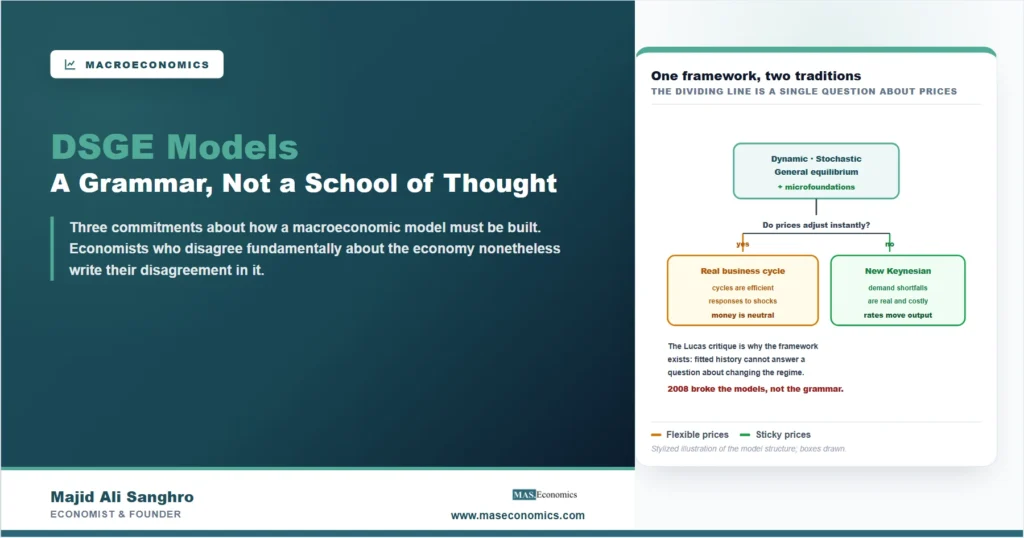
Because the framework is a grammar rather than a claim, the loudest disagreement in modern macroeconomics is conducted inside it. Both sides accept dynamics, shocks, general equilibrium and microfoundations. They differ over one question: how fast do prices adjust?
Answer “immediately” and you get the tradition our article on the real business cycle model describes. If prices clear markets at every moment, a recession cannot be a failure of demand, because any excess supply would be eliminated by a falling price. What remains is that the economy is genuinely less productive for a while, and the fall in output is the efficient response of households and firms to that fact. The policy implication follows immediately and is uncomfortable: there is nothing to stabilise, because the fluctuation is not a mistake.
Answer “slowly” and you get the New Keynesian tradition. Firms cannot reset prices whenever they like, so when demand falls the price does not fall to meet it and output falls instead. That single friction changes everything downstream. Now a recession is a real loss rather than an efficient adjustment, and a central bank that moves the interest rate changes real activity because it changes the real rate that households face. The relationship this produces between inflation and activity is the one our article on the New Keynesian Phillips curve sets out.
This equation is worth pausing on because it shows what microfoundations buy. Inflation today depends on expected inflation tomorrow and on the output gap, and the coefficient in front of the gap is not a free parameter fitted to data. It is built from how often firms reset prices and how sensitive their costs are to activity. A central bank asking what happens if it becomes more credible is asking what happens when the expectation term shifts, and the model answers using the same structure that generated the historical data, which is exactly what the Lucas critique demanded. The rule the central bank follows is written into the model too, usually in the form our article on the Taylor rule describes.
Calibration, Estimation, and Where the Credibility Sits
A model is a set of equations with parameters in them, and how those numbers are chosen is where the honest argument about DSGE work belongs. Two approaches exist, and they answer to different standards.
Calibration, the older practice, sets each parameter from evidence outside the model. The discount factor is chosen so the model’s steady-state interest rate matches the long-run average real rate. The capital share is set from national accounts. The labour supply elasticity is taken from microeconomic studies. The model is then run and its simulated moments, the volatility of output and the correlation between consumption and income, are compared with the same moments in the data. The standard is whether the model reproduces features it was not built to match.
Estimation, which now dominates, treats the model as a statistical object and fits its parameters to observed series, usually by Bayesian methods that combine a prior belief about each parameter with the likelihood of the data. This delivers standard errors and formal model comparison, and it is why the techniques in our article on maximum likelihood estimation now sit at the centre of macroeconomic practice.
Both approaches have a weakness that is easy to state and hard to fix. Some parameters are weakly identified, meaning the data barely distinguishes between quite different values of them, so the reported number reflects the prior rather than the evidence. When that happens, a result presented as an estimate is closer to an assumption with a confidence interval attached. The honest response is to report how much the conclusion moves when the prior moves, and a paper that does not do so has left its most important robustness check undone.
| Question | Settled by being a DSGE model | Left to the modeller |
|---|---|---|
| Where do equations come from? | From agents solving optimisation problems | Which agents, and what they care about |
| How are expectations formed? | Using the model’s own structure | Whether all agents are equally informed |
| Do prices adjust instantly? | Nothing: the framework is silent | The central dividing line between traditions |
| Is there a financial sector? | Nothing: the framework is silent | Absent before 2008, standard after it |
| Are households alike? | Nothing: the framework is silent | Representative agent, or a distribution of them |
| How are parameters chosen? | Nothing: the framework is silent | Calibration, Bayesian estimation, or both |

|
||
What 2008 Broke, and What It Did Not
The financial crisis produced the most serious criticism these models have faced, and the criticism was correct about its target. The workhorse models in use at central banks in 2007 had no banking sector worth the name, no role for leverage, no mechanism by which a fall in asset prices could tighten credit and no way for a solvent borrower to be refused a loan. A model without those features cannot produce the event that happened, and no amount of estimation will make it do so. That is a devastating criticism of the models that existed. It is a weaker criticism of the framework, and the distinction is where most of the public argument goes wrong.
What followed was an unusually clear test of whether a research programme can absorb a failure. Financial frictions were built in: net worth constraints on borrowers, balance-sheet constraints on banks, and a spread between the policy rate and the rate a firm actually pays. Heterogeneous-agent models replaced the single representative household with a distribution of households facing individual risk, which matters because a stimulus payment reaches a household with no savings very differently from one with a large buffer, and because the distributional questions in our article on the overlapping generations model cannot be asked of a model with one household in it. The zero lower bound, an awkward special case before 2008, became a central object of study.
Two criticisms survive that work. The first is that rational expectations remains a demanding assumption about people, and that behavioural evidence points elsewhere; the response, incomplete but real, has been to build models with limited information or bounded rationality inside the same grammar. The second is about forecasting, and here the record is genuinely modest: DSGE models do not reliably beat the statistical alternatives in our article on vector autoregression at short horizons. That comparison is often presented as decisive and it is not quite the right test, because these models are built to answer conditional questions about policy rather than to produce the best unconditional forecast. Judging a tool by a task it was not designed for is a way of avoiding the harder question, which is whether its answers to the questions it was designed for can be trusted.
MASEconomics Explains
3 concepts behind a DSGE model
These concepts are explored in depth across our educational articles library.
Conclusion
A DSGE model is not a claim about how the economy works. It is a set of rules about how a claim must be written: decisions taken over time by agents who look ahead, an economy pushed by shocks rather than following a path, every market solved at once, and every equation traceable to somebody optimising. Those rules were adopted because the Lucas critique showed that fitted historical relationships cannot answer questions about policies that would change them, and the rules are the constructive half of that argument rather than a doctrine attached to it.
What follows matters for how the literature should be read. The real business cycle and New Keynesian traditions are not rival frameworks; they are the same framework with different answers to one question about price adjustment, and that single difference produces opposite policy conclusions. The absence of a financial sector before 2008 was a modelling choice, not a property of the method, and it was repaired once its cost became clear. Where scepticism is warranted is narrower and more technical than the public argument suggests: in weakly identified parameters that report priors as findings, in the demanding treatment of expectations, and in the gap between what these models are built to do and the forecasting standard they are often judged against. A reader who knows which of those applies to the paper in front of them is in a position to judge it. A reader who treats the whole framework as a single position is not.
Frequently Asked Questions
What does DSGE stand for?
Dynamic stochastic general equilibrium. Dynamic means agents make decisions over time while looking ahead; stochastic means the economy is hit by random shocks rather than following a fixed path; general equilibrium means all markets are solved together and consistently. A fourth commitment, microfoundations, is not in the name but does much of the work.
Why do economists insist on microfoundations?
Because of the Lucas critique. A relationship estimated from history was produced under a particular policy regime, so using it to evaluate a change of regime is circular. Parameters describing preferences and technology are more likely to stay fixed when policy changes, so a model built from them can be asked about policies that have never been tried.
What is the difference between real business cycle and New Keynesian models?
How quickly prices adjust. Real business cycle models assume prices clear markets continuously, so fluctuations are efficient responses to productivity shocks and monetary policy cannot change real output. New Keynesian models assume prices are sticky, so demand shortfalls are possible and costly and the central bank’s interest rate has real effects. Both are DSGE models.
What is the difference between calibration and estimation?
Calibration sets parameters from evidence outside the model, such as national accounts or microeconomic studies, and then asks whether the model reproduces features of the data it was not built to match. Estimation fits parameters to observed series, usually by Bayesian methods, and delivers standard errors and formal model comparison. Estimation now dominates, but it inherits any weak identification in the model.
Did the 2008 crisis discredit DSGE models?
It discredited the models in use at the time, which had no meaningful financial sector and so could not generate the event. It did not discredit the framework, which absorbed the criticism: financial frictions, borrower and bank balance-sheet constraints, heterogeneous households and the zero lower bound are now standard. The surviving criticisms concern rational expectations and weak identification rather than the structure itself.
Are DSGE models good at forecasting?
Not reliably better than statistical alternatives such as vector autoregressions at short horizons. That comparison is worth knowing but is not the test the models are built for. Their purpose is conditional analysis, answering what happens to output and inflation under a specified change in policy, and they should be judged first on whether those conditional answers are credible.
Thanks for reading! It is a grammar rather than a position, which is why the fiercest disagreements in macroeconomics are written in it. Happy learning with MASEconomics