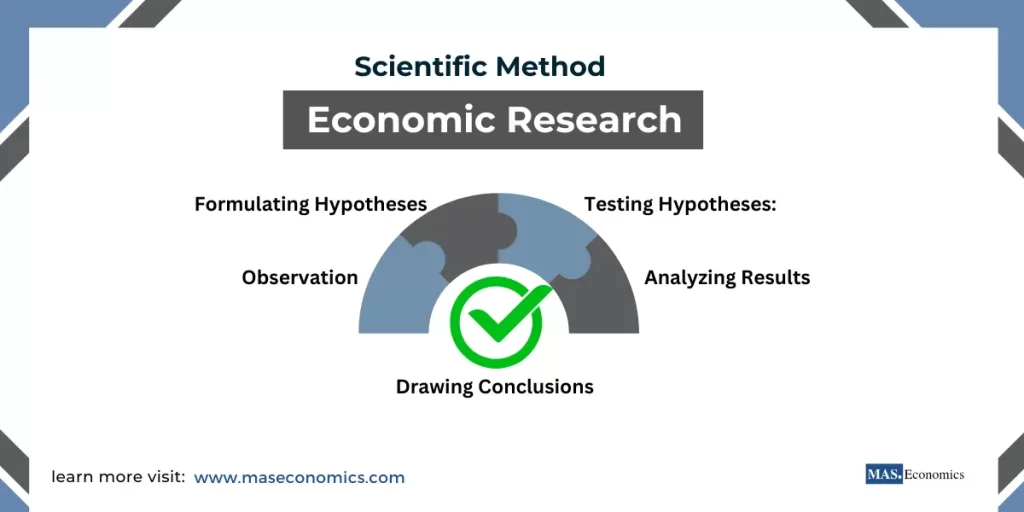
Economic research depends on a disciplined sequence of claims, evidence, tests, and revision. Scientific Method in Economics refers to the structured process economists use to move from observed economic facts to testable hypotheses, empirical analysis, and transparent conclusions. It is the bridge between theory and evidence.
The method matters because economics studies social systems rather than controlled physical objects. Prices, wages, unemployment, inflation, trade flows, household choices, and firm behaviour are shaped by institutions, incentives, expectations, and policy rules. Evidence must therefore be organized carefully before statistical results can be interpreted.
A scientific approach in economics does not mean copying laboratory physics. It means applying the same discipline of testable claims, public evidence, transparent assumptions, and open revision to economic questions. The result is not perfect certainty. It is a stronger standard for judging whether an economic claim is credible.
Observation Begins the Inquiry
The scientific method begins with observation. In economics, observation usually means noticing a pattern in data, institutions, markets, or behaviour. A researcher may observe rising food prices, falling labour-force participation, differences in wages across regions, or a policy reform that affected one group but not another.
Observation is not the same as explanation. A rise in unemployment during a recession is a fact that needs interpretation. A fall in consumer spending after an interest-rate increase is a pattern that could reflect income effects, confidence effects, credit constraints, or other causes. The first task is to turn the observation into a researchable question.
Economic observation often begins with official data, firm records, survey evidence, administrative datasets, market prices, or historical archives. The article on data collection in economics explains why the source, coverage, timing, and measurement of data shape the credibility of later analysis.
Questions Become Testable Claims
A research question becomes scientific only when it can be tested against evidence. A broad question, such as whether inflation is harmful, is too general. A testable version asks whether a change in inflation expectations affects wage bargaining, whether energy shocks pass through to core prices, or whether monetary tightening reduces household credit growth.
The next step is hypothesis formation. A hypothesis is a clear prediction about a relationship between variables. It states what the researcher expects to observe if the proposed mechanism is correct. A hypothesis may predict a positive relationship, a negative relationship, a threshold effect, a difference between groups, or no effect under specified conditions.
The existing article on formulating hypotheses in economics develops the mechanics of moving from theory to testable claims. The planned Phase 1 upgrade on Unlocking Insights with Hypothesis Testing in Economics and Statistical Analysis should later be linked from this section after the upgraded version is published.
A good hypothesis also identifies the relevant population, variable definitions, and expected direction of the relationship. For example, “higher unemployment reduces consumer spending” is clearer than “unemployment affects the economy.” The better version names the explanatory variable, the outcome variable, and the predicted direction.
Theory Gives Evidence Structure
Economic theory gives the scientific method its structure. It explains why certain variables belong in the analysis, why some relationships should be expected, and why other relationships may be misleading. Without theory, data analysis becomes a search for patterns without a clear standard for interpretation.
Consider a study of minimum wages and employment. A competitive labour-market model predicts that a binding wage floor can reduce employment. A monopsony model allows a higher minimum wage to increase employment if firms have wage-setting power. Both theories lead to different hypotheses, different mechanisms, and different tests. The scientific method does not remove theory. It disciplines theory through evidence.
This link between theory and evidence is developed further in the synergy of economic theory and research. Theory defines what should be measured. Evidence tests whether the theory survives contact with data.
Economics Differs From Natural Science
The scientific method has common principles across disciplines, but economics adapts them to social behaviour. Natural sciences often use controlled experiments, stable physical laws, and repeatable laboratory conditions. Economics often studies historical events, policy changes, market behaviour, and institutional rules that cannot be fully controlled.
This does not make economics unscientific. It changes the evidence problem. Economists must work harder to separate causation from correlation, identify counterfactuals, account for incentives, and state the assumptions behind each comparison. Randomized trials, natural experiments, regression discontinuity designs, panel data, and systematic reviews all address this challenge in different ways.
| Element | Natural Science Pattern | Economics Adaptation | Example |
|---|---|---|---|
| Observation | Physical events are often directly measurable under controlled conditions. | Economic events are measured through surveys, administrative data, markets, and institutions. | Inflation is measured through price indexes rather than direct observation of all prices. |
| Hypothesis | Hypotheses often concern stable physical relationships. | Hypotheses often concern incentives, constraints, expectations, and institutional settings. | Higher interest rates may reduce consumption through borrowing costs and wealth effects. |
| Experiment | Researchers may control the environment and repeat the experiment. | Researchers often rely on randomized trials, natural experiments, or quasi-experimental variation. | A policy cutoff can create a regression discontinuity design. |
| Measurement | Variables can often be measured with instruments under standardized conditions. | Variables may contain reporting error, sampling error, missing observations, and changing definitions. | Household income can differ across tax records, surveys, and administrative sources. |
| Causality | Controlled settings can isolate causal mechanisms more directly. | Causal claims require credible counterfactuals and identification strategies. | Difference-in-differences compares treated and untreated groups before and after a policy. |
| Replication | Experiments can often be repeated under similar laboratory conditions. | Replication often means reproducing code, data cleaning, estimates, and sensitivity checks. | AEA-style replication packages document data and code paths. |
| Generalization | Findings may generalize through stable physical laws. | Findings travel only when populations, institutions, incentives, and time periods are comparable. | A labour-market result from one region may not apply to another with different institutions. |

|
|||
The comparison shows why research design matters so much in economics. The same scientific ideals apply: clarity, evidence, testing, revision, and transparency. The difference is that economic evidence usually comes from social systems where behaviour responds to incentives and institutions.
The Scientific Cycle in Economics
The scientific method is best understood as a cycle rather than a straight line. A study begins with an observation, but its results often create new questions. A rejected hypothesis may lead to a better theory. A confirmed relationship may need replication in another setting. A policy result may require mechanism evidence before it becomes useful for broader inference.
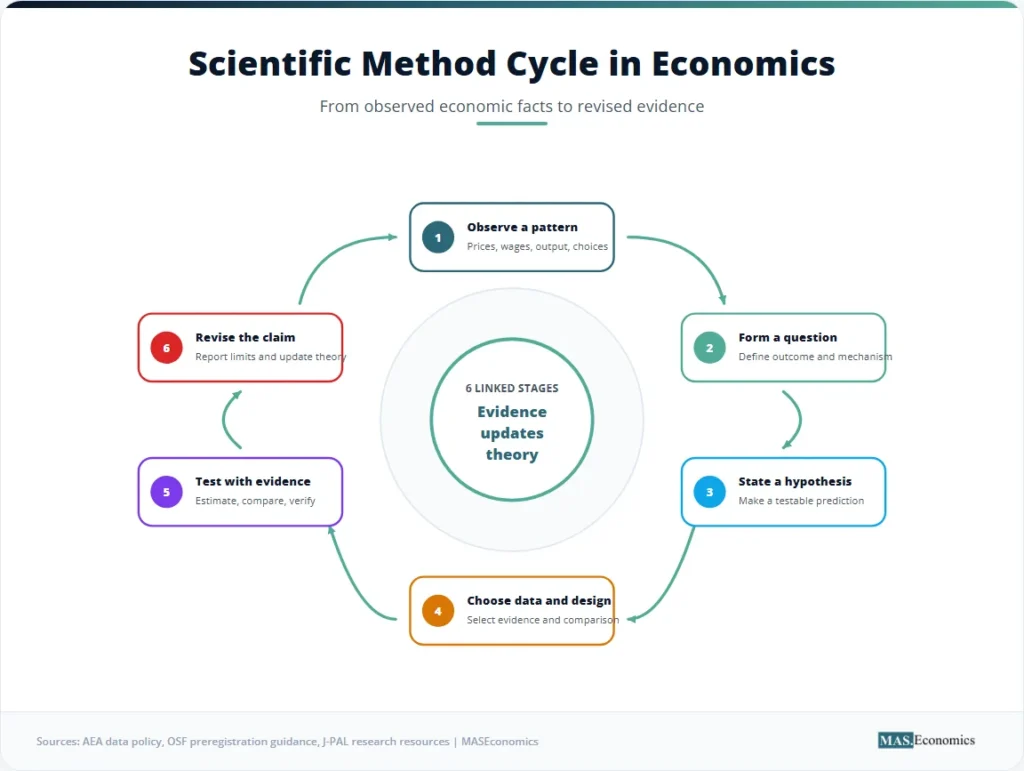
The cycle matters because no single study is final. Evidence may support a hypothesis in one market but fail in another. A causal result may be credible for the studied group but limited outside that setting. A descriptive pattern may become the starting point for a later causal design. The planned Phase 2 article on External and Internal Validity in Economic Research should later be linked from this discussion because it explains how far economic findings can travel across populations, institutions, and time periods.
Testing Requires Research Design
Testing a hypothesis in economics requires more than running a regression. The researcher must decide what evidence would count for or against the claim. That decision includes the population, the comparison group, the measurement strategy, and the timing of observation.
Randomized controlled trials are one way to test economic hypotheses when assignment can be controlled. The J-PAL research resources describe randomized evaluations as studies in which individuals, groups, or institutions are randomly assigned to receive a programme or not receive it, making comparison groups credible when implementation is sound. J-PAL randomized evaluation resources
Randomization is not always possible. Many economic questions involve national policies, historical institutions, financial shocks, trade agreements, or central-bank decisions that cannot be randomly assigned. In these cases, economists use quasi-experimental designs, observational data, or structural reasoning to build a credible comparison. The article on natural experiments in economics explains how real-world variation can sometimes play the role of an experiment.
Testing also connects directly to econometrics. A simple relationship may be estimated using simple linear regression. A study with several covariates may require multiple regression models. A causal study threatened by endogeneity may require instrumental variables. A repeated-observation study may require panel data methods. The method identifies the evidence problem. Econometrics supplies the formal tools.
Results Need Interpretation
After testing, the results must be interpreted. A coefficient, p-value, confidence interval, or effect size does not speak by itself. Interpretation requires returning to the original theory, the hypothesis, the measurement strategy, and the identification assumptions.
For example, a negative association between unemployment and consumer spending may fit the hypothesis that job loss reduces income and demand. But the result may also reflect falling confidence, credit tightening, regional shocks, or omitted variables. The scientific method requires the researcher to ask whether the evidence actually supports the proposed mechanism or only records a surface relationship.
This is why the distinction between correlation and causation is central in economics. A statistical relationship may be useful for description or prediction even if it is not causal. A causal claim requires stronger evidence about the counterfactual: what would have happened without the policy, shock, or treatment. The article on causal inference in economics develops this standard in detail.
Interpretation also includes uncertainty. Economists report uncertainty through standard errors, confidence intervals, robustness checks, sensitivity analysis, and alternative specifications. In time-series research, uncertainty may also require attention to persistence and stationarity, as discussed in stationarity in time series econometrics.
Transparency Keeps the Cycle Open
The scientific method works only when other researchers can inspect the evidence. Transparency allows the research community to examine data sources, replicate code, test alternative assumptions, and evaluate whether the conclusion follows from the design.
The American Economic Association requires authors of accepted papers, subject to exceptions, to provide data and code sufficient to reproduce published results. AEA Data and Code Policies and Guidance This policy reflects a broader shift in economics from trust in final tables toward scrutiny of the full research pipeline.
Pre-registration and pre-analysis plans also support transparent science. OSF describes preregistration as a time-stamped, read-only plan that records research decisions before data collection or analysis. OSF Registrations and Preregistrations. The AEA RCT Registry provides a registry for randomized controlled trials in the social sciences. AEA RCT Registry Policy
These practices do not make research automatically correct. They reduce hidden flexibility and make deviations visible. A study can still have weak measurement, poor external validity, or an unconvincing comparison group. Transparency improves the conditions under which research can be checked, criticized, and improved.
Evidence Builds Through Replication
Scientific knowledge in economics builds cumulatively. One study may produce an estimate, but a body of evidence comes from replication, comparison across settings, systematic reviews, and meta-analysis. This is especially important because economic effects often depend on institutions, market structure, demographics, and timing.
The Cochrane Handbook describes systematic reviews as structured evidence syntheses that define eligibility, collect data, assess bias, and summarize findings using explicit methods. Cochrane Handbook for Systematic Reviews of Interventions. Although Cochrane is rooted in health evidence, the logic of transparent evidence synthesis applies closely to economics.
MASEconomics already covers systematic literature reviews in economics and the broader research process in research methods in economics. The scientific method sits between these two themes. It explains why individual studies must be testable and why evidence must remain open to revision.
Limits of Scientific Economics
The scientific method improves economic research, but it does not remove every difficulty. Economic systems are complex. People respond to incentives, expectations, rules, and social context. Policies can change behaviour in ways that alter the relationship being studied. Data can be incomplete, delayed, revised, or measured with error.
Another limit is generalization. A policy effect estimated in one labour market may not apply to another. A behavioural result from one experimental setting may not survive in field conditions. A historical relationship may break when institutions change. Scientific economics, therefore, requires careful statements about scope.
The strongest economic studies do not claim more than their design supports. They state what was measured, which comparison was used, what assumptions were needed, how uncertainty was handled, and where the findings may fail. That discipline is the main contribution of the scientific method to economics.
MASEconomics Explains
4 economic concepts behind the scientific method
These concepts are explored in depth across our educational articles library.
Explore the MASEconomics BlogConclusion
Scientific Method in Economics is the disciplined process that connects observation, theory, hypotheses, evidence, interpretation, and revision. It gives economic research a standard for judging claims rather than accepting patterns at face value.
The method is especially important because economics studies social systems where experiments are limited, institutions matter, and causal claims require careful design. Strong economic research, therefore, makes its question clear, tests its hypothesis with appropriate evidence, documents its assumptions, and leaves a transparent path for replication.
Frequently Asked Questions
What is the scientific method in economics?
The scientific method in economics is the structured process of observing economic facts, forming testable hypotheses, collecting evidence, testing claims, interpreting results, and revising theories. It turns economic ideas into evidence-based arguments.
Why is the scientific method important in economics?
It is important because economic claims can easily confuse correlation with causation. The scientific method forces researchers to define the question, choose evidence carefully, state assumptions, test hypotheses, and report uncertainty.
What are the steps of the scientific method in economics?
The usual steps are observation, question formation, hypothesis development, data and design selection, empirical testing, interpretation, and revision. In economics these steps often repeat as new data or stronger research designs become available.
How does economics use experiments?
Economics uses field experiments, lab experiments, randomized evaluations, and quasi-experimental designs. When random assignment is not possible, economists rely on research designs such as natural experiments, regression discontinuity, difference-in-differences, and instrumental variables.
How is the scientific method different in economics and natural science?
Natural sciences often use controlled laboratory settings and stable physical relationships. Economics often studies social behaviour, institutions, markets, and policies, so evidence depends heavily on measurement, identification, counterfactual reasoning, and replication.
Thanks for reading! If you found this helpful, share it with friends and spread the knowledge. Happy learning with MASEconomics