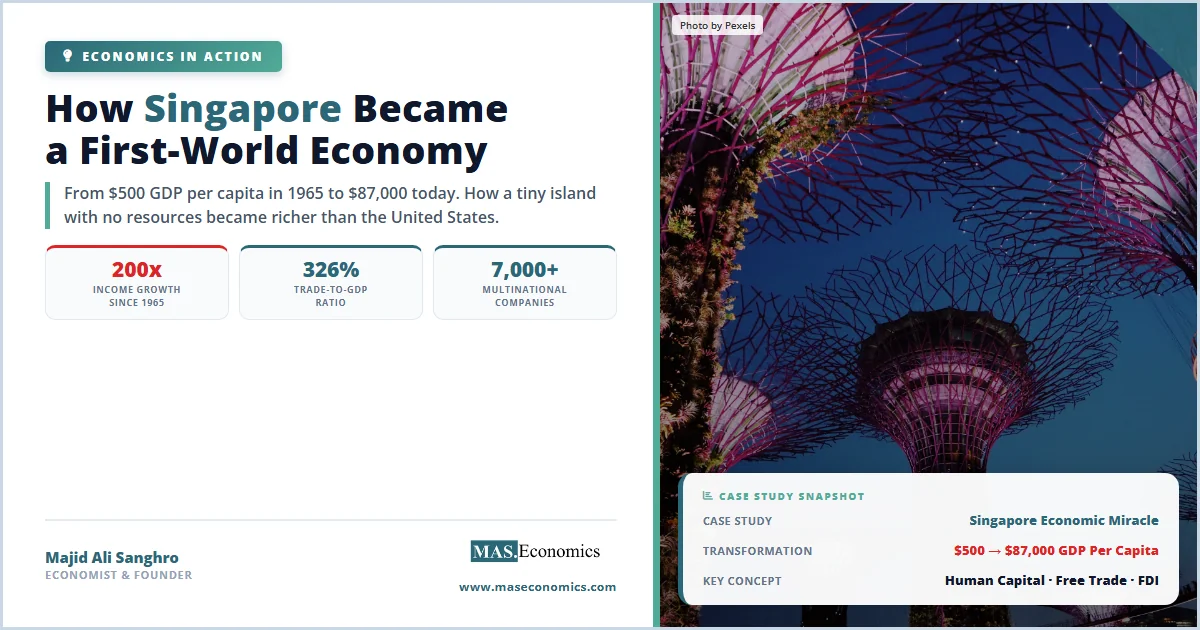
In 1965, Singapore was expelled from the Federation of Malaysia. It was a tiny tropical island with no natural resources, no hinterland, no army, and a GDP per capita of roughly $500, lower than that of Mexico, Jamaica, and South Africa at the time. Its population of 1.9 million was divided along ethnic lines, unemployment was above 10%, and the British military bases that provided a quarter of the island’s economic activity were about to close.
Six decades later, Singapore’s GDP per capita exceeds $87,000 at purchasing power parity, higher than that of the United States, Switzerland, and Norway, according to the IMF World Economic Outlook. The country ranks first globally in the World Bank’s Business Enabling Environment index, first in intellectual property protection, and consistently in the top three of every global competitiveness ranking. Its port is the world’s second busiest. Its airline, Singapore Airlines, is consistently ranked among the best on Earth. Its sovereign wealth fund, GIC, manages over $700 billion in assets.
No country in modern history has achieved this scale of economic transformation in such a short time. Singapore’s story is not a miracle. It is a masterclass in applied economics, where the right policies, institutions, and incentives turned a nation’s greatest weakness, its smallness, into its greatest competitive advantage.
From Third World to First in One Generation
Singapore’s transformation can be understood in three distinct economic phases, each driven by deliberate policy choices that exploited the opportunities of the moment.
Phase 1: Industrialisation Through FDI (1965-1985)
The newly independent government, led by Prime Minister Lee Kuan Yew and his economic architect Dr. Goh Keng Swee, faced an immediate crisis. With separation from Malaysia, Singapore lost its natural economic hinterland and the common market it had relied upon. The British withdrawal threatened to remove 20% of GDP. Import-substitution industrialisation, the popular strategy across the developing world, was impossible for a country with no domestic market to protect.
Singapore chose the opposite path: export-oriented industrialisation driven by foreign direct investment. The Economic Development Board (EDB), created in 1961, was transformed into the world’s most aggressive FDI attraction agency. The government offered multinational corporations a package that no competitor could match: zero tariffs, tax holidays of up to 15 years, fully serviced industrial parks, a disciplined English-speaking workforce, and political stability guaranteed by a strong, corruption-free government.
The results were dramatic. Texas Instruments, Hewlett-Packard, and General Electric were among the first wave of multinationals to establish manufacturing operations. By the mid-1970s, Singapore had become a major exporter of electronics and petroleum products. Manufacturing’s share of GDP rose from 12% at independence to over 28% by 1980. Unemployment fell from over 10% to under 3%.
Phase 2: Upgrading to High-Value Industries (1985-2000)
The 1985 recession, Singapore’s first since independence, forced a strategic rethink. Wage costs had risen to the point where low-cost manufacturing was migrating to cheaper neighbours like Thailand and Indonesia. The government responded with a deliberate policy of economic upgrading: shifting from labour-intensive assembly to capital-intensive, high-value industries.
This phase saw the aggressive development of Singapore as a global financial centre, a petrochemical refining hub (Jurong Island became one of the world’s largest integrated refining complexes), and a biomedical sciences cluster. The government invested heavily in education, sending thousands of students to top universities worldwide on government scholarships, with bonds requiring them to return and contribute to the economy. The Solow-Swan growth model predicts that sustained growth requires not just capital accumulation but technological progress and human capital development. Singapore’s leaders understood this intuitively and acted on it decades before most developing nations.
Phase 3: The Knowledge Economy (2000-Present)
In the 21st century, Singapore has reinvented itself again, this time as a hub for the knowledge economy, innovation, and wealth management. The government launched the Research, Innovation, and Enterprise plans, committing over $25 billion to R&D between 2006 and 2025. Singapore attracted global pharmaceutical giants like Novartis, Roche, and GSK to build research facilities. The country became the Asian headquarters for hundreds of multinational technology companies, including Google, Meta, and ByteDance.
The financial sector grew to account for roughly 14% of GDP, with Singapore managing $4.1 trillion in assets under management by 2023, making it the largest wealth management hub in Asia. The integration of digital technology into global value chains created new opportunities that Singapore seized aggressively, positioning itself as a fintech hub, a data centre cluster, and a regional headquarters for the AI industry.
The timeline below captures the key milestones in Singapore’s economic transformation.
Singapore’s Economic Transformation: Key Milestones (1965-2025)
| Year | Event | Economic Significance |
|---|---|---|
| 1965 | Independence from Malaysia | GDP per capita ~$500; no natural resources; 10%+ unemployment |
| 1968 | British military withdrawal announced | Threatened loss of 20% of GDP; forced industrialisation strategy |
| 1968 | Economic Expansion Incentives Act | Pioneer tax holidays attract first wave of multinational manufacturers |
| 1972 | Monetary Authority of Singapore (MAS) established | Central bank focuses on exchange rate management; anchors price stability |
| 1985 | First post-independence recession (-1.4% GDP) | Triggers shift from low-cost manufacturing to high-value industries |
| 1997 | Asian Financial Crisis | Singapore weathered the storm with $80B+ in reserves; grew 1.5% while neighbours contracted |
| 2000s | Biomedical Sciences Initiative & Integrated Resorts | Diversification into pharma R&D and tourism; two casinos generated $5B+ annually |
| 2010s | Smart Nation initiative launched | Government-led digital transformation; fintech licensing attracts global firms |
| 2023 | GDP per capita exceeds $87,000 (PPP) | Among the top 5 richest countries on Earth per person |
 |
||
What Theory Explains Singapore’s Success?
Singapore’s economic miracle can be explained through four interconnected economic concepts that, together, created a self-reinforcing growth engine.
Human Capital
Without natural resources, Singapore bet everything on its people. Government spending on education rose from 2.5% of GDP at independence to over 4% by the 1980s. The education system was reformed to prioritise English (the language of international business), mathematics, and science. Technical and vocational training was expanded massively to produce the skilled workforce that multinational manufacturers demanded.
The results are measurable. Singapore’s students consistently rank in the top 3 globally in the OECD’s Programme for International Student Assessment (PISA) in mathematics, science, and reading. The country’s labour force participation rate exceeds 68%, and its workforce productivity, measured as GDP per hour worked, has grown at roughly 3% per year over the past three decades.
Economists since Gary Becker and Theodore Schultz have argued that investment in human capital, the skills, knowledge, and health of a population, is the single most important driver of long-term economic growth. Singapore is the clearest empirical validation of this theory. The Solow-Swan model shows that without technological progress and human capital accumulation, growth from physical capital alone will eventually hit diminishing returns. Singapore escaped this trap by continuously upgrading the quality of its workforce.
Free Trade and Openness
Singapore embraced free trade more aggressively than perhaps any other country in history. With no domestic market worth protecting, tariffs were set at zero for virtually all goods. The country signed free trade agreements with every major trading partner: the ASEAN Free Trade Area, bilateral deals with the United States, China, Japan, the European Union, India, and Australia. Today, Singapore’s total trade (exports plus imports) exceeds 300% of its GDP, one of the highest trade-to-GDP ratios in the world.
The theory of comparative advantage, first articulated by David Ricardo, predicts that countries benefit from specialising in what they produce most efficiently and trading for everything else. For a tiny nation with no natural endowments, this principle was existential. Singapore could not produce food, energy, or raw materials competitively. But it could provide world-class port services, financial intermediation, refining, and high-value manufacturing. By specialising ruthlessly and trading freely, Singapore achieved a standard of living that its resource endowments could never have supported in isolation.
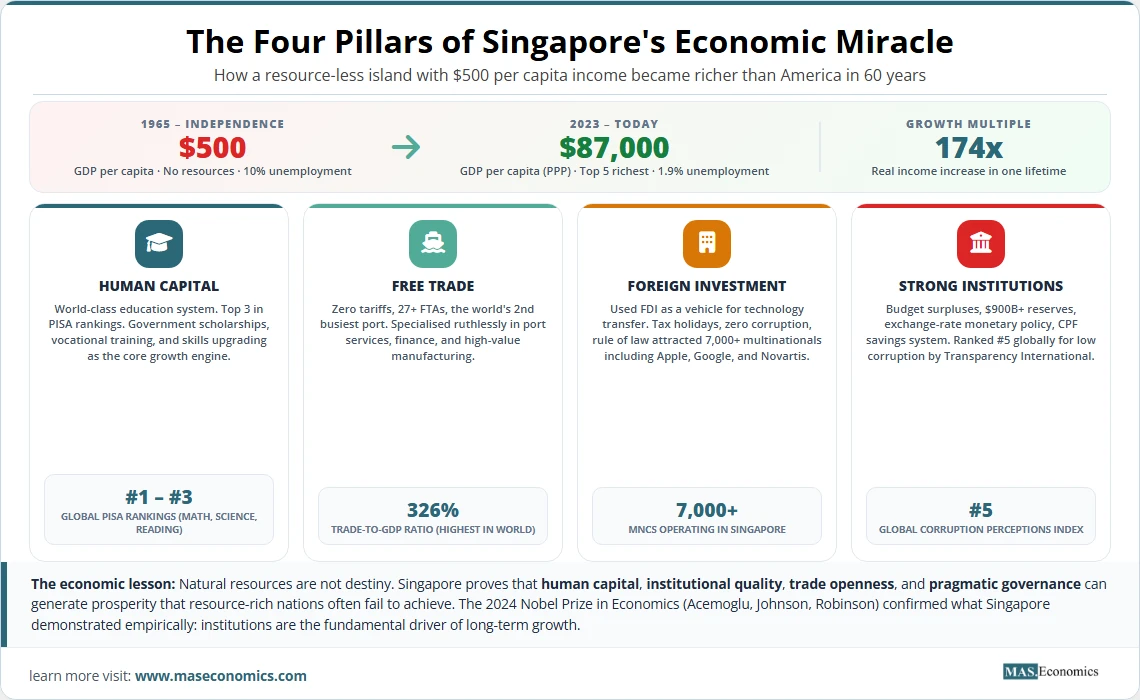
Foreign Direct Investment
Rather than trying to build indigenous technology from scratch, a process that takes decades, Singapore used foreign direct investment as a vehicle for technology transfer. Multinational corporations brought not just capital, but management expertise, production technology, quality standards, and access to global distribution networks. Singapore’s workers learned by doing, acquiring skills that eventually enabled the country to move up the value chain.
The government created conditions that minimised the barriers to FDI entry that plague most developing nations: corruption was virtually eliminated, property rights were rigorously enforced, the legal system was transparent and efficient, and the regulatory environment was among the most business-friendly in the world. The 2024 Nobel Prize in Economics, awarded to Acemoglu, Johnson, and Robinson for their work on institutions, validated what Singapore had demonstrated empirically for decades: that the quality of institutions is the fundamental determinant of long-term prosperity
Sound Macroeconomic Management
Singapore’s fiscal policy has been remarkably disciplined. The government has run budget surpluses in most years since independence, accumulating reserves that now exceed $900 billion. The Central Provident Fund (CPF), a compulsory savings scheme where both employers and employees contribute a percentage of wages, serves as both a retirement system and a national savings engine. CPF contributions, combined with government surpluses, have given Singapore one of the highest national savings rates in the world, consistently above 45% of GDP.
The Monetary Authority of Singapore (MAS) uses an unusual monetary policy framework: instead of targeting interest rates like the Federal Reserve or the Bank of England, MAS manages the exchange rate of the Singapore dollar against a trade-weighted basket of currencies. This approach, known as an exchange rate-centred monetary policy, is uniquely suited to a small, open economy where imported goods constitute a large share of consumption. By allowing the Singapore dollar to appreciate gradually over time, MAS has kept inflation consistently low, averaging under 2% over the past three decades, while maintaining the country’s export competitiveness.
Singapore’s Transformation in Numbers
The speed and scale of Singapore’s economic ascent are best captured through comparative data. The chart below shows GDP per capita (purchasing power parity) for Singapore versus selected comparator countries since independence.
GDP Per Capita (PPP, Current International $): Singapore vs. Comparators (1965-2023)
Source: World Bank Development Indicators and IMF World Economic Outlook. PPP-adjusted figures in current international dollars.
Singapore’s trade openness is without parallel among major economies. The chart below compares trade-to-GDP ratios across selected countries, illustrating just how central trade is to Singapore’s economic model.
Trade Openness: Total Trade as a Percentage of GDP (2023)
Source: World Bank. Total trade = exports + imports of goods and services as % of GDP.
The following table compares Singapore’s key economic indicators against those of peer nations, revealing how a country that started with less than almost everyone now outperforms almost everyone.
Singapore vs. Peer Nations: Key Economic Indicators (2023)
| Indicator | Singapore | United States | United Kingdom | South Korea | Malaysia |
|---|---|---|---|---|---|
| GDP Per Capita (PPP) | $133,900 | $80,400 | $56,800 | $56,700 | $35,500 |
| Trade as % of GDP | 326% | 27% | 69% | 97% | 131% |
| Unemployment Rate | 1.9% | 3.6% | 4.0% | 2.7% | 3.4% |
| Inflation (CPI, Annual) | 4.8% | 4.1% | 7.3% | 3.6% | 2.5% |
| Government Debt (% GDP) | 168%* | 123% | 101% | 54% | 66% |
| Corruption Perceptions Index | #5 (83/100) | #24 (69/100) | #20 (71/100) | #32 (63/100) | #57 (50/100) |
| *Singapore’s gross debt is high but largely held by government-linked entities (CPF); net debt position is strong. Sources: IMF, World Bank, Transparency International. | |||||
|
|||||
The Trade-Offs of the Singapore Model
The Winners
Singapore’s citizens have experienced one of the most dramatic improvements in living standards in human history. Life expectancy has risen from 65 years at independence to 84 years today, the third highest in the world. Home ownership exceeds 87%, one of the highest rates globally, enabled by the CPF housing scheme. The education system produces students who outperform virtually every other nation. Per capita income has increased more than 200-fold in real terms.
Multinational corporations have found Singapore to be one of the most profitable and efficient bases in the world. Over 7,000 multinationals have operations in Singapore, drawn by low taxes (17% corporate rate, with generous incentives that can reduce effective rates further), rule of law, intellectual property protection, and access to Asian markets. For companies, Singapore offers stability in a volatile region.
The global trading system benefits from Singapore’s role as a neutral, hyper-efficient logistics hub. The Port of Singapore handles roughly 37 million shipping containers per year, connecting producers and consumers across Asia, Europe, and the Americas.
The Trade-Offs
Income inequality is significant. Singapore’s Gini coefficient, after taxes and transfers, is around 0.37, higher than most European nations, though lower than the United States. The wealth generated by the financial sector and multinational headquarters has created a visible divide between the affluent professional class and lower-income workers, particularly in services and construction, many of whom are migrant labourers with limited protections.
Housing costs have surged. Despite the public housing programme covering 80% of the population, private property prices in Singapore are among the highest in Asia. Young Singaporeans increasingly report difficulty affording homes without substantial family support, a challenge common to small, wealthy city-states.
Political freedoms have been curtailed in exchange for economic development. The model of authoritarian governance combined with market economics, sometimes called the “Lee Kuan Yew model,” has been effective in delivering growth but has drawn persistent criticism from international human rights organisations. Whether this trade-off is acceptable is ultimately a political and philosophical question, not a purely economic one.
Can the Singapore Model Be Replicated?
Singapore’s success offers four transferable lessons that apply far beyond a small island in Southeast Asia.
First, institutions matter more than natural resources. The work of Acemoglu, Johnson, and Robinson, honoured with the Nobel Prize, provides the theoretical framework: countries with inclusive, well-governed institutions grow faster and more sustainably than those relying on resource extraction. Singapore is living proof.
Second, human capital is the ultimate competitive advantage. In a world where physical capital can be borrowed, and technology can be licensed, the quality of a nation’s workforce is the one asset that cannot be easily replicated. Singapore’s relentless investment in education, training, and skills upgrading is the single most important factor in its success.
Third, openness to trade and investment amplifies domestic capabilities. Singapore’s embrace of globalisation allowed it to access markets, technologies, and talent pools far beyond what its domestic economy could generate. For small and developing nations, the lesson is clear: integration into the global value chain, not isolation from it, is the fastest path to prosperity.
Fourth, pragmatic economic management beats ideology. Singapore’s government never committed to a single economic doctrine. It was pro-market when markets worked, interventionist when markets failed, and always willing to adapt when circumstances changed. This pragmatism, more than any single policy, is what separates Singapore from the many countries that adopted similar strategies but achieved far less.
MASEconomics Explains
Conclusion
Singapore’s journey from a struggling, resourceless island to one of the wealthiest nations on Earth is the most compelling case study in development economics. It demonstrates that economic growth is not determined by geography, natural resources, or luck. It is determined by policy choices: investing in people, embracing trade, attracting foreign investment, building strong institutions, and managing the macroeconomy with discipline and pragmatism.
The Singapore story is not without its costs and contradictions. Inequality, housing affordability, and political freedoms remain contested issues. But as a demonstration of what applied economics can achieve when theory is translated into action, Singapore stands alone. In 1965, it had nothing but its people and a port. Six decades later, it has everything. That is the power of economics in action.
Did you find this article helpful? Share it with someone who loves economics. And remember, at MASEconomics, we make complex ideas simple.