
A market price, a bargaining offer, or a savings decision can look irrational only after economists observe how people respond to incentives. Lab experiments behavioral economics use controlled settings to test how real people make choices when risk, fairness, loss aversion, trust, framing, or strategic behavior changes.
A laboratory experiment in economics is a structured research design in which participants make incentivized decisions under rules set by the researcher. The researcher can vary one feature of the environment, hold other conditions fixed, and observe how behavior changes. That makes lab experiments different from surveys, where people report attitudes, and different from field experiments, where interventions occur inside real institutions.
The behavioral economics tradition uses lab experiments to examine where standard economic assumptions work, where they fail, and which alternative mechanisms explain the data better. A lab experiment can test whether people maximize expected payoffs, punish unfairness, overvalue goods they own, cooperate with strangers, anchor on irrelevant numbers, or respond differently to losses than to gains.
Controlled Choice as Core Design
The defining strength of a lab experiment is control. The researcher defines the decision problem, the available actions, the information participants see, the timing of choices, and the payoff structure. Participants usually receive real payments tied to their decisions, so choices carry incentives rather than remaining hypothetical.
Control makes the design useful for testing mechanisms. If a researcher wants to know whether fairness affects bargaining, the lab can hold the monetary stakes fixed while varying the proposer’s offer. If the question is loss aversion, the experiment can compare behavior when the same payoff is framed as a gain or a loss. If the question is trust, the researcher can separate the first mover’s willingness to trust from the second mover’s willingness to reciprocate.
This design logic links directly to behavioral economics. Behavioral economics studies systematic departures from the simplest rational-choice model. Lab experiments provide one way to isolate those departures under clear conditions.
Laboratory control does not mean laboratory realism. A lab decision is simpler than a household budget, a labor contract, a retirement portfolio, or a firm investment decision. The value of the lab is that it can isolate a mechanism that is difficult to see in noisy real-world data.
Incentives vs Opinion Polls
Economists usually care about choices under incentives. A participant who says they value fairness may behave differently when money is at stake. A participant who says they dislike risk may take risky options when the expected payoff is high. A participant who claims to trust strangers may not transfer money when the transfer is irreversible.
For that reason, many economics lab experiments use monetary payoffs. Participants earn money according to the decisions they make and the rules of the game. The amount may be modest, but it gives the decision a cost. That feature distinguishes incentivized experiments from simple survey questions.
Incentives also help researchers compare behavior with theoretical predictions. In a standard model, a self-interested participant chooses the option with the highest expected payoff, given beliefs and constraints. If observed behavior repeatedly differs from that prediction, the researcher can ask what additional preference or bias is needed: fairness, reciprocity, loss aversion, present bias, ambiguity aversion, overconfidence, or limited attention.
The goal is not to prove that people are irrational. The goal is to identify which model of behavior fits the observed decision environment. Some experiments confirm standard economic theory. Others show that the standard model needs additional psychological or social mechanisms.
Classic Behavioral Experiments
Laboratory economics became influential because simple designs produced results that were hard to ignore. Competitive market experiments showed that prices can converge toward equilibrium even with limited information. Bargaining games showed that people reject unfair offers even when accepting would earn money. Endowment experiments showed that ownership can raise willingness to accept. Trust games showed that many people transfer resources to strangers and many recipients reciprocate.
| Experiment | Core decision | Behavioral mechanism | Research lesson |
|---|---|---|---|
| Double-auction market | Buyers and sellers trade induced-value goods | Market learning and price convergence | Even simple lab markets can approach competitive predictions |
| Ultimatum game | One player proposes a split, the other accepts or rejects | Fairness, punishment, and social preferences | People often reject low offers despite a positive payoff |
| Dictator game | One player decides how much to give another player | Altruism, warm glow, and social image | Giving can occur even when the recipient has no strategic power |
| Trust game | A first mover sends money, a second mover can return some | Trust and reciprocity | Cooperation can appear without formal contracts |
| Endowment effect experiment | Ownership is randomly assigned, then trading is observed | Loss aversion and reference dependence | Owners may demand more to sell than buyers will pay |
|
Source: MASEconomics synthesis based on Smith (1962), Güth, Schmittberger, and Schwarze (1982), Berg, Dickhaut, and McCabe (1995), and Kahneman, Knetsch, and Thaler (1990).

|
|||
Vernon Smith’s competitive market experiments helped establish that controlled laboratory markets could produce meaningful economic evidence. Güth, Schmittberger, and Schwarze’s ultimatum bargaining experiment made fairness and rejection behavior central to experimental economics. Berg, Dickhaut, and McCabe’s trust game gave economists a simple way to study trust and reciprocity. Kahneman, Knetsch, and Thaler’s endowment effect experiments showed how ownership can change valuation.
Ultimatum Game Tests Fairness
The ultimatum game is one of the clearest examples of how a lab experiment can challenge a simple prediction. One participant receives a sum of money and proposes how to divide it with another participant. The responder can accept or reject. If the responder accepts, both players receive the proposed split. If the responder rejects, both receive nothing.
A narrow self-interest model predicts that the proposer should offer the smallest positive amount and the responder should accept it, because something is better than nothing. In many experiments, however, low offers are often rejected, and proposers commonly offer more than the minimum.
The result does not show that people ignore incentives. Rejection is costly. It shows that some participants treat unfairness as a cost worth punishing. The experiment therefore reveals a behavioral mechanism: preferences can include fairness, reciprocity, or a desire to punish perceived unfairness, not only own monetary payoff.
This mechanism matters for economics beyond the lab. Wage bargaining, workplace cooperation, tax compliance, price fairness, and consumer backlash can all involve perceived fairness. The lab does not reproduce the full institution, but it identifies a mechanism that can operate inside those institutions.
Treatment and Control Comparisons
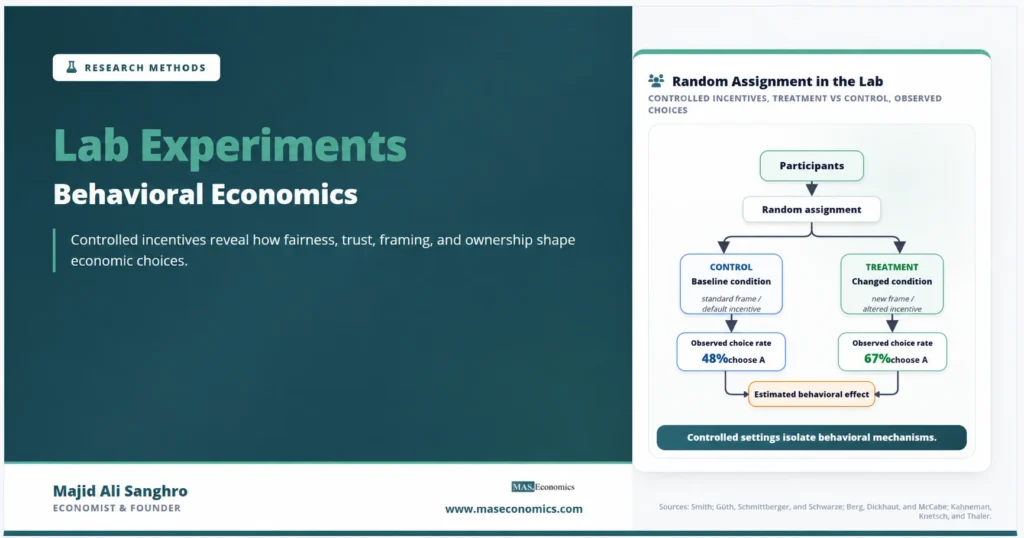
Good lab experiments are not just games. They are comparisons. The researcher changes one feature of the decision environment and compares behavior across conditions. A control condition gives the baseline. A treatment condition changes the information, framing, payoff, ownership status, or social context.
The following stylized visual shows this logic. The same decision task can produce different behavior when the treatment changes what participants own, know, lose, gain, or expect from others.
Endowment Effect and Reference Dependence
The endowment effect is a central behavioral finding because it shows that valuation can depend on ownership. In a standard market model with stable preferences and low transaction costs, randomly giving a mug to half the participants should not strongly affect whether trading occurs. Some owners should prefer money to the mug, and some nonowners should prefer the mug to money.
Kahneman, Knetsch, and Thaler found that randomly assigned owners often demanded more to give up a good than nonowners were willing to pay to acquire it. The design is powerful because ownership was assigned by the experiment, not chosen by participants. That helps separate the effect of owning the good from pre-existing differences in taste.
The behavioral interpretation is reference dependence. Once a participant owns the mug, giving it up can feel like a loss. If losses loom larger than gains, the selling price can exceed the buying price. That idea connects naturally to prospect theory, which explains why people evaluate outcomes relative to a reference point rather than only by final wealth.
The endowment effect has limits. It may weaken with market experience, clear resale motives, or professional trading contexts. That makes it a good example of how lab experiments should be read: they identify a mechanism under specific conditions, not a universal law that applies with the same strength everywhere.
Trust Games: Trust and Reciprocity
The trust game divides cooperation into two linked decisions. A first mover receives an amount of money and chooses how much to send to a second mover. The amount sent is multiplied by the experimenter. The second mover then chooses how much to return.
The first decision measures trust, or willingness to place resources under another person’s control. The second decision measures reciprocity, or willingness to reward trust even when keeping more money is possible. This separation is useful because real economic cooperation often combines both forces.
A simple self-interest model predicts little or no sending if the first mover expects the second mover to keep everything. Yet many experiments find positive transfers and positive returns. The design does not prove that all economic agents are trustworthy. It shows that trust and reciprocity can be measured separately under controlled incentives.
This evidence matters for contracts, credit, employment, informal insurance, supplier relationships, and platform transactions. Many economic exchanges depend on behavior that cannot be fully written into a contract. Lab experiments help economists study the social preferences and beliefs that support those exchanges.
Market Experiments Confirm Theory
Behavioral lab experiments are often associated with deviations from rational-choice predictions, but experimental economics also shows where standard economic theory performs well. Vernon Smith’s double-auction experiments demonstrated that buyers and sellers can converge toward competitive prices even when participants have limited information about the full market.
This matters because the lab is not only a tool for finding anomalies. It is also a tool for testing the conditions under which market institutions produce standard outcomes. A double auction, posted-offer market, sealed-bid auction, or bargaining protocol can produce different behavior because the institution changes information, timing, and strategic incentives.
That insight links lab experiments to game theory. In both cases, the rules of the interaction matter. A participant’s best response depends on the available actions, beliefs about others, payoff rules, and the sequence of moves.
Market experiments are especially useful for institutional design. Economists can compare auction formats, pricing rules, information disclosure, or matching procedures before a policy or platform is scaled. The lab simplifies the world, but it can reveal how rules shape behavior.
External Validity Limitation
The main criticism of lab experiments is external validity. Participants are often students. Stakes are often modest. Tasks are simplified. Time horizons are short. Social context is limited. Participants know they are being observed. These features can affect behavior.
That does not make lab evidence useless. It means the research claim must match the design. A lab experiment can credibly show that a mechanism exists under controlled conditions. It cannot automatically prove that the same mechanism explains behavior in every market, household, firm, or policy setting.
This distinction is central to internal and external validity. Internal validity asks whether the experiment identifies the effect inside the study setting. External validity asks whether the finding travels to other settings. Lab experiments often score strongly on internal validity and require caution on external validity.
Good experimental papers therefore explain the bridge from the lab to the economy. What institution does the game represent? Which real-world decision shares the same mechanism? Which features of the lab are artificial? Which features are essential to the research question?
Caveat. A lab experiment can identify a behavioral mechanism cleanly, but the researcher must still justify whether that mechanism matters outside the laboratory.
Demand Effects and Deception
Participants may try to infer what the researcher expects. If the experiment signals that generosity, risk-taking, or fairness is being studied, behavior can shift toward what participants think is socially approved. These are demand effects.
Experimental economists therefore pay close attention to instructions, anonymity, neutral wording, and payment rules. Small details can change behavior. A participant who believes the researcher can identify their choice may give more in a dictator game. A participant who thinks the experiment is about fairness may act differently from someone who sees only a neutral allocation task.
Deception is another issue. Some fields allow limited deception under strict ethical review. Experimental economics traditionally avoids deception because it can damage the credibility of future experiments. If participants suspect that payoff rules, partners, or information are not real, incentives lose their meaning.
These concerns connect lab experiments to ethical economic research. Participants must understand the task, face reasonable risks, receive promised payments, and be treated with respect. Clean behavioral evidence should not depend on misleading participants about core incentives.
Replication and Stability
A single lab experiment is rarely enough to settle a behavioral claim. Results can depend on sample, instructions, stakes, culture, framing, payment method, timing, and software implementation. Replication helps determine whether a finding is stable across contexts.
Replication is especially important because many behavioral experiments use small or moderate samples. Some effects are large and visible across designs. Others are fragile. A result that appears in one setting but disappears when incentives, subjects, or instructions change should be interpreted as context-dependent.
This links lab experiments to the broader replication crisis in economics. Behavioral findings are most useful when they are reproducible, pre-specified where possible, and tested across variations that help identify boundary conditions.
Open materials also matter. Clear instructions, code, payoff rules, randomization procedures, and data files make replication easier. Without those materials, later researchers may not know whether a failed replication reflects a weak finding or a different experimental implementation.
Lab and Field Complementarity
Laboratory experiments and field experiments answer different questions. The lab is strongest when the goal is mechanism identification. The field is strongest when the goal is policy performance inside real institutions. A complete evidence base often needs both.
A lab study may show that people punish unfair offers. A field study may examine whether perceived unfairness affects worker effort, tax compliance, or consumer response to prices. A lab study may show that ownership changes valuation. A field study may ask whether that affects housing markets, financial portfolios, or consumer returns.
Lab evidence can also guide field design. If a mechanism appears strong in the lab, researchers can design a field experiment to test whether it matters in practice. If a field result is puzzling, the lab can isolate possible explanations.
The relationship is not hierarchical. Field evidence is not automatically better, and lab evidence is not automatically weaker. The better design is the one that matches the research question.
Evaluating Lab Experiment Evidence
Readers should first ask what mechanism the experiment is trying to isolate. A game or task is only useful when it maps clearly onto an economic mechanism. If the experiment measures fairness, trust, risk preference, loss aversion, or strategic reasoning, the design should make that link explicit.
Second, readers should ask whether incentives were real and meaningful. Were participants paid according to their choices? Were stakes large enough to make attention worthwhile? Were the payoff rules clear?
Third, readers should examine the treatment-control comparison. What changed between conditions? Was random assignment used? Were instructions neutral? Were participants anonymous? Were outcomes measured consistently?
Fourth, readers should evaluate external validity. The question is not whether the lab perfectly replicates the real world. It never does. The question is whether the simplified task captures the mechanism that the paper claims to study.
Finally, readers should ask whether the finding has been replicated. A behavioral result becomes more persuasive when it survives changes in sample, stakes, country, wording, implementation, and analysis.
Explains
Four concepts behind laboratory evidence
Build stronger research judgment by learning how controlled experiments reveal economic behavior.
Explore the MASEconomics BlogConclusion
Lab experiments behavioral economics matters because it gives economists a controlled way to study decision‑making mechanisms that are difficult to isolate in ordinary data. By varying incentives, information, framing, ownership, or social interaction, lab experiments reveal how people respond when the rules of choice are clear.
The method is powerful because it combines real incentives with experimental control. It can show how fairness affects bargaining, how ownership affects valuation, how trust supports cooperation, and how market institutions shape price discovery. It also shows that standard economic theory works in some laboratory institutions and needs behavioral extensions in others.
The limitation is scope. A lab result identifies behavior under controlled conditions, not a universal rule for all markets and policies. The strongest interpretation connects laboratory evidence to theory, field evidence, replication, and institutional context. Used carefully, lab experiments help economics move from assumed behavior to observed decision‑making.
Frequently Asked Questions
What is a lab experiment in behavioral economics?
A lab experiment in behavioral economics is a controlled study in which participants make incentivized decisions while researchers vary specific conditions to test behavioral mechanisms.
Why do economists use laboratory experiments?
Economists use laboratory experiments to isolate mechanisms such as fairness, trust, loss aversion, risk preferences, framing, and strategic behavior under controlled incentives.
How are lab experiments different from field experiments?
Lab experiments emphasize control and mechanism identification. Field experiments test interventions in real-world settings where institutions, implementation, and context matter more.
What is the ultimatum game?
The ultimatum game is a bargaining experiment in which one participant proposes a money split and another accepts or rejects it. Rejection leaves both with nothing.
What is the biggest limitation of lab experiments?
The main limitation is external validity. A lab experiment can identify a mechanism clearly, but researchers must justify whether the same mechanism matters outside the laboratory.
Thanks for reading! If you found this helpful, share it with friends and spread the knowledge. Happy learning with MASEconomics