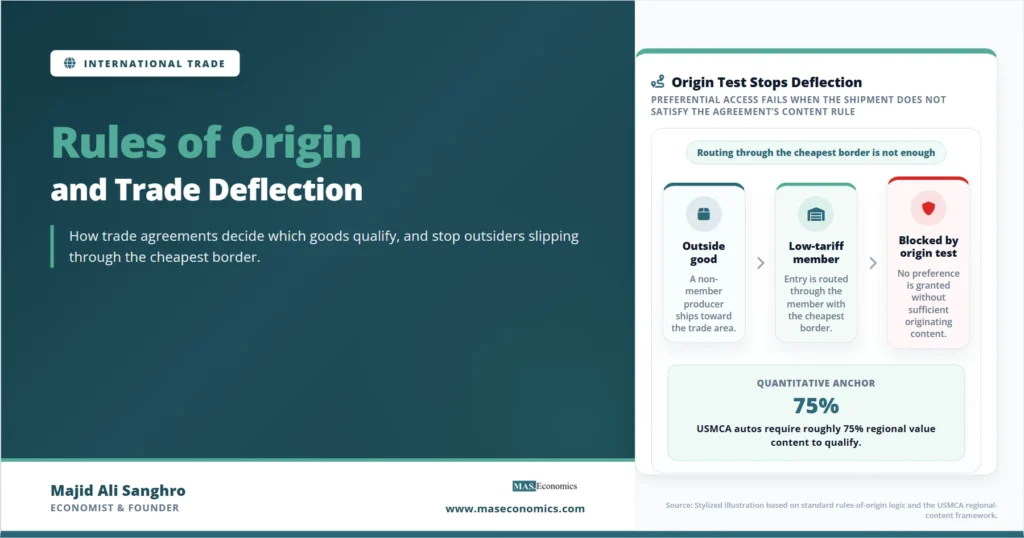
When the United States, Mexico, and Canada renegotiated their trade agreement into the USMCA, the requirement that a car contain 75 percent North American content to cross borders duty‑free reshaped supply chains. That threshold answers the fundamental question of which goods qualify for preferential treatment. Rules of origin are the legal tests that provide the answer, and they exist to stop trade deflection, where goods are routed through a low‑tariff member simply to enter a market cheaply.
The logic is straightforward once the problem is clear. A free trade agreement removes tariffs between its members but lets each member keep its own tariffs against outsiders. That gap creates an incentive to game the system. Without a rule defining what counts as a genuine product of a member country, an exporter from outside the bloc could ship goods into whichever member has the lowest external tariff, then forward them tariff-free to the rest. Rules of origin close that door by specifying how much transformation a good must undergo inside the bloc before it earns the preferential rate.
Free Trade Areas Require Origin Tests
The need for rules of origin depends entirely on how a trade bloc handles its external tariffs. The distinction between a free trade area and a customs union, examined more fully in the discussion of the different forms of economic integration, is what makes origin rules necessary in one case and largely redundant in the other.
In a free trade area, members drop tariffs on each other but each sets its own tariff on imports from non-members. Suppose the bloc contains two countries, A and B. Country A levies a 2 percent tariff on imported televisions from the rest of the world; country B levies 20 percent. An outside exporter that wants to sell in B faces an obvious workaround: ship the televisions into A at 2 percent, then move them across the open A-B border tariff-free, paying 2 percent instead of 20. The good has been deflected through the low-tariff member. The 18-point gap is pure arbitrage, and it undermines B’s tariff policy entirely.
A customs union avoids this because its members share a common external tariff. If A and B both charge the same rate on outside televisions, there is no gap to exploit and no reason to route goods through one member rather than another. This is why the European Union, a customs union, does not need internal rules of origin for goods already in free circulation, while agreements such as the USMCA, the CPTPP, and most modern free trade deals depend on them heavily.
Note. Rules of origin are the price a free trade area pays for letting members keep independent external tariffs. A customs union buys its way out of the problem by harmonizing those tariffs instead.
Trade Deflection Mechanism
Trade deflection is the specific abuse that origin rules are built to prevent, and it is worth separating from the related idea of transshipment fraud. Deflection in the strict sense uses the legal structure of a free trade area to arbitrage the tariff gap between members. The goods genuinely enter the low-tariff member, clear its customs, and then move on. No paperwork is falsified; the exporter simply exploits the lowest door into the bloc.

The damage is not limited to lost revenue in country B. Deflection hollows out each member’s ability to run an independent trade policy, concentrates customs traffic at the lowest-tariff entry point, and can pull investment toward the member with the cheapest external door rather than the most efficient location. Rules of origin neutralize the incentive by denying preferential treatment to goods that have not been substantially produced inside the bloc. A television merely passing through country A, with no real transformation there, fails the origin test and pays B’s full tariff on arrival.
Three Main Origin Tests
For goods made entirely in one country from local materials, origin is obvious. The hard cases involve goods made from imported inputs, which describes most manufactured products in a world of long supply chains. Three tests, often used in combination, decide whether such a good counts as originating. Each measures “substantial transformation” differently, and the choice among them is rarely neutral, because each can be tightened or loosened to protect particular industries.
| Method | What it tests | How it works | Typical use |
|---|---|---|---|
| Change in tariff classification | Whether processing changed the good’s category | The finished good must fall under a different tariff heading than its imported inputs | Common default in many agreements |
| Regional value content | How much value was added inside the bloc | Local content must reach a set percentage of the good’s value | Autos, electronics, complex goods |
| Specific processing rule | Whether a defined operation occurred locally | A named manufacturing step must be performed in the bloc | Textiles, chemicals, apparel |
|
Source: WTO Agreement on Rules of Origin and standard free trade agreement practice.
|
|||
The change-in-tariff-classification test asks whether processing moved the good into a different category of the Harmonized System, the international product-classification scheme. If imported cotton thread becomes a finished shirt, the tariff heading changes, and the shirt can qualify as originating. The appeal is simplicity: customs officials check codes rather than calculate values.
The regional value content test is the one most visible in the USMCA auto rule. It requires that a set share of the good’s value be added inside the bloc. The percentage can be computed in more than one way, and the formula matters. A common version subtracts the value of non-originating inputs from the transaction value of the finished good.
Regional Value Content
The specific processing rule names a manufacturing operation that must take place within the bloc. In textiles, the well-known “yarn-forward” rule requires that the yarn itself be made in a member country, not merely sewn there, so that origin attaches to the deeper stages of production rather than to final assembly alone. This kind of rule is harder to satisfy with imported inputs, which is precisely its purpose.
Origin Rules as Industrial Protection
Rules of origin have a legitimate purpose, but they are also one of the most effective disguised barriers in modern trade policy, a point that connects them to the wider family of non-tariff barriers. The same rule that blocks deflection can be tuned to force production into the bloc whether or not that is efficient, and the dividing line between the two functions is often a matter of where the threshold is set.
Raising a regional value content requirement from 60 percent to 75 percent does more than deter arbitrage. It compels manufacturers to source more inputs locally, even when cheaper or better inputs exist outside the bloc, or to forgo the tariff preference and pay the full rate. The USMCA auto rule was openly intended to pull supply chains back into North America, not merely to define genuine North American cars. That is industrial policy wearing the clothing of an origin test. The cost surfaces in the same place any protection does, as higher prices that fall partly on consumers, the mechanism traced in the analysis of who actually bears a tariff.
There is also a compliance cost that has nothing to do with protection. Proving origin requires documentation, certificates, audited cost breakdowns, and record-keeping across a supply chain. For firms that source globally, these administrative burdens can exceed the tariff being avoided, which is why some exporters decline the preference altogether and pay the standard rate. The result is a paradox: an agreement meant to liberalize trade can generate enough paperwork that part of the promised liberalization goes unused.
Caveat. A high local-content threshold and a strict processing rule look like anti-deflection safeguards on paper. In practice they can function as protection, raising costs for producers and consumers inside the bloc while doing little extra to stop genuine arbitrage.
The Spaghetti Bowl Problem
The difficulty compounds when a country belongs to many overlapping agreements at once, each with its own origin rules. The economist Jagdish Bhagwati gave this tangle its lasting name: the “spaghetti bowl.” A single exporter selling into several partner markets may face a different origin test, a different value threshold, and a different certification procedure for each agreement, even for the same product.
The consequences run against the purpose of trade liberalization. Differing rules raise compliance costs, fragment supply chains along the lines drawn by each agreement rather than by efficiency, and can steer sourcing decisions toward satisfying paperwork instead of minimizing cost. As the number of bilateral and regional deals has grown, mapped in the guide to bilateral and multilateral trade agreements, the bowl has only thickened. The same proliferation that expands market access also multiplies the rulebooks an exporter must satisfy, and the administrative drag is one reason economists favor multilateral liberalization, where a single set of rules applies, over a patchwork of preferential deals.
Origin Rules in Trade Policy
Seen whole, rules of origin are the connective tissue that lets preferential trade agreements function without dissolving each member’s tariff policy. They are not an exotic technicality but a direct response to the arbitrage that an open internal border combined with independent external tariffs would otherwise invite. Where a customs union removes the problem by harmonizing external tariffs, a free trade area must police origin instead, and the rules it writes determine how much real liberalization the agreement delivers.
Their dual nature is what makes them worth understanding. Set sensibly, they prevent deflection at modest cost and let an agreement do what it promises. Set aggressively, they become a tool of industrial policy and a source of compliance friction that can quietly cancel out the tariff cuts on the page. The same instrument that protects an agreement’s integrity can, with a few changed percentages, protect domestic producers from the competition the agreement was supposed to open up.
Explains
Three ideas that make origin rules clearer
See how the pieces of trade policy fit together.
Explore the MASEconomics BlogConclusion
Rules of origin exist because a free trade area creates a gap that goods will flow through if nothing stops them. By removing internal tariffs while letting members keep their own external rates, such an agreement invites trade deflection, the routing of outside goods through the lowest-tariff member to reach markets that would otherwise charge far more. Origin rules close the gap by defining how much production must occur inside the bloc before a good earns preferential treatment, using tests based on tariff classification, regional value content, or specific processing steps.
The same rules that prevent abuse can also protect. A high local-content threshold pulls supply chains into the bloc regardless of efficiency, and the documentation required to prove origin imposes costs that sometimes exceed the tariff being avoided. When a country joins many agreements with conflicting rules, the resulting spaghetti bowl fragments supply chains and raises compliance burdens, working against the liberalization the agreements were meant to deliver.
Origin rules are therefore neither purely protective nor purely facilitating. They are a necessary mechanism whose effect depends on how they are drawn. Understanding where the anti-deflection purpose ends and the protective purpose begins, is the key to reading any modern trade agreement, because the threshold on a single line can decide whether the deal opens a market or quietly fences it.
Frequently Asked Questions
What are rules of origin in international trade?
Rules of origin are the legal criteria that determine the economic nationality of a product. In a free trade agreement, they decide whether a good has been sufficiently produced within the bloc to qualify for preferential, usually duty-free, treatment, rather than being treated as an import from outside.
What is trade deflection?
Trade deflection is the practice of routing goods from outside a free trade area through the member with the lowest external tariff, then moving them tariff-free to a higher-tariff member. It exploits the gap created when members keep independent external tariffs, and rules of origin are designed to prevent it.
Why do customs unions not need rules of origin?
Customs union members share a common external tariff, so there is no gap to arbitrage. Because outside goods face the same rate at every entry point, there is no incentive to route them through one member rather than another, and internal origin rules become largely unnecessary for goods in free circulation.
How is regional value content calculated?
One common method subtracts the value of non-originating materials from the good’s transaction value, then divides by the transaction value and multiplies by 100. The good qualifies when this percentage meets the agreement’s threshold, such as 75 percent for autos under the USMCA. Other agreements build the figure up from qualifying costs instead.
What is the spaghetti bowl effect?
The spaghetti bowl effect, a term from economist Jagdish Bhagwati, describes the tangle created when a country belongs to many overlapping trade agreements, each with its own rules of origin. Exporters must satisfy different tests and paperwork for the same product across markets, raising compliance costs and fragmenting supply chains.
Thanks for reading! If you found this helpful, share it with friends and spread the knowledge. Happy learning with MASEconomics