A government that spends more than it collects has to finance the gap, and the instrument it reaches for most often is a bond. Companies do the same thing when they need money for longer than a bank is willing to lend it. Answering what is a bond starts with one plain idea: a bond is a loan written down as a tradable contract, with the amount, the interest, and the repayment date all fixed in advance.
That last word matters more than beginners expect. A bank loan usually stays with the bank that made it. A bond can be sold to somebody else the day after it is issued, and again the year after that. Because it trades, it acquires a market price, and that price moves for reasons that have nothing to do with the borrower missing a payment. Most of the confusion around bonds comes from mixing up the fixed contract with the moving price.
A Bond Is a Loan Split Into Identical Pieces
When a bank lends, one lender faces one borrower. When an issuer sells bonds, the loan is divided into many identical units, each carrying the same terms, and sold to whoever wants to buy. A pension fund can hold a thousand units, a household can hold one, and both hold the same claim per unit.
The issuer is the borrower. The bondholder is the lender. The issuer receives cash at the start, pays interest on a schedule, and returns the original amount on a stated date. Governments issue bonds to finance deficits and refinance maturing debt. Corporations issue them to fund investment, refinance existing borrowing, or hold cash for future needs.
This is the direct link to fiscal policy. As the guide to government budget balances sets out, a deficit is a flow that has to be financed, and in most economies bond issuance is how that financing happens. The deficit explains why the borrowing is needed. The bond is the instrument that carries it out.
Four Numbers Define Every Bond
Almost everything about a plain bond is captured by four figures agreed at issue.
The face value, also called par or principal, is the amount repaid at the end. The coupon rate is the annual interest rate applied to the face value. The maturity date is when the principal comes back. The issue price is what the buyer pays at the start, which is often close to face value but need not be exactly equal to it.
A bond with a face value of 1,000 and a coupon rate of 5 percent pays 50 a year until maturity, then returns the 1,000. If the coupon is paid twice a year, the holder receives 25 every six months. The schedule is contractual, which is why bonds are described as fixed income. The income is fixed even when the price is not.

Why Issuers Choose Bonds Over a Bank Loan
An issuer that needs a very large sum for a long period runs into a limit with banks. No single bank wants that much exposure to one borrower for twenty years. Issuing bonds spreads the same borrowing across thousands of lenders, each taking a small piece.
Bonds also let the issuer fix the cost in advance. A bond sold with a 5 percent coupon costs 5 percent of face value every year regardless of what happens to interest rates afterwards. For a finance ministry planning a decade ahead, that certainty is worth a great deal.
There is a third reason that matters for governments in particular. Bond markets are where the state’s borrowing cost becomes visible. Every auction produces a price, and that price is a public judgment on the borrower. The work on sovereign debt sustainability examines what happens when that judgment turns against a country, and Argentina’s repeated defaults show the consequences when access to those markets closes.
Price and Yield Move in Opposite Directions
This is the single idea that separates people who understand bonds from people who do not.
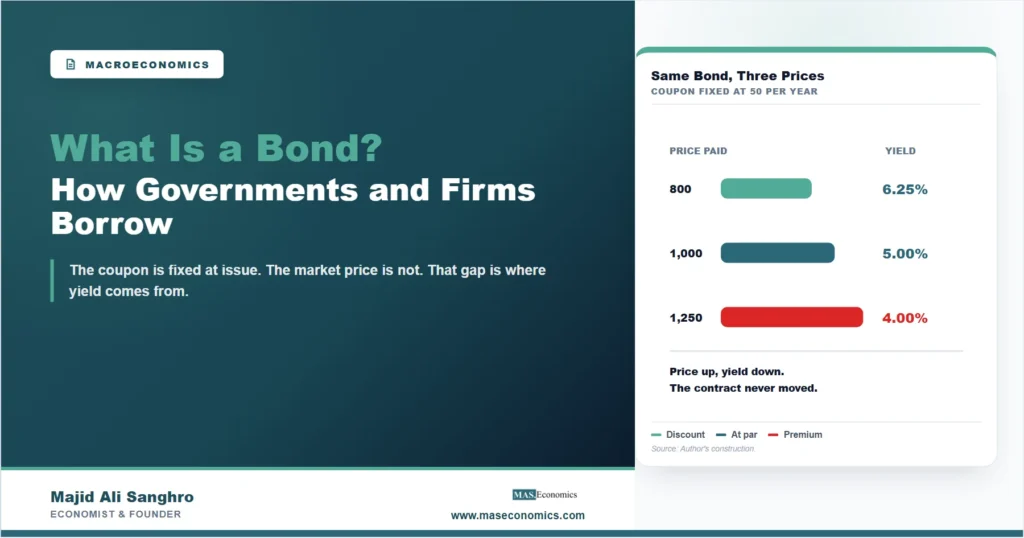
The coupon never changes. The market price does. When a bond that pays 50 a year is bought for less than 1,000, the buyer still receives 50 a year, so the return on the money actually spent is higher. When the same bond is bought for more than 1,000, the buyer still receives 50 a year, so the return on money spent is lower.
Buy that bond at 1,000 and the current yield is 5 percent. Buy it at 800 and the current yield is 6.25 percent. Buy it at 1,250 and the current yield is 4 percent. The contract did not move. Only the price paid for it did.
Prices move mainly because interest rates elsewhere have moved. If newly issued bonds start paying 7 percent, nobody will pay full price for an old bond paying 5 percent, so its price falls until the return is competitive. This is why bond prices fall when interest rates rise, and it is a mechanical relationship rather than a matter of sentiment. How strongly a particular bond reacts depends on its maturity and coupon, which is the subject of bond duration and convexity.
Read across many bonds of different maturities and this relationship produces the shape that markets watch most closely, which the article on the yield curve examines in detail.
How a Bond Reaches Its First Owner, and Its Second
Bonds live in two markets, and beginners often assume there is only one.
The primary market is where a bond is created. The issuer sells it and receives the cash. Governments usually do this by auction on a published calendar, which is one reason sovereign borrowing is so closely watched: the schedule is known in advance, and each auction produces a public price. Bidders state how much they will buy and at what yield, and the auction settles at the level that clears the amount on offer. Corporations more often work through investment banks that buy the issue and place it with institutional investors.
The secondary market is where that bond changes hands afterwards. The issuer is not part of these trades and receives nothing from them. A pension fund selling a ten-year government bond to an insurance company five years after issue does not affect the government’s obligation at all. The government still pays the same coupons to whoever holds the bond, and still repays the same face value on the same date.
This split explains something that puzzles people reading financial news. When a headline reports that borrowing costs for a country have risen, it usually refers to secondary market yields, not to money the government has actually borrowed at that rate. The rise matters because it signals what the next auction will probably cost, not because existing debt suddenly became more expensive. Debt already issued is locked at its original coupon.
Two features of the secondary market are worth knowing. Most bond trading happens directly between institutions rather than on a central exchange, which makes bond markets less visible than stock markets even though they are larger. And a bond’s tradability is itself valuable: an investor who may need the money early will accept a lower yield on an issue that is easy to sell than on one that is not. That preference is what makes liquidity risk, in the table below, a real cost rather than an abstraction.
What the Buyer Is Actually Taking On
A bond is often described as safe. That is too blunt. A bond transfers a specific set of risks from the issuer to the holder, and each one behaves differently.
| Risk | What can go wrong | What reduces it |
|---|---|---|
| Credit risk | The issuer fails to pay interest or principal | Stronger issuers, collateral, shorter maturities |
| Interest rate risk | Rates rise and the bond’s market price falls | Shorter maturities, holding to maturity |
| Inflation risk | Fixed payments buy less than expected | Inflation-linked bonds, shorter maturities |
| Liquidity risk | The bond cannot be sold quickly at a fair price | Large, frequently traded issues |
|
|
||
Credit risk is the one most people have heard of, usually through credit ratings. Rating agencies assign grades that sort issuers roughly by the likelihood of nonpayment, and the market divides them into investment grade and everything below it. Those grades matter in practice because many institutional investors are permitted to hold only investment grade paper, so a downgrade across that boundary can force selling regardless of what the fund manager thinks. A rating is an opinion rather than a measurement, and agencies have been slow to react before. It is a starting point for judgment, not a substitute for it.
Inflation risk deserves particular attention because it is the one beginners overlook. A bond paying 5 percent when prices rise 8 percent a year loses purchasing power even though every payment arrives exactly as promised. The contract is honored and the holder is still worse off. The discussion of how inflation works covers why that gap matters, and the case of negative interest rates shows how far the relationship between yields and prices can be pushed.
Government Bonds, Corporate Bonds, and the Space Between
Government bonds are issued by national treasuries. In the United States these are Treasury bills, notes, and bonds, distinguished mainly by maturity, and the official terms are published by TreasuryDirect. A government borrowing in its own currency has options that other borrowers do not, which is why sovereign debt is analyzed separately from corporate debt.
Corporate bonds are issued by companies. They usually pay more than government bonds of similar maturity because the risk of nonpayment is higher. That extra payment is the credit spread, and it widens when investors grow doubtful about a borrower or about the economy.
Municipal, agency, and supranational bonds sit between the two, issued by local governments, state-backed agencies, and institutions such as development banks. The United States Securities and Exchange Commission maintains a plain-language description of these categories for individual investors, and the Bank for International Settlements debt securities statistics track the size of these markets across countries.
A Bond Is Not a Share
A bondholder is a lender. A shareholder is an owner. The difference decides almost everything else.
A bondholder is owed a specific amount on a specific date and is paid before shareholders in a bankruptcy. A shareholder is owed nothing, has no maturity date, and receives whatever is left after everyone else is paid. That is why shares can rise without limit while a bond held to maturity returns its face value and no more, and why shares can go to zero while bondholders often recover something.
The long-run pay gap between those two positions is larger than the risk difference alone appears to justify, a puzzle examined in the article on the equity risk premium.
Central Banks Are Now the Largest Bondholders in Many Economies
One modern development changes how bond markets behave. Central banks buy government bonds in large quantities, both to conduct ordinary monetary policy and, since 2008, through asset purchase programs. When a central bank buys bonds it raises their price and lowers their yield, which is the intended mechanism of quantitative easing.
This makes the bond market a place where fiscal policy and monetary policy meet directly. The treasury issues, the central bank sometimes buys, and the yield that results is read as a signal about both. The overview of central banks and public debt management sets out how those roles are meant to stay separate and where the tension lies.
MASEconomics Explains
4 economic concepts behind bonds
These concepts are explored in depth across our educational articles library.
Explore the MASEconomics BlogConclusion
The answer to what is a bond is a loan divided into tradable units, with the repayment amount, the interest rate, and the maturity date fixed when it is issued. Governments use bonds to finance deficits and refinance old debt. Companies use them to raise sums that are too large or too long-dated for a bank.
The part that repays careful attention is the split between the contract and the price. The coupon is fixed and the principal is promised, but the market price moves with interest rates, inflation expectations, and the perceived reliability of the issuer. That is why yield moves opposite to price, why a bond held to maturity behaves differently from one sold early, and why a bond can be honored in full and still leave its holder poorer in real terms. Understanding those distinctions is what turns a bond from a piece of jargon into a readable instrument.
Frequently Asked Questions
What is a bond in simple terms?
A bond is a loan split into tradable units. The buyer lends money to a government or company, receives interest payments on a fixed schedule, and gets the original amount back on a stated maturity date.
Why do bond prices fall when interest rates rise?
The coupon payment is fixed at issue. If newly issued bonds pay more, an older bond paying less becomes worth less, so its price falls until the return it offers is competitive with new issues.
What is the difference between a bond and a stock?
A bondholder is a lender with a claim to fixed payments and a maturity date, paid before shareholders in a bankruptcy. A shareholder is an owner with no maturity date and no promised payment, holding a claim on whatever remains.
Are government bonds risk free?
No. Default risk is usually low for a government borrowing in its own currency, but the holder still carries interest rate risk if rates rise and inflation risk if prices rise faster than the coupon.
What is the yield on a bond?
Yield is the return measured against the price actually paid rather than the face value. A bond paying 50 a year yields 5 percent if bought at 1,000 and 6.25 percent if bought at 800.
Thanks for reading! If you found this helpful, share it with friends and spread the knowledge. Happy learning with MASEconomics