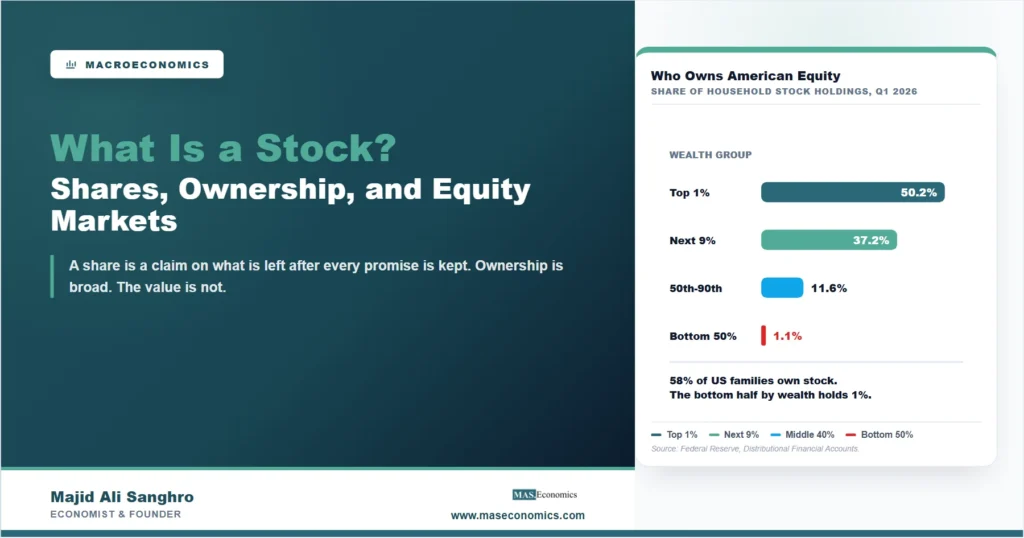
The Federal Reserve’s 2022 Survey of Consumer Finances found that 58 percent of American families held stock in some form, the highest share it has ever recorded. Only 21 percent held shares directly. The rest reached the stock market through a retirement account, often without choosing a single company. Answering what is a stock begins with the idea that separates it from every other financial instrument: a share is a piece of ownership, not a promise of payment.
That distinction does more work than it appears to. A lender is owed a specific amount on a specific date. An owner is owed nothing at all. What the owner holds is a claim on whatever remains after everyone with a promise has been paid, and on the decisions about what happens to that remainder. Most of what confuses beginners about equity markets comes from expecting a share to behave like a loan.
Ownership Cut Into Identical Units
A company issues shares to divide its ownership into units small enough to be sold. Each unit carries the same claim. A pension fund holding four million shares and a household holding four shares own the same thing per share, in the same proportion to the whole.
The proportion is what matters, not the count. Owning 40,000 shares of a company that has issued 400,000 is a tenth of the business. Owning 40,000 shares of a company that has issued four billion is a rounding error. The share price alone says nothing about the size of the claim, which is why comparing two companies by their share prices is meaningless without the share count beside it.
Ownership also comes with a limit that made the whole arrangement possible. A shareholder’s loss stops at the amount invested. If the company borrows heavily and fails, the lenders cannot pursue the shareholder for the shortfall. Limited liability is the legal invention that let strangers finance enterprises they had no way of monitoring, and it remains the reason a household can own a fragment of a company on the other side of the world without taking on that company’s debts.
The Owner Is Last in the Queue
A company’s revenue is spent in an order that is close to fixed. Suppliers and employees are paid because the business stops otherwise. Lenders are paid because the contract says so and default has consequences. Governments are paid because the tax is assessed on what is left after those costs. Only then does anything reach the owners.
Economists call the result a residual claim. It is the reason equity behaves so differently from debt in both directions. A small change in revenue passes through the fixed obligations untouched and lands entirely on the residual, so the owner’s share swings far more than the business does. A company whose revenue falls 5 percent may see the money available to owners fall by half, and the same arithmetic works in reverse in a good year.

This is also why the two claims on a company are priced so differently, and why the long-run gap between what shares have paid and what bonds have paid is wider than the difference in risk seems to justify. That gap is the subject of the equity risk premium puzzle, and the standard framework for pricing the risk itself is set out in the article on how finance learned to price risk.
| Feature | Lender (bondholder) | Owner (shareholder) |
|---|---|---|
| What is promised | A fixed interest payment and the principal | Nothing |
| When it ends | On the maturity date | Never, unless the holder sells |
| Order of payment | Before owners, in normal times and in bankruptcy | After every other claim |
| Best outcome | Paid in full, and no more | Unlimited |
| Worst outcome | Partial recovery in a restructuring | Zero, but never less than zero |
| Say in decisions | Only through covenants written in advance | A vote at the annual meeting |
|
|
||
Two Routes From Profit to Pocket
Money reaches a shareholder in exactly two ways, and the company chooses between them.
The first is a dividend, a cash payment out of profits, usually quarterly and set by the board. The second is a rise in the price of the share itself, which the holder converts to cash only by selling. Anything the company earns and does not pay out is retained, and retained earnings either sit on the balance sheet or are spent on investment, debt repayment, or buying back the company’s own shares.
A buyback is a dividend wearing different clothes. When a company purchases its own shares and cancels them, the remaining shares each represent a larger slice of the same business, so the value per share rises without any cash reaching the holder. The economic effect on a shareholder who does not sell is close to that of a dividend, with a different tax treatment and no commitment to repeat it next quarter. That flexibility is why buybacks have grown as a share of total payouts in the United States, and it explains why measuring what a company pays its owners by dividends alone now understates it.
Neither route is guaranteed. A board can cut a dividend to zero without breaking any contract, and many profitable companies have never paid one, preferring to reinvest. A share can also pay nothing for a decade and still be worth more at the end. The claim is on the residual, and the residual can be handed over, reinvested, or wasted.
Price Reflects Expectation, Not Assets
A common first assumption is that a company’s shares are collectively worth what the company owns. They rarely are. The price of a share is what someone will pay today for a claim on profits that have not been earned yet, which makes it a statement about the future rather than an inventory of the present.
Two companies with identical buildings and machines will trade at very different prices if one is expected to grow and the other is not. This is why share prices move on news that changes nothing physical: a regulatory decision, a competitor’s product, a shift in interest rates that alters what future money is worth today. The gap between market value and the replacement cost of a company’s assets is itself an economic signal, and the theory that turns that ratio into a prediction about corporate investment is covered in the article on Tobin’s Q.
Whether those expectations are already fully reflected in the price is the longest-running argument in finance. The case that public information is absorbed too quickly for any consistent advantage to remain is set out in the discussion of the efficient market hypothesis, and the systematic ways in which real investors depart from that assumption are catalogued in the work on biases in decision-making.
Inflation complicates the reading further. Company earnings are nominal, so a rise in the general price level lifts reported profits without making the business larger, while the discount applied to future profits usually rises at the same time. The two effects pull in opposite directions, which is why equities are an unreliable inflation hedge over short periods, a relationship examined in the article on inflation and capital markets.
The Share Count Is Not Fixed
A bond’s principal is written down and does not change. The number of shares in a company does, and beginners are rarely told so.
A company that needs money can issue new shares. The business is then divided among more units, and every existing holder’s proportion falls. This is dilution, and it is the shareholder’s equivalent of a borrower quietly increasing the loan. It happens routinely, through secondary offerings, through shares issued to acquire another company, and through the stock granted to employees as part of their pay. In many large technology companies, employee compensation issued in shares is a continuous source of new units.
The count also falls, through the buybacks described above, and it can be multiplied without changing anything at all. A stock split replaces each share with several, cutting the price proportionally. Nothing about the claim changes. The split exists to make the price convenient, which is a point about market plumbing rather than value.
The practical consequence is that a shareholder’s stake has to be tracked as a proportion rather than a number of units. Earnings per share, the figure most often quoted, has a denominator that management can move.
The Company Is Paid Once
Shares live in two markets and only one of them sends money to the company.
The primary market is where shares are created and sold by the company itself. An initial public offering is the best-known example, and the cash raised goes onto the company’s balance sheet. Later share issues work the same way. The United States Securities and Exchange Commission sets out the disclosure obligations a company takes on when it sells shares to the public, and those obligations are the price of access to that money.
The secondary market is everything afterwards. When one investor buys a share from another on an exchange, the company receives nothing and its balance sheet does not move. Almost all reported trading is of this kind. A company whose share price doubles has not been handed any money by that move; it has become cheaper for it to raise money the next time it issues shares, which is a different statement.
This distinction clears up a persistent misreading of financial news. A falling share price does not drain cash from a company. It changes the terms on which the company can raise more, it changes the value of shares held by employees and founders, and it changes the pressure on the board. The operating business is affected through those channels rather than directly.
What a Vote Is Actually Worth
Ownership carries control on paper. Shareholders elect the board of directors, and the board appoints and removes the executives who run the company. Ordinary shares usually carry one vote each, so control follows proportion.
In practice the vote is concentrated in a small number of hands, because a large share of the market is held through funds. An index fund holds shares on behalf of millions of savers and votes them as a single block, which places significant governance influence with a handful of asset managers who have no view on any individual company’s strategy. Some companies also issue two classes of shares, giving founders votes worth many times those of outside holders, so ownership and control can be separated deliberately.
For a household holding shares through a pension account, the practical position is that the economic claim is real and the control is nominal. That is not a defect in the design. It is what happens when ownership is divided finely enough to be sold in units of one.
Who Owns American Equity
Ownership of stock is far more common than ownership of much stock. The Federal Reserve’s Distributional Financial Accounts split the total value of corporate equities and mutual fund shares held by American households across the wealth distribution, and the split is stark.
Read those two facts together and a familiar sentence changes meaning. Most American families own some stock, and the bottom half of households by wealth holds about one percent of the total. A rising market therefore adds to the wealth of a broad group and to the balance sheet of a narrow one, and the two effects differ by orders of magnitude. Reporting a market gain as national good news describes the direction correctly and the distribution not at all. The measurement of that kind of concentration is the subject of the article on the economics of inequality.
The channel that reaches ordinary households is slower and less visible. Most families who own stock own it inside a retirement account, where the gain is not spendable now, is taxed on withdrawal, and matters at a horizon measured in decades. A market fall in that account does not change this month’s budget. It changes the age at which retirement becomes affordable, which is a real consequence that arrives without any headline.
A US Market Move Is a Global One
American equity is not held only by Americans. The Federal Reserve’s financial accounts of the United States show foreign investors holding 19.4 trillion dollars of US corporate equities at the start of 2026, against 91.9 trillion held in total, so roughly a fifth of American corporate ownership sits outside the country.
That share is the transmission channel. When US share prices move, the wealth of pension funds in Europe, sovereign funds in the Gulf, and insurers in Japan moves with them, and it moves in local currency terms that also depend on the dollar. A retiree in a country with no direct exposure to the American labour market can still have a pension whose funding level is set largely by American corporate profits.
The effect runs the other way as well. Because so much of the world’s savings is invested in American shares, US firms face a lower cost of equity than they otherwise would, which makes it cheaper for them to expand, including through the cross-border acquisitions traced in the article on foreign direct investment. The scale of foreign participation in one national market is a quiet form of integration that no trade agreement created.
Where Equity Ownership Fails
A share is a claim on a residual, and a residual can be zero. In bankruptcy, shareholders are paid after employees, suppliers, tax authorities, and every class of lender, which in most failures means they are paid nothing while bondholders recover part of their money. Diversification reduces the chance that any single failure matters, and it cannot remove the risk that affects all companies at once, a distinction developed in the guide to risk, uncertainty, and insurance.
Ownership also gives less information than it appears to. A shareholder sees audited accounts published quarterly and a share price updated by the second, and the accounts are the slower and more reliable of the two. The price contains everything the market believes, including things that are wrong, and it revises without notice when the belief changes.
MASEconomics Explains
4 economic concepts behind stocks
These concepts are explored in depth across our educational articles library.
Conclusion
The answer to what is a stock is a unit of ownership in a company, carrying a claim on whatever is left after every promise the company has made is kept, and a vote on who runs it. Nothing about that claim is fixed. The payment is discretionary, the proportion changes when the share count changes, and the price reflects expectations about profits that do not yet exist.
Two facts about the American market give the instrument its social shape. Stock ownership is now broad, reaching 58 percent of families, while the value is narrow, with the wealthiest tenth of households holding 87.4 percent of the total. And roughly a fifth of American corporate equity is owned abroad, which turns a move in one country’s share prices into a change in retirement wealth across several continents. The instrument is simple to define and its distribution is what makes it consequential.
Frequently Asked Questions
What is a stock in simple terms?
A stock is a unit of ownership in a company. The holder owns a proportion of the business and has a claim on whatever profit remains after employees, suppliers, lenders, and taxes are paid, along with a vote on who sits on the board.
What is the difference between a stock and a share?
In ordinary use the terms are interchangeable. Where a distinction is drawn, stock refers to the ownership interest in general and a share is one specific unit of it, so a person owns stock in a company and holds a stated number of shares.
How do stocks make money for their owners?
Through dividends, which are cash payments out of profit decided by the board, and through a rise in the share price, which becomes cash only on sale. A company that buys back its own shares raises the value of the remainder, which has an effect similar to a dividend without paying cash out.
Do all stocks pay dividends?
No. A dividend is not a contractual obligation, and a board can reduce or cancel it at any time. Many profitable companies pay nothing and reinvest their earnings instead, so the return to holders comes entirely through the share price.
What happens to stocks when a company goes bankrupt?
Shareholders are paid last, after employees, suppliers, tax authorities, and every class of lender. In most bankruptcies nothing remains for them and the shares become worthless, although the holder’s loss is limited to the amount invested.
Thanks for reading! The share count in the denominator is the part almost nobody checks, and it is the part management can move. Happy learning with MASEconomics