Every central bank keeps a facility whose entire purpose is to be there on the worst day of a bank’s life, and whose defining problem is that banks would rather risk the worst day than be seen using it. The discount window is the standing arrangement through which commercial banks can borrow from the central bank against collateral, at a posted rate, with no appointment necessary. It is the operational form of the central bank’s oldest duty, the lender of last resort, and it embodies a paradox that has shaped a century and a half of crises: the tool works only if banks use it, banks avoid using it because use signals weakness, and the avoidance turns survivable liquidity squeezes into failures the window existed to prevent.
Understanding the window means understanding three things: the Victorian rule it implements, the mechanics of how it lends, and the stigma that keeps defeating both. The third is where the modern story lives, because the twenty-first century has run the experiment repeatedly, and the results keep teaching the same uncomfortable lesson.
Bagehot’s Rule, Written Into Plumbing
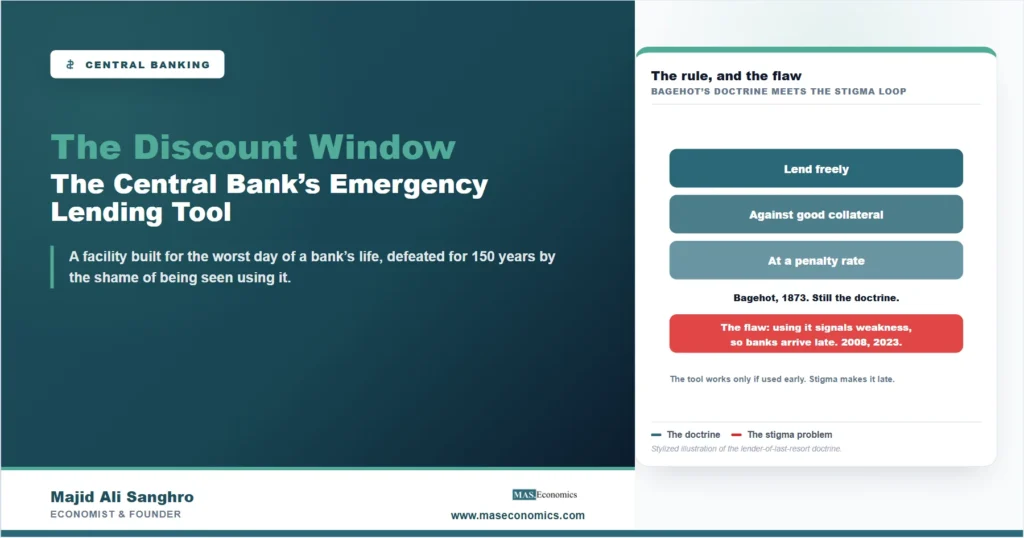
The intellectual foundation is a rule articulated by Walter Bagehot in 1873 and recited by central bankers ever since: in a panic, lend freely, against good collateral, at a penalty rate. Each clause has a job. Lend freely, because a solvent bank facing a run needs cash faster than it can sell assets, and the failure of a solvent bank is a pure waste that spreads. Against good collateral, so the central bank backs banks that own sound assets they cannot sell quickly, rather than propping up the genuinely broke. At a penalty rate, so the facility is a backstop rather than a subsidy, used when markets fail and abandoned when they heal.
The mechanics follow the rule closely. A bank pledges collateral, government securities at full value, loans and other assets with a haircut, a discount from face value that protects the lender, and borrows at the posted window rate, in normal times a margin above the policy rate. The loan is overnight or short-term, renewable, and available on demand: the point of a standing facility is that no committee needs to convene at three in the morning. Why such a facility must exist at all is the lesson of the Diamond-Dybvig model: banks fund long-term loans with deposits withdrawable on sight, so even a perfectly sound bank can be killed by depositors’ beliefs alone, and only an entity that can create money at will can credibly stand behind the deposits fast enough to make the beliefs self-defeating.
Stigma: The Design Flaw That Will Not Die
The window’s history is largely the history of banks refusing to walk through it. The logic of the refusal is airtight from the inside. Counterparties, analysts, and depositors know the window exists for trouble, so evidence that a bank used it, leaked, inferred from disclosures, or guessed from balance sheet data, reads as a distress signal, and in banking, being suspected of distress causes distress. Each bank therefore holds out, selling assets at bad prices and hoarding liquidity instead, until the window becomes the last resort in the literal sense: used only by institutions whose situation is already public, which confirms the stigma for the next cycle. The penalty rate, Bagehot’s own third clause, sharpens the problem by pricing the facility as something only the desperate would pay for.
The modern record is a case file. In 2008, banks were so reluctant to be seen at the window that the Federal Reserve invented an auction facility whose entire design purpose was anonymity through generality, letting banks borrow in a crowd; window balances stayed trivial even as the system burned, the episode traced in our account of the 2008 financial crisis. In March 2023, Silicon Valley Bank reached the window only in its final hours, having first tried everything else, and the record borrowing that followed its failure came from a system borrowing after the fear was public, not before. Each episode ends with the same finding: the facility priced and framed for early use gets used late, and lateness is the one thing a liquidity tool cannot survive.
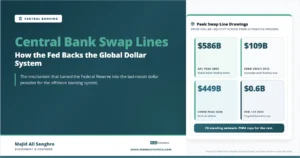
The reform effort since has attacked the signal rather than the price. Supervisors now push banks to pre-position collateral at the window in calm times and to test-borrow routinely, so that contact with the facility stops being informative; disclosure of borrowers is delayed by years; and officials repeat that window use is sound liquidity management, not confession. The same logic, at international scale, produced the central bank swap lines that backstop dollar funding abroad: standing, rule-based, and deliberately unremarkable. Whether the domestic rehabilitation succeeds is genuinely open; stigma is a belief about other people’s beliefs, and those move slowly.
The Window in the Toolkit
The discount window sits in a precise slot among the central bank’s instruments, and the boundaries matter. It is not monetary policy: the policy rate steers the economy’s credit conditions, while the window backstops individual institutions’ liquidity, one tool for the average and one for the tail, a division the survey in the functions of central banks makes clear. It is not a bailout: window lending is collateralized, short-term, and available only to institutions the supervisor deems viable, which is exactly the line between liquidity support and the solvency rescues that require governments, capital, and political decisions. And within the Federal Reserve’s structure it is the regional Reserve Banks that administer it, one of the last operational duties of the district system. When the line between illiquid and insolvent blurs, as it always does in the worst weeks, the window becomes the place where that judgment gets made under pressure, which is why its quiet existence matters most precisely when nobody is using it.
MASEconomics Explains
3 economic concepts behind the discount window
These concepts are explored in depth across our educational articles library.
Explore the MASEconomics BlogConclusion
The discount window is Bagehot’s rule cast as permanent infrastructure: a standing promise that a solvent bank with sound assets need never die of a queue, collateralized and priced to remain a backstop rather than a business. Its mechanics are simple and its necessity is settled theory, the run dynamics of Diamond and Dybvig made operational. Its tragedy is behavioral: the signal sent by using it defeats the timing that would make it work, and from 2008’s anonymous auctions to 2023’s final-hours borrowing, the case file keeps growing.
The current reform bet is that stigma can be starved rather than priced away, by making contact with the window routine, collateral pre-positioned, and disclosure slow. If it works, the next panic will be the first in which the emergency tool gets used before the emergency is public. Either way, the window’s paradox is worth carrying into every crisis headline: the most important lending facility in finance is the one whose success would look like nothing happening at all.
Frequently Asked Questions
What is the discount window in simple terms?
It is the central bank’s standing facility through which commercial banks can borrow short-term against collateral at a posted rate, at any time, without special approval. It exists so that a fundamentally sound bank facing sudden withdrawals can get cash immediately instead of failing while trying to sell assets.
Why do banks avoid the discount window?
Stigma. Because the window is associated with trouble, evidence of using it can be read by markets and depositors as a distress signal, and suspicion of distress is dangerous in banking. Banks therefore delay borrowing until their situation is already public, which defeats the facility’s purpose and reinforces the stigma for everyone else.
What is Bagehot’s rule?
The classical doctrine of last-resort lending, from Walter Bagehot’s 1873 book Lombard Street: in a panic, the central bank should lend freely to solvent institutions, against good collateral, at a penalty rate. The three clauses aim to stop runs, avoid propping up the insolvent, and keep the facility a backstop rather than a subsidy.
Is discount window lending a bailout?
No. Window loans are short-term, fully collateralized with haircuts, and available only to institutions supervisors consider viable, so the taxpayer is not absorbing losses. A bailout addresses insolvency, too little capital, and requires government decisions. The window addresses illiquidity, sound assets that cannot be sold fast enough.
What happened with the discount window in 2023?
The failure of Silicon Valley Bank in March 2023 showed the stigma pattern again: the bank reached the window only in its final hours, and the heavy borrowing that set records came from the wider system after the panic was public. The episode accelerated reforms pushing banks to pre-position collateral and treat window use as routine.
Thanks for reading! The best crisis tool is the one nobody is embarrassed to use early, and central banking is still trying to build it. Happy learning with MASEconomics