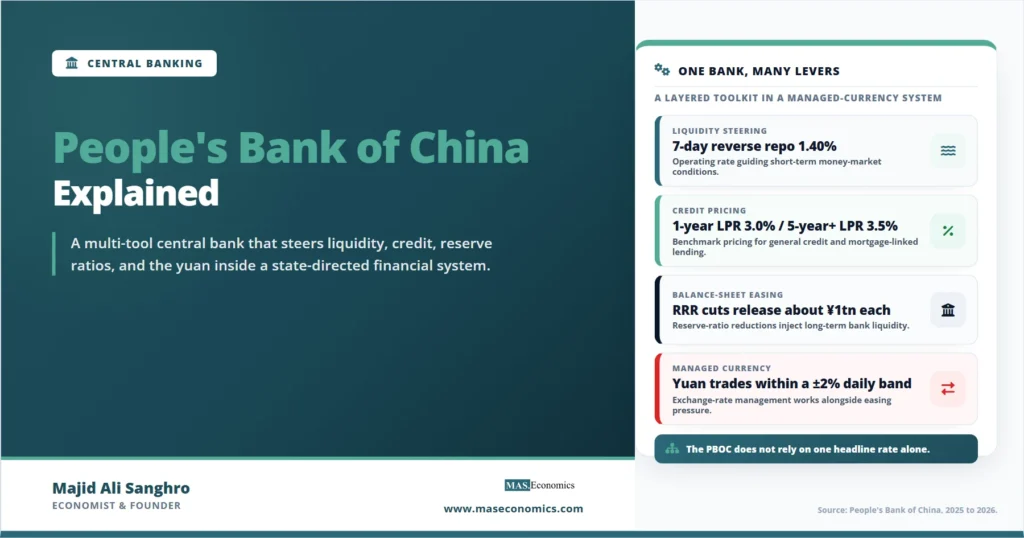
On May 7, 2025, the People’s Bank of China did three things at once. It cut the seven-day reverse repo rate by 10 basis points to 1.40%, lowered the reserve requirement ratio for banks by half a percentage point to release roughly one trillion yuan of liquidity, and announced a set of targeted re-lending programs for consumption, elderly care, technology, and small business. A Western central bank facing a slowdown would have done one of these things, a rate cut, and explained it in a press conference. China’s central bank did all three in a coordinated package, because its monetary policy does not run through a single interest rate. It runs through a toolkit.
That distinction is the key to understanding the institution. The People’s Bank of China is the central bank of the world’s second-largest economy, established in 1948 and designated as a central bank in 1983. It issues the renminbi, manages the largest stockpile of foreign exchange reserves on earth, supervises the plumbing of a banking system dominated by state-owned giants, and guides the price and quantity of credit across the economy. Unlike the Federal Reserve or the Bank of Canada, it does not target a single inflation number through a single policy rate. It manages quantities and prices together, steers the exchange rate inside a controlled band, and operates not as an independent authority but as an arm of the state under the direction of the State Council and the oversight of the Communist Party.
This profile covers the bank’s mandate, its layered policy toolkit, its governance inside the Chinese state, its management of the yuan, and the structural pressures it now faces. It is the evergreen reference that supports our coverage of Chinese monetary policy decisions and the broader Chinese economy.
Mandate Beyond Price Stability
The legal basis for the bank is the Law of the People’s Republic of China on the People’s Bank of China, adopted by the National People’s Congress in March 1995 and amended in 2003. The law assigns the bank a broad set of objectives rather than a narrow inflation mandate. It is charged with maintaining the stability of the currency value and thereby promoting economic growth, a formulation that bundles price stability, exchange-rate stability, and growth into a single mission rather than ranking them.
This is a wider remit than the inflation-targeting frameworks that organize most advanced-economy central banks. Where the Bank of Canada subordinates almost everything to a 2% target and the Federal Reserve weighs employment and prices, the People’s Bank of China carries an explicit growth objective, an exchange-rate objective, a financial-stability objective, and a development objective that includes opening and reforming the financial system. In practice, the bank has often been asked to support whatever the leadership’s economic priority is at a given moment, from export competitiveness to property-market stabilization to the financing of strategic industries.
Several functions that sit inside the Federal Reserve are held outside the People’s Bank of China. Bank supervision was largely moved to separate regulators, a function once split across the banking and securities commissions and later reorganized under a consolidated financial regulator. Foreign exchange administration runs through a dedicated state agency that operates under the bank’s umbrella. What the bank retains is the core of monetary control: currency issuance, the policy rate structure, reserve requirements, open market operations, the management of reserves, and the guidance of credit. The general architecture of these responsibilities is the subject of our explainer on what central banks do; the Chinese version simply distributes them differently.
From Mono-Bank to Central Bank
The institution was founded on December 1, 1948, in Shijiazhuang, through the merger of three Communist-run regional banks, the Huabei Bank, the Beihai Bank, and the Xibei Farmer Bank. For its first three decades, it was not a central bank in any recognizable sense. Under the planned economy it functioned as a mono-bank, simultaneously the central bank and effectively the only commercial bank, channeling credit to state enterprises according to the national plan and operating under the Ministry of Finance.
The transformation came with Deng Xiaoping’s reforms. In September 1983, the State Council decided that the bank would function exclusively as a central bank, and in January 1984 its commercial banking operations were spun off to create the Industrial and Commercial Bank of China, the first of the state-owned commercial giants. This established the two-tier banking system that still exists: a central bank on top, large state-owned commercial banks beneath. The 1993 financial reform resolution further sharpened the bank’s role in monetary policy and financial stability, and the 1995 central bank law gave the institution its first explicit legal foundation. Securities supervision had already been hived off to a separate commission in 1992, and banking supervision followed in 2003.
The result of this history is a central bank that grew out of a planning apparatus rather than out of a tradition of monetary independence. That origin shows in its instruments. A bank that once allocated credit by administrative direction still keeps quantity tools, reserve requirements, lending quotas, and direct guidance to banks close at hand, alongside the price tools that newer central banks rely on almost exclusively.
Layered Toolkit of Prices and Quantities
The defining feature of the People’s Bank of China is that it operates several instruments at once, across both the price of credit and its quantity. Understanding the bank means understanding how these layers fit together.
At the price layer, the bank has been consolidating around the seven-day reverse repo rate as its primary policy rate. Through 2024, it shifted the operational emphasis away from the medium-term lending facility, the MLF, toward the shorter reverse repo rate, bringing its framework a step closer to the short-rate anchor that Western central banks use. The MLF remains a tool for supplying medium-term funding to banks, but it is no longer the headline signal. The reverse repo rate in turn guides the loan prime rate, the LPR, which is the reference rate that commercial banks use to price loans. The LPR is quoted in one-year and over-five-year tenors, the latter serving as the anchor for mortgage pricing. As of April 2026, the one-year LPR stood at 3.0% and the over-five-year LPR at 3.5%, both unchanged for eleven consecutive months.
At the quantity layer sits the instrument that makes the bank distinctive among major central banks: the reserve requirement ratio. The RRR is the share of deposits that banks must hold at the central bank rather than lend out. Most advanced-economy central banks have let reserve requirements fade into irrelevance, but the People’s Bank of China uses RRR changes as a frontline tool, cutting the ratio to inject liquidity into the banking system and lifting it to drain liquidity out. A 50-basis-point cut typically releases on the order of one trillion yuan of lendable funds. The weighted average ratio has been guided down over successive cuts and sits in the mid-single digits, well below the levels of a decade ago but still a live and frequently used lever.
At the guidance layer, the bank deploys structural and administrative tools that have no clean Western equivalent. Re-lending and re-discount programs channel cheap central bank funding to specified sectors- technology, agriculture, small business, elderly care- in effect a targeted credit policy run through the monetary authority. Window guidance, the practice of directly signaling to banks how much and to whom they should lend, remains part of the operating reality. These tools let the bank direct credit to policy priorities rather than simply setting a price and letting the market allocate.
The table below sets out the main instruments and how each is used.
| Tool | Layer | What It Does |
|---|---|---|
| Seven-day reverse repo rate | Price | Primary policy rate that signals the monetary stance and guides money-market rates |
| Loan prime rate (LPR) | Price | Reference rate banks use to price loans; over-five-year tenor anchors mortgages |
| Medium-term lending facility (MLF) | Price and quantity | Supplies medium-term funding to banks; downgraded from primary signal in 2024 |
| Reserve requirement ratio (RRR) | Quantity | Sets the share of deposits banks must hold at the central bank; cuts release liquidity |
| Open market operations | Quantity | Daily reverse repos and, more recently, government bond trading to manage liquidity |
| Structural re-lending programs | Guidance | Channels cheap funding to targeted sectors such as technology, agriculture, and small business |
| Window guidance | Guidance | Direct administrative signals to banks on the volume and direction of lending |
| Exchange-rate management | External | Daily central parity fix and intervention to steer the yuan within its trading band |
|
Source: People’s Bank of China monetary policy documentation and official statements, 2025–2026.

|
||
One consequence of this layered approach is that the transmission of policy is more administrative and less market-driven than in the United States or Canada. A rate cut works partly through the price channel and partly through quotas, guidance, and the willingness of state-owned banks to act on policy direction. This is why the standard tools of Western monetary analysis travel poorly to China. A single reaction function of the kind described in our explainer on the Taylor Rule cannot capture an authority that moves several instruments simultaneously and allocates credit by sector. The broader logic of how rate changes reach the real economy, covered in our piece on the monetary transmission mechanism, applies in principle, but the Chinese channel runs heavily through state-directed banks rather than through arms-length markets.
Central Bank Inside the Party‑State
The governance of the People’s Bank of China is where it differs most fundamentally from its Western counterparts, and the difference is not a matter of degree. The bank is not independent. The 1995 law makes monetary policy the responsibility of the bank under the direction of the State Council, China’s cabinet. Major decisions, including changes to the policy rate, the exchange-rate regime, and reserve requirements, are taken with State Council approval rather than by an autonomous committee insulated from government.
Layered above the state structure is the Communist Party. The bank, like every significant Chinese institution, has an internal Party committee, and the Party Committee Secretary holds decisive influence over the institution’s direction. As of 2026, the bank is led by Governor Pan Gongsheng, who holds both the governorship and the Party Committee Secretary role, a combination that concentrates formal and political authority in a single figure. The governor is appointed through the state apparatus, nominated within the State Council structure and confirmed by the National People’s Congress, rather than serving a fixed term designed to span electoral cycles.
The contrast with the model described in our explainer on central bank independence is stark. Independence, as the concept is usually defined, means a central bank can set policy to achieve a mandate without taking instructions from the government of the day. The People’s Bank of China is structurally the opposite: an instrument of state economic policy whose value lies precisely in its responsiveness to the leadership’s priorities. This is not a flaw in the design from Beijing’s perspective; it is the design. The trade-off is the one independence is meant to solve. A responsive central bank can mobilize quickly behind national objectives, but it cannot offer the credible, rules-based commitment to price stability that anchors long-run inflation expectations in independent regimes.
Communication reflects the same logic. The bank publishes far less about its deliberations than the Federal Reserve or the European Central Bank. There are no detailed meeting minutes, no dot plot of individual policymakers’ rate expectations, and limited forward guidance. Markets read the bank’s intentions from its daily operations, its quarterly monetary policy reports, and signals from leadership work conferences, not from a transparent voting record. The full Federal Reserve model of governance and disclosure, set out in our profile of the Fed, is close to the mirror image of how the People’s Bank of China operates.
Managing the Yuan and Capital Account
No account of the People’s Bank of China is complete without its management of the exchange rate, which is bound up with the control of cross-border capital flows. Since July 2005 the yuan has operated under a managed float rather than a hard peg, but the emphasis falls on managed. Every trading morning, around 9:15 Beijing time, the bank sets a daily central parity rate, a reference midpoint for the dollar-yuan exchange rate. The onshore yuan is then permitted to trade within a band of 2% above or below that fix during the session. Since December 2015, the parity has formally referenced a basket of currencies tracked by the China Foreign Exchange Trade System, the CFETS index, rather than the dollar alone, though the dollar pair still draws the most attention.
The fix is the instrument of control. By setting the central parity stronger or weaker than market forces alone would imply, the bank guides the currency without spending reserves, and a fix that diverges sharply from expectations is read as a deliberate signal from Beijing. When the bank wants to resist depreciation pressure, it sets the parity on the strong side; the daily fix has in practice come to act as much as a ceiling on daily moves as a true midpoint. Behind this sits the largest war chest of foreign exchange reserves in the world, which the bank can deploy to smooth or defend the currency when it judges that necessary.
The exchange-rate regime only works because it is paired with control of the capital account. China maintains restrictions on the cross-border movement of capital, limiting how freely money can flow in and out of the country. These controls are what allow the bank to run an independent domestic monetary policy and a managed exchange rate at the same time, an arrangement that would be unstable in an economy with open capital flows. The logic of how such controls support exchange-rate and monetary objectives is the subject of our explainer on how central banks use exchange controls. For the People’s Bank of China, capital controls are not an emergency measure; they are a permanent feature of the system that makes the managed float possible.
Pressures for the Next Decade
The People’s Bank of China enters the second half of the 2020s managing a set of pressures that its toolkit was not originally built for.
The first is the risk of deflation rather than inflation. For most of its modern history, the bank fought to contain price rises and an overheating credit cycle. The recent danger has been the opposite: weak demand, falling property prices, and inflation drifting toward or below zero. This is why the bank entered 2026 signaling an appropriately loose stance and flagging further rate and reserve requirement cuts. Fighting deflation is harder than fighting inflation, because cutting nominal rates toward their floor does little when households and firms are unwilling to borrow, and the bank’s quantity tools cannot force credit into an economy that does not want it.
The second is the property sector and the debt built up around it. Years of credit-fueled construction left local governments, developers, and households heavily exposed to real estate, and the correction in that market has weighed on growth and on the balance sheets of the banks the central bank relies on to transmit policy. The over-five-year LPR, the mortgage anchor, has become a focus precisely because lowering it is one of the levers available to support housing without a broad-based easing that might pressure the currency.
The third is the long contest between control and reform. For two decades the bank’s technocrats have pushed, in fits and starts, toward a more market-based exchange rate, a more open capital account, and a greater international role for the renminbi. Each step toward openness collides with the State Council’s preference for stability and the Party’s interest in retaining control of the financial account. The result is a regime caught between ambitions: a currency that Beijing wants used more widely abroad but is unwilling to let trade freely, and a central bank that wants more market discipline but operates inside a system designed to limit it. How that tension resolves will shape not only Chinese monetary policy but the architecture of the global financial system, given the weight of the Chinese economy in world trade and finance.
Explains
Four ideas behind the People’s Bank of China
Connect these ideas to the wider library of central banking and global economy articles.
Explore the MASEconomics BlogConclusion
The People’s Bank of China is best understood not as an inflation-targeting central bank with Chinese characteristics, but as a different kind of institution altogether. It manages prices and quantities together, steers credit toward national priorities through reserve requirements and re-lending rather than relying on a single policy rate, and controls the exchange rate through a daily fix backed by capital controls and the world’s largest reserve stockpile. Above all, it operates not as an independent authority but as an instrument of the State Council and the Party, valued for its responsiveness to the leadership rather than for arms-length commitment to a numerical target.
That design gives Beijing a powerful and fast-acting lever over the economy, but it carries the cost that independence is meant to avoid: the absence of a credible, rules-based anchor for long-run expectations. As the bank confronts deflation risk, a damaged property sector, and the unresolved tension between control and reform, the question is not whether it can mobilize; it has shown it can move several tools at once within days, but whether a credit-allocation model built for a fast-growing, catching-up economy can manage a mature one facing weak demand. The answer will shape the trajectory of the world’s second-largest economy and the global system that depends on it.
Frequently Asked Questions
What is the People’s Bank of China in simple terms?
The People’s Bank of China is the central bank of the People’s Republic of China. It issues the renminbi, sets the main policy rates and reserve requirements, manages the country’s foreign exchange reserves, steers the value of the yuan, and guides the supply of credit. It operates under the direction of the State Council rather than as an independent authority.
What are the main tools the PBoC uses?
The bank uses several tools at once. Its main policy rate is the seven-day reverse repo rate, which guides the loan prime rate that banks use to price loans. It also adjusts the reserve requirement ratio to change how much banks can lend, runs structural re-lending programs that direct credit to favored sectors, and manages the yuan through a daily central parity fix. This multi-tool approach is why a single interest rate cannot summarize its policy.
Is the People’s Bank of China independent?
No. The bank conducts monetary policy under the direction of the State Council, and the Communist Party exercises oversight through the bank’s internal Party committee. As of 2026, Governor Pan Gongsheng also serves as the bank’s Party Committee Secretary. Its design prioritizes responsiveness to the leadership’s economic priorities over the arms-length independence found in many Western central banks.
How does the PBoC control the value of the yuan?
Each morning the bank sets a daily central parity rate for the yuan against the dollar, and the currency is allowed to trade within 2% above or below that fix. By setting the fix stronger or weaker than market pressure alone would suggest, the bank guides the currency, supported by capital controls that limit cross-border flows and by the largest foreign exchange reserves in the world.
When was the People’s Bank of China established?
The bank was established on December 1, 1948, through the merger of three Communist-run regional banks. It functioned as a combined central and commercial bank under the planned economy until reforms in 1983 and 1984 refocused it exclusively on central banking, and its central bank status was confirmed by law in 1995.
Thanks for reading! If you found this helpful, share it with friends and spread the knowledge. Happy learning with MASEconomics