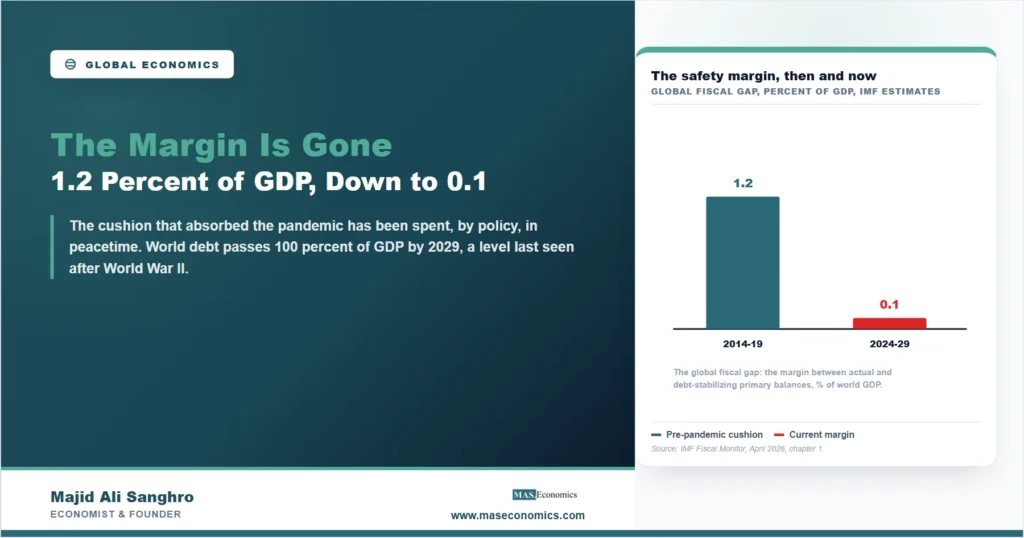
A decade ago the world’s governments, taken together, ran their budgets with about 1.2 percent of GDP to spare: their primary balances were comfortably stronger than the level needed to keep the world’s debt ratio from rising. That cushion was the margin for error, the room to absorb a recession, a war or a pandemic without debt spiraling. The IMF’s April 2026 Fiscal Monitor now estimates the global fiscal gap for 2024 to 2029 at 0.1 percent of GDP. The margin that took the strain of every shock of the past decade has, in the IMF’s own words, all but disappeared.
A number this abstract earns its place by what it implies. Zero margin means the world’s public debt ratio, already near 94 percent of world GDP in 2025 and heading past 100 percent by 2029, has stopped falling by design and now holds steady only if nothing goes wrong. The last time global debt stood at 100 percent of output was the aftermath of World War II. The difference is that in 1946 the number marked the end of an emergency. This time it is the baseline, reached without one.
What the Gap Measures, and Where It Went
The fiscal gap is the distance between two primary balances: the one the world’s governments actually run, and the one that would hold the global debt ratio constant given interest rates and growth. Positive means debt ratios drift down on their own; zero means every shock from here lands directly on the debt stock. The mechanics of that arithmetic, and why the interest-growth difference sits at the heart of it, are set out in our explainer on debt sustainability.
Where the cushion went is the report’s most consequential finding, because it rules out the comfortable explanation. The IMF decomposes the deterioration and finds the interest-growth component largely neutral, despite visibly higher borrowing costs. What consumed the margin was the primary balance itself: permanently higher spending and weaker revenue performance, concentrated in the largest economies. The report’s word for this is structural. The margin was not squeezed away by unlucky interest rates. It was spent, by policy, in peacetime, on commitments that recur every year.
The Composition Problem
| Measure | 2014-19 | 2024-29 | What drove the change |
|---|---|---|---|
| Global fiscal gap, percent of GDP | 1.2 | 0.1 | Primary balances almost entirely; interest-growth roughly neutral |
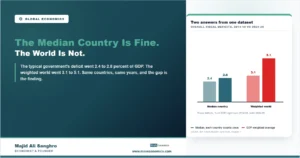
| Weighted world deficit, percent of GDP | 3.1 | 5.1 | Higher permanent spending, weaker revenues, largest economies |
| Weighted world debt, percent of GDP | 79.8 | 96.2 | Accumulated deficits; global total passes 100% by 2029 |
| Interest payments, percent of global GDP | ~2 | ~3 | Maturing debt refinanced at today’s higher rates |

|
|||
The interest row deserves a pause, because it looks like a contradiction and is not. Interest payments have risen from 2 to nearly 3 percent of global GDP in four years, yet the decomposition calls the interest-growth component neutral. Both are true: what the gap measures is interest relative to growth, and nominal growth has so far kept pace with the rising cost of debt. That is a description of the past four years, not a property of the world. The American experience shows how quickly the interest side can move, with the federal bill reaching the record levels we traced in where $1.2 trillion goes, and the transmission consequences examined in our companion piece on what high public debt does to a rate cut.
The global figure also averages across radically different countries, a problem we dissected in the median-and-mean split of the typical country against the world. The Fiscal Monitor’s own national cases make the point: Germany’s gap swung from a 3.6 percent cushion to minus 1.5 percent after the reform of its debt brake unlocked investment spending, a deliberate spending-down of margin, while Japan’s moved from about zero to a 4 percent cushion on stronger revenues and higher inflation. The United States, running deficits of 7 to 8 percent of GDP near full employment with gross debt heading for 142 percent by 2031, sits at the other extreme. Zero is not where every country stands. It is where the weighted world stands, and the weights point at a handful of capitals.
Living Without a Margin
What does a world at zero margin actually lose? The ability to treat the next shock the way it treated the last three. The pandemic response was financed from the cushion the 2014-19 world still had; the energy shock of 2022 and the current war have been absorbed the same way. At a gap of 0.1 percent, the next recession, conflict or disaster adds to a debt ratio already at a postwar record, in a market environment where, as the Fiscal Monitor notes, investors have become more sensitive to fiscal news and central banks are unwinding the bond holdings that used to absorb issuance. The textbook case for spending freely in downturns, which we set out in our piece on countercyclical fiscal policy, quietly assumes a margin to spend from. The assumption is now the weak link in the argument.
None of this is a prediction of crisis, and the report does not make one. Debt at 100 percent of world GDP is a level, not an event, and nothing in the arithmetic says the line cannot be held for years. What the closed gap changes is the distribution of outcomes: with the cushion gone, stability depends on nothing going wrong, and something eventually does. The honest reading is conditional. If growth holds and rates behave, the world carries its record debt indefinitely. If either fails, the adjustment that the margin used to provide will have to come from somewhere else, through the consolidation politics that our explainer on fiscal policy’s objectives and challenges describes, or through the market pressure that the world’s largest borrowers have so far been spared.
MASEconomics Explains
3 economic concepts behind the closed gap
These concepts are explored in depth across our educational articles library.
Conclusion
The global fiscal gap has gone from a 1.2 percent of GDP cushion in the five years before the pandemic to 0.1 percent for 2024 to 2029, and the IMF’s decomposition assigns the loss almost entirely to primary balances, permanent spending up and revenues down, concentrated in the largest economies, rather than to interest rates. The debt this margin used to protect now stands near 94 percent of world GDP, weighted at 96.2 percent across the projection, and passes 100 percent by 2029, a threshold last crossed on the way out of World War II.
The number is a description of lost optionality rather than a forecast of trouble. A world at zero margin can hold its position as long as growth and rates cooperate, but it meets every future shock with debt already at a record and the old cushion already spent. The pandemic was absorbed by the margin the world had built by 2019. The next emergency, whenever it comes, arrives at a world that has not rebuilt it, and that fact was chosen, budget by budget, in the years this comparison spans.
Frequently Asked Questions
What exactly is the global fiscal gap?
The distance between the primary balance the world’s governments actually run and the level that would hold the global debt ratio constant. A positive gap means debt ratios fall on their own; zero means they hold only if nothing goes wrong. The IMF estimates it fell from 1.2 percent of GDP in 2014-19 to 0.1 percent for 2024-29.
Did higher interest rates close the gap?
Mostly no. The IMF’s decomposition finds the interest-growth component roughly neutral, because nominal growth has so far kept pace with rising debt costs. The gap closed through primary balances: permanently higher spending and weaker revenues, which is why the report calls the deterioration structural.
Is every country in this position?
No, and the spread is wide. Germany deliberately spent down a 3.6 percent cushion to finance investment after reforming its debt brake, Japan built one, and the United States runs 7 to 8 percent deficits near full employment. The global figure is a weighted average that the largest economies dominate.
Does debt passing 100 percent of world GDP mean a crisis is coming?
Not by itself. The level is a record outside the World War II era, but the arithmetic can hold indefinitely if growth and interest rates cooperate. What the closed gap removes is insurance: the next large shock lands on the debt stock directly, with no margin to absorb it and markets more sensitive to fiscal news than a decade ago.
Why did interest payments rise if the interest-growth component is neutral?
Both facts are real. Interest costs rose from about 2 to nearly 3 percent of global GDP in four years as maturing debt refinanced at higher rates. The sustainability arithmetic, though, cares about interest relative to growth, and nominal growth has so far matched the climb. That balance is an observation about recent years, not a guarantee.
Thanks for reading! A margin of safety is invisible right up until the year it would have been used. Happy learning with MASEconomics