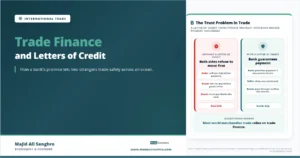
A container of goods crossing an ocean spends weeks belonging, in a sense, to nobody. The exporter has shipped it and not been paid; the importer has ordered it and not received it; neither wants to carry the other’s risk. What fills that gap is borrowed money and bank guarantees, and the scale of the arrangement is easy to miss: by UNCTAD’s estimate, over 90 percent of world trade depends on trade finance and cross-border banking infrastructure. The ships are the visible half of globalization. The credit lines underneath them are the half that decides who gets to participate.
UNCTAD’s Trade and Development Report 2025 puts that financial layer at the center of its analysis, and its core observation is an asymmetry. The physical network of suppliers has spent two decades becoming more decentralized and more diversified, spreading across the Global South. The financial network that enables it has not followed. It remains concentrated in a small number of banks, currencies and jurisdictions, which means the diversification of world trade is running on an infrastructure that never diversified with it.
The South Trades Like a Principal and Finances Like a Client
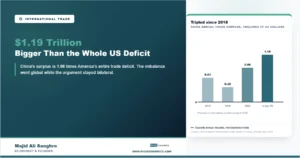
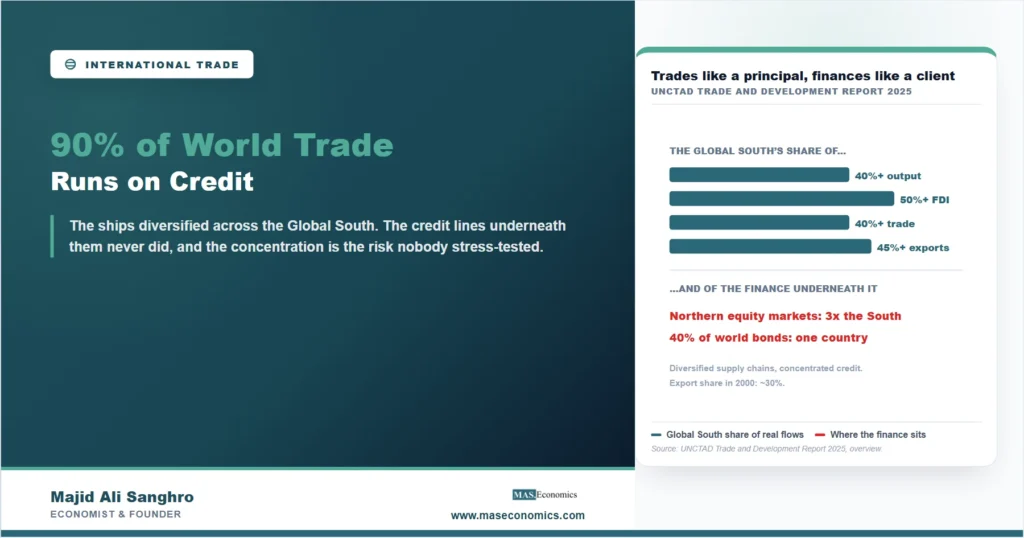
The asymmetry in that chart is the report’s central fact. Economies of the Global South now account for over 40 percent of global output, more than half of foreign direct investment inflows and more than 40 percent of trade, and their share of merchandise exports has risen from roughly 30 percent in 2000 to over 45 percent today, a shift we examined from the deficit side in our piece on China’s $1.19 trillion surplus. Their position in the financial system tells a different story. Northern equity markets are more than three times the size of the South’s, and 40 percent of the global bond market resides in a single country. The countries that produce and ship an increasing share of world goods remain clients of a financial infrastructure they do not host, do not price and do not control.
What the Plumbing Does When It Works, and When It Does Not
Trade finance is the machinery that lets strangers trade: letters of credit under which a bank promises the exporter payment, working-capital loans that bridge the weeks at sea, and the correspondent banking relationships through which money actually moves between jurisdictions, the same rails whose mechanics we set out in our explainer on export credit agencies. When this machinery works it is invisible. Its importance shows up only in the research on what happens when it stops.
The evidence the report assembles is specific. During the global financial crisis, firms dependent on external finance suffered significantly larger export declines, and a one-percentage-point rise in the credit default swap spread of a firm’s main bank cut its export growth by 7 to 8 percent. Japanese firms whose trade-credit banks were impaired after the Lehman collapse lost exports in proportion to that impairment. Tighter loan rollover rules in China reduced firms’ probability of exporting at all. And cross-border credit from the core financial centers predicts trade volumes, especially in emerging economies. The pattern across all of it: trade contracts when finance contracts, before any factory closes and before any tariff passes, a channel entirely separate from the policy barriers we covered in the tariff war.
The consequence of concentration follows. When over 90 percent of trade needs credit, the terms on which credit flows become the terms on which trade flows. A monetary tightening in the issuing centers, a shift in risk appetite, or a compliance-driven withdrawal of correspondent banking, the de-risking wave that has thinned bank relationships across whole regions, transmits directly into whether a shipment from Karachi or Lagos is financeable at all. The exporter’s competitiveness is set in a boardroom it will never see. That is what it means, concretely, for the financial side of globalization to have stayed concentrated while the physical side spread, and it is the same dependence that our piece on globalization and financial development approaches from the optimistic direction.
The Banks Stepped Back, and Something Else Stepped In
The report’s most striking chapter follows what happened when post-2008 regulation made transaction-level trade finance expensive for banks. The banks did not simply leave; the function migrated. Large commodity traders now perform what the report calls synthetic banking: they originate financing, assess risk and service transactions, funding themselves through revolving bank credit and by securitizing trade receivables into instruments sold to capital market investors. Since 2018, income from financial intermediation has consistently accounted for 74 to 76 percent of the revenues of the major food trading firms. The firms that move the world’s grain earn three quarters of their revenue acting as its bankers, without a banking license or Basel-style supervision.
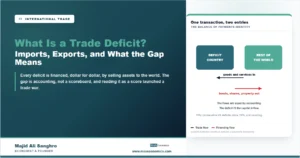
Whether this is a problem depends on questions nobody can yet answer from public data, which is part of the report’s point: the migration moved a systemically important function into entities that disclose far less than the banks they replaced. What can be said is structural. A concentrated, lightly supervised financial layer now intermediates essentials, food among them, and the failure of a major trader would propagate through trade channels in ways the 2008 framework never contemplated. The stakes of that fragility are not abstract for the deficit countries on the other side of the flows, whose position we set out in what a trade deficit means.
The report’s resilience finding belongs in the same frame. World trade grew roughly 4 percent in real terms in the first half of 2025 despite the sharpest tariff increases in decades, though UNCTAD’s own netting of frontloading and AI-related investment puts underlying growth at 2.5 to 3 percent, a distinction that matters for the reasons our analysis of deglobalization claims explored. Trade has so far absorbed the policy shocks. The report’s warning is that the financial infrastructure underneath it is the less tested layer, and the one with fewer shock absorbers.
MASEconomics Explains
3 economic concepts behind the trade-finance layer
These concepts are explored in depth across our educational articles library.
Conclusion
Over 90 percent of world trade depends on trade finance and cross-border banking, and that dependence has a geography: the Global South now supplies more than 45 percent of merchandise exports, up from about 30 percent in 2000, while the financial infrastructure those exports run on remains concentrated in Northern banks, Northern markets and, for 40 percent of the global bond market, a single country. The evidence that this matters is not theoretical, since every financial contraction on record, from Lehman to Chinese rollover rules, shows up in trade volumes within months.
The quiet structural change is who provides the credit. Banks stepped back after 2008 and commodity traders stepped in, to the point where financial intermediation supplies three quarters of the major food traders’ revenues, outside the regulation written for the function they now perform. World trade has proven resilient to tariffs; the report’s warning is about the layer underneath, which diversified less, discloses less and has never been stress-tested at its current scale. The ships are not the system. The credit is.
Frequently Asked Questions
What does it mean that 90 percent of trade depends on trade finance?
Almost all cross-border transactions involve credit or guarantees somewhere between order and payment: a letter of credit, a working-capital loan, or settlement through correspondent banks. Very little trade is prepaid in cash between strangers. The estimate is UNCTAD’s, and it describes dependence on the infrastructure, not a single instrument.
Why does concentration of the financial layer matter?
Because conditions set in a few financial centers transmit to everyone’s trade. Research finds that bank distress, tighter credit and withdrawal of correspondent relationships cut exports quickly and disproportionately in emerging economies. A diversified supply chain financed through a concentrated system inherits the concentration risk.
What replaced the banks that pulled back from trade finance?
Largely the big commodity traders. They finance transactions themselves, funded by revolving bank credit and by securitizing trade receivables for capital market investors. Since 2018, 74 to 76 percent of major food traders’ revenues have come from financial intermediation, a banking function performed outside banking regulation.
Is trade collapsing under the current tariffs?
No. World trade grew about 4 percent in real terms in the first half of 2025, roughly 2.5 to 3 percent after netting out frontloading and AI-related investment. UNCTAD’s concern is not current volumes but the untested financial layer beneath them, where a shock would transmit faster than any tariff.
Who is most exposed to a trade-finance shock?
Exporters and importers in the Global South, who depend on the infrastructure most while hosting the least of it. They face higher financing costs in normal times, lose correspondent relationships first in de-risking waves, and have the fewest alternatives when credit conditions tighten in the issuing centers.
Thanks for reading! Follow any container across an ocean and the most fragile thing aboard is the credit that paid for the voyage. Happy learning with MASEconomics