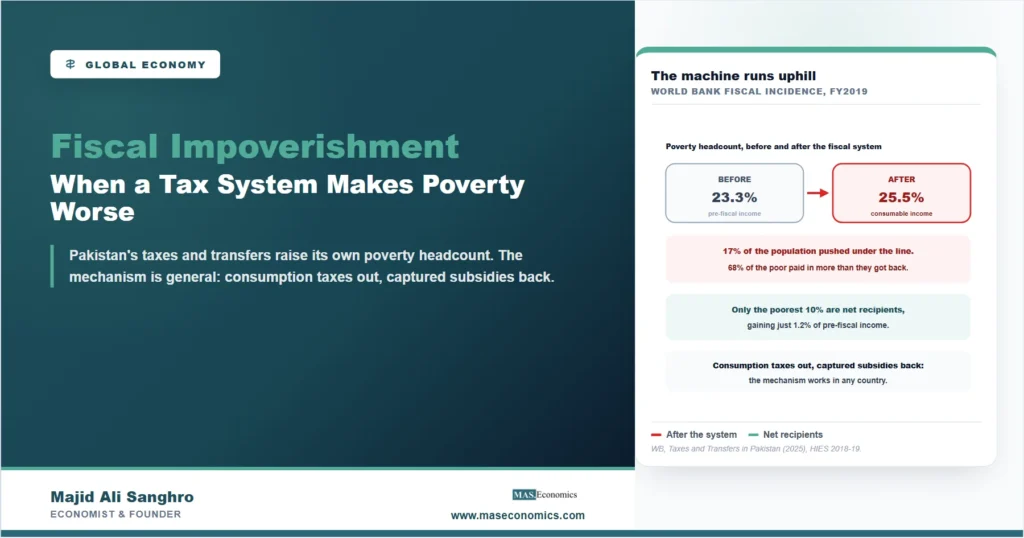
A government collects taxes and pays out transfers, and the ordinary assumption is that the net effect runs downhill: the poor get back more than they pay, poverty falls, and the argument is only about how much. The World Bank tested that assumption on Pakistan by tracing every major tax, transfer and subsidy through the household data, and the result inverts it. Taxes and transfers together raise Pakistan’s poverty headcount from 23.3 percent to 25.5 percent. The name for this is fiscal impoverishment, and the detail is worse than the headline: 17 percent of the entire population became poor in the passage from pre-fiscal to post-fiscal income, 68 percent of the poor paid more into the fiscal system than they received from it, and only the poorest tenth of the population comes out ahead at all, by a net gain of just 1.2 percent of their pre-fiscal income. Nothing in that arithmetic required bad intentions. It is what happens mechanically when revenue is raised through taxes on consumption and returned through subsidies the non-poor capture, and that mechanism is not Pakistani. It is available to any country that builds its fiscal system the same way, which is why the case is worth reading far beyond the country it measures.
How a Fiscal System Gets Measured End to End
The method matters, because the claim is only as strong as the accounting behind it. The study applies the fiscal incidence approach to Pakistan’s 2018-19 household survey combined with fiscal administrative data, and it works by building a household’s income up in layers. Start with market income plus pensions, the pre-fiscal position. Subtract direct taxes, add direct transfers such as the Benazir Income Support Program cash payments, and you have disposable income. Subtract indirect taxes and add indirect subsidies, on energy and agricultural inputs, and you reach consumable income, the post-fiscal position that determines what a household can actually buy. Comparing the poverty count at the first layer with the count at the last answers a question no budget document answers: after everything the state takes and gives, are there more poor people or fewer? For Pakistan in FY2019 the answer was more, by 2.3 percentage points, and the study can also say where the damage happens, because most of the increase, 3.6 points, occurs in the step where indirect taxes are subtracted. The general sales tax has the single largest negative impact on the poverty headcount of any instrument modeled. This is the incidence logic set out in our explainer on what a tax is and who really pays it: a consumption tax reaches everyone who buys soap and cooking oil, filer or not, poor or not, and no exemption schedule fully undoes that.
Where the Money Actually Goes
The finding stops being a paradox once the composition of the system is laid out, and the study lists the fiscal facts plainly. Tax collection was low, at 13.4 percent of GDP, and generated in large part from indirect taxes that reach the poor with every purchase. Most of what came in was committed to rigid expenditures: debt service, the public wage bill and pensions. What remained for redistribution went disproportionately into general subsidies on energy and agricultural inputs, and these are captured overwhelmingly by non-poor, non-vulnerable households, because a subsidy delivered through a price benefits whoever buys the most of the subsidized thing, and richer households consume more electricity and more gas. The instrument that actually works, the BISP cash transfer, is the study’s own benchmark for cost-effectiveness against both poverty depth and inequality, and the poorest quintile receives roughly half of all direct transfer spending. The trouble is proportion: the effective instrument is small and the ineffective ones are large, which is why the system in aggregate takes more from the poor than it returns. That left little fiscal space for the targeted transfers and the health and education spending that reach large families in the bottom half of the distribution, a structural bind our profile of Pakistan’s boom-bust cycle meets from the macro side, and one reason reformers keep returning to the revenue base itself, the subject of our piece on digitalizing Pakistan’s tax system.
Set against its peers, the result is an outlier but not an anomaly. Among the comparator middle-income countries in the study, Pakistan shows the largest poverty increase and the smallest inequality reduction, with the Gini coefficient falling only from 29.0 to 28.6 across the whole fiscal system. One caveat belongs beside that ranking, and the study itself supplies it: Pakistan’s model includes the indirect effects of indirect taxes, estimated through an input-output matrix, and among the comparators only Brazil and Indonesia do the same. Including indirect effects raises measured impoverishment, so part of Pakistan’s distance from the pack is methodological rather than real. It is worth noticing that Brazil, one of the two comparators measured the same way, is also one of the few that shows a poverty increase. The honest reading is that the ranking is softer than it looks and the direction is not: however the comparators are measured, a system that raises its own poverty headcount is failing at the thing redistribution is for. How the underlying inequality numbers are built, and what the Gini does and does not capture, is the subject of our guide to Gini, Lorenz and the top 1 percent.
The Mechanism Travels
The reason this study deserves an audience outside Pakistan is that nothing in the mechanism depends on Pakistan. The recipe has three ingredients. Raise revenue through broad consumption taxes, because they are administratively easy in an economy where incomes are hard to observe. Spend through general price subsidies, because they are politically visible and administratively easy in exactly the same way. Let direct, targeted transfers stay small, because they are administratively hard. Any fiscal system assembled from those parts will transfer resources regressively in the aggregate, whatever its stated intentions, because each ingredient leaks in the same direction: the consumption tax collects from everyone including the poor, and the price subsidy pays out to everyone in proportion to consumption, which means mostly to the non-poor. Large informal sectors make the recipe more likely, since income taxes are hardest to collect exactly where informality is highest, a constraint our article on the cash economy traces through monetary policy and this study traces through fiscal policy.
The same accounting also says what works, and the answer is unglamorous. Direct taxes are the most cost-effective revenue instrument for reducing inequality while shielding poor households, and targeted cash transfers are the most cost-effective spending. The study’s recommendation follows: expand the targeted transfer, finance it by rationalizing the general subsidies and harmonizing the GST, and compensate poor households directly for what the tax reform costs them. None of that is news to a public finance economist. What the incidence analysis adds is the ability to say, with a number, what the current arrangement does: it makes 17 in every 100 Pakistanis poor on the way through the fiscal machine, and it hands the savings to households that were never poor. A budget debate conducted without that number is a debate about intentions. With it, it is a debate about results, which is the entire point of measuring, and the reason our guide to fiscal policy objectives insists that redistribution is something a budget does, not something it declares.
MASEconomics Explains
3 economic concepts behind the finding
These concepts are explored in depth across our educational articles library.
Explore the MASEconomics BlogConclusion
Fiscal impoverishment is what the World Bank found when it traced Pakistan’s taxes, transfers and subsidies through the household data end to end: a system that raises the poverty headcount from 23.3 to 25.5 percent, pushes 17 percent of the population below the line in the passage from pre-fiscal to post-fiscal income, and leaves 68 percent of the poor paying in more than they get back. Only the poorest tenth of the population is a net recipient, and only just, at 1.2 percent of pre-fiscal income. The causes are structural rather than sinister: revenue raised mainly through indirect taxes that reach the poor with every purchase, spending dominated by general subsidies the non-poor capture, and a targeted cash transfer that works well but is too small to offset the rest.
Two things keep the finding honest. The figures are from fiscal year 2019, the study’s vintage, and the comparator ranking is softened by method, since Pakistan’s model counts the indirect effects of indirect taxes and only Brazil and Indonesia among the comparators do the same. Neither caveat touches the direction. The general lesson is the part worth exporting: a fiscal system built from consumption taxes, price subsidies and small targeted transfers will impoverish from the middle down regardless of the country it operates in, because each component leaks toward the non-poor. The fix the incidence analysis points to is equally general and equally unglamorous, direct taxes and direct transfers, and the measurement itself is the real contribution. A state cannot fix a transfer machine it has never audited, and most states have never audited theirs.
Frequently Asked Questions
What is fiscal impoverishment?
It is when the fiscal system itself pushes people below the poverty line, because the taxes they pay exceed the transfers and subsidies they receive. In the World Bank’s analysis of Pakistan for FY2019, 17 percent of the total population became poor in the passage from pre-fiscal to post-fiscal income, and 68 percent of the post-fiscal poor were fiscally impoverished.
How can taxes and transfers increase poverty?
Through composition. Pakistan raised revenue mainly from indirect taxes, which everyone pays with every purchase, and returned it mainly through general energy and input subsidies, which flow to households in proportion to how much they consume, meaning mostly to the non-poor. The general sales tax has the largest negative effect on the poverty headcount of any instrument modeled.
Does anything in Pakistan’s fiscal system work for the poor?
Yes. The Benazir Income Support Program cash transfer is the most cost-effective instrument in the study for reducing both poverty depth and inequality, and the poorest quintile receives roughly half of all direct transfer spending. The problem is scale: the effective instrument is small while the ineffective general subsidies are large, so the system’s total effect still runs against the poor.
Is Pakistan unusual among middle-income countries?
It shows the largest poverty increase and the smallest inequality reduction among the study’s comparators, with the Gini falling only from 29.0 to 28.6. One caveat: Pakistan’s model includes the indirect effects of indirect taxes and only Brazil and Indonesia among comparators do the same, which raises measured impoverishment. Notably, Brazil also records a poverty increase.
What would fix it?
The study’s own arithmetic points to expanding targeted cash transfers and financing them by rationalizing general subsidies and harmonizing the GST, with poor households compensated directly for what tax reform costs them. Direct taxes are the most cost-effective revenue tool for equity, and direct transfers the most cost-effective spending, in Pakistan as in the general case.
Thanks for reading! A budget states its intentions once a year, but only an incidence analysis ever finds out what it actually did. Happy learning with MASEconomics