The most consequential term in trade law is also its most misleading. Most favored nation status sounds like a privilege granted to a special friend, and it means the opposite: a promise of non-discrimination, under which every trading partner holding the status automatically receives the best treatment given to any of them. If a country cuts its tariff on bicycles for one WTO member, the cut applies at once to bicycles from all of them; no one may be treated worse than the most favored. The principle sits in the first article of the GATT, the founding trade agreement of 1947, and everything else in the multilateral system is scaffolding built around it. Understanding MFN is understanding why a tariff schedule negotiated decades ago still sets the price of most of what crosses borders today, why free trade agreements are technically exceptions to the rules, and what it actually means when a country is stripped of the status, as Russia was by most Western economies in 2022.
One Column for Almost Everyone
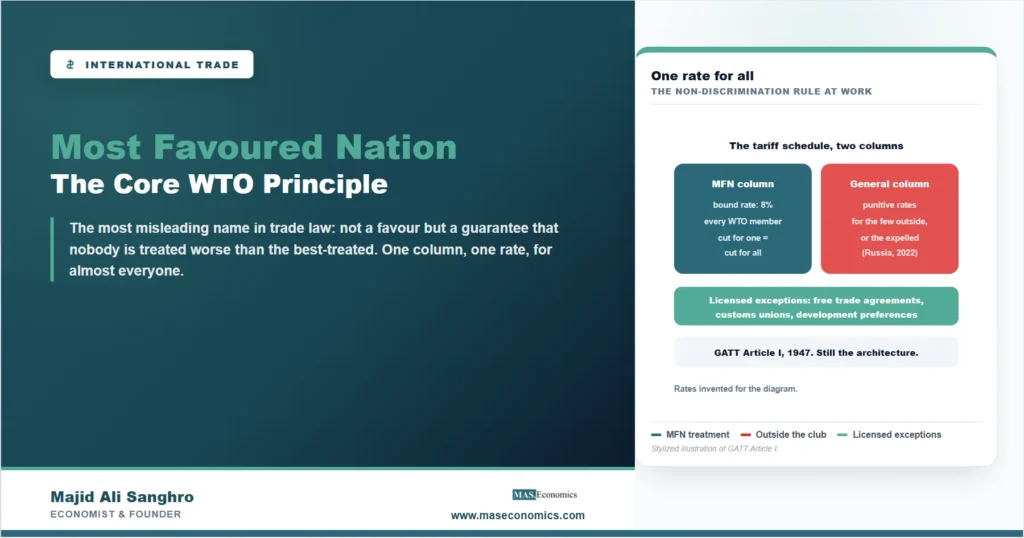
The practical form of MFN is a column in a tariff schedule. Every country maintains a list of duties by product, and the MFN column states the rate charged to imports from all WTO members, which is to say from economies covering the overwhelming share of world trade. A separate and higher set of rates, often called general or statutory rates, waits for the handful of countries outside the club. When commentators say a product faces a tariff of a given percentage, they nearly always mean the MFN rate, and how such a tariff works mechanically is covered in our beginner’s guide. The rates in the column are not merely current policy; most are bound, meaning the country has committed at the WTO not to raise them above a ceiling, and those bindings are the accumulated capital of every negotiating round since 1947. The principles are set out in the WTO’s own summary of the trading system’s principles.
The genius of the arrangement is what it does to negotiations. Under MFN, a tariff concession granted to one is granted to all, so every bilateral bargain multilateralizes itself automatically. Small countries receive the benefits negotiated by large ones without having anything to trade for them, which is the system’s quiet subsidy to the weak. Discrimination, the natural instrument of power politics, is disarmed by default: a great power cannot reward one supplier and punish another through the tariff schedule without breaking the rule the whole system rests on. And exporters get certainty, because access to a market depends on a published, bound rate rather than on this year’s diplomatic weather.
The Licensed Exceptions
Almost everything interesting in modern trade policy happens in MFN’s legal exceptions. The largest is the free trade agreement: GATT Article XXIV permits members to eliminate tariffs among themselves without extending the elimination to everyone, provided the deal covers substantially all trade between them. Every FTA and customs union on earth, from the European Union to USMCA to the regional agreements multiplying across Asia and Africa, lives inside this carve-out, which is why economists insist that such deals are preferential, not free, trade; whether a given bloc helps or harms depends on the balance of trade creation against trade diversion, an accounting this site takes up separately. The second exception runs in favor of development: rich countries may grant developing economies preferences below the MFN rate without owing them to anyone else, the legal basis of the tariff schemes many poorer exporters sell under. The result is that the MFN rate has become, for many trading pairs, the fallback rather than the actual price, a rate you pay when no deeper deal applies, which is precisely why economists watch the gap between MFN and preferential rates as a measure of how much the multilateral system still disciplines anyone, alongside the broader instruments cataloged in our overview of trade policies.
Losing the Status, and Working Around It
Because MFN is the default, its removal is the trade system’s severest formal sanction. When most Western economies revoked Russia’s status after the 2022 invasion of Ukraine, Russian exports fell out of the MFN column and into each importer’s punitive general rates, a repricing of an entire country’s trade executed through a single legal switch. The reverse journey mattered historically too: China’s accession to the WTO in 2001 made its MFN access to the American market permanent, ending the annual congressional renewal that had kept the relationship conditional, and the certainty that followed was itself a cause of the era of globalization that reshaped the world economy.
The deeper current story, though, is erosion by workaround rather than revocation. The tariff conflict of the mid-2020s, chronicled in our account of the global tariff war, has been conducted largely through instruments that bypass the MFN architecture: national security exceptions, which the GATT leaves nearly unreviewable; bilateral deals struck outside the WTO’s framework; and remedies aimed at single countries. Each device is a way of doing exactly what Article I was written to prevent, charging different partners different prices for political reasons, while formally keeping the rulebook on the shelf. Whether the principle survives this period as a discipline or merely as a column heading is one of the live questions of the decade, and the measured answer so far, that most trade among most members still flows at bound MFN rates, is examined in our data-driven piece on whether deglobalization is real. For the ordinary consumer the stakes are concrete: which column applies to a trading partner is a difference measured in the shelf price of everything imported from it.
MASEconomics Explains
3 economic concepts behind most favored nation
These concepts are explored in depth across our educational articles library.
Explore the MASEconomics BlogConclusion
Most favored nation status is the trade system’s founding bargain dressed in a misleading name: not a favor but a guarantee, that no member will be treated worse than the best-treated, enforced through a single bound column in every member’s tariff schedule. The rule multilateralizes every concession, shelters small economies behind bargains struck by large ones, and replaces diplomatic weather with published prices, which is why it was placed first in the GATT and why everything since has been built around it.
Its present condition is honest ambiguity. The licensed exceptions have grown until the MFN rate is often the fallback price rather than the operative one, and the tariff conflicts of this decade have found instruments that discriminate in effect while leaving the rule formally intact. Yet the column endures, most trade still moves at its rates, and the two cleanest demonstrations of its power remain the bookends of recent history: a China whose permanent access transformed world trade, and a Russia whose loss of the status repriced an economy overnight. A principle that can do both of those things is diminished, not dead.
Frequently Asked Questions
What does most favored nation status actually mean?
It means non-discrimination: a country granting MFN status promises to treat that partner’s goods no worse than those of any other partner. Any tariff cut or trade advantage given to one member of the system automatically extends to all members holding the status. Despite the name, it is the standard treatment, not a special favor.
Why are free trade agreements allowed if MFN forbids discrimination?
Because the GATT builds in a licensed exception: Article XXIV permits free trade areas and customs unions that eliminate tariffs on substantially all trade among their members, without extending those cuts to outsiders. Development preferences enjoy a similar carve-out. FTAs are therefore legal, but they are preferential trade, not multilateral liberalization.
What happens when a country loses MFN status?
Its exports drop out of the MFN column and face the importer’s general or statutory rates, which are typically much higher, and it loses the protection of bound ceilings. The revocation of Russia’s status by Western economies in 2022 is the modern example: a single legal switch that repriced an entire country’s trade.
Is the MFN rate the tariff most goods actually pay?
It is the reference price, and for trade between partners with no deeper agreement it is the actual price. But a large share of world trade now moves inside free trade agreements and preference schemes at rates below MFN, making the column the fallback that applies when no club deal does. The gap between the two is a running measure of how preferential world trade has become.
Where does the term most favored nation come from?
From centuries of bilateral commercial treaties in which each side promised the other whatever treatment it gave its most favored trading partner. The GATT of 1947 generalized the old clause: instead of a web of bilateral promises, one multilateral rule made every member simultaneously the most favored.
Thanks for reading! The best-named rule in trade law is the one whose name means its opposite: nobody is favored, and that is the favor. Happy learning with MASEconomics