World trade law forbids very few things outright. Tariffs are legal if bound, quotas are conditionally tolerated, and most industrial policy lives in shades of gray; but paying firms to export is one of the rare practices the system prohibits flat out. Export subsidies are government payments or tax advantages granted on the condition that goods are sold abroad rather than at home, and they occupy a strange position in economics: a policy that is banned by treaty, condemned by textbooks as a gift to foreigners financed by one’s own citizens, and nonetheless practiced continuously, in disguise, by nearly every major trading power. Understanding why the ban exists, and why it keeps being circumvented, teaches more about the politics of trade than almost any other single instrument.
The subject has moved from the textbook’s back pages to the front of the news, because the great industrial-policy programs of the 2020s, chips, electric vehicles, solar, batteries, all sit somewhere on the spectrum between legitimate production support and disguised export promotion, and the world’s trade disputes increasingly turn on which side of the line a given billion falls.
A Policy That Taxes Your Own Shoppers
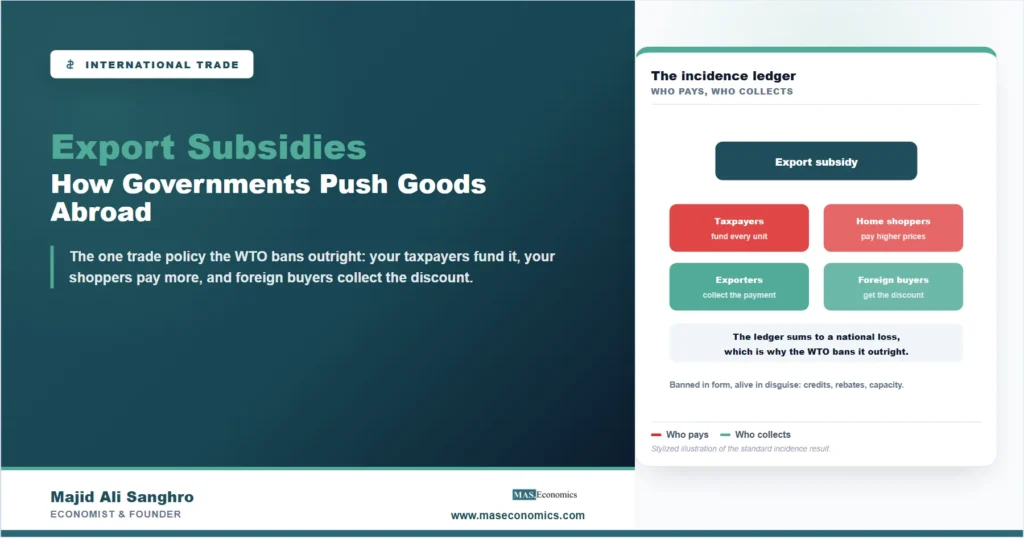
Start with the mechanics, because they contain the surprise. A subsidy paid per exported unit raises what a producer earns from selling abroad. Producers respond by diverting output toward export markets, and they will not sell at home for less than the subsidized export return, so the domestic price rises toward the world price plus the subsidy. The effects then land on four groups. Exporting firms gain, visibly. Foreign consumers gain, since more supply reaches world markets and, if the exporting country is large, pushes the world price down. Domestic consumers lose, paying more for their own country’s goods precisely because a foreign buyer is being paid to take them. And taxpayers fund the whole arrangement. Add the ledger up and the standard result follows: the subsidizing country loses more than its exporters gain, with the loss deepening for a large country because cheapening your exports on world markets is a deliberate worsening of your own terms of trade. The mirror-image logic of a tariff, where home consumers also pay but the treasury at least collects revenue, makes the subsidy the odder policy: here the treasury pays for the privilege. The deep symmetry between taxing imports and taxing exports, and by extension between subsidizing them, is the subject of our article on the Lerner symmetry theorem.
Why the Trade System Bans Them Outright
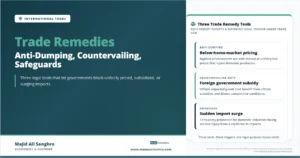
If the policy mostly harms the country using it, why prohibit it by treaty? Because the harm it does abroad is concentrated and corrosive. A subsidized export does not merely reach a foreign market; it undercuts that market’s own producers with the backing of a foreign treasury, converting commercial competition into fiscal competition, which the deepest pockets win. Left unpoliced, the logic runs to subsidy wars in which every treasury pays and no country gains, the trade equivalent of an arms race. The WTO’s Agreement on Subsidies and Countervailing Measures therefore treats subsidies contingent on export performance as prohibited per se, no injury test required, the harshest category in trade law; the long-tolerated exception for farm products was finally closed when members agreed at the 2015 Nairobi conference to eliminate agricultural export subsidies. The system also arms the injured: a country whose producers are hurt by subsidized imports may, after investigation, impose countervailing duties that offset the subsidy at the border, one of several remedies surveyed in our overview of trade policies.
The political economy explains why the ban was needed in the first place. The gains from an export subsidy are concentrated on identifiable firms, sectors, and towns, which organize, lobby, and vote; the losses are scattered across every taxpayer and shopper in the country, none of whom sees the line item. That asymmetry, familiar from every corner of trade politics, means the self-harming policy is frequently the politically winning one, and treaties exist precisely to let governments bind themselves against pressures they cannot resist one industry at a time.
The Disguises
Prohibition did not end the practice; it re-dressed it. Export credit agencies lend to foreign buyers at rates a private bank would not offer, which delivers the subsidy through the financing rather than the price. Tax systems rebate more at the border than the exporter actually paid inside. Subsidized energy, land, and credit reach firms that happen to export nearly everything they make, achieving contingency in effect while avoiding it on paper. An undervalued currency operates as the broadest export subsidy of all, paired with an implicit tax on imports, without a single payment appearing in any budget. And the largest gray zone is the production subsidy: support granted on output or investment rather than exports is legal in a way export contingency is not, but when the resulting capacity far exceeds the home market, the subsidy arrives on world markets just the same. That is the shape of the current disputes over semiconductor subsidies and electric vehicle programs, in which each bloc reads its own spending as legitimate industrial policy and its rivals’ as disguised export promotion, and answers with countervailing duties. The escalation logic that follows, duty answering subsidy answering duty, is a thread running through the tariff war of 2025 and 2026, and it is the old subsidy-war dynamic the 1947 drafters set out to cage, returned at industrial scale.
For the smaller trading country, the modern lesson is defensive. It cannot win a treasury contest against the majors, but it inherits both edges of theirs: its consumers and importers collect the discount when subsidized goods arrive, while its producers in the contested sector face competitors financed by foreign taxpayers, with the countervailing-duty process as the lawful shield. Knowing which of its industries stand on which edge is the beginning of a sensible response.
MASEconomics Explains
3 economic concepts behind export subsidies
These concepts are explored in depth across our educational articles library.
Explore the MASEconomics BlogConclusion
Export subsidies are the trade policy that fails its own country twice: the treasury pays exporters to sell abroad, and home consumers pay higher prices so that foreign buyers can pay lower ones, with the arithmetic reliably summing to a national loss and, for a large country, a self-inflicted terms-of-trade wound on top. That is why they hold the distinction of being flatly prohibited in a legal system that tolerates almost everything else, and why the remaining agricultural exception was closed at Nairobi in 2015.
Yet the instrument persists, because its benefits concentrate where politics listens and its costs scatter where politics cannot see, and because prohibition polices form rather than effect. The subsidy now travels as export credit, over-rebated taxes, cheap inputs, undervalued currencies, and, above all, production support so large that its output must be exported. The chips and electric vehicle contests are the old policy in new clothes, and the old questions still apply to every program: who inside the country is paying, who abroad is collecting, and whether the visible jobs at the front of the arrangement are worth the invisible ledger behind it.
Frequently Asked Questions
What is an export subsidy in simple terms?
It is a payment, tax break, or below-market financing a government provides on the condition that goods are sold abroad. It raises what producers earn from exporting, so more output goes overseas, home prices rise toward the subsidized export return, and taxpayers fund the difference.
Who wins and who loses from an export subsidy?
Exporting firms win, and foreign consumers win through cheaper goods. Domestic consumers lose by paying more at home, and taxpayers pay the bill. The standard result is that the losses exceed the gains, so the subsidizing country is worse off overall, which is the reverse of what the policy’s supporters usually claim.
Why does the WTO prohibit export subsidies but not tariffs?
Tariffs are constrained but lawful because they are transparent, negotiable, and capped by bound schedules. Export subsidies convert market competition into a contest of treasuries, which the richest government wins, and invite mutually destructive subsidy wars. The Subsidies and Countervailing Measures Agreement therefore treats export-contingent subsidies as prohibited outright, with no need to prove injury.
Are programs like chips acts and EV supports export subsidies?
Legally, mostly no: they are structured as production and investment support, not payments contingent on exporting. Economically, the distinction thins when subsidized capacity far exceeds home demand, because the surplus must be exported and arrives on world markets carrying the subsidy’s price advantage. That gap between legal form and economic effect is where most current trade disputes live.
What is a countervailing duty?
A charge an importing country places on subsidized goods at its border, after an investigation establishes the subsidy and the injury to its own producers, calibrated to offset the subsidy’s value. It is the system’s self-help remedy: rather than waiting for the subsidizer to stop, the injured country neutralizes the advantage at the frontier.
Thanks for reading! The strangest thing about paying foreigners to take your goods is how many governments still queue to do it. Happy learning with MASEconomics