The passenger in seat 14C paid three times what the passenger in 14D paid for an identical journey, the student in the cinema paid less than the adult beside her for the same film, and the shopper who clipped the coupon bought the same cereal as the shopper who did not, at a different price. None of this is accident or error; it is strategy with a two-hundred-year-old name. Price discrimination is the practice of charging different buyers different prices for the same good, for reasons unrelated to cost, and it is among the most common pricing strategies in the economy precisely because uniform pricing leaves so much money on the table. A single price forces the seller to choose between margin and volume: price high and lose the budget-constrained, price low and give the eager a bargain they never asked for. Discrimination refuses the choice, and the machinery it uses, the three classical degrees and their booming data-driven descendants, decides who pays what for a remarkable share of what everyone buys. Its welfare economics, unusually for a practice with such a sinister name, is genuinely two-sided.
The Two Conditions, and the Three Degrees
Discrimination needs two preconditions, and their absence is why the wheat farmer cannot practice it. The seller must have pricing power, some slope in its demand curve of the kind held by any monopolist or differentiated seller, since a perfect competitor faces a single market price and takes it. And the seller must be able to prevent arbitrage: if the cheap buyers can resell to the dear ones, the price structure collapses into a single price set by the resellers, which is why discrimination thrives in services, haircuts and flights cannot be resold, and struggles in storable goods.
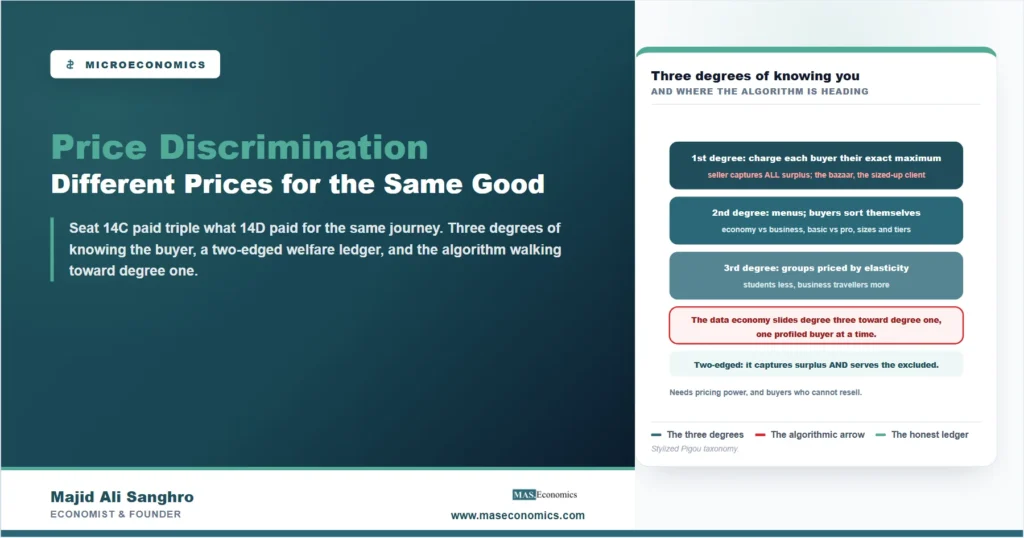
Given the conditions, the classical taxonomy sorts strategies by information. First-degree discrimination is the theoretical limit: the seller knows each buyer’s exact willingness to pay and charges it, person by person, capturing the entire surplus the market generates. Pure cases are rare, the haggling bazaar and the fee negotiated after the lawyer sizes up the client approach it, but the limit matters because technology keeps walking toward it. Second-degree discrimination knows nothing about individual buyers and lets them sort themselves through a menu: quantity discounts, small-medium-large, economy against business class, the software’s basic and pro tiers. The seller designs versions so that the price-insensitive select the expensive option themselves, a self-selection logic whose deliberately degraded cheap versions, the slower train, the feature-locked app, exist purely to keep the rich from buying them. Third-degree discrimination divides buyers into observable groups and charges each group its own price: student and senior discounts, regional pricing, weekday against weekend fares. The economics of the group split is elasticity arithmetic, treated in our article on price elasticity: each group is charged according to its responsiveness, the elastic (students, the flexible, the poor) getting low prices not from kindness but because they flee at high ones, the inelastic (business travellers, the committed, the rushed) paying more because they will.
The Two-Edged Welfare Economics
The practice’s name invites a verdict its economics refuses to deliver cleanly. Begin with the case against: relative to uniform pricing, discrimination transfers surplus from buyers to the seller, that is its entire purpose, and in the first-degree limit the transfer is total, every buyer paying the most they would tolerate, the market’s whole gain landing on one side of the counter. The distributional objection is real and is what most people mean when the practice feels unfair. But the efficiency ledger runs the other way, and this is the result worth owning. A uniform-pricing monopolist restricts output, excluding every buyer whose willingness to pay falls below the single profit-maximizing price, and that exclusion is deadweight loss, value destroyed rather than transferred. Discrimination lets the seller serve those buyers at lower prices without cannibalizing the high-price segment, so output expands toward the efficient level; in the first-degree limit, every buyer who values the good above its cost is served, and deadweight loss vanishes entirely, the least equal and most efficient outcome the market can produce. The friendly faces of the practice live here: the student discount, drug pricing that charges poor countries less than rich ones, and the versioned software that gives a stripped tier to those who could not pay full freight are all markets extended to buyers uniform pricing would have turned away. Third-degree discrimination sits ambiguously between the poles, helping where it opens markets that a single price would have left unserved and merely redistributing where it does not, which is why the empirical question, did output actually expand, is the honest test of any given scheme.
The Algorithmic Frontier, and the Reader’s Position
The classical taxonomy assumed the seller’s ignorance was permanent; the data economy is repealing that assumption. Purchase histories, browsing behavior, device type, and location let sellers estimate individual willingness to pay at scale, and the pricing this enables, personalized offers, targeted coupons, algorithmically timed discounts, is the third degree sliding continuously toward the first, one profiled buyer at a time. Platform businesses sit at the frontier because they see both sides of their markets and every transaction on them, an informational position whose consequences our study of platform economics develops, and dynamic schemes such as surge pricing mix genuine cost-and-scarcity pricing with discrimination in proportions that are hard to audit from outside, a tangle visible in our analysis of the food delivery business. The efficiency result from the previous section still applies, personalized pricing serves buyers a uniform price would exclude, but its distributional edge sharpens: the surplus captured approaches everything, and the buyers least able to compare or wait, often the least advantaged, can face the highest personalized markups. For the reader, the practice’s mechanics double as a self-defense manual. The discriminating seller prices your signals, so the counter-moves are signal management: compare across devices and sessions, cultivate the flexibility that marks the elastic buyer, take the versioned product’s cheap tier when the degradation is cosmetic, and treat every “special offer just for you” as an estimate of your willingness to pay, which is exactly what it is. In a discriminated market, appearing price-sensitive is the closest thing to a discount code that always works.
MASEconomics Explains
3 economic concepts behind price discrimination
These concepts are explored in depth across our educational articles library.
Explore the MASEconomics BlogConclusion
Price discrimination is uniform pricing’s refusal of a dilemma: rather than choosing between margin and volume, the seller with power and an arbitrage barrier charges buyers according to what they will bear, through the exact prices of the first degree, the self-selecting menus of the second, and the elasticity-priced groups of the third. The taxonomy is really a ladder of information about the buyer, which is why the data economy matters so much to it: personalization is the third degree climbing toward the first, converting a theoretical limit into a commercial practice one profile at a time.
The welfare verdict deserves to be carried in its honest, two-edged form. Discrimination transfers surplus from buyers to sellers, and it also extends markets, serving buyers a single price would exclude and shrinking the deadweight loss that uniform monopoly pricing creates; the student discount and the personalized markup are the same machinery wearing different faces, and the test of any scheme is whether output expanded or surplus merely moved. For the buyer, the theory is also tactics: the discriminating market prices your visible signals, and managing them, comparing, waiting, choosing the cheap version, distrusting the offer built just for you, is the rational reply of the discriminated. Few concepts explain so much of the checkout, and fewer still hand the reader something to do about it.
Frequently Asked Questions
What is price discrimination in simple terms?
Charging different buyers different prices for the same good for reasons unrelated to cost: airline seats sold at many fares, student and senior discounts, coupons, and versioned software tiers. It requires the seller to have some pricing power and the ability to stop cheap buyers reselling to dear ones.
Is price discrimination illegal?
Mostly no. Charging consumers different prices is generally lawful and ubiquitous, discounts, fares, and regional pricing included. Legal limits typically target specific contexts, discrimination between business customers that damages competition, or pricing on protected characteristics, with the details varying by jurisdiction.
What are the three degrees of price discrimination?
First degree charges each buyer their exact willingness to pay, capturing all surplus; second degree offers menus of versions and quantities through which buyers sort themselves; third degree splits observable groups, students, seniors, regions, and prices each by its elasticity. The degrees are ranked by how much the seller knows about the buyer.
Why do airlines charge so many different fares?
Because seats expire at takeoff and passengers differ enormously in flexibility, airlines run intensive discrimination: advance-purchase and Saturday-stay conditions sort business from leisure travellers, fare classes version the identical cabin, and dynamic pricing adjusts to remaining demand. A flight is a bundle of nearly identical goods sold at dozens of prices, each aimed at a segment’s elasticity.
Is price discrimination good or bad for consumers?
Both, and honestly so. It transfers surplus from buyers to sellers, which is its purpose, yet it also serves buyers a uniform price would exclude, students, poorer regions, light users, shrinking the output restriction of single-price market power. The distributional edge sharpens with personalization, and the honest test of any scheme is whether it expanded the market or merely repriced it.
Thanks for reading! Every offer built just for you is an estimate of what you would bear; appearing price-sensitive is the discount code that always works. Happy learning with MASEconomics