Ask where your salary comes from and the answer is your employer; ask where your employer’s money comes from and the answer is its customers; ask where the customers’ money comes from and the answer is their employers, one of which, eventually, is somebody spending money that started as your salary. The circular flow of income is this observation promoted to the foundation of macroeconomics: an economy is not a pile of wealth but a loop of payments, in which every act of spending is, at the same instant and by the same amount, an act of income creation for someone else. Nothing in the loop is anyone’s money at rest; it is everyone’s money in motion, and the motion is the economy. The model sounds like a child’s diagram and carries three adult consequences: it explains why output, income, and expenditure are the same number measured three ways, which is the architecture of GDP; it identifies the leakages and injections whose balance decides whether the loop swells or shrinks; and it reframes recessions as circulation failures, in which the attempt by everyone to spend less makes everyone poorer, a mechanism no household analogy can see.
The Loop, and the Identity It Enforces
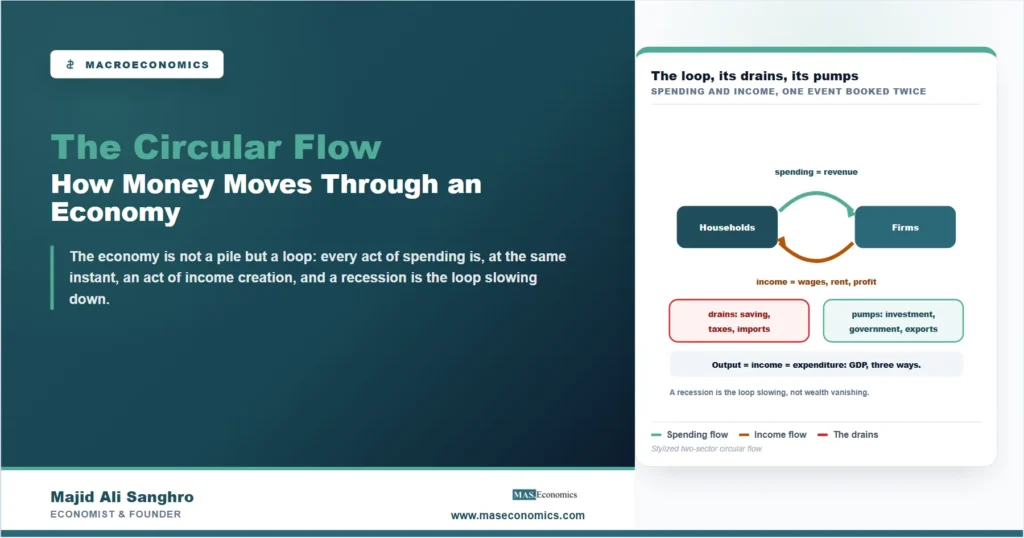
The simplest version has two actors and two counter-rotating loops. Households own the economy’s resources, labor above all, and firms hire them; in exchange, wages, rent, interest, and profit flow from firms to households, the income loop. Households then spend that income on the goods and services firms produce, the expenditure loop, and the two flows chase each other around the circle: firms’ revenue becomes households’ income becomes firms’ revenue. Underneath the money runs the real economy in the opposite direction, labor flowing to firms, goods flowing to households, money being the counter-flow that keeps score. The diagram’s first adult consequence is an accounting identity with teeth. Everything a firm receives for its output is paid out as somebody’s income, wages to workers, interest to lenders, rent to landlords, and the residual, profit, to owners, so the value of production, the income generated, and the spending that bought it are one magnitude viewed from three sides. That triple identity is not a theory but bookkeeping, and it is the architecture of national accounts: the production, income, and expenditure approaches to measuring GDP are the three vantage points on this circle, and their obligation to agree, explored in our guide to measuring national income, is the circular flow expressed as statistical law.
Drains, Pumps, and the Plumbing Between Them
The two-actor loop is sealed; real economies leak, and the model earns its keep by tracking where. Three flows exit the circle each round. Households save part of their income rather than spending it; governments tax income before it can be spent; and some spending leaks abroad to buy imports, income for foreign loops rather than this one, which is why a widening trade deficit is, in circular-flow terms, a drain. If leakages were the whole story every economy would spiral quietly to zero, and the reason none does is that each drain has a matching pump. Saving flows into the financial system, which lends it to firms for investment spending, factories, machines, buildings, that re-enters the circle; taxes fund government purchases and transfers, the fiscal pump whose settings are the subject of our guide to fiscal policy; and foreigners buy exports, pumping their income into this loop as imports drained ours into theirs. The loop is in balance, neither swelling nor shrinking, when total leakages equal total injections, and the three plumbing systems, banks, government, and the world, are precisely the institutions society builds to recycle the drains back in. The framing quietly reorganizes several debates: saving is not hoarding if the financial system converts it into investment, and becomes contractionary exactly when that conversion fails; budget and trade positions are not moral scorecards but entries in one economy-wide balance of drains and pumps, linked by the same accounting.
When the Circle Breaks: Recessions as Circulation Failures
The model’s deepest teaching arrives when the loop falters, because the circle transmits fear as efficiently as it transmits money. Suppose households, worried about the future, collectively cut spending to save more. Each household’s plan is individually prudent, and the circle turns it collectively perverse: reduced spending is, identically, reduced revenue for firms, which cut production and payrolls, which reduces household income, which cuts spending further, and the intended extra saving may never materialize because the income it was to be saved from has shrunk, the paradox of thrift, visible only from the circular vantage. The same loop amplifies in both directions: any initial change in spending travels the circle repeatedly, each round smaller as leakages siphon it away, summing to a multiplied final effect, which is the multiplier in its native habitat, with the leakage rates setting its size. This is the sense in which a recession is a circulation failure rather than a subtraction of wealth: the factories, workers, and wants all still exist, but the flow connecting them has slowed, spending withheld because incomes fell because spending was withheld. It is also the logic of counter-cyclical policy: if the private loops are draining faster than private pumps refill, the fiscal pump can inject spending directly, and the monetary system can price the conversion of saving into investment more attractively, both interventions comprehensible in one glance at the diagram. The circle’s growth over time, and what a rising flow does and does not say about welfare, is the territory of our article on GDP growth; the loop’s own money, and how the banking system’s creation of it lubricates every arc, is the story of the money supply.
MASEconomics Explains
3 economic concepts behind the circular flow
These concepts are explored in depth across our educational articles library.
Explore the MASEconomics BlogConclusion
The circular flow of income replaces the intuitive picture of an economy as a stock of wealth with the correct one: a loop of payments in which spending and income are the same event booked twice, money in motion keeping score of resources and goods moving the other way. Its three consequences scale from bookkeeping to crisis. The triple identity of output, income, and expenditure is the loop written as accounting and the architecture of GDP measurement; the drains of saving, taxes, and imports against the pumps of investment, government spending, and exports give macroeconomics its balance-sheet of flows, with banks, the state, and the world as the recycling plumbing; and the loop’s capacity to transmit contraction, each withheld purchase becoming someone’s lost income becoming further withheld purchases, makes recessions circulation failures and explains both the paradox of thrift and the multiplier that amplifies every shock.
The diagram’s simplicity is its function. It will not price assets or forecast quarters, but it disciplines the intuitions that mislead most confidently: the economy is not a household, one agent’s cut in spending is another’s cut in income, saving helps only as far as the plumbing converts it, and policy in a downturn is not largesse but the refilling of a draining loop. Macroeconomics builds many stories above this foundation; the reader who keeps the circle in view can tell, for most public arguments, whether the building above still stands on it.
Frequently Asked Questions
What is the circular flow of income in simple terms?
The model of an economy as a loop: households supply labor to firms and receive income, then spend that income on firms’ goods, returning it as revenue that funds the next round of incomes. Every act of spending is simultaneously income for someone else, so money circulates rather than resting anywhere.
Why do output, income, and expenditure all equal GDP?
Because they are the same circle measured at three points: the value of what firms produce is paid out entirely as wages, rent, interest, and profit, someone’s income, and is purchased by someone’s spending. National accountants exploit the identity by measuring GDP all three ways and using the required agreement as a cross-check.
What are leakages and injections?
Leakages are flows that exit the spending loop each round: household saving, taxes, and spending on imports. Injections are flows that enter from outside: firms’ investment, government spending, and foreigners’ purchases of exports. The loop neither swells nor shrinks when the two sets balance, and each leakage has an institution recycling it back in.
Does saving hurt the economy?
Not when the plumbing works: saving routed through the financial system funds investment, re-entering the loop as spending on machines and buildings. It contracts the economy when that conversion fails, in downturns when firms will not borrow whatever the terms, which is when everyone’s simultaneous thrift shrinks the very incomes the saving was planned from.
How does the circular flow explain recessions?
As circulation failures: an initial fall in spending is identically a fall in someone’s income, which cuts their spending, and the contraction travels the loop in shrinking rounds, multiplied into a larger total decline. Nothing real has been destroyed, factories and workers remain, but the flow connecting them has slowed, which is why policy aims at restarting circulation.
Thanks for reading! The economy is not a pile but a loop, and your spending is somebody’s salary already in motion. Happy learning with MASEconomics