In 2021 and 2022, governments worldwide discovered that they could hand households money faster than factories, ports, and energy grids could hand them goods. Spending arrived; production could not keep up; prices did the reconciling. The episode was a compressed lesson in what is aggregate supply: the total output of goods and services that an economy’s firms are willing and able to produce at a given price level. Demand can be conjured with a budget line or an interest rate cut. Supply is workers, machines, energy, materials, and know-how, and none of those can be legislated into existence by Friday.
The spending side of the economy has its own machinery and its own article on this site. This piece covers the other half: what determines how much an economy can produce, why the answer differs between this quarter and this decade, and why the distinction between a demand problem and a supply problem is the most consequential diagnosis in macroeconomic policy. The full framework in which the two sides meet is the AD-AS model, treated separately in our master guide to the framework; the ground floor of that building is what follows.
What an Economy Can Produce, and at What Cost
Aggregate supply is not a warehouse inventory. It is a decision, repeated across every firm in the economy: given the prices my output fetches and the costs my inputs carry, how much is worth producing? The raw ingredients are the classic factors of production: the labor force and its skills, the capital stock of machines and buildings, land and natural resources, and the technology and organization that combine them. But the willingness sits on top of the ingredients. A factory that exists but cannot cover its energy bill at current prices is capacity that does not become supply.
That distinction, between what exists and what is offered, is why aggregate supply responds to the price level at all. When the prices of output rise while many costs are fixed in advance, existing capacity gets worked harder: overtime shifts, deferred maintenance, marginal production lines switched on. When costs rise while output prices lag, the same capacity quietly idles. Aggregate supply summarizes those margins across the whole economy, which makes it the side of the ledger where profitability, not purchasing power, does the talking.
Two Horizons: Sticky Costs Now, a Hard Ceiling Later
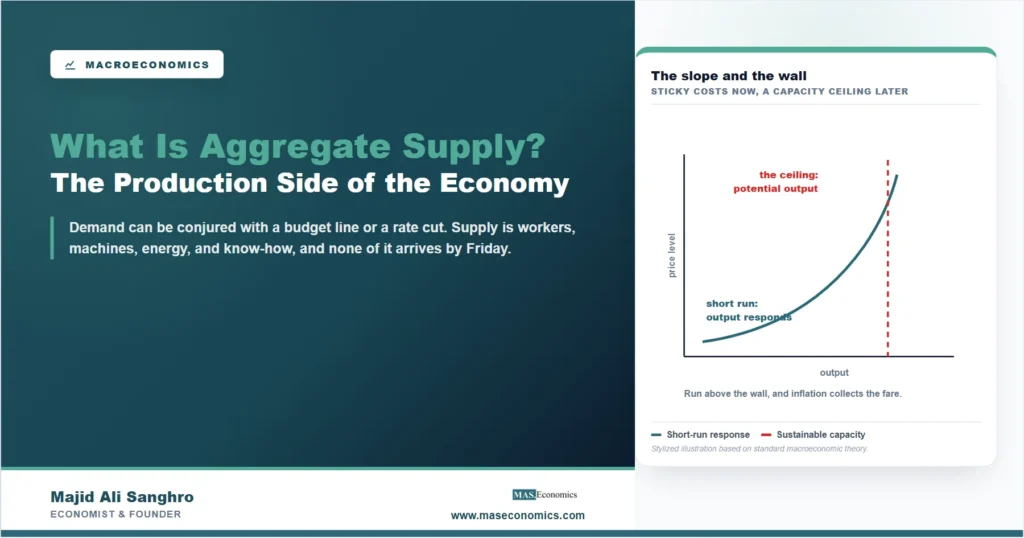
The central complication is that the answer to “how much can the economy produce” has a time horizon inside it. In the short run, many costs are locked: wages sit in contracts, supplier prices in agreements, rents in leases. Locked costs mean rising demand meets firms that find extra output profitable at slightly higher prices, so production genuinely responds; the economy can run above its normal capacity for a while, visible as overtime, backlogs, and hiring difficulty. This is the world our article on the short run and long run maps in general terms, applied here to the whole economy at once.
In the long run the locks open. Wages and contracts reprice, and once they have, producing more than the economy’s resources sustainably allow is no longer profitable at any price level. Output settles back toward what economists call potential output: the level set by the size and skill of the labor force, the capital stock, and, above everything else over decades, productivity. Potential output is a ceiling in a specific sense. It is not the maximum conceivable in an emergency, but the maximum sustainable without accelerating inflation, which is why economies can exceed it temporarily and always pay for the visit in rising prices.
Supply Shocks: When Producing Gets Harder Everywhere at Once
Most disturbances hit the economy through spending. A supply shock is the other kind: an event that changes what production costs, or what is physically producible, across many industries simultaneously. Energy is the classic carrier because it is an input to nearly everything, so when oil prices jump, the effect lands not just at the fuel pump but inside the cost structure of freight, plastics, fertilizer, and food. The 2026 oil shock is the live example: one strait, and the production costs of every energy-importing economy moved together. Harvest failures, pandemics, and the reorganization of supply chains work the same way, each making a given level of output more expensive to deliver.
Supply shocks earn their reputation because they break the usual relationship between growth and inflation. A demand slump lowers output and cools prices together; a supply shock lowers output while raising prices, the combination that acquired the name stagflation in the 1970s. The policy bind follows directly. Central bank tools work on spending: raise rates and demand cools, cut them and it warms. Against a supply shock, tightening enough to hold prices down deepens the output loss, while easing enough to protect output feeds the inflation. The instrument does not match the disease, which is why the inflation-unemployment relationship traced in our article on the Phillips curve breaks down most visibly in supply-shock decades. Diagnosing which side of the economy an inflation is coming from is therefore not an academic exercise; it decides whether the standard medicine helps or harms.
What Moves the Ceiling Itself
Over any horizon that matters for living standards, the interesting question is not where the ceiling is but what raises it. The arithmetic of potential output has a short list of entries. A larger or more skilled workforce raises it, which is where demographics, migration, and the accumulated schooling and health economists call human capital enter. More capital per worker raises it, the reward for sustained investment. And productivity, the efficiency with which labor and capital are combined, raises it without limit, which is why technology and organization dominate the long-run record: the difference between rich and poor economies is overwhelmingly a difference in output per hour, not in hours worked.
The ceiling is also invisible, and that is a genuine practical problem. Potential output cannot be observed, only estimated from the behavior of inflation, unemployment, and capacity use, and the estimates are revised for years. A government that overestimates its economy’s potential will read the resulting inflation as a mystery; one that underestimates it will accept unemployment it did not need to accept. A meaningful share of macroeconomic policy error, in rich and developing economies alike, consists of misjudging the position of a line nobody can see.
MASEconomics Explains
3 economic concepts behind aggregate supply
These concepts are explored in depth across our educational articles library.
Explore the MASEconomics BlogConclusion
What is aggregate supply comes down to a decision made economy-wide: how much production is worth offering at current prices and current costs. In the short run, with costs locked in contracts, the answer flexes with demand, which is why economies can be talked into producing more for a while. In the long run the answer is capacity itself, the potential output set by workers, capital, and productivity, a ceiling that policy cannot move quickly and inflation always finds.
The concept’s practical weight lies in diagnosis. Inflation born of spending and inflation born of costs look identical at the checkout and demand opposite treatments, and supply shocks put central banks in a bind no interest rate resolves cleanly. The slow entries, meanwhile, decide everything durable: an economy’s standard of living is its aggregate supply side compounding over decades, one productivity gain at a time, whatever the spending side does in between.
Frequently Asked Questions
What is aggregate supply in simple terms?
Aggregate supply is the total quantity of goods and services that all the firms in an economy are willing and able to produce at a given price level. It depends on the economy’s resources, workers, machines, energy, and technology, and on whether current prices make using those resources profitable.
What determines aggregate supply?
In the short run, input costs and the price level: with wages and contracts temporarily fixed, higher output prices make extra production profitable. In the long run, the determinants are real: the size and skill of the labor force, the capital stock, natural resources, and productivity. Long-run aggregate supply is another name for the economy’s sustainable capacity.
What is the difference between short-run and long-run aggregate supply?
Short-run aggregate supply responds to demand and prices because many costs are locked in contracts, so firms profitably expand or contract output. Long-run aggregate supply is the capacity ceiling that remains after all contracts have repriced; it is set by labor, capital, and productivity and does not respond to the price level.
What is a supply shock in economics?
A supply shock is an event that changes production costs or capacity across much of the economy at once, such as an oil price surge, a harvest failure, or a pandemic disrupting supply chains. An adverse supply shock raises prices and lowers output simultaneously, which is what makes it harder for central banks to treat than a demand disturbance.
How is aggregate supply different from aggregate demand?
Aggregate demand is the economy’s total planned spending; aggregate supply is its total offered production. Demand runs on purchasing power and can be moved quickly by fiscal and monetary policy. Supply runs on resources, costs, and profitability, and its ceiling moves slowly, through investment, workforce growth, and productivity gains.
Thanks for reading! Half of macroeconomics is asking whether the problem is the spending or the producing, and now the producing half has a shape. Happy learning with MASEconomics