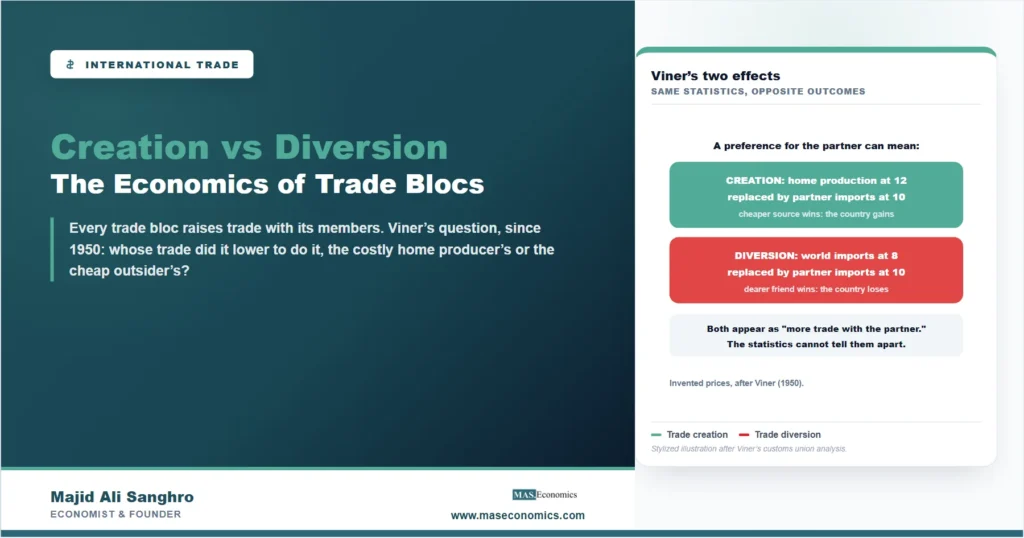
When two countries sign a free trade agreement, the press release always says the same thing: more trade, more growth, everybody wins. In 1950, the economist Jacob Viner pointed out that the press release is not necessarily true, and his distinction has governed the analysis of trade blocs ever since. Trade creation and diversion are the two things a preferential agreement can do at once: it can create trade, replacing expensive home production with cheaper imports from the new partner, which enriches the country; and it can divert trade, replacing cheap imports from the wider world with dearer imports from the partner, which impoverishes it while looking identical in the trade statistics. Every customs union and free trade area on earth, from the European Union to the regional pacts multiplying across Asia and Africa, is a running balance of the two effects, and the balance decides whether a bloc is a step toward open trade or a detour away from it.
Viner’s Uncomfortable Arithmetic
The insight is easiest to see with three countries and one good. Suppose Home can buy shirts from Partner at 10 dollars or from World, the cheapest producer anywhere, at 8 dollars, and protects its own shirt industry, which produces at 12, behind a tariff of 5 dollars on everyone. With the tariff, World’s shirts cost 13 at the border and Partner’s cost 15, so Home makes its own at 12. Now Home signs an agreement with Partner, and Partner’s shirts enter free while World still pays the tariff. Partner’s price to the consumer becomes 10, World’s stays 13, home production costs 12: everyone buys from Partner. Domestic production at 12 has been replaced by imports at 10, and that is trade creation, a genuine efficiency gain of the kind the classical theory of comparative advantage promises.
But run the same agreement with one number changed: suppose Home’s tariff had been 3 dollars, not 5. Before the deal, World’s shirts cost 11 at the border, beating home production at 12, so Home was importing from the world’s cheapest producer and collecting 3 dollars of revenue on every shirt. After the deal, Partner sells tariff-free at 10, undercutting World’s 11, and all the business moves to Partner. The consumer saves one dollar per shirt; the treasury loses three. The country now pays 10 dollars of real resources to Partner for a shirt the world would have supplied for 8, and the difference is pure loss, transferred partly to Partner’s producers. Imports rose, the agreement looks like a success, and the country is poorer. That is trade diversion, and its defining feature is that it is invisible in the headline numbers politicians quote.
What Tilts the Balance
Whether a real bloc creates more than it diverts is an empirical question, but the theory says where to look. Diversion is fed by high external tariffs: the bigger the wedge between the preference and the outside world, the more business the preference can steal from the world’s best producers. That is why economists judge a bloc first by what happens to its external barriers; a union that lowers its common wall as it integrates internally leans toward creation, while one that keeps the wall high converts its members into a captive market. Creation is fed by partners who were natural traders anyway: economies that are close, large, and competitive with each other, so that the preference mostly removes friction between the right partners rather than redirecting purchases to the wrong ones. The gravity model of trade makes the point quantitatively: countries that would trade heavily on distance and size alone lose little by favoring each other, while distant, artificial pairings invite diversion by construction.
The composition of members matters in a second way. A bloc among low-cost producers gives its members access to sources near the world frontier, capping how much diversion is even possible; a bloc among high-cost producers can wall its consumers off from the frontier entirely. And rules of origin, the paperwork defining which goods count as partner-made, add a quiet tax of their own, since firms must document supply chains to claim preferences, one of the frictions cataloged in our article on non-tariff barriers. The accumulated evidence on the great blocs is, unsurprisingly, mixed by sector: the same union can be strongly trade-creating in machinery and strongly diverting in food, which is why serious evaluations work product by product rather than pronouncing on the bloc whole.
Why the Distinction Runs the Modern Debate
Viner’s arithmetic is the reason economists have never agreed whether regional agreements are stepping stones or stumbling blocks for the world system. The multilateral rules license blocs on the theory that internal liberalization outweighs external discrimination, but every new preference erodes the non-discrimination principle a little further, and the world now runs hundreds of overlapping agreements whose tangled preferences and origin rules have their own costs. The question has sharpened as trade policy has turned geopolitical: agreements are increasingly signed for alliance reasons, with partners chosen by friendship rather than by cost, which is a recipe for diversion by design, the deliberate rerouting of supply chains examined in our article on nearshoring, reshoring, and friendshoring. Whether the resulting rearrangement of world trade amounts to fragmentation or adaptation is the live measurement question taken up in our review of the deglobalization data.
For the consumer and the taxpayer, the lesson travels well beyond the seminar. A new agreement’s benefits are real where it lets you buy from the cheapest producer; its costs arrive when it merely redirects your purchases to a pricier friend while the tariff revenue quietly disappears. The next time a bloc is announced, the question to ask is Viner’s: not whether trade with the partner will grow, which it always will, but whose trade it replaces, the expensive home producer’s or the cheap outsider’s. One answer is a gain, the other a loss, and the statistics announcing the agreement’s success cannot tell them apart.
MASEconomics Explains
3 economic concepts behind trade creation and diversion
These concepts are explored in depth across our educational articles library.
Explore the MASEconomics BlogConclusion
Trade creation and diversion are Viner’s reminder that a preferential agreement is two policies wearing one signature: liberalization toward the partner and discrimination against everyone else. Creation replaces dear home production with cheaper partner imports and enriches the country; diversion replaces the world’s cheapest suppliers with dearer partners who owe their business to the tariff wall alone, and impoverishes it. Both raise trade with the partner, both fill the same press release, and only the underlying costs, which the headline numbers never show, distinguish the gain from the loss.
The balance is settled by design choices the theory identifies precisely: low external barriers, natural trading partners, and light origin rules tilt a bloc toward creation, while high walls and politically chosen members tilt it toward diversion, a tilt the current era of alliance-driven agreements has adopted almost deliberately. Seventy-five years on, the distinction remains the sharpest single question to ask of any trade bloc, and the fact that it cannot be answered from the trade statistics alone is exactly what makes it worth asking.
Frequently Asked Questions
What is trade creation in simple terms?
It is the gain that arises when a trade agreement lets cheaper imports from a partner replace more expensive production at home. Resources stop being wasted on high-cost domestic output, consumers pay less, and the country as a whole is better off. It is the effect the press releases promise.
What is trade diversion and why is it harmful?
It is the switch from a cheap outside supplier to a dearer partner that happens because the partner enjoys tariff-free entry while the outsider still pays the tariff. The country ends up paying more real resources for the same goods and loses the tariff revenue it used to collect, so it can be worse off even though trade with the partner rises.
Who first distinguished trade creation from trade diversion?
Jacob Viner, in his 1950 study of customs unions. Before Viner, economists broadly assumed any tariff removal improved welfare; his three-country arithmetic showed that removing tariffs preferentially, for some partners but not others, could reduce it, a result that still frames every serious evaluation of trade blocs.
How can you tell whether a trade bloc creates or diverts trade?
Not from headline trade growth, which rises in both cases. Evaluations compare where imports come from and at what cost: business shifting away from home production signals creation, while business shifting away from cheaper non-members signals diversion. High external tariffs, artificial partner choices, and heavy rules of origin all predict a diversion-heavy bloc.
Are free trade agreements good or bad for the world trading system?
Both cases are real, which is why the debate has lasted decades. Blocs liberalize genuinely among members and can pilot deeper rules, but each one discriminates against outsiders, and hundreds of overlapping agreements have built a costly tangle of preferences. The modern turn toward alliance-based agreements leans further toward diversion, since partners are chosen by politics rather than cost.
Thanks for reading! Every trade bloc raises trade with its members; Viner’s question is whose trade it lowered to do it. Happy learning with MASEconomics