On 1 January 2026, a piece of European climate policy that had spent two years as a paperwork exercise began charging real money. The carbon border adjustment mechanism, established by EU Regulation 2023/956, entered its definitive phase, and importers of cement, iron and steel, aluminium, fertilisers, electricity, and hydrogen became financially liable for the carbon emitted in making those goods abroad. The instrument is the European Union’s answer to a problem its own climate ambition created: if Europe taxes carbon at home but its trading partners do not, production and emissions can simply move offshore, leaving the climate no better off and European industry worse off. CBAM is designed to close that escape route by putting a carbon price on imports at the border.
The idea is novel enough that it does not fit neatly into the usual categories of trade policy. It is not a protective tariff in the classic sense, though it functions like one. It is not a domestic carbon tax, though it extends one. It is a border charge calibrated to a domestic carbon price, intended to make an imported tonne of steel carry the same carbon cost as a tonne made inside the bloc. Understanding why the EU built it, and why it is so contested, means starting with the market failure it is trying to correct.
Carbon Leakage Problem
Carbon emissions are the textbook case of a negative externality. A factory that emits carbon imposes a cost on the global climate that it does not pay for, so it emits more than is socially optimal. The standard economic fix, examined in the discussion of market failure and externalities, is to put a price on the emissions, forcing the polluter to internalize the cost. The EU does this through its Emissions Trading System, which makes industrial installations buy allowances for the carbon they release.
A carbon price applied in one region but not others creates a loophole. Suppose European steel must carry a carbon cost that steel made in a country with no carbon price does not. European steel becomes more expensive, European buyers switch to cheaper imports, and European producers either lose market share or relocate to the unpriced jurisdiction. Emissions do not fall; they move. This is carbon leakage, and it defeats the purpose of the policy twice over. The climate sees no benefit because the carbon is still emitted, and Europe loses the industry and the jobs as well. The externality has not been corrected, only exported, a failure that connects directly to the logic of private cost diverging from social cost.
Note. CBAM does not exist to raise revenue or to shield European firms for its own sake. It exists because a carbon price that stops at the border can push emissions abroad rather than reduce them. The mechanism is an attempt to make the carbon price follow the carbon.
Mechanism Design and Operation
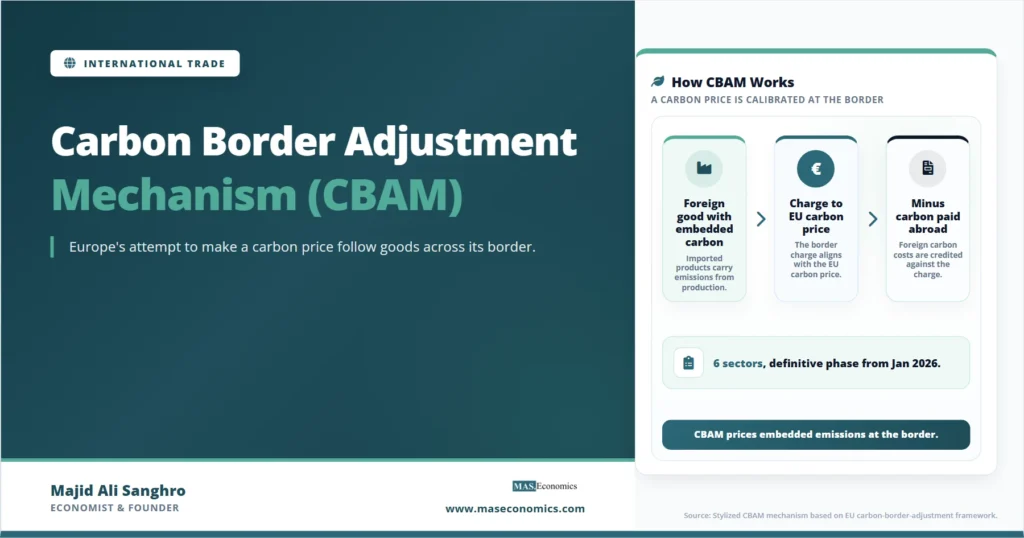
CBAM functions by charging imports the carbon price they would have paid had they been produced under EU rules. An importer of covered goods must calculate the embedded emissions in each shipment, the carbon released during the product’s manufacture, and surrender CBAM certificates corresponding to those emissions. The price of a certificate tracks the EU Emissions Trading System allowance price, so the imported tonne and the domestic tonne face the same carbon cost. If the exporter already paid a carbon price in its home country, that amount is deducted, which avoids charging the same carbon twice and gives other countries a reason to price carbon themselves.
The design is best read as the mirror image of the EU’s internal carbon price rather than as an ordinary border tax. The two are deliberately linked so that protection of European producers is incidental to equal treatment, not its purpose.
CBAM Charge
The rollout is deliberately gradual. A transitional phase from October 2023 to December 2025 required importers only to report embedded emissions, with no payment, so that firms and authorities could build the data systems first. The definitive phase, with financial obligations, began on 1 January 2026. The charge is then phased in over years, rising as the free allowances that currently cushion EU producers under the Emissions Trading System are withdrawn, with full application reached by 2034. To keep the system manageable, a de minimis threshold exempts importers bringing in less than fifty tonnes of covered goods a year; the European Commission estimates this exempts roughly 90 percent of importers while still covering about 99 percent of the emissions, since the bulk of covered imports comes from a small number of large traders.
| Element | Detail |
|---|---|
| Legal basis | EU Regulation 2023/956 |
| Sectors covered | Cement, iron and steel, aluminium, fertilisers, electricity, hydrogen |
| Transitional phase | October 2023 to December 2025, reporting only |
| Definitive phase | From 1 January 2026, certificates required |
| Price reference | EU Emissions Trading System allowance price |
| Credit for foreign carbon price | Deducted from the charge |
| Full phase-in | By 2034, as ETS free allowances are removed |
|
Source: European Commission, Carbon Border Adjustment Mechanism, and Regulation (EU) 2023/956.

|
|
Selecting the First Six Sectors
The initial scope is not arbitrary. The six sectors were chosen because they combine two features: high emissions per unit of output and high exposure to carbon leakage. These are heavy, energy-intensive materials where the carbon cost is a large share of the price and where production can plausibly shift to unpriced jurisdictions. Starting with them captures a large share of the leakage risk while keeping the system administratively contained, since each sector involves a relatively traceable set of products and emissions.
The scope is meant to widen. The European Commission has proposed extending CBAM to downstream products that contain a lot of steel or aluminium, closing a gap where a country could avoid the charge by exporting finished goods rather than raw materials. This staged expansion mirrors how the system is being phased in financially, and it signals that the six sectors are a starting point rather than the final boundary.
Climate Policy or Protectionism Debate
The hardest questions about CBAM are not technical but about its character. Supporters describe it as the missing piece of a credible carbon price: without a border adjustment, a domestic carbon price is undermined by leakage, so CBAM is what makes ambitious climate policy survivable in an open economy. Critics, many of them in developing and exporting countries, see something closer to green protectionism, a tariff that happens to wear climate clothing and that conveniently shelters European heavy industry from foreign competition.
Both readings contain truth, which is what makes the debate durable. CBAM does protect European producers, because equalizing the carbon cost necessarily removes the price advantage that unpriced foreign carbon gave importers. Whether that protection is a side effect of correcting an externality or the real motive dressed up as climate policy is partly a question of design and partly a question of intent. The instrument shares this ambiguity with other measures examined under non-tariff barriers, where a rule can serve a legitimate public purpose and a protective one at the same time, and where the dividing line sits in the details.
Caveat. A measure can correct a genuine market failure and protect domestic industry at once. CBAM does both. Judging it requires asking whether the carbon charge is calibrated to actual emissions and whether foreign carbon prices are credited fairly, not simply whether European producers benefit.
Three concrete objections give the protectionism charge weight. First, the compliance burden of measuring installation-level embedded emissions falls heavily on exporters, especially smaller producers in developing economies that lack the data systems large firms can afford. Second, distributional fairness is contested: countries that contributed least to historical emissions argue they are being asked to bear costs to protect a market they had little hand in warming. Third, there is the risk of trade fragmentation and retaliation, with affected exporters challenging CBAM at the World Trade Organization or building competing schemes, a dynamic that fits the wider strains on the trading system traced in the discussion of how trade policy instruments interact.
CBAM in Climate and Trade Policy
CBAM marks a shift in how climate policy and trade policy intersect. For most of the era of trade liberalization, environmental rules and trade rules were treated as separate domains that occasionally clashed. CBAM fuses them: it is a trade instrument whose entire justification is climate, and a climate instrument that operates through the customs system. It belongs to the broader rethinking of economic frameworks around climate examined in green macroeconomics, and it tests whether a single bloc can extend its environmental standards beyond its borders through the leverage of market access.
The deeper significance is the precedent. If CBAM works, other jurisdictions with carbon prices have a template for protecting their own climate policy from leakage, and the pressure on unpriced exporters to adopt carbon pricing grows. If it fails, through legal challenge, retaliation, or administrative collapse under its own complexity, it will stand as a warning about the limits of unilateral climate action in an interconnected trading system. Either way, the experiment is now live, and its outcome will shape how seriously the world treats the idea that carbon should carry a price wherever it is emitted.
Explains
Three ideas behind CBAM
See how climate policy is reshaping trade and economics.
Explore the MASEconomics BlogConclusion
The carbon border adjustment mechanism exists to solve a specific failure that ambitious climate policy creates. When the European Union prices carbon at home but its trading partners do not, production and emissions can shift offshore through carbon leakage, leaving the climate no better off and European industry weaker. CBAM closes that route by charging imports of carbon-intensive goods the same carbon price they would have faced had they been made under EU rules, with credit for any carbon price already paid abroad. Its charge is tied to the EU Emissions Trading System price, which makes it the border extension of a domestic carbon market rather than an ordinary tariff.
The mechanism is being introduced in stages: a reporting-only phase through 2025, financial obligations from January 2026, and full application by 2034 as the free allowances that protect EU producers are withdrawn. It begins with six energy-intensive sectors chosen for high emissions and high leakage risk, and the European Commission has proposed widening it to downstream products. A de minimis threshold keeps the system focused on the large traders that account for nearly all covered emissions.
The lasting controversy is whether CBAM is the necessary complement to a credible carbon price or green protectionism in another form. It is genuinely both: equalizing the carbon cost protects European producers as an unavoidable consequence of correcting the externality. Whether it succeeds will turn on whether the charge tracks real emissions, whether foreign carbon prices are credited fairly, and whether it survives the legal and diplomatic challenges it has already drawn. As the first serious attempt to make a carbon price follow goods across borders, its result will influence climate and trade policy well beyond Europe.
Frequently Asked Questions
What is the carbon border adjustment mechanism?
It is an EU policy that charges imports of certain carbon-intensive goods a carbon price equivalent to what they would have paid if produced under EU rules. Importers must surrender certificates matching the emissions embedded in their goods, with the certificate price tied to the EU Emissions Trading System. Its purpose is to prevent carbon leakage.
What is carbon leakage?
Carbon leakage occurs when a carbon price in one region pushes production, and the emissions that come with it, to regions without a carbon price. The emissions are not reduced; they simply move. CBAM is designed to stop this by ensuring imported goods face the same carbon cost as goods made inside the EU.
Which sectors does CBAM cover?
In its initial scope, CBAM covers six sectors: cement, iron and steel, aluminium, fertilisers, electricity, and hydrogen. These were chosen for their high emissions intensity and high risk of carbon leakage. The European Commission has proposed extending the scope to downstream products containing significant steel or aluminium.
When did CBAM start charging importers?
A transitional phase from October 2023 to December 2025 required only reporting of embedded emissions, with no payment. The definitive phase, in which financial obligations apply and certificates must be purchased and surrendered, began on 1 January 2026. The charge is then phased in gradually, reaching full application by 2034.
Is CBAM a tariff or a climate policy?
It is designed as a climate policy that operates like a border charge. Supporters argue it is the necessary complement to a domestic carbon price, without which leakage would undermine the policy. Critics call it green protectionism. Both views hold some truth, because equalizing the carbon cost protects EU producers as a direct consequence of correcting the emissions externality.
Thanks for reading! If you found this helpful, share it with friends and spread the knowledge. Happy learning with MASEconomics