Since October 1983, through a stock crash, a handover of sovereignty, an Asian financial crisis, and a global pandemic, the Hong Kong dollar has traded at essentially 7.80 to the US dollar, and no committee meets to decide whether it should. A currency board is the arrangement that makes such a thing possible: a monetary regime in which the domestic currency is issued only against full reserves of a foreign anchor currency, at a fixed rate written into law, with the issuing authority stripped of every discretionary power a normal central bank has. It is often described as a hard peg, and the description undersells it. A peg is a promise that a central bank makes and can break; a board is machinery built so that there is nothing left to decide. The country that adopts one has, quite literally, outsourced its monetary policy to the anchor country, and the interesting economics is in what that purchase costs.
The regime matters beyond its handful of current practitioners, because it is the permanent second item on the menu whenever a country’s monetary credibility collapses. Every few years, somewhere, a society exhausted by inflation debates handing the printing press to a foreign anchor, most recently in Argentina’s dollarization argument, and the currency board is the halfway house in that debate. Knowing how the machinery works, and where it has broken, is knowing what is actually on offer.
A Peg With the Discretion Removed
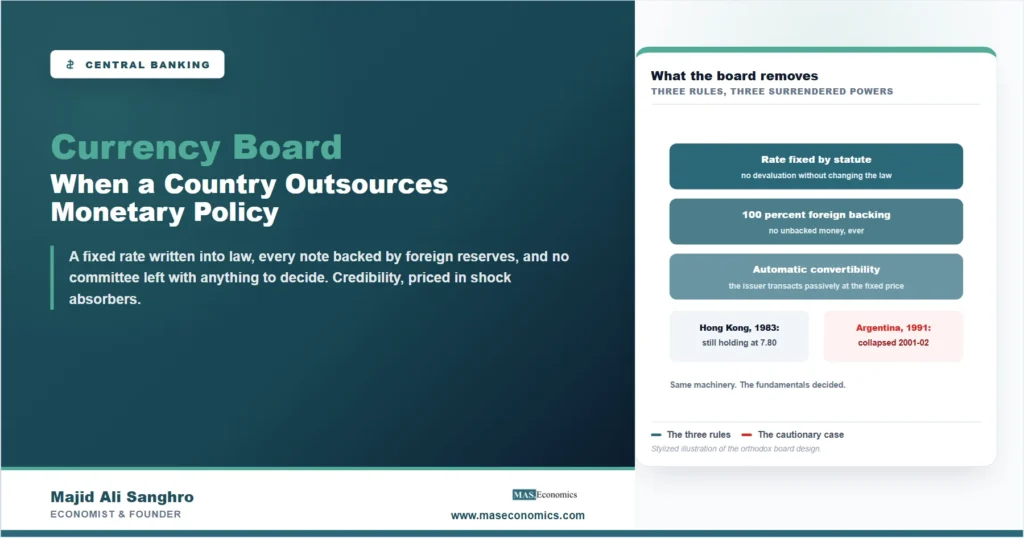
Three rules define the orthodox board, and each one removes a power. First, the exchange rate is fixed by statute, not by policy: changing it requires changing the law, which is the point, since a rate that parliament must vote to move is a rate speculators cannot talk the central bank into moving. Second, the monetary base must be backed at least one hundred percent by reserves in the anchor currency, so every note in circulation is matched by hard foreign assets; the issuer can never print money it does not have backing for, which abolishes both monetary financing of the government and discretionary stimulus in one stroke. Third, convertibility is automatic and unlimited: present domestic currency, receive anchor currency at the fixed rate, and the other way around, with the issuer obliged to transact passively at that price. Under these rules there are no open market operations, no policy rate decisions, and, in the strict version, no lender of last resort, because rescuing a bank would mean creating unbacked money. The contrast with an ordinary fixed exchange rate, where a central bank defends a chosen parity with finite reserves and retains every discretionary power it has not tied down, is developed in our article on policy under a peg.
The Machinery in Motion
With discretion gone, adjustment happens through arithmetic. When money flows out of a board economy, the issuer buys back domestic currency with its reserves, and the monetary base shrinks automatically; scarcer money pushes domestic interest rates up until holding the currency is attractive again. When money flows in, the base expands and rates fall. The board economy thus runs on a self-correcting mechanism much like the classical gold standard’s, with the anchor currency playing the role of gold, and the discipline is real: interest rates are set, in effect, in the anchor country, plus whatever premium markets attach to local risk. Hong Kong’s rates track the Federal Reserve’s decisions regardless of whether the local economy needs them, which is the outsourcing made visible. In the language of the Mundell trilemma, the board picks the fixed exchange rate and open capital markets, and surrenders monetary independence completely and by design; the general behavior of exchange rates in global trade becomes, for such an economy, somebody else’s policy variable.
What the machinery buys is credibility of a kind no announcement can manufacture. Because devaluation requires legislation and the backing rule makes a reserve crisis arithmetically impossible, speculative attacks lose their usual target; Hong Kong’s board, administered under the Linked Exchange Rate System, absorbed the full force of the 1997 and 1998 Asian crisis attacks and held. What the machinery costs is every shock absorber. A board economy hit by a recession cannot cut rates, cannot depreciate, and cannot print; it must deflate its way back to competitiveness through falling wages and prices, which is slow and politically brutal. And its banks live dangerously, because the strict version of the regime has no lender of last resort, so a solvent bank facing a run must find private help, survive on its own liquidity, or fail.
The Case File: Hong Kong, Bulgaria, Argentina
The modern record is three stories told at different temperatures. Hong Kong is the working exhibit: a small, hyper-open financial center whose trade and finance are dollar-linked anyway, running the board since 1983 within a narrow band around 7.80, with enormous reserves and a flexible economy whose wages and prices genuinely adjust. Bulgaria is the redemption story: after a hyperinflationary collapse in the mid-1990s, of the family chronicled in our survey of hyperinflation case studies, it adopted a board in 1997 anchored first to the Deutsche Mark and then to the euro, and the machine did what it was built to do, ending the inflation at once and holding the anchor for decades; the Baltic states ran the same play on their road into the euro.
Argentina is the cautionary tale, and the one every proposal must answer for. The 1991 Convertibility Law fixed the peso one-to-one to the dollar and killed an inflation that had reached hyperinflationary levels, delivering several years of stability and growth. But the dollar strengthened through the 1990s and dragged the peso up with it, pricing Argentine exports out of their markets; fiscal deficits continued, financed by external debt, since the board had closed the printing press but not the borrowing window; and when recession came there was no devaluation valve and no lender of last resort behind a dollarized banking system. The regime collapsed in the crisis of 2001 and 2002 amid default, bank freezes, and a devaluation that broke contracts across the economy, a sequence our study of Argentina’s recurrent defaults places in its longer national pattern. The comparison with Hong Kong is the whole syllabus: the machinery is identical, and the outcomes diverged on the fundamentals around it, wage flexibility, fiscal discipline, the fit between the anchor and the economy’s actual trade. A board does not create those conditions. It bets everything on their being present.
MASEconomics Explains
3 economic concepts behind currency boards
These concepts are explored in depth across our educational articles library.
Explore the MASEconomics BlogConclusion
A currency board is what remains of a central bank after every discretionary power has been removed: a fixed rate written into law, a monetary base fully backed by foreign reserves, and an issuer that transacts passively at the statutory price. The design buys credibility by making the two classic escape routes, devaluation and the printing press, constitutionally unavailable, and the purchase is genuine, as Hong Kong’s four decades and Bulgaria’s post-hyperinflation stability attest. The price is paid in shock absorbers: no independent interest rate, no exchange rate valve, and no lender of last resort, so every adjustment runs through wages, prices, and employment.
The honest summary is that a board is not a monetary policy but a decision to stop having one, and the wisdom of that decision depends entirely on conditions the board itself cannot supply. An economy whose trade matches its anchor, whose prices flex, and whose budget balances can wear the straitjacket and call it a spine. An economy that lacks those things, as Argentina did, discovers that the straitjacket does not create discipline; it only raises the cost of not having it, and settles the bill in a single crisis. Outsourcing monetary policy, like any outsourcing, works precisely when what remains in-house is sound.
Frequently Asked Questions
What is a currency board in simple terms?
It is a system where a country’s money is issued only against full reserves of a foreign currency, at a rate fixed by law, and is exchangeable on demand at that rate. The issuer has no power to print unbacked money, set interest rates, or change the rate, so monetary policy is effectively imported from the anchor country.
How is a currency board different from an ordinary peg?
An ordinary peg is a policy: the central bank promises a rate, defends it with finite reserves, and can abandon it by decision. A board is a legal structure: the rate is statutory, the backing is complete by rule, and there is no committee with the authority to devalue. Pegs are attacked because they can break; boards are designed so there is nothing to break short of changing the law.
What is the difference between a currency board and dollarization?
A board keeps the national currency in circulation, fully backed and convertible; dollarization abolishes it and uses the foreign currency outright. The board preserves the seigniorage earned on backing reserves and a legal exit route, however costly. Dollarization surrenders both, which makes it harder to reverse and, for that reason, marginally more credible.
Why did Argentina’s currency board fail while Hong Kong’s survived?
The machinery was similar; the surroundings were not. Hong Kong pairs its board with dollar-linked trade, flexible wages and prices, large reserves, and fiscal restraint. Argentina anchored to a currency its trade did not match, kept running deficits financed by external debt, and had rigid prices, so when the strong dollar and recession arrived there was no adjustment valve left except collapse, which came in 2001 and 2002.
Does a currency board stop inflation?
Domestically generated inflation, yes, and quickly: with money creation tied to reserves, the inflationary financing of budgets becomes impossible, which is why boards are adopted after hyperinflations, as Bulgaria’s 1997 experience showed. The economy instead inherits the anchor country’s inflation, along with its interest rates and its monetary mistakes.
Thanks for reading! A currency board is not a stronger promise; it is the removal of the power to break one. Happy learning with MASEconomics