
Most explanations of the Edgeworth box stop at the diagram. They show two origins, a few indifference curves, a contract curve sweeping across the middle, and then declare that exchange moves the traders toward efficiency. What they rarely do is put numbers on it and solve for the answer. That gap is where understanding breaks down, because the box only becomes intuitive once a specific endowment, specific preferences, and a specific price are taken, and the exact outcome is computed. Worked Edgeworth box examples turn a static picture into a procedure: given who starts with what and what they want, find the prices that clear the market and the allocation trade delivers.
A complete example, from endowment to competitive equilibrium, illustrates every step. Two traders, two goods, fixed total supply, Cobb‑Douglas preferences. The numbers serve only to demonstrate the method, which transfers directly to any two‑person, two‑good exchange problem. By the end, the diagram stops being decorative and becomes the worked answer to a question with a single right solution. Readers who want the underlying concepts first can start with the conceptual treatment in the Edgeworth box and the broader framework in general equilibrium analysis.
Two Traders, Two Goods, Fixed Totals
Consider two people, Anna and Ben, and two goods, X and Y. The economy has a fixed total of 10 units of X and 8 units of Y. There is no production; the only economic activity is trade. The Edgeworth box is 10 wide and 8 tall, with Anna’s bundle measured from the bottom-left origin and Ben’s measured from the top-right origin. Every point in the box is a complete division of the fixed totals, since whatever Anna does not hold, Ben holds.
The starting allocation, the endowment, is the position the traders occupy before any exchange. In this example Anna begins with 2 units of X and 6 units of Y, written as A = (2, 6). Ben therefore begins with the rest, B = (8, 2). This endowment is lopsided: Anna is rich in Y and short of X, while Ben is rich in X and short of Y. That imbalance is exactly what creates room for mutually beneficial trade.
Both traders have Cobb-Douglas preferences with equal weight on the two goods, so each one’s utility is the product of the quantities consumed.
Preferences
Step 1: Find the Efficient Allocations
Before solving for what trade delivers, it helps to know which allocations are efficient. An allocation is Pareto efficient when neither trader can be made better off without making the other worse off, which happens where Anna’s indifference curve is tangent to Ben’s. Tangency means the two traders’ marginal rates of substitution are equal. For Cobb-Douglas utility, the MRS of good X for good Y is simply the ratio of the quantities, \( MRS = y/x \).
Setting Anna’s MRS equal to Ben’s, and using the fact that the totals are fixed, gives the contract curve as an equation in Anna’s bundle alone.
Contract Curve
So every efficient allocation in this economy satisfies \( y_A = 0.8\,x_A \). The contract curve runs as a straight line from Anna’s origin in the bottom-left corner to Ben’s origin in the top-right corner. The endowment A = (2, 6) is not on this line, since \( 0.8 \times 2 = 1.6 \neq 6 \), which confirms the starting point is inefficient and gains from trade remain. How the contract curve relates to the full set of efficient allocations is treated separately in our explainer on the contract curve and Pareto efficient allocations.
Step 2: Set Up the Competitive Equilibrium
Knowing which allocations are efficient does not yet tell us which one trade reaches. To pin that down, introduce prices. In a competitive exchange economy each trader takes prices as given, values their endowment at those prices to get an income, and buys the bundle they most prefer subject to that income. The equilibrium is the price ratio at which both markets clear, meaning total demand equals total supply for each good.
Normalize the price of Y to 1 and let the price of X be \( p \). Each trader’s income is the market value of their endowment. Anna’s income is the value of 2 units of X plus 6 units of Y; Ben’s is the value of 8 units of X plus 2 units of Y.
Endowment Incomes
For Cobb-Douglas preferences with equal weights, a familiar result is that a consumer spends exactly half of income on each good. The demand for X is therefore half of income divided by the price of X, and the demand for Y is half of income divided by the price of Y.
Demand Functions
Step 3: Solve for the Equilibrium Price
The market for X clears when Anna’s demand for X plus Ben’s demand for X equals the total supply of 10. Substituting the demands and incomes gives a single equation in the price \( p \).
Market Clearing for X
Combine the numerators over the common denominator: \( (2p + 6) + (8p + 2) = 10p + 8 \), so the left side is \( (10p + 8)/(2p) \). Setting this equal to 10 gives \( 10p + 8 = 20p \), which solves to \( 10p = 8 \), or \( p = 0.8 \). The equilibrium price of X is 0.8 times the price of Y. Intuitively, X is the good Ben is flush with, and Anna needs, and the relative price settles below 1 because the supply of X is plentiful relative to demand once both traders optimize. By Walras’ law, if the market for X clears, then the market for Y clears automatically, so there is no need to solve the Y market separately.
One price does all the work. Once the relative price of X is known, every other quantity in the problem follows mechanically from the demand functions. This is why competitive equilibrium in the box reduces to solving a single market-clearing equation.
Step 4: Compute the Final Allocation
With \( p = 0.8 \), plug back into the incomes and demands. Anna’s income is \( M_A = 2(0.8) + 6 = 7.6 \). Her demand for X is \( 7.6 / (2 \times 0.8) = 7.6 / 1.6 = 4.75 \), and her demand for Y is \( 7.6 / 2 = 3.8 \). Ben’s income is \( M_B = 8(0.8) + 2 = 8.4 \). His demand for X is \( 8.4 / 1.6 = 5.25 \), and his demand for Y is \( 8.4 / 2 = 4.2 \). The two demands for X sum to \( 4.75 + 5.25 = 10 \) and the two demands for Y sum to \( 3.8 + 4.2 = 8 \), so both markets clear exactly.
| Trader | Endowment (X, Y) | Equilibrium (X, Y) | Net trade | Utility before, after |
|---|---|---|---|---|
| Anna | (2, 6) | (4.75, 3.8) | +2.75 X, −2.2 Y | 12.0, 18.05 |
| Ben | (8, 2) | (5.25, 4.2) | −2.75 X, +2.2 Y | 16.0, 22.05 |
| Totals | (10, 8) | (10, 8) | Balanced | Both gain |
|
Source: Stylized example based on standard Cobb-Douglas exchange formulas.

|
||||
The net trades are equal and opposite, as they must be: Anna gives up 2.2 units of Y and receives 2.75 units of X, while Ben does the reverse. Both traders end on higher indifference curves, since Anna’s utility rises from 12 to about 18.05 and Ben’s from 16 to about 22.05. The equilibrium allocation A = (4.75, 3.8) satisfies the contract curve condition \( y_A = 0.8\,x_A \), since \( 0.8 \times 4.75 = 3.8 \), confirming the outcome is efficient. Trade has moved the economy from an inefficient endowment to an efficient allocation that both parties preferred to where they started.
The Worked Example as a Diagram
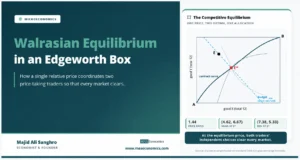
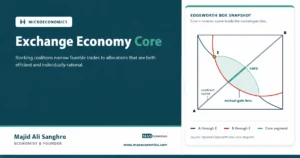
The full solution maps onto the box directly. The endowment sits off the contract curve inside the box. The two indifference curves through the endowment enclose the lens of mutually beneficial trades. The budget line, with slope equal to the negative of the equilibrium price ratio, passes through both the endowment and the final allocation. The equilibrium allocation lands where that budget line touches the highest indifference curve each trader can reach, which is the tangency point on the contract curve.

Reading the diagram confirms the algebra. The endowment E lies inside the box but off the diagonal, so it is inefficient. The shaded lens is the region both traders prefer to E. The budget line pivots through E at the equilibrium price ratio of 0.8 and carries the traders to E*, the point on the contract curve inside the lens where each trader’s highest affordable indifference curve is tangent to the budget line. That tangency is the competitive equilibrium.
A Second Example: Changing the Endowment
To see what depends on the endowment and what does not, change only the starting point and keep the preferences. Suppose Anna and Ben start at A = (5, 1) and B = (5, 7), so Anna now begins rich in X and short of Y. The preferences are unchanged, so the contract curve is still the diagonal \( y_A = 0.8\,x_A \), and the efficient locus has not moved at all. The endowment, though, sits in a different place, so the lens of beneficial trades and the equilibrium price shift.
Running the same market-clearing step with the new incomes, \( M_A = 5p + 1 \) and \( M_B = 5p + 7 \), the demand for X sums to \( (10p + 8)/(2p) = 10 \), which again gives \( p = 0.8 \). In this symmetric case, the price happens to be the same, but the equilibrium allocation differs because the incomes differ: Anna’s income is now lower relative to Ben’s, so she ends with a smaller bundle. The lesson generalizes. The contract curve is fixed by preferences and totals, while the equilibrium price and the final allocation depend on the endowment. This is the same distinction that separates the full efficient set from the part trade can reach, explored in the comparison of the core of an exchange economy.
Why the Outcome Is Efficient: The Welfare Connection
The example illustrates the First Welfare Theorem in miniature. A competitive equilibrium, reached by self-interested traders responding only to prices, lands on the contract curve, which is the set of Pareto efficient allocations. No central coordinator directed the trade; the price did the coordinating. This is the formal version of the claim that decentralized exchange tends to exhaust the gains from trade, and it connects the worked box to the general results in welfare economics and Pareto efficiency.
What the example does not show is any judgment about fairness. The equilibrium gave Anna a utility of about 18 and Ben about 22, an unequal split that traces back to their unequal endowments rather than to anything inefficient. A different starting distribution would support a different efficient equilibrium with a different division of welfare. Efficiency fixes that the economy reaches the contract curve; it does not fix where on the curve it lands. That separation between efficiency and distribution is the single most important idea the worked box teaches.
Explains
Three ideas behind the worked example
Explore related explainers on exchange, prices, and efficiency.
Explore the MASEconomics BlogConclusion
Working through Edgeworth box examples step by step turns the diagram from an illustration into a solvable problem. The procedure is always the same: write down endowments and preferences, derive the contract curve from equal marginal rates of substitution, set up each trader’s income and demand at a relative price, solve the single market-clearing equation for that price, and substitute back to get the final allocation. In the example here, an endowment of A = (2, 6) and B = (8, 2) with equal-weight Cobb-Douglas preferences produced an equilibrium price ratio of 0.8 and a final allocation of A = (4.75, 3.8) and B = (5.25, 4.2), efficient and preferred by both traders to where they began.
The second example showed what the method holds fixed and what it lets vary. Preferences and total resources fix the contract curve; the endowment fixes the equilibrium price and the final division of welfare along that curve. The box ends up doing exactly what a good example should do, which is to make a general result concrete: competitive exchange reaches an efficient allocation, but efficiency alone says nothing about whether the result is fair.
Frequently Asked Questions
How do you solve an Edgeworth box example step by step?
Write down each trader’s endowment and preferences, then derive the contract curve by setting the two marginal rates of substitution equal. Normalize one price, compute each trader’s income as the value of their endowment, and write their demand functions. Set total demand for one good equal to its supply, solve for the equilibrium price, and substitute back to get the final allocation. Check that both markets clear.
What is the contract curve in an Edgeworth box example?
It is the set of all Pareto efficient allocations, found where the two traders’ indifference curves are tangent and their marginal rates of substitution are equal. For equal-weight Cobb-Douglas preferences it is a straight diagonal from one trader’s origin to the other’s. In the example here, the contract curve is the line where Anna’s Y equals 0.8 times her X.
How do you find the equilibrium price in an exchange economy?
Set one good’s price as the numeraire, value each trader’s endowment to get income, and write demands as functions of the price. Then impose market clearing for one good, meaning total demand equals total supply, and solve the resulting equation for the price. By Walras’ law, if one market clears the other clears automatically, so a single equation determines the relative price.
Why is the competitive equilibrium in the box efficient?
Because at a competitive equilibrium each trader sets their marginal rate of substitution equal to the common price ratio. Since both face the same prices, their marginal rates of substitution are equal to each other, which is exactly the tangency condition for Pareto efficiency. The equilibrium therefore lands on the contract curve. This is the First Welfare Theorem demonstrated in a two-person economy.
Does the equilibrium allocation depend on the endowment?
Yes. The contract curve depends only on preferences and total resources, so it does not move when the endowment changes. The equilibrium price and the final allocation do depend on the endowment, because each trader’s income is the value of what they start with. A different endowment generally supports a different efficient equilibrium with a different division of welfare.
Thanks for reading! If you found this helpful, share it with friends and spread the knowledge. Happy learning with MASEconomics