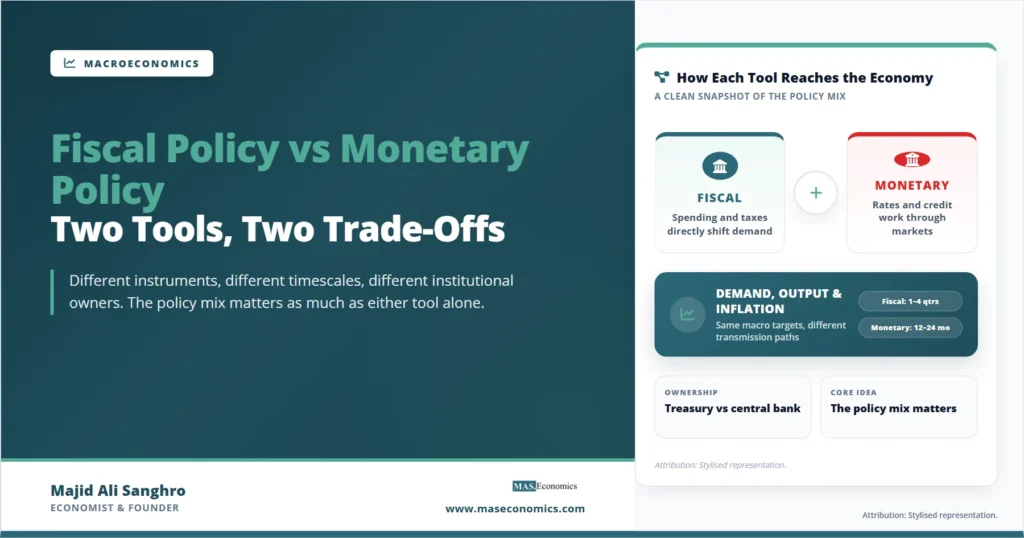
When the COVID-19 pandemic hit in March 2020, the United States response was an instructive natural experiment in policy choice. Within weeks, Congress had passed the CARES Act, sending $1,200 cheques to households, expanding unemployment benefits, and providing forgivable loans to small businesses. Within the same weeks, the Federal Reserve cut its policy rate to zero, restarted large-scale asset purchases, and opened emergency lending facilities for corporate debt, municipal bonds, and money market funds. The two responses ran in parallel because they are different tools controlled by different institutions doing different things. Understanding fiscal policy vs monetary policy is understanding why a modern economy needs both, why they sometimes work together and sometimes against each other, and why every recession in living memory has produced an argument about which one should lead.
Two Tools, Two Institutional Owners
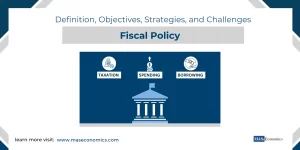
Fiscal policy is what governments do with taxes and spending. When a parliament passes a budget that raises infrastructure investment, expands the child tax credit, or cuts the corporate tax rate, that is fiscal policy. Its instruments are decisions about how much to take from the private sector through taxation, how much to return through spending and transfers, and how much to borrow to cover the difference. Fiscal policy in the United States is owned by Congress and the executive branch; in the United Kingdom, by the Treasury and Parliament; in the eurozone, by national finance ministries subject to common rules. It is, in every advanced democracy, a deeply political instrument because every fiscal decision is also a decision about distribution.
Monetary policy is what central banks do with the money supply and interest rates. When the Federal Reserve raises the federal funds rate, the European Central Bank conducts a longer-term refinancing operation, or the Bank of England announces a programme of asset purchases, that is monetary policy. Its instruments are the price and quantity of central bank reserves: the interest rate paid on those reserves, the rate charged for short-term borrowing against collateral, the size of the central bank’s balance sheet, and forward guidance about future policy. Monetary policy in advanced economies is owned by an independent central bank with a statutory mandate, deliberately insulated from day-to-day political pressure to make decisions on a longer horizon than the next election.
The first thing to understand about the two tools is that they are not substitutes performing the same function with different labels. They affect the economy through different channels, on different timescales, with different distributional consequences, and through different institutional decision processes. A government that needs to stimulate demand can, in principle, use either, but the consequences of using one versus the other are not equivalent.
Side-by-Side: The Core Differences
The comparison below captures the structural differences across six dimensions that matter for policy design.
| Dimension | Fiscal policy | Monetary policy |
|---|---|---|
| Instruments | Government spending, transfers, taxation, public borrowing | Policy interest rate, reserve operations, balance sheet, forward guidance |
| Controller | Legislature and executive (politically elected) | Independent central bank (statutorily insulated) |
| Implementation lag | Long: legislation, appropriation, disbursement (often 6–18 months) | Short: rate decisions implemented within days; effects build over quarters |
| Transmission lag | Direct injection of demand; multiplier effects over 1–4 quarters | Indirect; “long and variable lags” of 12–24 months to peak effect |
| Distributional impact | Explicit and targeted (who gets the spending, who pays the tax) | Implicit and broad (savers vs borrowers, asset holders vs wage earners) |
| Reversibility | Politically difficult: spending programmes acquire constituencies | Mechanically straightforward: rates can move in either direction |
| Primary objective | Resource allocation, redistribution, demand management | Price stability (typically 2% inflation target); employment in some mandates |
|
Source: MASEconomics editorial synthesis.

|
||
Several of these differences deserve elaboration because they shape when each tool works and when each fails.
Transmission Channels of Each Tool
Fiscal policy operates through direct injection. When a government writes a cheque to a household, hires a contractor to build a road, or extends unemployment insurance, the money enters the income stream immediately and creates demand for goods and services in the next quarter. The size of the effect depends on the fiscal multiplier, which measures how much total GDP rises per dollar of additional government spending or per dollar of tax cut. Multipliers vary by context: spending on goods and services produces larger multipliers than tax cuts to high-income households because the propensity to consume is higher among lower-income recipients. Multipliers are also larger in deep recessions, when monetary policy is at the zero lower bound, and crowding-out concerns are minimal, than in expansions.
Monetary policy operates through prices and intermediaries. The central bank moves the short-term policy rate, which propagates through the term structure of interest rates, into mortgage and corporate borrowing costs, exchange rates, asset prices, and ultimately into consumption and investment decisions across the economy. Each step in this chain takes time. The classical formulation by Milton Friedman that monetary policy operates with “long and variable lags” describes a real feature of the transmission process. Empirical work using vector autoregressions and dynamic stochastic general equilibrium models typically estimates that the peak effect of a monetary policy change on inflation arrives twelve to twenty-four months after the change is implemented. The peak effect on output arrives somewhat sooner.
This timing difference has a practical consequence. Fiscal policy is better suited to addressing sharp, identifiable demand shortfalls because the effect arrives quickly, even if legislation itself takes months. Monetary policy is better suited to managing the path of inflation and the cyclical position of the economy over a multi-year horizon, because the effect builds gradually and persists.
The Role of Institutional Design
The institutional separation between fiscal and monetary policy in modern economies is one of the most important arrangements in economic governance. It arose from hard experience. The hyperinflations of the twentieth century, Weimar Germany, Hungary, Zimbabwe, Venezuela, all involved central banks under the direct control of governments that used the printing press to finance deficits. The architecture of central bank independence exists to prevent this dynamic from arising in advanced economies.
The trade-off is straightforward. Politically controlled monetary policy responds quickly to short-term political pressures: cutting rates before an election, accommodating fiscal needs when revenue falls, prioritising growth over inflation. Politically insulated monetary policy responds slowly to such pressures, prioritising the medium-term inflation target even when doing so is politically costly. The latter arrangement produces lower average inflation, more stable inflation expectations, and a credible nominal anchor that allows long-term contracts and financial planning. The price is that the central bank cannot be redirected toward other goals, such as full employment beyond the natural rate, exchange rate management, and fiscal financing, without weakening the credibility that gives it traction in the first place.
Fiscal policy, by contrast, is fundamentally political. Every dollar of spending is a dollar going to some constituency rather than another. Every tax change reshapes incentives and distribution. There is no technocratic answer to whether a government should spend more on healthcare or defence, whether it should tax wealth or labour, or whether it should run deficits in a downturn. These are democratic questions, and the institutional architecture of fiscal policy reflects this: it is contested, slow, distributional, and accountable through elections.
Conditions That Favour Fiscal Policy
Three conditions tilt the optimal policy mix toward fiscal action. The first is the zero lower bound on nominal interest rates. When the policy rate is already at or near zero, the central bank cannot cut further to stimulate the economy through conventional channels. Quantitative easing and forward guidance offer partial substitutes but with diminished traction. The Japanese experience from the 1990s onward and the global experience after 2008 demonstrated that in this regime, fiscal policy is the more powerful demand-management tool. Liquidity trap conditions shift the institutional comparative advantage from the central bank to the treasury.
The second is a deep, sharp demand collapse where the speed of injection matters more than the precision of calibration. The 2020 pandemic response is the textbook example: when an entire economy shuts down for public health reasons, the immediate need is to keep households solvent and prevent business bankruptcies. Mailing cheques and expanding unemployment benefits do this directly. Cutting interest rates does it slowly and indirectly, with much of the benefit accruing to existing borrowers and asset holders rather than to the workers losing income.
The third is a structural shift in the composition of demand that monetary policy is not well-equipped to address. If a country needs to invest in energy transition, public health infrastructure, or human capital, lower interest rates create cheaper financing but do not direct the resources toward those uses. Fiscal policy can target specific sectors, regions, and populations in a way that interest rate policy cannot. The current debate about industrial policy in the United States, Europe, and East Asia is partly a debate about whether such targeting is appropriate, but it is also a recognition that monetary policy by itself does not produce the desired sectoral allocation.
Conditions That Favour Monetary Policy
Three different conditions tilt the optimal policy mix toward monetary action. The first is when the economy is at or near full employment, and inflation is the binding constraint. Inflation targeting as a framework was developed precisely because central banks can adjust the path of inflation expectations through credible commitment to a numerical target in a way that fiscal authorities cannot. The Volcker disinflation of 1979 to 1982 in the United States, the Bank of Canada’s adoption of inflation targeting in 1991, and the European Central Bank’s response to the 2022 inflation surge all illustrate the role of monetary policy in stabilising the price level over a medium-term horizon.
The second is when policy needs to be fine-tuned in response to evolving conditions. The Federal Open Market Committee meets eight times per year and can adjust the policy rate at each meeting, with intermeeting moves available in emergencies. Congress passes a major fiscal package perhaps once or twice per business cycle, with months of negotiation preceding each one. For routine macroeconomic management in normal times, monetary policy is the operationally flexible instrument; fiscal policy is reserved for larger interventions where the inertia of legislative action is acceptable.
The third is when sovereign debt sustainability constrains fiscal space. A country running large primary deficits with rising debt-to-GDP ratios faces hard limits on how much further it can use fiscal policy to stimulate demand without raising borrowing costs or triggering a debt crisis. Debt sustainability is a real constraint, and the countries that have it (Germany, Switzerland, Norway, Japan, despite high debt because the holders are domestic) have more fiscal latitude than countries that do not (Argentina, Italy, much of the developing world). Where fiscal space is constrained, monetary policy carries more of the cyclical burden by default.
A Stylised Comparison of Transmission Channels
The diagram captures something important about the structural difference. Fiscal policy reaches aggregate demand in three steps, each of which is observable in real time. Monetary policy reaches the same target in three steps, but the middle step is mediated by financial markets and household decisions that are themselves shaped by expectations about future policy. This is why central bank communication matters as much as the policy itself: a rate cut that markets expect to be reversed quickly has a smaller effect than the same rate cut accompanied by credible guidance that policy will remain accommodative.
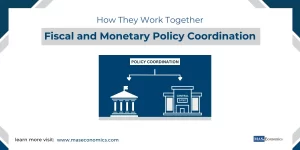
Coordinated Policy Easing
The most powerful macroeconomic interventions occur when fiscal and monetary policy reinforce each other. The 2020 pandemic response is the clearest recent example. Treasury cheques and expanded unemployment benefits injected demand directly while the Federal Reserve held the policy rate at zero, purchased trillions in Treasury and mortgage-backed securities, and opened emergency lending facilities. The combined effect prevented the deep recession that the underlying public health shock would otherwise have produced. Output recovered to pre-pandemic levels within roughly eighteen months, faster than any post-1945 recovery.
The 2008 to 2010 response was similar in structure, though smaller in scale and slower in execution. The American Recovery and Reinvestment Act of 2009 provided around $830 billion in stimulus over several years; the Federal Reserve cut rates to near zero and launched three rounds of quantitative easing. The two policies were broadly aligned, though policy debates of the period suggest that better coordination and a larger fiscal package would have produced a faster recovery. Coordinated policy responses are not automatic; they require deliberate alignment between independent institutions with different mandates.
Policy Mix Imbalance
The more troubling cases arise when fiscal and monetary policy work against each other. The classic example is what economists call a policy mix imbalance. If the government runs persistent large deficits while the central bank tries to maintain price stability, the central bank must hold interest rates higher than it otherwise would to offset the fiscal stimulus. The result is a high-deficit, high-interest-rate equilibrium that crowds out private investment, attracts foreign capital, appreciates the exchange rate, and damages export competitiveness. The United States in the early 1980s, under expansionary Reagan-era fiscal policy and contractionary Volcker monetary policy, produced exactly this configuration. The dollar appreciated by roughly fifty percent against major currencies between 1980 and 1985, and the US trade deficit widened dramatically.
The opposite imbalance also exists. A government that is tightening fiscal policy through austerity while the central bank is trying to stimulate through low rates produces a low-rate, low-demand equilibrium. The eurozone after 2010 provides the example: peripheral countries cut spending and raised taxes under bailout conditions, while the European Central Bank cut rates and launched targeted longer-term refinancing operations. The fiscal contraction overwhelmed the monetary expansion, and the eurozone returned to recession in 2012 to 2013. The argument that “you cannot push on a string” applies when monetary policy is trying to expand demand in the face of contractionary fiscal policy and weak private-sector spending.
The Anchor for Inflation
The 2021 to 2023 inflation episode in advanced economies revived a debate that had been dormant for a generation. When inflation surged from around 2 percent to peaks of 9 to 11 percent, the policy response was overwhelmingly monetary. The Federal Reserve raised the federal funds rate from near zero to over 5 percent in eighteen months. The European Central Bank raised rates by 450 basis points in roughly the same period. The Bank of England raised the Bank Rate from 0.1 percent to 5.25 percent. Fiscal policy played a much smaller role in the disinflation, despite the fact that the initial inflation surge was partly driven by pandemic-era fiscal stimulus.
The reason is institutional. Central banks have a single, well-defined mandate to maintain price stability, the operational independence to act on it without political negotiation, and the technical tools to do so. Fiscal authorities have multiple mandates, must negotiate every action through legislative bodies, and face strong political incentives against the type of contractionary action that disinflation typically requires. Tightening fiscal policy to fight inflation means raising taxes or cutting spending, both of which are politically costly. Raising interest rates is also costly, but the cost is distributed differently and the political accountability is more diffuse. The result is that monetary policy carries the burden of anchoring inflation in modern economies. Fiscal policy provides the cyclical support around that anchor.
This division of labour is not accidental. It reflects a long-running consensus, formalised in the inflation-targeting frameworks adopted by most advanced central banks, that monetary policy is the appropriate tool for managing the nominal side of the economy and that fiscal policy is the appropriate tool for managing the real allocation of resources. The consensus has been challenged by Modern Monetary Theory and by recent debates about fiscal dominance, but it remains the operating framework in most countries.
The Choice in Practice
Real policy choices rarely involve picking one tool to the exclusion of the other. The practical question is the policy mix: how tight or loose each instrument should be in relation to the other, given the cyclical position of the economy, the constraints on each instrument, and the institutional context. Several rules of thumb emerge from the historical record.
In recessions with positive interest rates and adequate fiscal space, both tools should ease. The relative weight depends on the speed needed, the size of the gap, and the structural composition of the demand shortfall. Monetary policy can act faster but more diffusely; fiscal policy can be targeted but acts more slowly through the legislative process.
In recessions at the zero lower bound, fiscal policy must do more of the work. Quantitative easing and forward guidance provide partial monetary substitutes but with reduced effectiveness. The IMF’s recommendation during the 2010s, and again during the pandemic, was that countries with fiscal space should use it rather than relying solely on extraordinary monetary measures.
In expansions with rising inflation pressure, both tools should tighten in principle, but in practice, the tightening is asymmetric. Central banks raise rates; fiscal authorities rarely cut spending or raise taxes in real time. This asymmetry contributes to the political-economy bias toward higher average debt levels and higher average inflation than would emerge from a fully optimised policy mix.
In countries facing debt sustainability constraints, fiscal space is limited, and monetary policy carries more of the cyclical burden by default. This is the position of many developing economies and of some advanced economies in periods of fiscal stress.
Note. The framework above assumes a flexible exchange rate and a domestic-currency debt stock. Fixed exchange rate regimes, currency unions like the eurozone, and dollarised economies face additional constraints because they do not control their own monetary policy. The Mundell-Fleming model formalises how the policy mix changes under different exchange rate arrangements.
Constraints on Each Tool
Neither fiscal nor monetary policy is unconstrained. Fiscal policy is bounded by the willingness of bond markets to absorb government debt at sustainable interest rates, by the political feasibility of raising taxes or cutting spending, and by the inflationary consequences of running deficits in an economy operating at full capacity. Monetary policy is bounded by the zero lower bound on nominal rates (or, where it exists, the effective lower bound below zero), by the credibility of the central bank’s commitment to its inflation target, and by the financial stability consequences of unconventional measures such as large-scale asset purchases.
Both tools also face the problem that the economy they are trying to manage is forward-looking. Households, firms, and financial markets form expectations about future policy and act on those expectations today. A fiscal stimulus that is expected to be reversed by future tax increases produces a smaller effect than one expected to be permanent. A monetary stimulus that is expected to be tightened quickly produces a smaller effect than one expected to be sustained. This is why credible commitment to a policy path matters as much as the immediate action. It is also why rules-based monetary policy outperforms purely discretionary policy in much of the empirical literature: a predictable policy rule allows expectations to align with policy intentions.
Explains
Three ideas that frame the fiscal-monetary comparison
Explore more analysis of macroeconomic policy, central banking, and the institutions that shape modern economies.
Explore the MASEconomics BlogConclusion
The distinction between fiscal policy vs monetary policy is not a question of which tool is better. It is a question of which tool is appropriate for which job, in which conditions, given which constraints. Fiscal policy is the right instrument for targeted, large-scale interventions in response to identifiable demand shortfalls, structural shifts, or distributional objectives. Monetary policy is the right instrument for ongoing management of inflation and the cyclical position of the economy at a higher frequency than legislative processes allow. The institutional separation between the two reflects a hard-won understanding of what each can credibly do and what each cannot.
In every major macroeconomic episode, the policy mix matters as much as the level of any single instrument. Coordinated easing produced rapid recoveries from the 2008 and 2020 shocks. Conflicting tightening and loosening produced the high-interest-rate equilibrium of the early 1980s and the prolonged eurozone recession of the early 2010s. Asymmetric tightening contributed to the high debt levels that now constrain fiscal space in many advanced economies. Reading any macroeconomic episode well requires reading both tools, the relationship between them, and the institutional context in which both operate.
Frequently Asked Questions
What is the main difference between fiscal policy and monetary policy?
Fiscal policy uses government spending and taxation to influence the economy and is controlled by the legislature and executive. Monetary policy uses interest rates and the money supply and is controlled by an independent central bank. The two tools affect the economy through different channels, on different timescales, and with different distributional consequences.
Which is more effective, fiscal policy or monetary policy?
Neither is universally more effective; their relative effectiveness depends on conditions. Fiscal policy is more powerful at the zero lower bound, in deep demand collapses, and where targeted intervention is needed. Monetary policy is more effective for ongoing inflation management, fine-tuning the cyclical position, and acting at higher frequency than legislative processes allow.
Can fiscal and monetary policy work against each other?
Yes. When fiscal policy is expansionary and monetary policy is contractionary, the central bank must hold interest rates higher than it otherwise would, crowding out private investment and appreciating the exchange rate. The United States in the early 1980s is the textbook case. The opposite imbalance, fiscal austerity combined with monetary easing, produced the eurozone double-dip recession of 2012 to 2013.
Why is the central bank independent from the government?
Independence insulates monetary policy from short-term political pressures that would otherwise produce systematically higher inflation. The hyperinflations of the twentieth century all involved central banks under direct political control. Statutorily independent central banks with credible inflation targets produce lower average inflation, more stable expectations, and a reliable nominal anchor for long-term contracts.
How quickly does each policy work?
Fiscal policy faces long implementation lags because legislation, appropriation, and disbursement take months. Once disbursed, however, the effect on aggregate demand arrives within one to four quarters. Monetary policy can be implemented within days of a decision but takes twelve to twenty-four months to reach its peak effect on inflation, because the transmission runs through financial markets, exchange rates, asset prices, and household decisions.
Which policy tool fights inflation better?
Monetary policy is the standard tool for managing inflation in modern economies. Central banks have a single mandate, operational independence, and the technical tools to act quickly. Fiscal authorities face conflicting mandates and political constraints that make them poorly suited to the contractionary action that disinflation typically requires. The 2022 to 2023 inflation episode was addressed almost entirely through monetary tightening.
Thanks for reading! If you found this helpful, share it with friends and spread the knowledge. Happy learning with MASEconomics