Two governments borrow for ten years in the same currency, under the same central bank, from the same investors. One pays 2.97 percent. The other pays 3.68. That 0.71-point difference, the france germany bond spread between the French OAT and the German Bund in June 2026, is one of the purest prices in financial markets, because everything that usually muddies a comparison of borrowing costs has been stripped away. No exchange rate can move between the two bonds. No separate monetary policy can favor one. What remains is the market’s estimate of the difference between two treasuries, and its history over two decades tells the story of the euro itself.
The number is worth a close reading now for a quiet reason. Spreads usually make news when they explode, as they did in the euro crisis. France’s has not exploded. It has crept: an average of 56 basis points in 2022, 65 in 2024, 76 in 2025. The 2025 average exceeded the average of 2011, the year the euro crisis began, without a single crisis headline. Something is being repriced slowly, and slow repricings are the kind investors and governments tend to notice too late.
Twenty Years of One Number
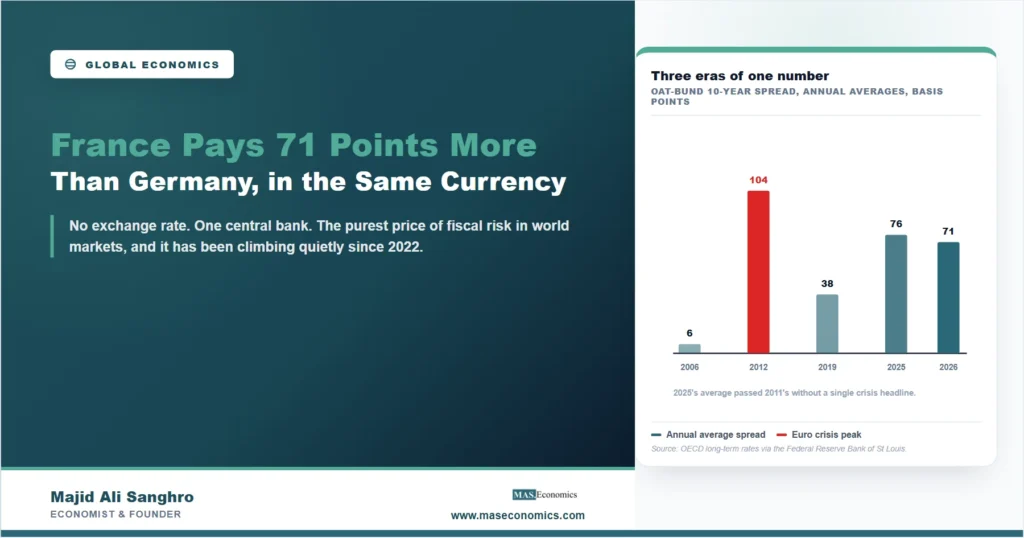
Three eras sit in those bars. In the mid-2000s the spread was 3 to 9 basis points: the market treated the euro area as effectively one credit, and lending to Paris was priced within a rounding error of lending to Berlin. The euro crisis destroyed that assumption, and 2012’s average of 104 basis points, alongside far larger spreads for the periphery, taught investors that euro membership does not make treasuries interchangeable, a lesson whose full story is told in our account of the European debt crisis. The central bank’s backstop then compressed the spread into a 35-to-50 range for nearly a decade.
The third era is the current one, and it has no crisis in it. From 2022 the spread stepped up and kept stepping: 56, 56, 65, 76, and 71 in the first half of 2026. France’s fiscal position, its deficits, its debt ratio, and the political difficulty of changing either, is being repriced one auction at a time. The mechanics of why a fixed-coupon bond’s yield moves this way are covered in our primer on how bonds work; what matters here is the direction and the persistence.
What Exactly Is Being Priced
Because both bonds live in the same currency, the usual suspects are eliminated before the analysis starts. A dollar-yen yield gap contains expected currency moves; a US-Germany gap contains two central banks’ policies. The OAT-Bund gap contains neither, which leaves two ingredients. The larger one is credit and fiscal risk: the probability, small but no longer treated as zero, that French debt is restructured or that holding it through a euro-area stress episode proves costly. The smaller one is a liquidity and scarcity premium: Bunds are the euro area’s safe asset and collateral of choice, perpetually in demand for reasons beyond Germany’s creditworthiness, which flatters the German side of the comparison. An honest reading assigns the level of the spread partly to each ingredient, but the change since 2022 is hard to attribute to liquidity, which did not shift on that timetable. The repricing is about France.
Seventy-one basis points is not a crisis number, and the article’s claim is not that one is coming. On France’s debt, which exceeds its annual output, an extra 0.71 percent a year amounts, as the stock rolls over onto new rates, to a permanent additional bill in the tens of billions of euros annually relative to borrowing on German terms, money that competes with every other line in the French budget. The spread also anchors private borrowing: French banks, firms, and ultimately mortgage borrowers price off the OAT curve, so the state’s risk premium quietly becomes the private sector’s floor. The general framework for whether such burdens compound or stabilize is the subject of our piece on sovereign debt sustainability.
The Cleanest Case of a Global Repricing
France’s creeping spread belongs to a family. The same years produced rising term premiums on American debt, where our analysis of the Fed’s cuts and the stubborn 10-year found the market demanding more compensation to hold long Treasuries even as policy eased, and an interest bill examined in where $1.2 trillion goes. But the American evidence is entangled with Fed policy, dollar dynamics, and global demand for Treasuries. The France-Germany pair holds all of that fixed by construction: one currency, one central bank, one investor base, and still the market moved. That is why 71 basis points in Paris is the cleanest single reading available of the decade’s larger fact, that lenders have started charging rich governments for their fiscal positions again, and why every finance ministry in the euro area, not only France’s, reads this spread as a preview of its own examination. The euro area’s structural inability to converge, which we measured in its labor markets, has a bond-market price, and this is it.
MASEconomics Explains
3 economic concepts behind the OAT-Bund spread
These concepts are explored in depth across our educational articles library.
Explore the MASEconomics BlogConclusion
The france germany bond spread of 71 basis points is a small number carrying a large history: 6 basis points when markets believed the euro made every member the same credit, 104 when the crisis taught them otherwise, 35 to 50 under the central bank’s decade of protection, and now a slow climb, 56 to 65 to 76, driven not by panic but by arithmetic done calmly on French deficits. The 2025 average surpassed 2011’s without a headline, which is precisely the point: this is what repricing looks like when it happens on a budget’s timetable instead of a crisis’s.
Because the pair shares a currency, a central bank, and an investor base, the spread is as close as markets come to a controlled experiment in what fiscal positions cost, and its verdict generalizes: the years of lenders ignoring rich-country balance sheets are over, in Paris measurably, and by extension everywhere governments borrow long. It remains a price to watch not because it signals disaster, but because it compounds, quietly, into budgets, bank funding, and mortgages, one auction at a time.
Frequently Asked Questions
What is the OAT-Bund spread?
It is the difference between the yields on French and German 10-year government bonds, the OAT being France’s benchmark bond and the Bund being Germany’s. Because both are issued in euros under one central bank, the spread measures the market’s assessment of relative credit and fiscal risk rather than currency or policy expectations.
Why does France pay more to borrow than Germany?
Mainly because investors assign France more fiscal risk: higher deficits, a larger debt ratio, and greater political difficulty in correcting them. A smaller part reflects the Bund’s special status as the euro area’s safe asset, which keeps German yields lower than Germany’s credit alone would explain.
Is a 71 basis point spread a crisis signal?
No. Crisis-era spreads were larger and moved violently; 2012 averaged 104 basis points, and peripheral spreads went far higher. What distinguishes the current level is its persistence and steady climb since 2022 without any crisis, which marks a durable repricing of French fiscal risk rather than an emergency.
Does the spread affect ordinary borrowers in France?
Yes, indirectly. French banks and firms fund themselves at rates anchored to the government’s curve, and mortgage pricing follows the same base. When the state’s borrowing premium rises, the floor under private borrowing costs rises with it, spreading the fiscal risk premium through the economy.
Why compare France with Germany rather than with the United States?
A France-US comparison would mix in exchange rate expectations and two different central banks’ policies. France and Germany share the euro and the ECB, so those factors cancel, leaving the cleanest available measure of what markets charge for fiscal positions alone. That is what makes this spread a reference number well beyond Europe.
Thanks for reading! Seventy-one basis points, twenty years of history, and not a single variable left to hide behind: that is what makes this small number worth watching. Happy learning with MASEconomics