Over the four quarters to mid-2026, euro area growth amounted to 0.94 percent. Germany managed 0.89 percent over the same year, France 0.73. These are not recession numbers; nothing is collapsing. They are something arguably harder to fix: the two largest economies of a 350-million-person currency union expanding by less than one percent a year, slowly enough that a single bad month can erase a quarter, while absorbing an energy shock and a trade war at the same time.
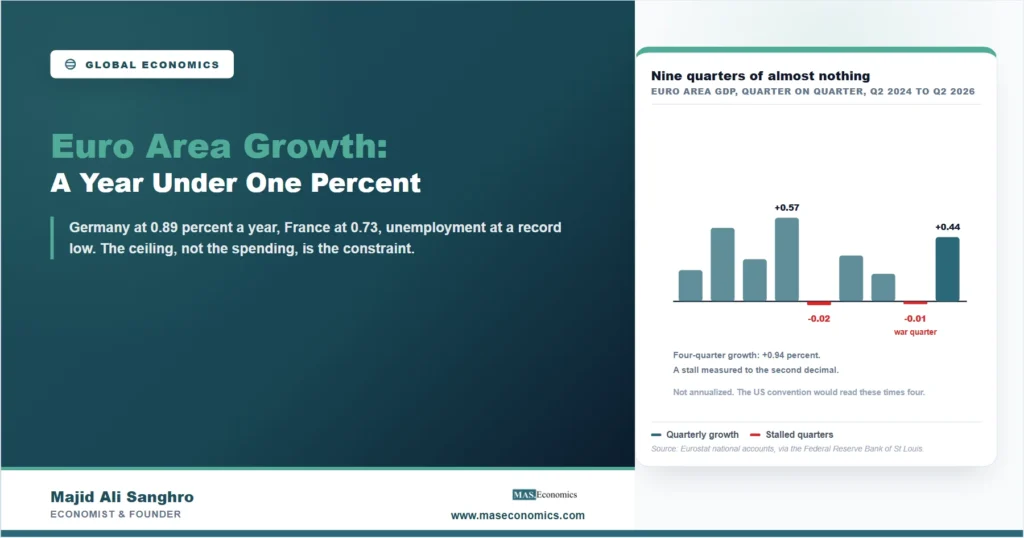
The quarterly path shows how thin the margin has become. The euro area’s first quarter of 2026, the one that caught the war’s outbreak on 28 February and the oil spike that followed, printed a growth rate of exactly minus 0.01 percent: a stall, to the second decimal. France shrank 0.15 percent that quarter. The second quarter rebounded to 0.44 percent, the area’s best in over a year, and that rebound, worth about 1.8 percent at an annualized pace, now counts as good news. The bar for celebration has been lowered to what other decades called ordinary.
Nine Quarters of Almost Nothing
One translation note keeps this chart honest for readers used to American headlines. The United States reports GDP at a seasonally adjusted annualized rate, so an American “+1.8 percent” and a European “+0.44 percent” describe the same pace. Comparing the raw numbers across the Atlantic without converting is one of the most common errors in economic commentary, and it always makes Europe look four times worse than it is. Europe’s problem is real, but it is the level of the pace, not a factor-of-four gap.
Where the Weakness Sits, and Where It Does Not
Germany and France carry the story because they carry the union: together they produce roughly half of euro area output. Germany’s year of 0.89 percent extends a stagnation that predates every recent shock, rooted in an industrial model built on imported energy and exported machinery, both of which became harder businesses this decade. Its odd distinction in the latest data is having grown 0.43 percent in the war quarter itself while France shrank, a reminder that quarterly figures bounce and single quarters should not carry grand narratives. France’s year of 0.73 percent came with the additional weight of the bond market’s scrutiny of its public finances. The union-wide framework these two anchor, and its longer list of structural problems, is mapped in our profile of the eurozone economy.
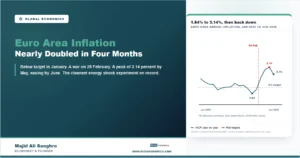
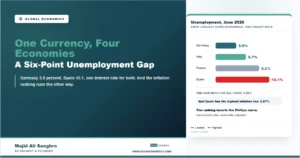
What makes the near-stagnation genuinely strange is what surrounds it. Euro area unemployment sits at 6.3 percent, its record low. Inflation, after the oil shock of early 2026 passed through, is already easing back toward target. This is not an economy starved of demand in any obvious way; it is an economy whose ceiling appears to be about one percent. Growth that slow with a labor market that tight points away from the spending side and toward capacity: a shrinking workforce, weak investment, and above all the productivity growth that has been Europe’s missing ingredient for two decades. An economy can be at full employment and barely growing at the same time, and the euro area in 2026 is the demonstration.
That diagnosis matters because it decides which tools apply. The European Central Bank, already at a moderate 2.25 percent deposit rate, has little room to conjure growth that capacity will not supply, and cutting into an energy-shock inflation would have risked its credibility for a demand problem the data does not clearly show. The levers that match a capacity problem, investment, energy costs, market integration, workforce, belong to governments and take years. Meanwhile the margin for error stays at zero: with trend growth near one percent, any shock, an oil spike, a tariff round, a hard winter, reads as a recession scare, which is why European headlines lurch between stagnation and relief on moves of a few tenths.
Why This Reaches Beyond Europe
For American readers, Europe’s pace is not a spectator statistic. The European Union is the largest customer for American exports of goods and services taken together, and the destination for a large share of US corporate earnings; a Europe compounding at one percent buys less of both, year after year. For the world economy, the euro area’s stagnation subtracts one of the three great engines: as our overview of GDP growth sets out, a large economy’s trend matters more than any single quarter anywhere else. And for every currency union proposal and regional integration debate elsewhere, Europe remains the working experiment: one interest rate over economies whose labor markets, as we measured in one currency, four economies, refuse to converge, and whose growth now hugs the floor together.
MASEconomics Explains
3 economic concepts behind Europe’s slow year
These concepts are explored in depth across our educational articles library.
Explore the MASEconomics BlogConclusion
Euro area growth of 0.94 percent in a year, with Germany at 0.89 and France at 0.73, describes an economy that has stopped falling and forgotten how to climb. The quarterly record makes the fragility concrete: a war-quarter stall of minus 0.01 percent, a rebound to 0.44 that counts as the best in over a year, and a running average that leaves no cushion for the next shock. Corrected for the annualization difference that trips up transatlantic comparisons, Europe is growing clearly below the American pace, at full employment, with inflation near target.
That combination is the finding. An economy this tight that grows this slowly is constrained by what it can produce, not by what it is willing to spend, which places the burden on productivity, investment, and workforce, the slow levers, rather than on the central bank’s fast ones. Until those move, one percent is the euro area’s speed limit, and every quarter will continue to be graded against a bar that would once have signified trouble.
Frequently Asked Questions
How fast is the euro area economy growing?
Real GDP grew 0.94 percent over the four quarters to mid-2026, with the latest quarter at 0.44 percent quarter on quarter, roughly 1.8 percent annualized. Germany grew 0.89 percent over the year and France 0.73, so the union’s two largest economies are both expanding at less than one percent a year.
Why do US and European growth numbers look so different?
They use different conventions. The United States reports growth at a seasonally adjusted annualized rate, compounding one quarter’s pace over a full year; Europe reports the plain quarterly change. An American 1.8 percent and a European 0.44 percent describe the same speed, so raw comparisons overstate the gap about fourfold.
Is the euro area in recession?
No. The common shorthand definition of recession is two consecutive quarters of shrinking output, and the euro area has avoided that: its worst recent readings were single stalled quarters of minus 0.02 and minus 0.01 percent, each followed by renewed growth. The condition is closer to prolonged near-stagnation than to contraction.
Why is European growth so slow if unemployment is at a record low?
That combination points to a supply constraint rather than weak demand. With the workforce fully employed and inflation near target, output can only grow as fast as productivity and the labor force allow, and both have been weak in Europe for years. The bottleneck is capacity, which interest rate cuts cannot expand.
Does slow European growth affect the United States?
Yes, through trade and earnings. The European Union is the largest combined customer for American exports, and many US multinationals earn a substantial share of their revenue there. A Europe compounding at one percent buys less each year than a Europe at two, a drag that accumulates quietly across export orders and corporate results.
Thanks for reading! A stall measured to the second decimal and a rebound that counts as a triumph: Europe’s growth story fits inside a rounding error, which is the story. Happy learning with MASEconomics