The global market for rare earth oxides was worth about $6 billion in 2024, and the permanent magnets made from them roughly $25 billion. Those are small numbers. A single mid-sized company can turn over more than the entire world trade in the raw material. Yet the IMF’s April 2026 analysis estimates that a severe, sustained disruption to rare earth supply would cut United States GDP by about 1.5 percent within a year, which on any large economy is a recession-sized loss produced by interrupting a commodity market smaller than many corporate balance sheets. That disproportion is the whole subject. The economics of rare earths is not the economics of a scarce resource, because rare earths are not especially scarce. It is the economics of a bottleneck: a tiny, concentrated market sitting underneath a very large one, where the leverage comes from position rather than from volume, and where, as the Fund’s own numbers show, the entire threat has an expiry date most of the debate ignores.
Four Elements, Ninety-Six Percent of the Value
Start with what the category actually contains, because the name misleads twice over. Rare earths are a group of 17 chemically similar metals, split into light and heavy elements by atomic weight, with the heavy ones substantially less abundant in the earth’s crust. They are not rare in the geological sense; what is scarce is the refining and separating capacity, which is concentrated. Nor does the whole group matter equally. The Fund notes that the economics of rare earths are increasingly driven by just four of the seventeen: neodymium and praseodymium among the light elements, terbium and dysprosium among the heavy ones. These “magnet-4” elements jointly account for 96 percent of the total rare earth oxide market value. The bottleneck is therefore narrower than the phrase suggests: not seventeen elements but four, and mostly for one application. Permanent magnets, in which as many as four rare earths are combined with iron and boron to make an alloy that keeps its magnetism at high temperatures, are the single most important use, and they were invented in 1983 at General Motors. In the United States, those magnets drive about 70 percent of the value added the Fund identifies as being at risk.
The trigger for the current concern is recent and specific. In April 2025, shortly after the United States imposed large tariffs on most of its trading partners, China, the world’s top producer, introduced export licensing requirements for seven rare earth elements and for rare earth permanent magnets, causing temporary but serious supply disruptions for manufacturers worldwide. The sequence matters for how the episode is read: this was a response inside a trade conflict rather than a resource shortage, which is why our piece on the tariff war of 2025 to 2026 is the setting for it, and why the Fund’s stated first-best remedy is not mining but diplomacy: avoiding trade tensions and restrictions remains the best way to keep supply steady. A chokepoint only functions as a weapon when relations are bad enough for someone to use it, which is why our guide to trade policy instruments treats export restrictions alongside tariffs and quotas.
The Same Shock, Two Answers, Depending on the Clock
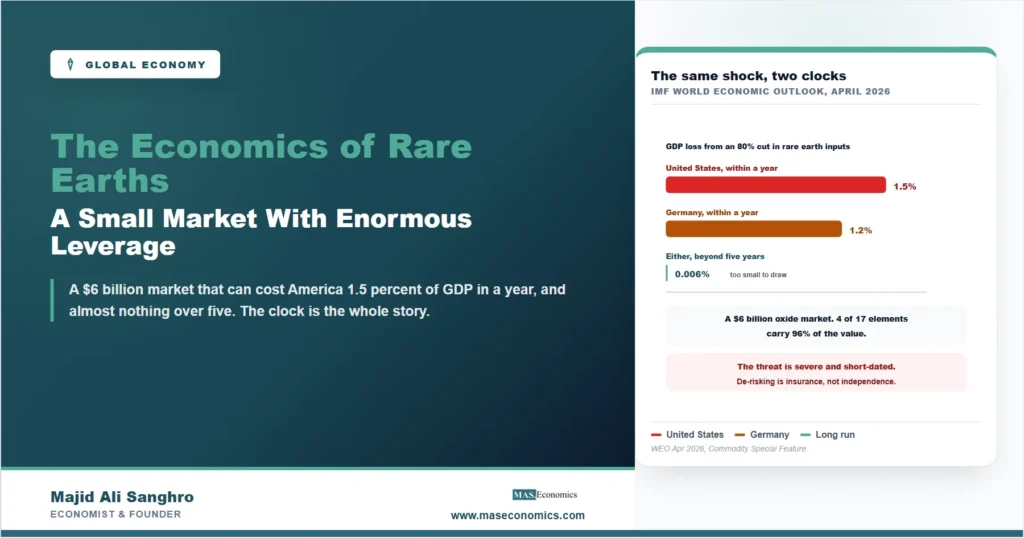
The Fund’s simulation applies a persistent 80 percent reduction in all rare earth inputs, covering oxides, metals, compounds and magnets, a size chosen to match the average single-supplier import concentration of the advanced economies. In other words, the scenario asks what happens if each country loses roughly what its main supplier provides. The answer depends almost entirely on one parameter, and it is not a geological one. Where firms have little scope to replace rare earths, which the Fund treats as the base case for horizons shorter than a year, United States GDP falls about 1.5 percent, and the loss is amplified through input-output linkages to nearly twice the direct value-added measure. Germany loses about 1.2 percent. The uneven country incidence is the same pattern our article on trade and inequality traces at the level of workers rather than of nations. The ordering is counterintuitive and the explanation is precise: American rare-earth-intensive sectors, motor vehicles, electrical equipment, computers and electronics, have stronger forward linkages, so the disruption propagates further downstream even though Germany’s direct exposure is larger.
Now change the horizon. When the substitution elasticity is raised to reflect what producers can do over periods longer than about five years, the estimated GDP losses become negligible, averaging 0.006 percent. That is not a smaller version of the same problem; it is a different problem. The same 80 percent supply cut is on the order of two hundred and fifty times more expensive inside the first year than it is beyond the fifth, and the reason is that engineers redesign, alternative chemistries mature, recycling scales and new refining capacity is commissioned. The strategic implication is uncomfortable for both the alarmed and the relaxed reading of this issue. Rare earth leverage is real, large and genuinely dangerous, and it is also a short-dated instrument. A supplier holding this position holds it for a window measured in months and a few years, not permanently, and every month of that window that passes without being used makes it worth less. The correct comparison is not with oil, where substitution is slow across decades, but with any input where the constraint is a production line rather than a deposit. Our guide to supply chain economics works through the general reshoring calculus, and comparative advantage explains why the concentration arose in the first place rather than being imposed.
De-risking Is Insurance, Not Independence
What follows from a short-dated threat is a policy conclusion the Fund states plainly and that deserves more attention than it gets. Because reshoring is costly, policymakers should weigh the efficiency losses from producing at home in normal times against the expected losses from disruption in a crisis, and optimal de-risking is better viewed as an insurance policy than as a route to independence. That framing changes what success looks like. An insurance policy is not judged by whether it eliminates the risk; it is judged by whether the premium is proportionate to the exposure. Applied here, the exposure is a one-off loss of up to 1.5 percent of GDP concentrated in a window of months, and the premium is the permanently higher cost of making at home what could be bought more cheaply abroad. Governments are already paying premiums: joint financing and coordinated procurement have mobilized an estimated $6.4 billion in public and private funding to de-risk rare earth supply chains, including the July 2025 MP Materials deal with its equity and loan components and a January 2026 agreement between the US Department of Commerce and USA Rare Earth, and the Fund notes these measures have improved the financial prospects of listed firms in the industry.
The adaptation menu has more than one item and each buys something different. Stockpiling provides a short-term buffer and may deter coercion in the first place, which is a real benefit, but the Fund is clear it does not address the underlying structural dependence and can be constrained in practice. Recycling offers longer-term promise. Reshoring refining capacity addresses the actual bottleneck rather than the raw material. Read against the time-horizon finding, these fit together in a way the headlines rarely arrange: stockpiles and diplomacy cover the months when losses are largest, while recycling and new capacity cover the years by which substitution would have blunted the threat anyway. Spending heavily to achieve full domestic self-sufficiency in a decade is buying protection that mostly arrives after the danger has passed. This is the same reasoning our article on the revival of industrial policy applies to picking winners generally, and the demand side of it, the electrification that made these four elements matter at all, is the subject of our piece on the economics of electric vehicles. The honest position is that rare earths deserve serious policy and not panic, and that the design of that policy should follow the clock.
MASEconomics Explains
3 economic concepts behind the leverage
These concepts are explored in depth across our educational articles library.
Explore the MASEconomics BlogConclusion
The economics of rare earths is the economics of a bottleneck rather than of a scarce resource. Seventeen elements carry the name, four of them carry 96 percent of the oxide market’s value, and one application, permanent magnets, carries most of the consequence, driving about 70 percent of the value at risk in the United States. The market itself is small, roughly $6 billion in oxides and $25 billion in magnets in 2024, and the leverage comes from position in the production chain rather than from size. That is why an export licensing decision taken in April 2025, inside a trade conflict rather than because of any shortage in the ground, was able to disrupt manufacturers across the world.
The number that should reorganize the debate is the pair, not the single figure. A persistent 80 percent cut in rare earth inputs costs the United States about 1.5 percent of GDP within a year and Germany about 1.2 percent, amplified through the linkages of vehicles, electrical equipment and electronics. The same cut, given five years for producers to adjust, costs about 0.006 percent. The threat is severe and short-dated, which makes the policy question one of timing rather than of sovereignty. The Fund’s own conclusion is that de-risking is best understood as an insurance policy, weighed against the permanent efficiency cost of producing at home what could be bought cheaply abroad, and that avoiding trade tensions is the first-best way to keep supply steady in the first place. Stockpiles and diplomacy cover the dangerous months. Recycling and new refining capacity cover years in which the danger was fading anyway. Spending to reach full self-sufficiency by the time substitution would have solved the problem is buying an expensive umbrella for a storm that has moved on.
Frequently Asked Questions
Are rare earth elements actually rare?
Not in the geological sense. They are 17 chemically similar metals, and while the heavy ones are substantially less abundant in the earth’s crust than the light ones, the binding constraint is refining and separation capacity rather than deposits. The concentration that creates the risk is industrial, which is also why it can be changed with investment and time.
How can a $6 billion market matter so much?
Because the value at stake sits downstream. Rare earth oxides were worth about $6 billion in 2024 and permanent magnets about $25 billion, but those magnets go into motor vehicles, electrical equipment, computers and electronics, defense systems and clean energy hardware. In the United States, permanent magnets drive about 70 percent of the value added the IMF identifies as at risk.
How large would the damage from a supply disruption be?
The IMF models a persistent 80 percent reduction in all rare earth inputs, sized to match the average single-supplier import concentration of advanced economies. Within a year, when firms cannot substitute, US GDP falls about 1.5 percent and German GDP about 1.2 percent. Over horizons beyond five years, when producers can adjust, estimated losses average about 0.006 percent.
Why is the American loss larger than the German one?
Because of forward linkages rather than direct exposure. Germany’s direct value-added-at-risk score is higher at 2.5 percent, but US rare-earth-intensive sectors, particularly motor vehicles, electrical equipment and computers and electronics, feed more of the rest of the economy, so the disruption propagates further downstream and the total GDP effect ends up larger.
Should countries build their own rare earth supply chains?
The IMF frames it as insurance rather than independence: weigh the efficiency losses of producing at home in normal times against the expected losses from disruption in a crisis. Roughly $6.4 billion in public and private funding has already been mobilized for de-risking. Stockpiling buffers the short run and may deter coercion, recycling and new capacity help over years, and avoiding trade restrictions is described as the first-best outcome.
Thanks for reading! Leverage over a supply chain is a short-dated instrument, and every month it goes unused is a month of its value expiring. Happy learning with MASEconomics