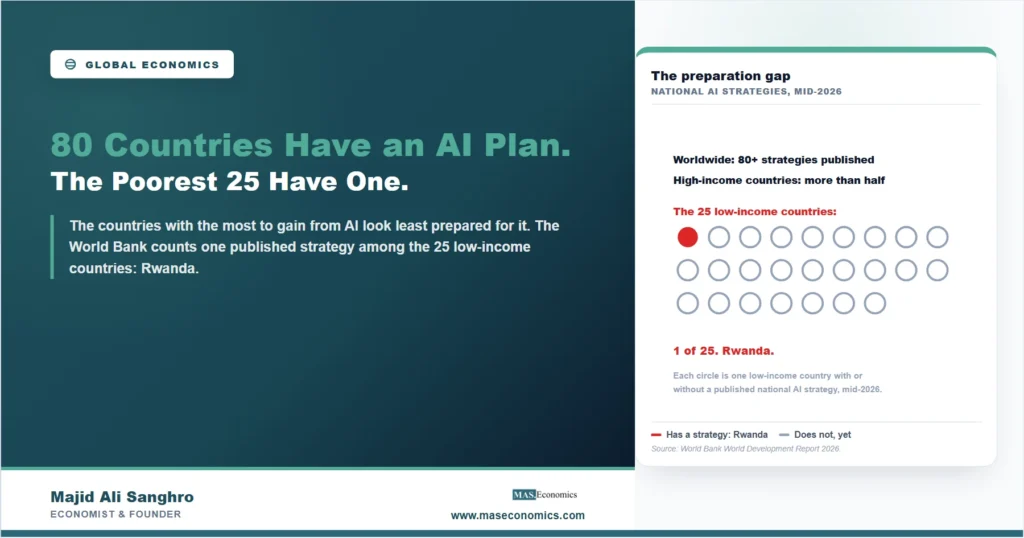
As of mid-2026, more than 80 countries have published a national AI strategy, a government plan for how artificial intelligence will be regulated, adopted and turned to national advantage. The World Bank’s World Development Report 2026 adds the sentence that turns this from a statistic into a problem: of the world’s 25 low-income countries, exactly one has done so, Rwanda. Among high-income countries, more than half have. The report’s own summary is hard to improve on: the countries with the most to gain appear today to be the least prepared.
The gap deserves attention precisely because AI is the rare technology whose benefits do not require building anything. No poor country needed to invent the mobile phone to be transformed by it, and none needs to train a frontier model to use one. What a strategy represents is not laboratories or chips but decisions: what the schools teach, what the state digitizes, what data rules apply, and which public services get rebuilt around tools that already exist and mostly cost little. Twenty-four of the twenty-five poorest countries have not yet made those decisions on paper.
The Preparation Gap in One Picture
A fair objection arrives immediately: a strategy is a document, and documents do not run schools or power grids. The report’s answer is that the document is a leading indicator of everything that does. Rwanda’s strategy is already visible as AI-awareness modules in secondary schools, folded into a broader digital transformation program. A published plan assigns ministries, budgets and timelines; its absence usually means the questions have not been asked. The pattern echoes every previous technology wave, in which the gap that mattered was never invention but adoption, the same human-capital machinery we set out in our explainer on skills, education and health.
Why the Stakes Are Higher for the Poorest
The reason preparation matters more at the bottom of the income distribution is that AI’s plausible gains there are larger, not smaller. Low-income economies run on scarce expertise: too few doctors, agronomists, teachers and engineers per person. AI’s economic character is precisely the mass reproduction of expertise, which is why the report argues that developing countries should ignore the rich-world debate, dominated by job-loss fears on one side and the race to build frontier models on the other, and treat AI as what it is for them: the cheapest productivity tool ever offered, the mechanism our piece on output per hour and living standards shows compounding into everything else.
The report’s prescription is deliberately unglamorous: adopt, adapt, and only then advance. Do not build models; deploy them into agriculture extension, public health triage, teacher support and government paperwork, and concentrate public spending on the constraints that gate adoption, electricity, connectivity, data systems and skills. The same logic ran through the labor-market evidence we examined in AI job displacement is no longer a forecast, but with the sign reversed: in economies where the binding constraint is absent expertise rather than expensive labor, the technology substitutes for what does not exist, which is the definition of a windfall.
| Group | National AI strategies | What AI mainly threatens or offers |
|---|---|---|
| High-income countries | More than half | Automation of white-collar work; the frontier race |
| All countries | More than 80 | Mixed, dominated by the large middle-income adopters |
| The 25 low-income countries | One: Rwanda | Mass reproduction of scarce expertise, if adoption is prepared |

|
||
The Familiar Shape of a New Divide
What makes the 1-of-25 statistic uncomfortable is its familiarity. Every general-purpose technology has produced the same geometry: the economies best placed to absorb it move first, compound their advantage, and the distance grows before it shrinks. The countries in Figure 1’s empty circles are, in most cases, the same fragile and low-income economies whose incomes have stopped converging at all, the stall we documented in nearly a decade of lost convergence. A technology that raises productivity wherever it is adopted, adopted everywhere except where productivity is lowest, widens exactly the gap that already stopped closing.
None of this is destiny, and the report is explicit that the window is open rather than closed. The inputs a strategy coordinates are buildable: connectivity is spreading, the models themselves are largely free at the margin, and Rwanda demonstrates that a strategy does not require wealth, only decision. The report’s warning is about time. Preparation, in its phrase, has begun in a substantial number of developing countries, but not in the countries that need it most, and each year of that sentence staying true converts a potential windfall into another layer of divergence. For the ordinary citizen of a low-income country the stake is concrete: whether the clinic, the school and the land office they use this decade work better, or whether those improvements arrive everywhere else first.
MASEconomics Explains
3 economic concepts behind the AI preparation gap
These concepts are explored in depth across our educational articles library.
Conclusion
One national AI strategy among 25 low-income countries, against more than 80 worldwide and more than half of the rich world, is the cleanest single measure yet published of who is preparing for the decade’s defining technology and who is not. The World Bank’s framing removes the usual excuse: for poor countries the relevant AI is not the frontier model but the free or cheap tool that multiplies scarce expertise, and the binding constraints are electricity, connectivity, data and skills, all of which respond to exactly the coordination a strategy provides.
The risk the number encodes is not that AI harms the countries in the empty circles, but that it bypasses them while compounding everyone else, arriving as a second divide on top of incomes that have already stopped converging. Rwanda’s existence in the filled circle is the counter-argument to fatalism: the entry ticket is a decision, not a budget. The report’s sentence stands as the decade’s quiet warning, that the countries with the most to gain are currently the least prepared, and every year it remains true it becomes more expensive.
Frequently Asked Questions
What counts as a national AI strategy?
A published government plan setting out how the country will adopt, regulate and benefit from artificial intelligence, typically covering skills, data policy, public-sector use and infrastructure. The World Development Report 2026 counts more than 80 such documents as of mid-2026.
Why does a document matter?
Because it is a leading indicator of coordination: strategies assign ministries, budgets and timelines for the constraints that actually gate adoption, such as electricity, connectivity and skills. Rwanda’s strategy, for example, is already visible as AI-awareness modules in secondary schools within a wider digital program.
Should poor countries be building AI models?
The report’s answer is no, not first. Its sequencing is adopt, adapt, advance: deploy existing tools into health, agriculture, education and administration, adapt them to local languages and problems, and treat frontier development as a later stage. The gains for low-income economies come from using AI to multiply scarce expertise.
Is the worry about job losses the same as in rich countries?
No. In advanced economies the debate centers on automating existing white-collar work. In low-income economies the scarce input is expertise itself, too few doctors, teachers and engineers per person, so the same technology functions as a substitute for what is missing rather than for what is employed.
Which low-income country has a strategy?
Rwanda, alone among the World Bank’s 25 low-income countries as of mid-2026. Its example matters because it shows the entry requirement is governmental decision rather than wealth, which is also what makes the other 24 empty circles a choice rather than a fate.
Thanks for reading! The cheapest development tool ever offered is waiting on twenty-four unwritten documents. Happy learning with MASEconomics