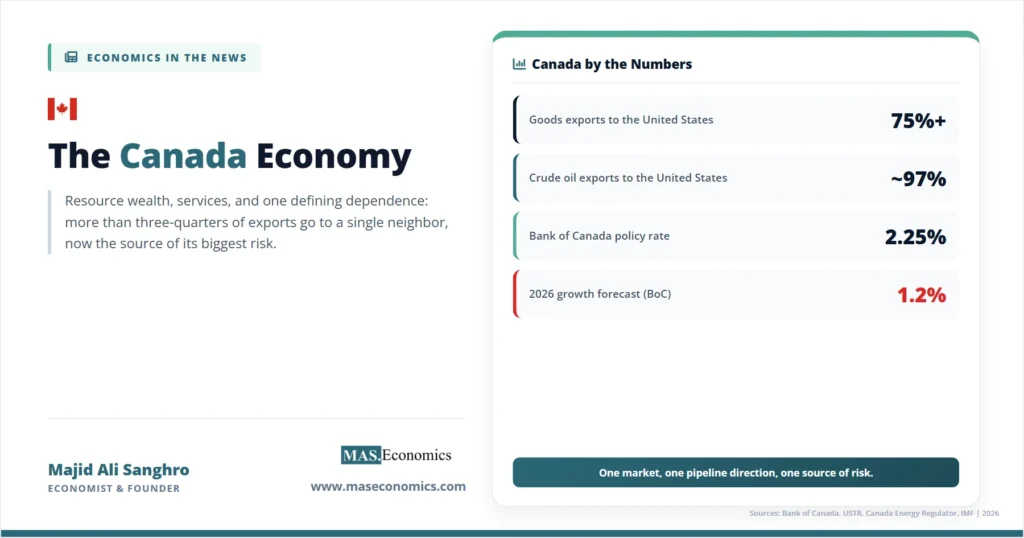
More than three-quarters of everything Canada sells abroad goes to a single buyer, and roughly 97 percent of the crude oil it exports flows to that same destination: the United States. No other advanced economy is so dependent on one trading partner. That dependence is the organizing fact of the Canada economy, and in 2026 it has moved from a quiet structural feature to the country’s central economic problem. After Washington imposed tariffs on Canadian goods in 2025, the Canadian economy contracted in the final quarter of that year, growth slowed to a crawl, and the Bank of Canada was left managing an economy squeezed between a hostile trade environment and a global energy shock it did not create.
Canada is a wealthy, resource-rich, services-based economy of about 41 million people, the tenth or eleventh largest in the world by nominal output. It runs on three engines: natural resources, especially oil; deep trade and supply-chain integration with the United States; and a large domestic services sector. Each of those strengths is also a vulnerability. The resource wealth ties the economy to volatile commodity prices, the US integration leaves it exposed to American policy, and the services economy rests on a housing market and a productivity record that have both become liabilities. Understanding Canada means understanding how those strengths and weaknesses are the same features seen from different angles.
Resource‑Based Economy and Proximity
Canada’s prosperity has always drawn heavily on what lies under its land. It is one of the world’s largest producers of crude oil, with the bulk of output coming from the Alberta oil sands, and a major exporter of natural gas, potash, uranium, lumber, and agricultural commodities. The resource sector is not the largest part of the economy by employment, since services account for around 70 percent of output, but it dominates the export base and shapes the country’s external position and its currency, which tends to strengthen when commodity prices rise and weaken when they fall.
Geography did the rest. Canada sits beside the largest consumer market on earth, and over more than half a century the two economies have woven their supply chains together, especially in autos and energy. That integration was formalized through a sequence of trade agreements, from the 1965 auto pact through the Canada–United States Free Trade Agreement, NAFTA, and now the United States-Mexico-Canada Agreement. The result is an economy whose manufacturers, farmers, and energy producers are organized around selling into the United States rather than around domestic demand or diversified global markets. That orientation delivered decades of prosperity, and it is precisely what makes the trade conflict of 2025 and 2026 so damaging.
US Dependence by the Numbers
The scale of the reliance is hard to overstate. In 2024, Canada was the top destination for US goods exports and the third-largest source of US goods imports, with total goods trade between the two countries running near 720 billion dollars. Canada sends over three-quarters of its goods exports south and buys almost half of its goods imports from the United States. In energy, the concentration is near total: Canada is the largest single supplier of US energy imports, and the overwhelming majority of its crude oil has nowhere else to go, because the pipeline network was built to run north to south rather than to Canadian coasts for overseas shipment.
This is the textbook case of gains from trade turning into strategic exposure. The same specialization that the theory of comparative advantage predicts will raise both countries’ incomes also concentrates Canada’s risk in one relationship. When that relationship is cooperative, Canada captures the efficiency gains. When it turns adversarial, as it did in 2025, Canada has little leverage and few alternative buyers, a contrast with the more diversified and post-Brexit-reoriented trade position of the UK economy. The structural strengths and vulnerabilities on the other side of that border are set out in our profile of the US economy.
| Indicator | Value | Source and period |
|---|---|---|
| Nominal GDP | ~US$2.4 trillion | IMF, 2026 estimate |
| Real GDP growth | 1.7% (2025) | Statistics Canada, full year |
| BoC growth forecast | 1.2% (2026) | Bank of Canada, April 2026 MPR |
| Policy interest rate | 2.25% | Bank of Canada, April 2026 |
| Unemployment rate | 6.5%–7.0% | Bank of Canada, April 2026 |
| Goods exports to the US | Over 75% | USTR, 2024–2025 |
| Crude oil exports to the US | ~97% | Canada Energy Regulator |
|
Sources: IMF; Statistics Canada; Bank of Canada, Monetary Policy Report (April 2026); Office of the United States Trade Representative; Canada Energy Regulator.

|
||
Impact of the 2025 Tariffs
In early 2025, the United States imposed tariffs on most Canadian imports, citing an emergency at the border, with a lower rate on energy and potash and later increases that pushed the headline rate higher. Goods that qualified under the USMCA rules of origin remained exempt, which set off a scramble among Canadian exporters to document compliance. Energy adjusted fastest, with nearly all Canadian oil eventually entering duty-free, but many non-energy sectors, from manufacturing to agriculture and furniture, struggled to meet the content requirements and faced a real tariff wall.
The macroeconomic effect was immediate. The Canadian economy contracted in the fourth quarter of 2025, and for the full year growth slowed to its weakest pace since the pandemic downturn. The labor market softened, with job losses concentrated in the sectors the tariffs targeted and the unemployment rate settling in a 6.5 to 7 percent range that reflected both weak hiring and discouraged workers leaving the search. Business investment and exports bore the brunt, while consumer and government spending kept the economy from falling further. The wider story of how this trade conflict reshaped the global economy is the subject of our account of the global tariff war of 2025–2026.
Bank of Canada’s Narrow Path
The Bank of Canada entered 2026 holding its policy rate at 2.25 percent, having eased through the prior period as inflation moderated. The 2026 problem is that the two forces acting on the economy push monetary policy in opposite directions. The tariff shock and weak business investment argue for keeping rates low or cutting further to support demand. The energy price surge from the Middle East conflict, transmitted through fuel and transport costs, argues for caution because it pushes inflation up. The Bank has described the result as two-sided risk and has signaled that policy will stay data-dependent rather than committing to a path.
This is a milder version of the bind facing the US Federal Reserve, and the tools are the same set of monetary policy tools that any modern central bank deploys. Canada’s particular difficulty is that the largest force acting on its economy, US trade policy, lies entirely outside the Bank of Canada’s control. Interest rate changes cannot offset a tariff, and a weaker Canadian dollar, which normally cushions exporters, provides limited relief when the problem is market access rather than price competitiveness. The fundamentals of how rate-setting institutions operate are covered in our overview of central banking and monetary policy.
Loonie as Commodity Currency
The Canadian dollar, widely called the loonie, behaves like a commodity currency. It tends to appreciate when oil and other resource prices rise and to depreciate when they fall, because resource exports drive a large share of the foreign currency flowing into the country. Through 2026, the US dollar strengthened against most major currencies as the Federal Reserve held rates high to fight inflation, and the Canadian dollar weakened against it. A softer loonie raises the cost of imported goods for Canadian households while improving the competitiveness of exports priced in Canadian dollars, though that benefit is blunted when tariffs restrict access to the main export market regardless of price.
The currency’s commodity sensitivity also illustrates a broader point about how exchange rates respond to fundamentals over time, the subject of the theory of purchasing power parity. For Canada, the practical consequence is that the external value of the currency is tied to forces- oil prices and US monetary policy- that the country does not set, reinforcing the theme that runs through its entire economic structure.
Housing and Productivity Weaknesses
Beneath the trade story sit two long-running domestic problems. The first is housing. Canadian home prices rose for years to levels that strained affordability, and the sector has since become a drag, with residential investment declining and activity held back by affordability limits, slower population growth, and economic uncertainty. A housing market that once added to growth now subtracts from it, and the household debt accumulated during the boom leaves consumers more sensitive to interest rates than in many peer economies.
The second is productivity. Canada has struggled for years with weak growth in output per worker, lagging the United States by a widening margin. Low business investment outside the resource sector, a smaller technology base, and a reliance on population growth rather than efficiency gains to expand the economy have all contributed. Productivity is the ultimate source of rising living standards, and Canada’s persistent shortfall means that even when the economy grows, growth per person, the measure that actually reflects prosperity, has been disappointing. Attracting the foreign direct investment that raises the capital stock is part of the long-run answer, but tariff uncertainty has made Canada a less predictable place to invest.
Outlook for 2026
The near-term outlook is for slow growth. The Bank of Canada’s April projection put 2026 growth around 1.2 percent, with a gradual recovery only as exports and business investment resume along a lower path in later years. The energy shock from the Middle East conflict adds inflationary pressure and, as an oil exporter, gives Canada a partial offset that oil-importing economies lack, since higher crude prices support export revenues even as they raise domestic costs. That dual exposure, covered in our analysis of the 2026 Iran oil shock, makes Canada’s response to the energy story different from that of most advanced economies.
The defining uncertainty remains the trade relationship and the coming review of the USMCA, which will determine how much of Canada’s export base can continue to reach the US market on favorable terms. The deeper question the year has exposed is whether an economy this concentrated on one partner can afford to remain so, and whether Canada can build the diversified trade links, domestic productivity, and infrastructure to ship resources to other markets that would reduce its exposure. Those are the structural debates that a single year of conflict has pushed to the center of Canadian economic policy, and they connect to the broader forces reshaping cross-border commerce that we examine in what globalization means.
Conclusion
The Canada economy is a prosperous, resource‑rich, services‑based economy whose greatest strength and greatest weakness are the same: its deep integration with the United States. That integration delivered decades of gains from trade and a high standard of living, and in 2025 and 2026 it became the channel through which American tariff policy pushed Canada into contraction and slow growth. The Bank of Canada holds its rate at 2.25 percent while managing two‑sided risk it cannot fully control; the loonie tracks oil prices and US monetary policy, and the domestic economy carries the additional burdens of a weak housing market and a long‑standing productivity shortfall.
What 2026 has clarified is that Canada’s central economic challenge is no longer cyclical but structural. The reliance on a single market, the dependence on resource exports that must travel south, and the persistent gap in productivity all point to the same conclusion: the features that made Canada wealthy also make it vulnerable, and reducing that vulnerability would require diversifying trade, raising business investment, and building the capacity to reach markets beyond the United States. None of that is quick, which is why the trade relationship and the USMCA review will shape the Canadian economy not only through 2026 but for years beyond it.
Thanks for reading! If you found this helpful, share it with friends and spread the knowledge. Happy learning with MASEconomics