Open three microeconomics textbooks to the chapter on exchange, and you will find the terms used in three subtly different ways. One calls the set of all efficient allocations the Pareto set. Another calls the same locus the contract curve. A third draws a distinction between them and warns that conflating the two is a common error. The confusion behind Pareto set vs contract curve is not pedantic. It turns on the difference between every allocation that is efficient and the smaller group of efficient allocations that two traders would actually be willing to reach from a given starting point. Getting the relationship right is the difference between understanding what efficiency guarantees and overstating it.
Both concepts live inside the Edgeworth box, the standard diagram for a pure exchange economy with two people and two goods. Inside that box, the Pareto set is the full collection of Pareto efficient allocations, and the contract curve is the part of that collection that is reachable through voluntary trade from a specific endowment. In the most common textbook setup, the two coincide, which is why the names are often used interchangeably. They come apart the moment the geometry stops being well behaved, and that is exactly where the distinction earns its keep.
Efficiency in the Edgeworth Box
Consider two people, call them A and B, and two goods, x and y, in fixed total supply. The Edgeworth box represents every possible way of dividing those fixed totals between the two people. Width measures the total quantity of good x, height measures the total quantity of good y, A’s bundle is read from the bottom-left origin, and B’s bundle is read from the top-right origin. Every point in the box is a complete allocation: whatever A does not hold, B holds. Each person has preferences represented by indifference curves, A’s bowing out from the bottom-left and B’s bowing out from the top-right.
An allocation is Pareto efficient when no reallocation can make one person better off without making the other worse off. Geometrically, that happens where an indifference curve of A is tangent to an indifference curve of B. At a tangency, the two curves touch but do not cross, so there is no small swap of goods that lifts both parties onto higher curves. Where the curves cross rather than touch, a mutually improving trade still exists, and the allocation is inefficient. The condition for efficiency is therefore equality of the two traders’ marginal rates of substitution, since the MRS is the slope of an indifference curve.
Efficiency Condition
Pareto Set: Complete Efficient Locus
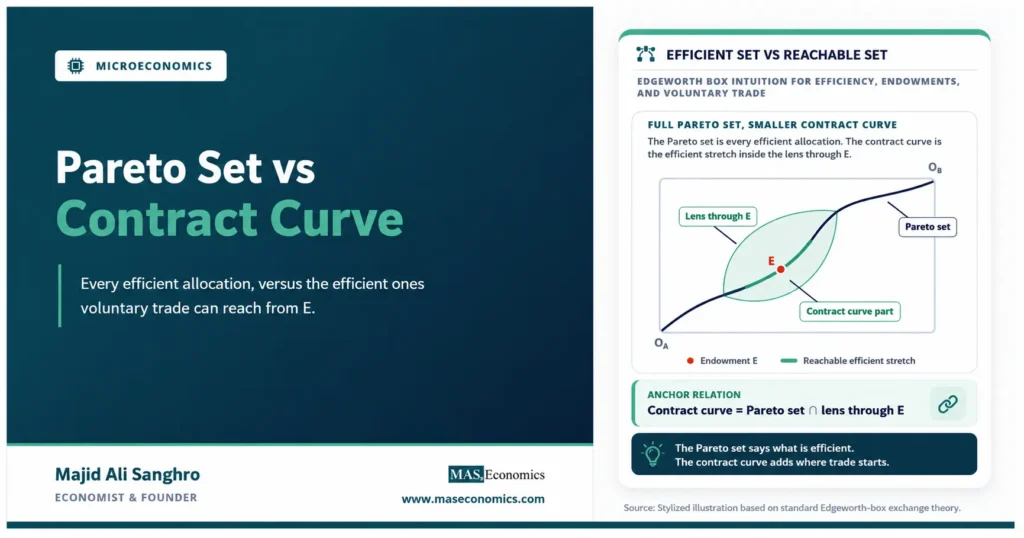
The Pareto set is the collection of all Pareto efficient allocations in the box. Trace out every point where an A indifference curve is tangent to a B indifference curve, and the result is a locus that typically runs from A’s origin in the bottom-left corner to B’s origin in the top-right corner. That locus is the Pareto set. It is defined entirely by preferences and the total quantities of the two goods. It says nothing about who started with what, because the tangency condition does not mention endowments at all.
This is the first key point. The Pareto set is a property of the economy’s preferences and resources, not of any particular starting allocation. If you handed the two traders the entire box and asked which divisions are efficient, the Pareto set is the complete answer. It includes allocations that give almost everything to A, allocations that give almost everything to B, and everything in between. Efficiency is silent on distribution: a wildly unequal split can be just as Pareto efficient as an even one, a point that connects directly to the broader treatment in welfare economics and Pareto efficiency.
Contract Curve: Reachable Efficiency
The contract curve introduces the missing ingredient, the endowment. Suppose the two traders begin at a specific initial allocation, their endowment point E, which need not be efficient. Voluntary trade will only happen if both parties agree, and a rational trader never accepts a deal that leaves them worse off than they were at E. Each trader’s indifference curve through the endowment marks their participation constraint: A will not move below A’s curve through E, and B will not move below B’s curve through E.
Those two indifference curves through the endowment enclose a lens-shaped region, the set of allocations that make both traders at least as well off as they were to begin with. The contract curve is the portion of the Pareto set that lies inside this lens. It is the set of efficient allocations that voluntary trade can actually deliver starting from E. Allocations on the Pareto set but outside the lens are still efficient; they are simply unreachable by mutual agreement from this endowment, because reaching them would require one trader to accept a loss.
Reachable Set
This is the second key point. The contract curve depends on the endowment; the Pareto set does not. Move the endowment, and the lens shifts, so the reachable stretch of efficient allocations shifts with it. The Pareto set underneath stays exactly where it was. The contract curve is therefore best read as the Pareto set seen through the window of a particular starting point, and the allocations within it are precisely the ones a competitive market or bilateral bargaining could settle on. Which of those allocations is finally selected, and how blocking coalitions narrow the field, is the subject of the core of an exchange economy.
Coincidence and Divergence Cases
In the textbook case, the contract curve and the Pareto set are drawn as the same curve, and writers use the names interchangeably without much harm. That happens because of two convenient assumptions. The first is that preferences are convex and smooth, so the efficient locus is a single well-behaved curve of tangencies running corner to corner. The second is that the endowment lies in a position from which the entire interior locus is reachable, or the author quietly treats the whole tangency locus as the object of interest and sets the endowment question aside.
The two concepts diverge as soon as either assumption is dropped. If the endowment is extreme, sitting near one corner, the lens of mutually beneficial trades covers only part of the efficient locus, so the contract curve is a strict subset of the Pareto set rather than the whole of it. If preferences are non-convex, perfect substitutes, or perfect complements, the efficient set may include boundary segments, kinked pieces, or even thick regions rather than a single smooth interior curve, and the tangency rule no longer captures all of it. In these cases the careful distinction matters: the Pareto set is the complete efficient set defined by preferences and resources, and the contract curve is whatever part of it voluntary trade from the given endowment can reach.
| Feature | Pareto set | Contract curve |
|---|---|---|
| Definition | All Pareto efficient allocations in the box | Efficient allocations reachable by voluntary trade from the endowment |
| Depends on the endowment? | No | Yes |
| Determined by | Preferences and total resources | Preferences, total resources, and the starting point E |
| Geometric description | Full locus of indifference-curve tangencies | The part of that locus inside the lens through E |
| Relationship | The larger set | A subset of the Pareto set |
| Bottom line | What is efficient | What is efficient and individually acceptable |
|
Source: MASEconomics editorial synthesis.

|
||
Importance for Welfare Analysis
The practical payoff is in what each concept licenses you to claim. The Pareto set tells you the menu of efficient outcomes the economy could in principle support. The First Welfare Theorem says a competitive equilibrium lands somewhere on it, and the Second Welfare Theorem says that any point on it can be supported as a competitive equilibrium given the right initial distribution. Those are powerful statements about the whole efficient locus, and they are statements about the Pareto set.
The contract curve tells you something narrower but more immediately useful: given where people actually start, which efficient outcomes are within reach without coercion. That is the relevant object when the question is what bargaining or trade will deliver from the status quo, rather than what a planner could engineer by first redistributing endowments. It also clarifies a frequent confusion in policy debate. Efficiency does not pin down distribution, and an outcome can be efficient yet deeply unequal, which is why distributional judgments require a separate criterion such as the Kaldor-Hicks criterion. The whole exchange picture extends naturally to economies with prices and many agents in the treatment of general equilibrium.
Explains
Three ideas that anchor the welfare geometry
Explore related explainers on exchange, efficiency, and welfare.
Explore the MASEconomics BlogConclusion
The distinction at the heart of Pareto set vs contract curve is the distinction between every efficient allocation and the efficient allocations that voluntary trade can actually reach. The Pareto set is fixed by preferences and total resources and is silent about who starts with what. The contract curve adds the endowment, keeping only the efficient allocations that leave both traders at least as well off as they began. In the smooth, convenient textbook case, the two coincide, and the names get used interchangeably; with extreme endowments or non-convex preferences, they separate, and the looser usage starts to mislead.
Reading the contract curve as the Pareto set seen through the lens of a particular starting point keeps both ideas straight. It also keeps the welfare claims honest. Efficiency describes a menu, not a verdict on fairness, and the reachable part of that menu depends on where the economy begins. Holding the two apart is what lets the Edgeworth box say precisely what it can about exchange, and no more.
Frequently Asked Questions
Is the Pareto set the same as the contract curve?
Not always. The Pareto set is every Pareto efficient allocation in the Edgeworth box, defined by preferences and total resources. The contract curve is the part of that set reachable by voluntary trade from a specific endowment. In the standard smooth, convex textbook case they coincide, so the terms are often used interchangeably, but they diverge when the endowment is extreme or preferences are non-convex.
Why does the contract curve depend on the endowment but the Pareto set does not?
The Pareto set is defined purely by where the two traders’ indifference curves are tangent, which depends only on preferences and the total quantities of goods. The contract curve adds the requirement that neither trader ends up worse off than at the starting point. Since that participation constraint is measured against the endowment, moving the endowment changes which efficient allocations qualify.
Can an allocation be on the Pareto set but not on the contract curve?
Yes. An allocation can be fully efficient yet leave one trader worse off than their endowment. Such an allocation sits on the Pareto set but outside the lens of mutually beneficial trades, so it is not on the contract curve. Voluntary trade from that endowment cannot reach it, because one party would have to accept a loss to get there.
What does the contract curve represent economically?
It represents the efficient outcomes that two traders could agree to through voluntary exchange starting from their current holdings. Every point on it makes both parties at least as well off as before and exhausts the gains from trade, since no further mutually beneficial swap remains. It is the set of bargaining outcomes that are both efficient and individually acceptable.
Thanks for reading! If you found this helpful, share it with friends and spread the knowledge. Happy learning with MASEconomics