A gasoline price can rise at the same time that people buy more gasoline because income, commuting patterns, weather, or expectations changed at the same time. That does not mean the law of demand failed. It means the real world moved more than one variable at once. Economists use ceteris paribus to separate one effect from the many other forces moving around it.
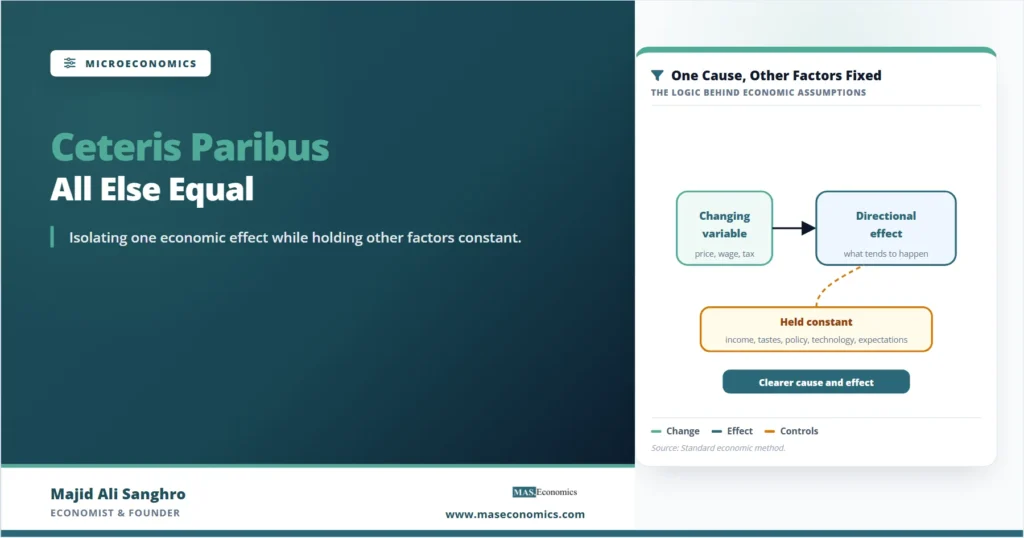
Ceteris paribus is a Latin phrase usually translated as “all else equal” or “other things held constant.” In economics, it means an analyst is isolating the effect of one variable while temporarily assuming that other relevant variables do not change. If the price of a good rises, ceteris paribus, the quantity demanded tends to fall. The phrase tells the reader exactly what is being isolated.
The assumption is not a claim that real economies stand still. They do not. It is a method for thinking clearly before adding complexity back in. Without it, every economic statement would have to discuss income, tastes, technology, policy, expectations, weather, credit, global shocks, and institutional rules at the same time.
The Point of Holding Other Things Constant
Economic life is crowded with causes. A household’s spending can change because of income, prices, wealth, interest rates, job security, taxes, family size, expectations, and preferences. A firm’s output can change because of wages, technology, input prices, demand, credit, regulation, and competition. If everything changes together, it becomes difficult to know which force did what.
Ceteris paribus works like a mental experiment. It says: imagine one variable changes while the other relevant variables stay fixed. What direction should the effect take? This lets the analyst identify a tendency before considering whether other forces will strengthen, weaken, or reverse the observed outcome.
The assumption is especially important in causal reasoning. When economists say a tax raises the price paid by buyers, they are not saying every actual tax episode will look identical. They are saying that the tax creates a specific pressure, holding other influences constant. Demand, supply, market structure, enforcement, and timing then determine how large the final effect is.
The MASEconomics article on supply and demand uses this logic throughout. A movement along a demand curve isolates the effect of price on quantity demanded. A shift of the curve means something else changed, such as income, tastes, substitutes, expectations, or the number of buyers.

Why the Phrase Appears So Often in Demand and Supply
Demand curves are the classic ceteris paribus example. A downward-sloping demand curve says that, holding other factors constant, a higher price reduces quantity demanded. It does not say that price is the only thing affecting demand. Income, preferences, substitutes, complements, expectations, and population can all shift demand.
Suppose coffee becomes more expensive. Ceteris paribus, consumers buy less coffee. But if incomes rise sharply, a health trend increases coffee demand, or a cold season raises hot-drink purchases, actual coffee sales may still rise. The ceteris paribus claim isolates the price effect. The observed market outcome reflects all effects combined.
Supply curves use the same logic. A higher market price gives producers a reason to supply more, holding input costs, technology, taxes, weather, and capacity constant. But if wages rise, a storm damages production, or a new regulation increases costs, actual supply may fall even while price is higher.
This distinction keeps students from confusing movement along a curve with a shift of the curve. A price change moves along demand or supply. A change in a non-price determinant shifts the curve. Ceteris paribus is the rule that makes that separation possible.
What the Assumption Does Not Mean
Ceteris paribus does not mean other things are unimportant. It means they are temporarily held fixed so one relationship can be studied. Once the relationship is understood, the analyst can bring the other forces back into the story. This is a method of simplification, not denial.
It also does not mean the prediction is guaranteed. Economic relationships are about tendencies under specified conditions. If the conditions change, the result can change. A minimum wage increase may have one effect in a competitive labor market and another effect in a market with monopsony power, weak enforcement, or strong local demand.
The assumption does not remove uncertainty either. Data can be noisy. People respond differently across income groups, regions, sectors, and time periods. Firms may absorb cost changes in margins before changing prices. Consumers may adjust slowly because of habits, contracts, or lack of alternatives. Ceteris paribus simplifies the first step; it does not finish the analysis.
This is why the distinction between facts and values also matters. A ceteris paribus claim can be a positive economic statement: it describes what tends to happen when one variable changes. Whether that result is desirable, fair, or worth changing through policy is a separate normative question.
| Statement | Variable isolated | Factors held constant |
|---|---|---|
| If price rises, quantity demanded falls. | Price of the good. | Income, tastes, substitutes, expectations, and number of buyers. |
| If wages rise, a firm may hire fewer workers. | Wage cost. | Output demand, productivity, technology, and other input prices. |
| If interest rates rise, borrowing tends to fall. | Interest rate. | Income, confidence, credit standards, collateral values, and inflation expectations. |
| If input costs rise, supply shifts left. | Cost of production. | Technology, output price, taxes, capacity, and weather. |
| If income rises, demand for normal goods tends to increase. | Consumer income. | Prices, preferences, household size, and expectations. |
|
|
||
How Data Work Uses the Same Logic
Official economic data also depend on controlled definitions. The US Bureau of Labor Statistics Consumer Price Index overview explains that the CPI represents changes in prices of goods and services purchased for consumption by urban households, using prices collected from many areas and establishments. That does not hold the entire economy fixed, but it does define what the index is measuring and what it excludes.
When an analyst says inflation rose, the statement is only meaningful after naming the measure. CPI inflation, producer prices, the GDP deflator, and personal consumption expenditures inflation are not identical. Each holds some measurement choices fixed so the statistic has a defined meaning. Without those rules, a price claim would be too vague to evaluate.
The US Bureau of Economic Analysis GDP explainer shows the same method in national accounting. GDP measures the value of final goods and services produced in the economy. BEA also distinguishes real GDP from current-dollar GDP, with real GDP adjusted to remove inflation over time. That adjustment is a measurement choice designed to isolate changes in production from changes in prices.
The MASEconomics guide to economic indicators makes this point across many statistics. Indicators are useful because they define a question precisely. Ceteris paribus is the verbal version of the same discipline: say what is changing, say what is held fixed, and then interpret the result carefully.
Curve Movements, Curve Shifts, and Actual Data
Ceteris paribus is easiest to see in a graph. A movement along a curve usually means the variable on the axis changed while other determinants were held constant. A shift of the curve means one of those other determinants changed. This distinction is basic, but it prevents many errors in reading markets.
For demand, a change in the good’s own price creates a movement along the demand curve. A change in income, tastes, substitute prices, complementary goods, expectations, or the number of buyers shifts the demand curve. For supply, a change in the output price creates a movement along the supply curve. A change in input costs, technology, taxes, weather, or producer expectations shifts supply.
Cost analysis uses the same logic. If a firm’s wage cost rises, ceteris paribus, the cost of producing each unit may increase. But the final effect depends on productivity, technology, material costs, scale, and demand for the firm’s output. The MASEconomics article on costs of production shows why fixed cost, variable cost, and marginal cost have to be separated before a firm decision can be interpreted.
Market structure can also change the result. A competitive firm, a monopolist, and an oligopolist may respond differently to the same cost shock. The MASEconomics guide to market structures explains why pricing power, entry barriers, and rival behavior matter. Ceteris paribus gives the first effect; market structure shapes the final outcome.
Policy Claims Need the Assumption Made Visible
Policy debates often hide ceteris paribus assumptions. A person may say, “Higher interest rates reduce inflation.” That is a directional claim. It assumes, at least for the first step, that other forces do not overwhelm the effect: energy prices, fiscal policy, exchange rates, supply disruptions, expectations, and wage-setting behavior.
The Federal Reserve’s longer-run goals statement describes a policy framework involving maximum employment, stable prices, and moderate long-term interest rates. The relationship among those goals cannot be read from one variable alone. Interest rates matter, but they work through credit, spending, asset prices, expectations, and labor markets.
The MASEconomics article on central banking and monetary policy explains why policy transmission is a chain rather than a switch. Ceteris paribus helps isolate one link in that chain, but policy analysis must then ask what else changes at the same time.
Fiscal policy works similarly. A tax cut may increase disposable income, holding other things constant. But the final effect depends on how households save or spend the money, how the policy is financed, whether the economy has spare capacity, and how monetary policy responds. The MASEconomics article on fiscal policy shows why government decisions are evaluated through multiple objectives rather than one isolated effect.
Why Ceteris Paribus Can Mislead
The assumption becomes dangerous when it is forgotten. A person may start with a useful simplified claim and then treat it as a complete description of the world. The phrase “holding other things constant” must stay attached to the statement. If it disappears, the reader may confuse a tendency with a forecast.
One risk is reverse causality. A rise in price may reduce quantity demanded, ceteris paribus. But in actual data, prices often rise because demand increased first. If an analyst sees price and quantity rising together, the explanation may be a demand shift rather than a violation of demand theory.
Another risk is omitted variables. Suppose a city raises transit fares and ridership falls. The fare increase may matter. But if employment also fell, remote work increased, fuel prices changed, or service quality declined, ridership may have changed for several reasons. A ceteris paribus statement isolates the fare effect; an empirical study must account for other variables.
A third risk is composition. What is true for one person or firm may not hold for the whole economy. One household can save more by spending less. If many households cut spending at the same time, business revenue may fall, and income may weaken. This is why some microeconomic ceteris paribus claims need macroeconomic feedback before they become policy conclusions.
How to Use the Phrase Correctly
The best way to use ceteris paribus is to name the isolated variable and the held-constant variables. Instead of saying “higher interest rates reduce borrowing,” a clearer statement is: “Higher interest rates tend to reduce borrowing, holding income, credit standards, expectations, and collateral values constant.” The second sentence is longer, but it is more precise.
For a beginner, the phrase should trigger three questions. First, what is changing? Second, what is being held constant? Third, what might change in reality and alter the final outcome? These questions turn the phrase from a Latin decoration into an analytical tool.
It also helps to separate theory from evidence. Theory often begins with ceteris paribus reasoning because the relationship has to be isolated. Evidence then asks whether the relationship appears in data after controlling for other influences. The two steps are connected, but they are not the same.
The strongest economic arguments state their assumptions openly. They do not pretend that one variable explains everything. They isolate one mechanism, test it against evidence, and then ask how the mechanism interacts with the rest of the economy.
MASEconomics Explains
4 economic concepts behind ceteris paribus
These concepts are explored in depth across our educational articles library.
Explore the MASEconomics BlogConclusion
Ceteris paribus means holding other relevant factors constant so one economic relationship can be studied clearly. It is the assumption behind many claims about demand, supply, interest rates, wages, taxes, inflation, and policy effects.
The phrase is useful because it isolates a tendency before the full complexity of the economy is added back in. It becomes misleading only when readers forget the assumption and treat a simplified claim as a complete forecast. Careful economics states what changes, what is held fixed, and what other forces may affect the final result.
Frequently Asked Questions
What does ceteris paribus mean?
Ceteris paribus means all else equal or other things held constant. Economists use it to isolate the effect of one variable while assuming that other relevant variables do not change.
Why do economists use ceteris paribus?
Economists use ceteris paribus because many variables change at the same time. Holding other factors constant helps identify the direction and logic of one specific relationship before adding other causes back into the analysis.
What is an example of ceteris paribus?
A common example is: if the price of a good rises, quantity demanded falls, ceteris paribus. This means the statement holds income, tastes, substitutes, expectations, and other demand factors constant.
Is ceteris paribus realistic?
It is not a full description of reality. It is a simplifying assumption used to isolate one effect. Real-world analysis must then relax the assumption and consider other changing variables.
How is ceteris paribus different from a forecast?
A ceteris paribus statement describes a tendency when other things are held constant. A forecast tries to predict what will actually happen after many variables, shocks, and responses are considered together.
Thanks for reading! If you found this helpful, share it with friends and spread the knowledge. Happy learning with MASEconomics