Walmart employs about 2.1 million people, and on any working day they coordinate the movement of goods across thousands of stores without buying or selling anything from one another. Inside the company, nobody haggles. Tasks are assigned, schedules are set, and resources move by instruction. Step outside the company’s walls and everything reverses: Walmart negotiates prices with suppliers, truckers, and landlords in ordinary markets. The what is a firm question is really the question of why that inner world exists at all. A firm is an organization that combines labor, capital, and materials to produce goods or services under unified direction, replacing market bargaining with management inside its own boundary.
That definition hides a genuine puzzle. Economics spends most of its energy explaining how well prices coordinate strangers. If the price system works so impressively, why does so much of economic life happen inside organizations that deliberately switch it off?
An Island of Command in a Sea of Markets
The economic definition of a firm is about coordination, not paperwork. Legally, firms come in familiar shells: sole proprietorships, partnerships, and corporations, each with its own rules on ownership and liability, which are covered in detail in our guide to the three types of firms. Economically, what all of them share is more interesting. Within the firm’s boundary, the market stops. An engineer does not sell her design to the assembly line; a manager allocates her time by decision. The firm is a small planned economy operating, usually successfully, inside a large unplanned one.
The scale of this arrangement is easy to underestimate. Americans filed more than five million new business applications in each of the last several years, and the population of firms is in constant churn: on Bureau of Labor Statistics survival data, roughly one in five new establishments closes within its first year. Firms are born, tested against the market’s discipline, and dissolved continuously. The ones that survive are the ones whose internal coordination beats the alternative of buying everything in.
The Question Coase Asked in 1937
The puzzle was posed sharply by Ronald Coase, then a young British economist, in a 1937 essay called The Nature of the Firm. His later work on property rights and externalities became the Coase theorem, but the earlier essay asked something simpler. If prices coordinate activity so well, why do firms exist? His answer, which helped earn him the 1991 Nobel Prize, is that using the market is not free. Finding a trading partner costs time. Negotiating terms costs effort. Writing a contract that anticipates every contingency is impossible, and enforcing one is expensive. Economists call these transaction costs, and they are the friction the price system generates in the act of using it.
A firm exists where doing something inside, by instruction, is cheaper than contracting for it outside. Hiring an employee is one open-ended contract that replaces thousands of small negotiations: instead of pricing every task separately, the employer buys the right to direct the employee’s effort within agreed limits. That single arrangement economizes on an enormous amount of bargaining.
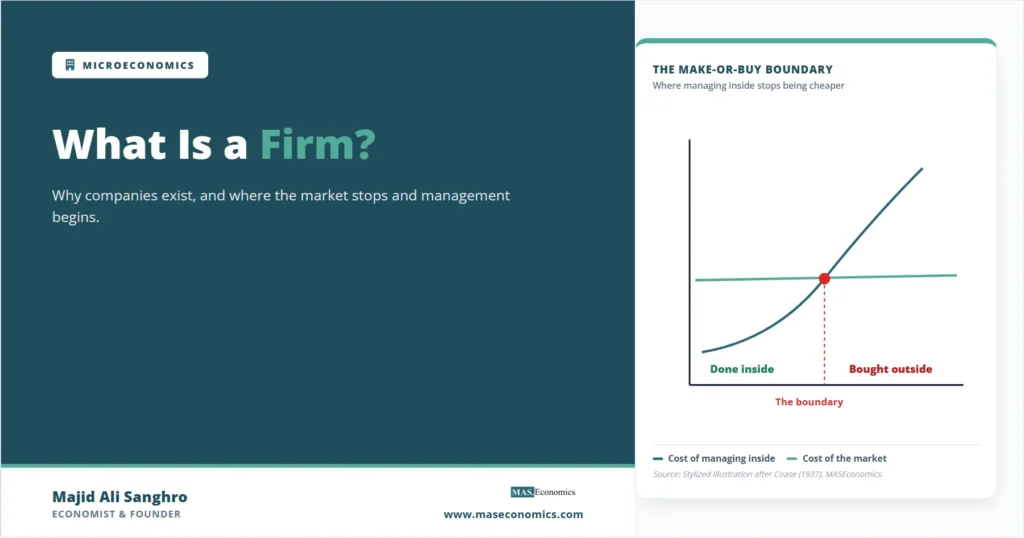
The same logic sets the firm’s limit. Command has its own costs. As an organization grows, information travels through more layers, managers know less about the work they direct, incentives weaken because pay is loosely tied to individual effort, and internal politics consumes energy. The firm expands as long as organizing one more activity inside is cheaper than buying it outside, and stops where the two costs meet. That crossing point is the boundary of the firm, and it is different for every company and every activity.
Make or Buy: The Decision That Draws the Line
Every firm answers the boundary question constantly, activity by activity. Apple designs its own chips and pays a contract manufacturer to fabricate them. Airlines own aircraft and buy catering. Almost no company generates its own electricity, yet many now build and operate their own data centers. Each of these is the same calculation: is this activity cheaper to manage or cheaper to buy?
Oliver Williamson, who shared the 2009 Nobel Prize for extending Coase’s idea, identified the condition that most reliably pulls an activity inside the firm: asset specificity. When a supplier must invest in equipment, locations, or skills that have value only in serving one particular buyer, both sides become vulnerable after the investment is made. The buyer can squeeze the supplier, knowing the specialized assets have no alternative use; the supplier can threaten to halt a production line it alone can feed. Anticipating this hold-up problem, companies bring highly specific activities under common ownership, where a manager settles disputes that contracts cannot foresee. Generic activities, ones any supplier can serve, stay in the market, where competition keeps prices honest.
The boundary also moves with technology. Cheaper communication and better contract enforcement lower the cost of using the market, which is why recent decades saw so much outsourcing and offshoring: activities once managed inside were unbundled and bought from specialists, often on other continents, a shift visible in the rise of multinational corporations that keep design in one country and contract production across several others.
How Firms Decide: Profit at the Margin
Once its boundary is set, the firm’s internal decisions follow a consistent logic. It hires factors of production, land, labor, capital, and organization, and combines them to produce output whose sale must at least cover their cost. The comparison that guides each decision is marginal: what does one more unit of output add to revenue, and what does it add to cost? Production expands while the first exceeds the second. Costs already paid and unrecoverable are ignored by a well-run firm, however painful that discipline feels, because sunk costs cannot be changed by any current choice. And the true cost of any decision is the best alternative it forecloses, which is the firm-level version of opportunity cost.
In a small owner-run business, the person deciding and the person bearing the consequences are the same. In a large corporation they are not. Ownership sits with shareholders, who hold the firm through stock, while control sits with hired managers, and the two groups’ interests are aligned only imperfectly. Managers may prefer size, comfort, or caution over the value of the enterprise. Economists call this the principal-agent problem, and much of corporate life is machinery built to contain it: boards of directors, audited accounts, performance pay, and the standing threat that a badly run company becomes cheap enough for outsiders to buy and fix.
| Dimension | Inside the firm | Through the market |
|---|---|---|
| Coordination signal | Instructions from managers | Prices offered and accepted |
| Typical contract | One open-ended employment relationship | Many specific transactions |
| Incentive strength | Weaker: pay loosely tied to each task | Stronger: revenue depends on each sale |
| Best suited for | Specific assets, hard-to-write contracts | Generic goods, easily compared offers |

|
||
The Boundary Is Moving Again
The gig economy is the theory of the firm running as a live experiment. Ride-hailing and delivery platforms took work that once sat inside firms, with employees, schedules, and supervisors, and pushed it back toward the market, paying independent contractors per task. The result sits uneasily between Coase’s two worlds: a driver receives instructions from an app the way an employee receives them from a manager, yet bears the risks of a contractor. Courts have been asked, in effect, to locate the boundary of the firm. In 2021 the United Kingdom’s Supreme Court ruled that Uber’s drivers are workers entitled to minimum wage and holiday pay, judging that the platform’s control over fares, contracts, and performance placed the relationship closer to employment than to independent trade. Similar disputes continue across the United States and the European Union, and they are transaction-cost arguments in legal dress.
Technology keeps shifting the calculation in both directions. Software that monitors output makes market contracting easier, shrinking firms; the value of closely guarded data and firm-specific knowledge pulls activities back inside, growing them. There is no permanent answer to make or buy, only a moving frontier.
What the Cost Story Leaves Out
The transaction-cost account is powerful, but it is not the whole of the matter. Some economists argue that a firm’s real identity is what it knows how to do: routines, shared experience, and organizational capability that cannot be written down or bought, which explains why two firms with identical inputs perform differently for decades. Others point out that firms are not only efficiency devices but small polities, with authority, careers, and internal bargaining that shape decisions in ways no cost calculation captures.
The definition also stretches at its edges. State-owned enterprises produce under political as well as commercial objectives. Family firms weigh continuity against profit. Cooperatives are owned by their customers or workers rather than by investors. Each is recognizably a firm, an organization directing resources under one authority, while answering the profit question differently. The economic core survives these variations: wherever coordination by instruction has replaced coordination by price, a firm exists, whatever its ownership papers say.
MASEconomics Explains
3 economic concepts behind the firm
These concepts are explored in depth across our educational articles library.
Conclusion
What is a firm turns out to be a question about where markets stop. A firm is an organization that produces under unified direction, and it exists wherever coordinating by instruction is cheaper than contracting in the open market. Its boundary sits where the rising cost of managing one more activity inside meets the cost of buying that activity outside, which is why the same company confidently makes some things and just as confidently buys others.
The rest of the firm’s behavior follows from that foundation. It expands output while the margin pays, ignores what is already sunk, and, once ownership separates from control, spends real resources keeping managers pointed at the owners’ interests. The boundary itself keeps moving, outward through the outsourcing decades, inward where specific assets and closely held knowledge matter, and into the courts where platforms and their drivers dispute which side of the line they stand on. Coase’s 1937 question has never stopped being current, because every reorganization, spin-off, and gig-work lawsuit is a fresh answer to it.
Frequently Asked Questions
What is the difference between a firm and a company?
In everyday speech the words are interchangeable. Strictly, a company is a specific legal form, an incorporated entity, while a firm is the economist’s broader term for any organization that produces under unified direction, including sole proprietorships and partnerships that are not incorporated at all.
Why do firms exist, according to economists?
Because using the market is costly. Searching, negotiating, and enforcing contracts all take resources. Ronald Coase argued in 1937 that firms arise where organizing an activity internally, through employment and instruction, is cheaper than contracting for it externally, and that this comparison also sets each firm’s size.
What determines how large a firm grows?
The balance between internal and external costs. Growth adds layers, dilutes incentives, and slows information, so managing each additional activity gets more expensive. A firm expands until organizing one more activity inside costs as much as buying it from the market, and that point differs across industries and technologies.
What is the principal-agent problem in a firm?
It is the gap between the interests of owners and the managers they hire. Shareholders want the value of the enterprise maximized; managers may prefer scale, security, or perks. Since effort is hard to observe, firms use boards, audited accounts, and performance-linked pay to keep the two aligned.
Thanks for reading! The next time a company announces it is outsourcing one activity and bringing another in-house, you are watching Coase’s boundary being redrawn in public. Happy learning with MASEconomics