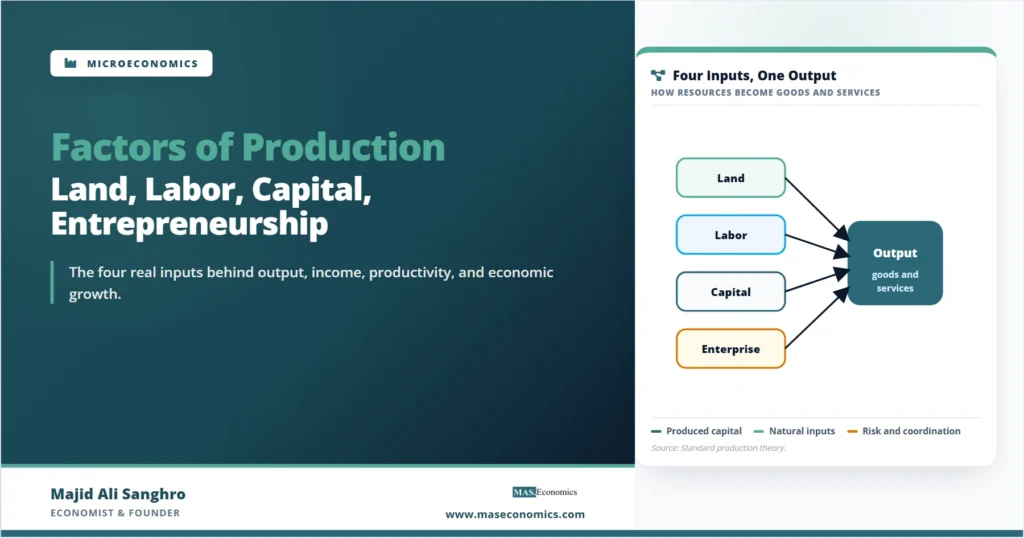
The World Bank tracks labor force, arable land, gross fixed capital formation, and new business creation as separate indicators because production is never created by money alone. A farm, a factory, a software firm, and a hospital all need inputs before they can produce output. The factors of production are the broad input categories economists use to organize that problem: land, labor, capital, and entrepreneurship.
These categories explain where output comes from and why economies with the same population or the same amount of money can produce very different results. Land supplies natural resources and location. Labor supplies human effort and skill. Capital supplies produced tools, machines, buildings, software, and infrastructure. Entrepreneurship combines the other three under uncertainty and decides what is worth producing.
The idea belongs near the beginning of any introduction to economics because it connects scarcity, choice, production, income, and growth. The four factors are not a slogan. They are a map of how real resources become goods and services.
The Four Inputs Behind Output
A finished product hides the inputs that made it possible. A loaf of bread contains wheat, water, labor time, ovens, delivery trucks, retail space, and a business decision to organize all of them. A mobile app contains programmers, servers, code libraries, office equipment, electricity, and a founder or management team that chose the product, hired the workers, raised funds, and accepted the risk of failure.
Economists group these inputs into factors because the details differ across industries, but the logic is stable. Land covers nature and location. Labor covers work. Capital covers produced means of production. Entrepreneurship covers organization, innovation, and risk-bearing. A firm buys or hires these inputs in factor markets, then sells the resulting good or service in product markets. That connection is why factor demand is derived demand: firms demand workers, machines, and sites because customers demand the output those inputs can create.
The factors also explain income. Labor earns wages and salaries. Land earns rent or resource royalties. Capital earns interest, depreciation allowances, and returns to owners. Entrepreneurship earns profit if the plan works and loss if it fails. The income side of gross domestic product follows the same broad logic: production generates income for the people and institutions that supply productive services.

Land Is Nature Put to Work
In economics, land means more than soil. It includes all naturally occurring resources used in production: farmland, forests, rivers, mineral deposits, oil fields, fisheries, sunlight, wind, and physical location. A downtown site has value because of access. A copper mine has value because of what lies below the ground. A fishing ground has value because a natural stock can be harvested if institutions prevent it from being exhausted.
The World Bank arable land indicator, based on FAO data, shows why land is treated separately. Economies do not choose their geography from scratch. Some have deep ports, large plains, forests, mineral deposits, or fertile river valleys. Others face deserts, mountains, water stress, or distance from major markets. Those conditions shape production possibilities before labor or capital enters the scene.
Land is also different because some of it is fixed in supply. A city can build taller buildings, improve roads, reclaim small amounts of land, or change zoning, but it cannot move its best harbor inland or create a second river delta at will. The return to land is called rent because the owner receives income from controlling a scarce natural or locational asset. That is why land connects directly to opportunity cost: using a plot for housing means not using it for industry, farming, offices, or a park.
Modern economies have made land less visible in some sectors, but not less important. Cloud computing still needs data centers, energy, cooling water, fiber routes, and physical security. Semiconductor production needs clean rooms, reliable power, water, specialized sites, and logistics. A service economy still rests on land, even when the final product is advice, software, finance, or health care.
Labor Is Effort Plus Skill
Labor is the human contribution to production. It includes physical effort, mental effort, time, attention, judgment, training, and experience. The US Bureau of Labor Statistics defines the labor force as people classified as employed or unemployed, meaning those working or actively looking for work. The World Bank labor force series measures the same broad input across countries.
Labor should not be reduced to headcount. Two economies can have the same number of workers and very different productive capacity because skills, health, education, experience, and organization differ. This is why economists often separate raw labor time from human capital. The World Bank Human Capital Project links health and education to the productivity of future workers, which is exactly the distinction the factor framework needs. Labor is not only hours. It is what those hours can do.
Wages are the main payment to labor, but wages reflect more than effort. They reflect scarcity of skills, bargaining institutions, technology, labor market regulation, worker mobility, and the value of the final product. A surgeon, a delivery driver, and a machine operator all supply labor, but their wages differ because their skills, training costs, risks, and market conditions differ. The article on types of unemployment shows what happens when labor is available but not matched to jobs.
Labor also changes when capital changes. A worker with a hand tool can produce one level of output; the same worker with advanced machinery, software, and logistics can produce far more. That does not make labor irrelevant. It changes the kind of labor demanded. When technology raises the value of analytical, technical, or supervisory tasks, labor demand shifts toward workers who can use the new capital effectively.
Capital Means Produced Tools
Capital is the most misunderstood factor because the everyday word often means money. In production theory, capital does not mean cash sitting in a bank account. It means produced assets used to make other goods and services: machines, buildings, tools, vehicles, software, roads, ports, power systems, warehouses, computers, and equipment. Money can buy capital, but money itself does not bake bread, refine oil, write code, or move cargo.
The World Bank gross fixed capital formation series measures investment in fixed assets as a share of GDP, drawing on national accounts. The System of National Accounts 2008 is the international framework behind those accounts, and it treats produced assets as part of the machinery through which current production builds future capacity.
Capital raises productivity because it lets labor work with more power, precision, scale, and speed. A road lets one driver serve a wider market. A machine lets one worker shape more material. A software system lets a firm coordinate inventory, payments, and deliveries with fewer errors. This is why capital appears inside formal production functions, where output depends on combinations of inputs rather than on one input alone.
Capital is also costly to create and maintain. Equipment wears out. Buildings depreciate. Software becomes obsolete. Infrastructure requires repair. A firm choosing its input mix must compare the cost of labor with the cost of capital, which is the same logic behind the isocost line. The best input mix is not always the most capital-intensive one. It is the one that produces the required output at the lowest cost for the technology and prices the firm faces.
Entrepreneurship Organizes the Risk
Entrepreneurship is the coordinating factor. It identifies a possible product, assembles land, labor, and capital, chooses a production method, raises finance, enters contracts, and bears the risk that customers may not buy enough to cover costs. The World Bank Entrepreneurship Database tracks new business registrations and business density because firm creation is one way economies observe this organizing function in practice.
Entrepreneurship does not have to mean a heroic founder. In a small business, it may be one owner taking direct risk. In a large corporation, the function is spread across executives, managers, engineers, investors, and boards. In a public enterprise or cooperative, the same organizing problem remains even when ownership differs. Someone must decide what to produce, how to finance it, which inputs to hire, and whether the expected return justifies the risk.
Profit is the reward when entrepreneurial judgment works. Loss is the penalty when it does not. That makes entrepreneurship different from the other factors. Land can earn rent under a lease. Labor can earn wages under a contract. Capital can earn interest or a required return. Entrepreneurship carries residual risk because revenue arrives only after production decisions have already been made.
A related MASEconomics page treats AI as a factor, but the distinction matters. Artificial intelligence can change how firms use labor, capital, data, and organization, while the classic factors of production remain the baseline map. AI may be embedded in capital, raise labor productivity, or support entrepreneurial decision-making. It does not remove the need to explain the traditional input categories first.
Why No Factor Works Alone
The factors of production are complements before they are substitutes. A fertile field without labor, tools, and organization produces little. A skilled workforce without capital cannot reach its potential. Machinery without trained workers sits idle. An entrepreneur with no resources has only a plan. Output appears when the inputs are combined in proportions that fit the production process.
This is the reason economists draw isoquants and solve producer-equilibrium problems. A firm can often produce the same output with different input combinations, but each combination has a cost. The technically possible mix is described by the production function; the affordable mix is constrained by input prices; the chosen mix sits where the firm reaches its target output at minimum cost. The article on producer equilibrium explains that geometry in detail.
Substitution matters, but it has limits. A factory may replace some routine labor with machines, but the machines still need energy, maintenance, software, supervision, and finance. A farm may use more capital-intensive irrigation, but soil, water, climate, and crop biology still matter. A consulting firm may need little physical machinery, but it still uses human capital, digital infrastructure, office systems, reputation, and management.
Factor Payments Explain Income
The four factors also explain why production creates several kinds of income. Workers receive wages. Owners of natural resources and locations receive rent. Owners or lenders of capital receive interest, dividends, depreciation allowances, or profits tied to capital ownership. Entrepreneurs receive residual profit if revenue exceeds cost, and absorb losses if it does not.
That income logic is embedded in national accounting. The US Bureau of Economic Analysis describes GDP as part of accounts that measure output, income generated, and how that income is used. The production side and income side are two views of the same process. Output does not float above people and institutions; it is tied to factor services supplied by workers, asset owners, firms, and entrepreneurs.
| Factor | What it contributes | Common measurement proxy | Typical payment |
|---|---|---|---|
| Land | Natural resources, space, location, climate, minerals, water | Arable land, resource reserves, site value, land area | Rent, royalties |
| Labor | Human effort, time, skill, judgment, experience | Labor force, hours worked, education, health, skills | Wages, salaries, benefits |
| Capital | Produced tools, machinery, buildings, software, infrastructure | Gross fixed capital formation, capital stock, equipment | Interest, depreciation allowance, capital return |
| Entrepreneurship | Coordination, innovation, risk-bearing, business formation | New firm creation, business density, startup activity | Profit or loss |
|
|
|||
The table separates payments for clarity, but actual income can mix categories. A self-employed farmer may receive returns to labor, land, capital, and entrepreneurship in one business income stream. A landlord who also improves a property receives rent from location and a return on capital improvements. A founder may earn wages as a manager and profit as an owner. The categories are analytical tools, not always separate bank deposits.
Factor Growth Raises Capacity
Economies grow when they increase the quantity of inputs, improve their quality, or combine them more effectively. More labor can raise output, but only if workers have jobs, skills, and capital to work with. More capital can raise output, but only if investment creates productive assets rather than unused structures. Better land use can raise output when irrigation, transport, property rights, and environmental management improve what existing resources can do. Better entrepreneurship can raise output by reallocating inputs toward higher-value uses.
This is why growth theory often begins with a production function. The Cobb-Douglas production function, for example, represents output as a function of capital, labor, and technology. It does not list every institutional detail, but it makes one central point precise: output depends on input quantities and on the efficiency with which those inputs are transformed into goods and services.
The factor framework also helps explain comparative advantage. Countries differ in factor endowments. Some have abundant land and natural resources. Some have large labor forces. Some have deep capital stocks. Some have dense entrepreneurial networks, research systems, and institutions that allow new firms to scale. Those differences influence what countries produce, export, import, and specialize in, which connects the idea to trade theory and the MASEconomics article on the Heckscher-Ohlin model.
Still, factor abundance is not destiny. Natural resources can be wasted. Labor can be underemployed. Capital can be misallocated. Entrepreneurship can be blocked by weak institutions, corruption, poor finance, or unstable policy. The productive value of a factor depends on whether an economy can use it well.
MASEconomics Explains
4 economic concepts behind factors of production
These concepts are explored in depth across our educational articles library.
Explore the MASEconomics BlogConclusion
Factors of production explain the input side of economics. Land provides nature and location, labor provides human effort and skill, capital provides produced tools and structures, and entrepreneurship organizes the whole process under uncertainty. Output is the result of their combination, not the result of any single input standing alone.
The framework also links production to income. Wages, rent, capital returns, and profit are not random labels; they are payments connected to factor services. That is why the idea matters beyond a textbook definition. It helps explain firms, production functions, national income, economic growth, and the limits imposed by scarcity.
Frequently Asked Questions
What are the four factors of production?
The four factors of production are land, labor, capital, and entrepreneurship. Land means natural resources and location, labor means human effort and skill, capital means produced tools and structures, and entrepreneurship means organizing the other inputs under risk.
Why is entrepreneurship a factor of production?
Entrepreneurship is a factor because land, labor, and capital do not automatically combine themselves. Someone must identify an opportunity, choose the input mix, organize production, and accept the risk that revenue may not cover cost.
Is money a factor of production?
Money is not usually treated as a factor of production because it does not directly produce goods and services. Money helps firms buy or rent real inputs such as machines, buildings, labor time, materials, and land services.
What is the difference between capital and financial capital?
Capital in production theory means produced assets such as machines, buildings, software, and infrastructure. Financial capital means money or financial claims used to fund purchases. Financial capital can buy productive capital, but it is not the same input.
How do factors of production affect economic growth?
Economic growth can come from more inputs, better inputs, or better ways of combining inputs. A larger skilled workforce, more productive capital, better land use, and stronger entrepreneurial coordination can all raise an economy’s productive capacity.
Thanks for reading! If you found this helpful, share it with friends and spread the knowledge. Happy learning with MASEconomics