The trade conflict that has run since 2025 has been fought almost entirely with one weapon, the tariff, and hardly at all with the other classic instrument of protection. That absence is worth noticing. What is a quota? It is a direct limit on the quantity of a good that may enter a country during a period: so many tons of sugar, so many vehicles, so many square meters of fabric per year, and once the limit is reached, no more crosses the border at any price. Quotas once governed a large share of world trade. Today they survive mainly in agriculture and in disguised forms, and the reasons they fell out of favor say as much about how trade policy works as the instrument itself does.
The comparison with a tariff is the cleanest way to understand both tools. As our companion piece on what a tariff is sets out, a tariff works through price: it taxes every unit that enters but lets the quantity be whatever buyers will pay for. A quota works through quantity: it fixes the amount and lets the price be whatever the shortage produces. That single difference decides where the money goes, who gets protected, and how the protection behaves as the world changes around it.
A Limit on Quantity, With a Price That Adjusts on Its Own
Suppose a country that imports shirts caps imports below what people were buying. Shirts become scarcer than before, so their domestic price rises above the world price until demand shrinks to fit the permitted supply. No official set that price. The quota set the quantity, and the price did the adjusting, which is the mirror image of the tariff, where the state sets the price wedge and the market decides the quantity.
Someone must decide who gets to bring in the limited amount, and that administrative detail turns out to be the heart of the instrument. Governments issue import licenses: to established importers by history, to firms by application, occasionally by auction. A license is valuable for a precise reason, and the next section is about that value.
The Money Does Not Disappear. It Changes Hands.
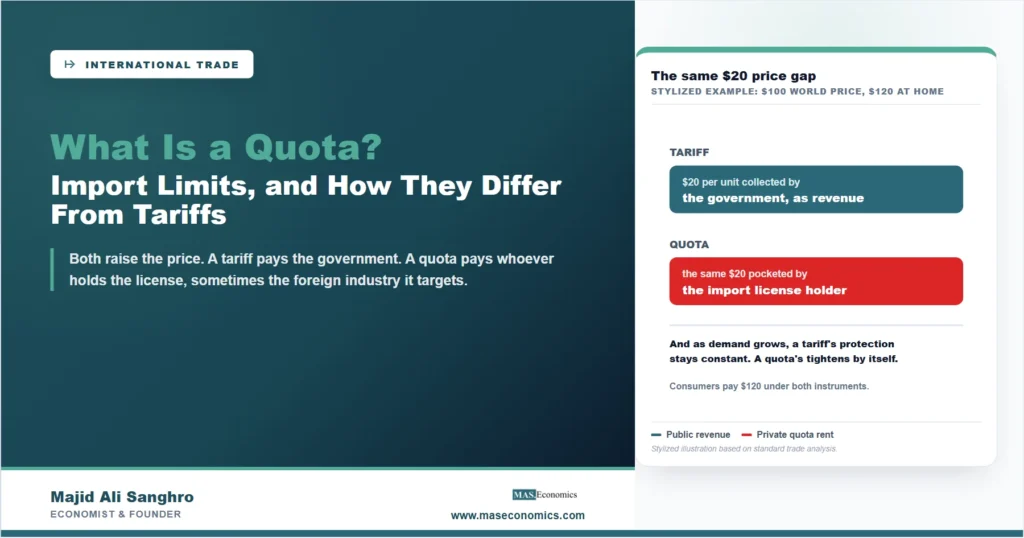
Here is a stylized example with the arithmetic in the open. Shirts trade on the world market at $100. A quota tightens supply until the domestic price settles at $120. A firm holding a license buys at $100, sells at $120, and pockets $20 on every shirt, not because it did anything clever but because the license is permission to buy low abroad and sell high at home. That $20 per unit is called quota rent.
Now run the same numbers as a tariff. A $20 duty on a $100 shirt produces the same $120 domestic price and roughly the same import volume. The difference is a single line in the ledger: under the tariff, the $20 goes to the treasury as revenue; under the quota, it goes to whoever holds the license. Same price for the consumer, same protection for the domestic producer, completely different recipient of the money.
Who holds the licenses is therefore not a detail: it is the policy. If domestic importers hold them, the rent stays home in private hands. If the government auctions them, a quota starts to resemble a tariff, with the auction price collecting the rent for the public. And if the licenses are effectively held by the foreign exporters, the rent leaves the country entirely, which is not a hypothetical, because that is precisely what the most famous quota episode did.
Three Real Shapes: Absolute Quotas, Tariff-Rate Quotas, and Restraints That Were Voluntary in Name
The textbook version, an absolute cap, is now rare for a legal reason: the postwar trade system, under Article XI of the GATT, generally prohibits quantitative restrictions, precisely because their opacity and their rents made them the more corrosive instrument. What survives takes three main shapes.
The first is the tariff-rate quota, the workhorse of agricultural protection. Imports up to a threshold enter at a low tariff; anything beyond faces a rate set high enough to be a wall. American sugar imports have worked this way for decades, which is part of why sugar routinely costs more inside the United States than on the world market. It is a quota wearing a tariff’s clothes, legal where an absolute cap would not be.
The second is the voluntary export restraint, in which the exporting country agrees, under pressure, to limit its own shipments. From 1981 Japan restrained its car exports to the United States rather than face harsher legislation. The economics followed the license logic exactly: because Japanese firms controlled the scarce right to export, the quota rent went to them, collected through higher prices on every car sold into the shortage. American buyers paid more, in exactly the pattern our article on who pays the tariff describes for the price instrument, and the premium flowed to the restrained exporters, who used the quantity limit as a reason to ship larger, better-equipped models. A policy meant to discipline an exporter handed that exporter the proceeds, and this instrument too was banned by the World Trade Organization’s rules in the 1990s.
The third shape is the quota that governed world clothing trade for a generation. Under the Multifibre Arrangement, rich countries held country-by-country quotas on textiles and garments until the system was finally dismantled on 1 January 2005, redrawing the map of a whole industry within a few years. The episode is a reminder of how large quota effects can be: the binding constraint on an entire sector was not cost or quality but a negotiated number.
Why Economists Rank the Quota Below the Tariff
Both instruments protect domestic producers, and both do it by taxing domestic consumers through higher prices, a family resemblance they share with every trade barrier in our overview of trade policies. But three properties make the quota the instrument economists trust less.
First, the revenue. A tariff at least pays the public for the distortion it creates; a quota hands the same money to license holders, and sometimes, as with the car restraints, to the foreign industry the policy was aimed at.
Second, the rigidity. Fix a tariff and let the economy grow: imports grow with demand, and the protection stays constant. Fix a quota and let the economy grow: imports cannot grow, so the shortage deepens and the protection silently tightens every year without any new decision being taken. A quota is protection on autopilot, escalating by default.
Third, the competition effect. A tariff still disciplines a powerful domestic firm, because unlimited imports stand ready at the tariff-inclusive price if it overcharges. A quota caps that discipline: beyond the fixed quantity, no import can arrive however high the domestic price goes, which restores exactly the pricing power that trade was eroding. For a country with concentrated industries, the difference between the two instruments is the difference between capped and uncapped market power. Add the lobbying that valuable licenses attract, and the quota’s reputation follows.
This is why the modern trade conflict is fought with tariffs and with rules rather than caps, the territory covered in our article on non-tariff barriers. The quantity instrument has not vanished, though. It has migrated to the export side, where countries restrict shipments of strategic materials through licensing regimes, and an export license cap is a quota in mirror image: the same scarcity, the same rent, collected by the seller’s side of the market.
MASEconomics Explains
3 economic concepts behind quotas
These concepts are explored in depth across our educational articles library.
Conclusion
What is a quota comes down to a cap on quantity where a tariff is a charge on price, and every practical difference between the two instruments follows from that swap. The price rises either way, and the consumer pays it either way. What changes is the destination of the money, government revenue under a tariff, private rent under a quota, and the behavior of the protection over time, constant under a tariff, silently tightening under a quota as demand grows against a fixed number.
The world’s trading rules read like a verdict on that comparison. Absolute quotas are generally prohibited, voluntary export restraints were banned outright, and the quantity instrument survives mainly as tariff-rate quotas in agriculture and as export licensing at the strategic edge of trade policy. When protection returned to the center of world politics in the tariff war of 2025–2026, it came back as tariffs. The quota’s history explains why: of the two ways to block trade, it is the one that pays the wrong people and escalates on its own.
Frequently Asked Questions
What is a quota in simple terms?
A quota is a legal limit on how much of a good may be imported during a period, for example a fixed tonnage of sugar per year. Once the limit is reached, further imports are barred regardless of price. The restricted supply pushes the domestic price above the world price, which is how a quota protects domestic producers.
What is the main difference between a tariff and a quota?
A tariff fixes a price penalty and lets quantity adjust; a quota fixes the quantity and lets price adjust. Both raise domestic prices, but a tariff generates government revenue while a quota creates private profit, called quota rent, for whoever holds the right to import. A quota also tightens automatically as demand grows, since the permitted quantity cannot expand.
What is quota rent and who receives it?
Quota rent is the gap between the world price and the higher domestic price, earned on each unit imported under the quota. The recipient depends on who holds the import rights: domestic license holders keep it at home, a government auction converts it into public revenue, and when exporters administer the limit, as under the Japanese car restraints of the 1980s, the rent flows to the foreign industry.
Are import quotas legal under world trade rules?
As a general rule, no. Article XI of the GATT prohibits quantitative restrictions on imports and exports, with limited exceptions, and voluntary export restraints were banned in the 1990s. That is why modern protection relies on tariffs, tariff-rate quotas in agriculture, and regulatory barriers rather than open quantity caps.
Why does sugar cost more in the United States than on the world market?
American sugar imports are governed by a tariff-rate quota: a set quantity enters at a low duty and imports beyond it face a prohibitive one. The restricted supply holds the domestic price above the world price, protecting domestic growers while consumers and food manufacturers pay the difference on every purchase.
Thanks for reading! Once you can spot who holds the scarce license, you can predict where the money from any trade restriction ends up. Happy learning with MASEconomics